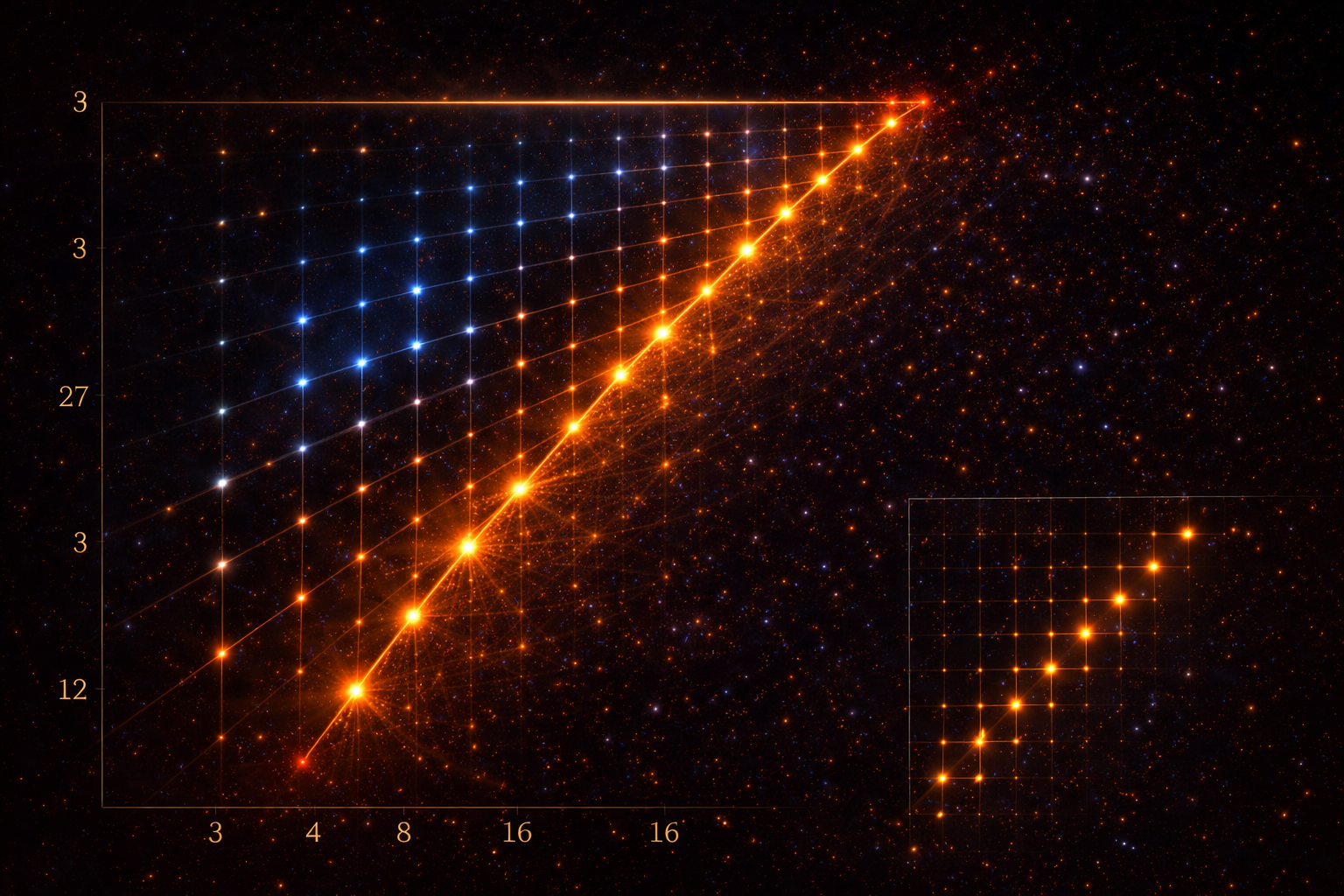
collision The Centered Collision Sum Subtract the family bias and the divergence vanishes. The centered sum converges at s=1, and the rate of convergence is controlled by the classical zero-free region.
collision The Collision Fluctuation Sum The collision deviations, summed over primes, drift downward at the Mertens rate. The drift has a sign, a constant, and a structural origin in the digit function.
collision Silent Primes At seven primes in base 10, the collision count is exactly zero. The recipe that finds them involves the bin partition and a specific floor-function identity.
collision The Character Structure of the Collision Fluctuation The collision fluctuation decomposes over Dirichlet characters. Only the odd characters survive, forced there by the complement involution. This is where the algebra begins.
spectral Bin Derangements and the Gate Width Theorem Nine multipliers produce zero collisions at every prime in base 10. The count is exactly b-1, independent of the prime. The proof identifies the deranging set explicitly.
spectral Phase-Filtered Ramanujan Sums and the Spectral Gate The last digit of a prime controls which spectral modes survive. A phase filter built from Ramanujan sums explains the gate, and the gate width is universal across primes.
spectral The Autocorrelation Formula The cross-spectral function had resisted a closed form. It turned out to factor through the digit function evaluated at shifted arguments. The formula closes the spectral chain.
spectral The Spectral Power of the Digit Function The squared bin sizes of the digit function control the alignment limit, the spectral structure, and the collision count. One object, three roles.
spectral The Spectral Structure of Fractional Fields The eigenvalues of the cross-alignment matrix are determined by the cyclic autocorrelation of the digit function. One formula gives the entire spectrum.
spectral The Cross-Alignment Matrix Compare every fraction to every other, digit by digit. The result is a symmetric matrix whose eigenvalues encode the internal structure of the fractional field.
spectral The Coherence Decomposition Alignment splits into two parts: a focused component from the repetend orbit, and a pairwise component from cross-matches. The decomposition explains why some integers are more coherent than others.
publication Primes and the Major Scale The primes that organize long division are the same primes that organize musical pitch. In base 30, the alignment deficit lattice produces the just major scale. In base 12, the Pythagorean comma.