Alignment
Primes and the Major Scale

I have been a musician for most of my life. I have also spent most of my life hearing that the golden ratio explains music. The explanations I encountered failed on contact with the mathematics, but I kept looking. After years of working on the question, I found a connection through repeating decimals. I call it the alignment-deficit lattice.
Here is the short version. For certain families of fractions, the share that lines up with the first fraction creeps toward a limit, and the amount still missing is a small, exact fraction. I call that amount the deficit. Divide one deficit by another and you get a ratio, and in the right base those ratios become the octave, the fifth, the major third and the other intervals a musician tunes by, and eventually the whole major scale. Which intervals you get depends on the primes in the base. Decimal, it turns out, cannot play a fifth.
The deficit below two thirds
Start with the twelfths, which set the upper edge of the empty band in The Three-Tier Theorem. Of the eleven proper twelfths, four eventually repeat the same digit as , and three more terminate and take a whole credit under the alignment convention. Seven credits among eleven fractions gives an alignment of .
Twelve belongs to a family. Every denominator with built only from 2s and 5s behaves the same way, and its alignment is
Every repeating tail in this family is a single digit, a 3 or a 6, so once the opening digits are cleared a row either matches the reference forever or never matches it at all. That keeps the counting simple.
As grows, the alignment climbs toward without ever getting there. The distance still to go is the deficit.
At the deficit is . Double to 8 and it drops to , and doubling again gives . Each doubling leaves a little less than half the previous deficit.


Divide one deficit by the next and you get , a bit more than 2. The next pair gives , closer still, and the ratios keep closing in on exactly 2. Any musician knows that number. Two to one is the octave, the same note again with the string half as long.
So each doubling of plays an octave, slightly sharp at every finite step, and the formula says exactly how sharp.
The fifth that decimal cannot supply
Nothing here depends on the prime 3 in particular. Take any prime that divides , which is what keeps every repeating tail down to a single digit, and let be built from the primes of the base . The alignment of climbs toward , and the deficit is
The thing to notice is the in the denominator. Deficits shrink like one over , so the ratio of two deficits behaves like the ratio of their integers turned upside down. Scale both integers by the same factor , made from the base’s primes, and the ratio settles on it exactly.
The smaller integer goes on top because its deficit is the larger one. The two subtracted ones keep every finite ratio a hair away from , and they fade as grows.
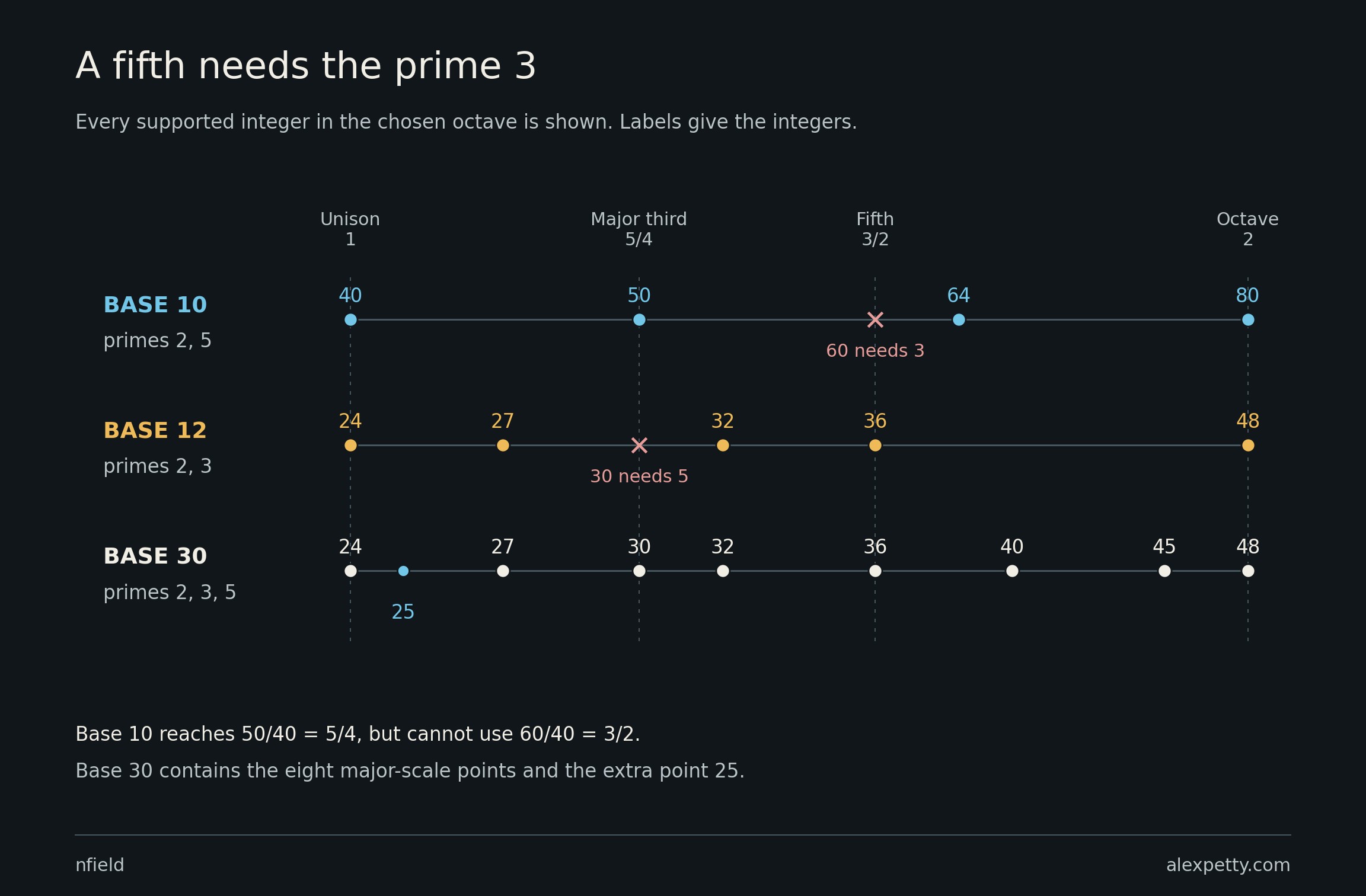
That is how integers become pitches. In decimal the integers we may use are products of 2 and 5, so the available intervals are ratios of those. The 2s give octaves, and the 5 gives the just major third, , the pair 40 and 50 for instance. A fifth above 40 would need 60, and 60 has a factor of 3.
No amount of multiplying and dividing by 2 and 5 ever produces exactly . There is a 3 in the denominator , but that 3 chooses the alignment family. The integers themselves have to come from the base, and decimal only has 2 and 5 to give. A clever choice of pair can get close to a fifth, but no fixed pair has as its limit.
Base 12 has both 2 and 3. The prime 11 divides , so takes over the job that 3 did in decimal, and the allowed integers sit on a grid with one axis for each prime. A step to the right multiplies by 2, and a step up multiplies by 3.


From 24, one step left and one step up lands on 36. Dividing by 2 and multiplying by 3 is the fifth, . These are the same prime-exponent coordinates Pythagorean tuning has always used. What the alignment count adds is a number at every point on the grid, and an exact formula for how close two of those numbers come to the interval between them.
Twelve fifths and seven octaves
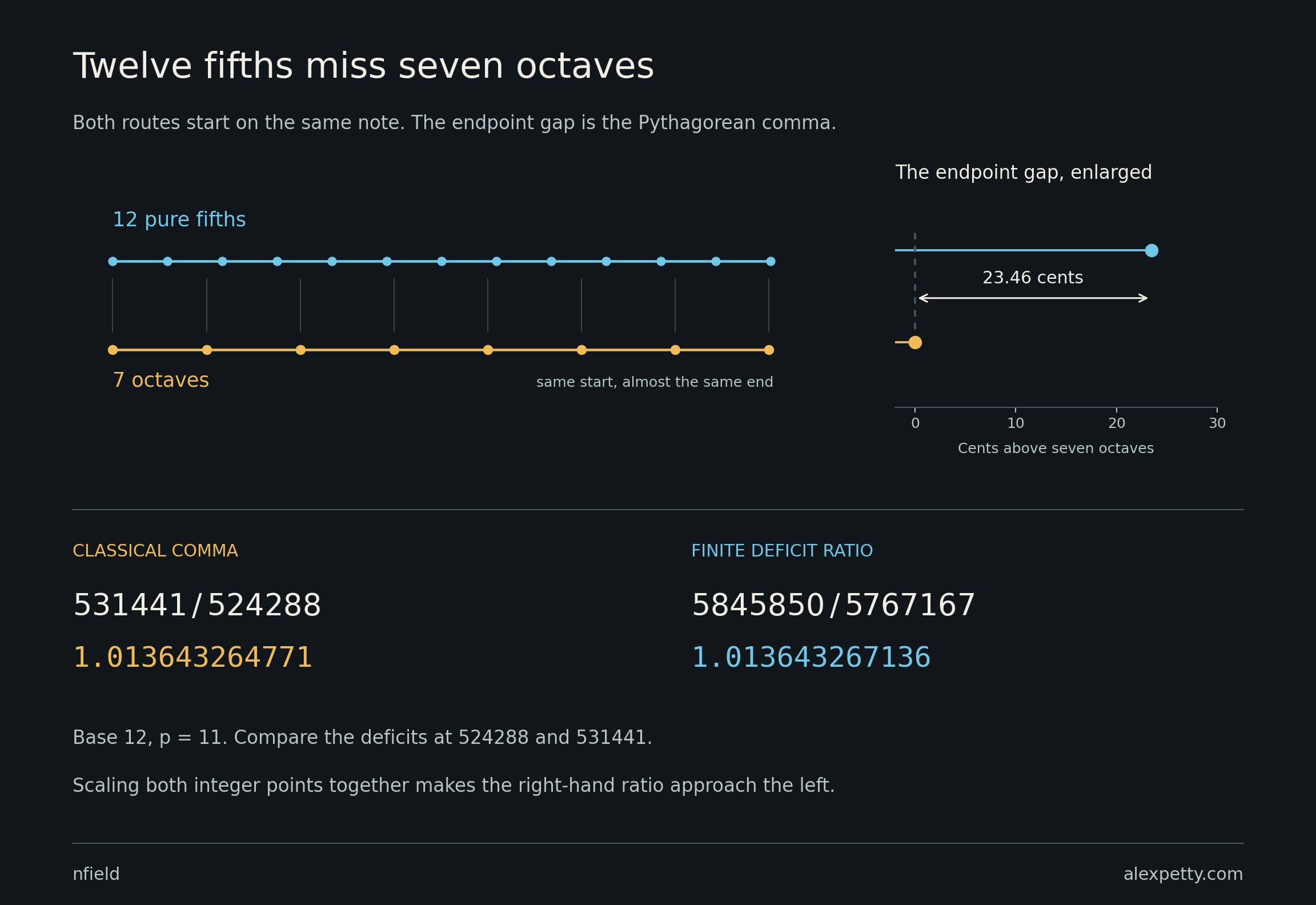
Twelve pure fifths take us almost, but not quite, to the same pitch as seven octaves. The discrepancy is small enough to disappear in a rough calculation and large enough to cause centuries of trouble in tuning.
Twelve fifths multiply the frequency by , and seven octaves multiply it by . The ratio between the two endpoints is
This is the Pythagorean comma, about 23.46 cents. A semitone in twelve-tone equal temperament is 100 cents, so the gap is almost a quarter of one. Pure fifths make a spiral, not a closed circle. Equal temperament narrows each fifth by a twelfth of the comma so that twelve of them land exactly on seven octaves. Benson follows the arithmetic of the mismatch.
Both integers in that fraction, and , are allowed points in base 12, so we can put their deficits straight into the ratio formula.
The finite ratio comes out slightly larger than the comma, and the two already agree through eight decimal places.


Scale both points together and the ratio converges to the comma itself. The deficits don’t smooth the problem away the way equal temperament does. They reproduce the pure intervals, spiral and all.
Eight notes from nine points
Base adds a third axis, for 5. With , the deficits now live on the grid of five-limit just intonation, the tuning in which no prime larger than 5 appears in any interval.
The just major scale, Do Re Mi Fa Sol La Ti Do, has the ratios
Put them over their common denominator, 24, and the scale becomes eight integers, 24, 27, 30, 32, 36, 40, 45 and 48, each built from 2, 3 and 5. That is a classical way to write the scale, also set out in Kurenniemi’s account of musical lattices.
One more integer between 24 and 48 is made from the same primes, .


Its interval, , belongs to the lattice but not to the familiar scale. The arithmetic hands us nine points, and picking the eight that make a major scale is still a musician’s choice.
Divide each note by the one before it and the steps are , , , , , and . That is the whole, whole, half, whole, whole, whole, half pattern every piano student learns, except that in this tuning the whole steps come in two sizes, and .
The fifth’s extra fraction
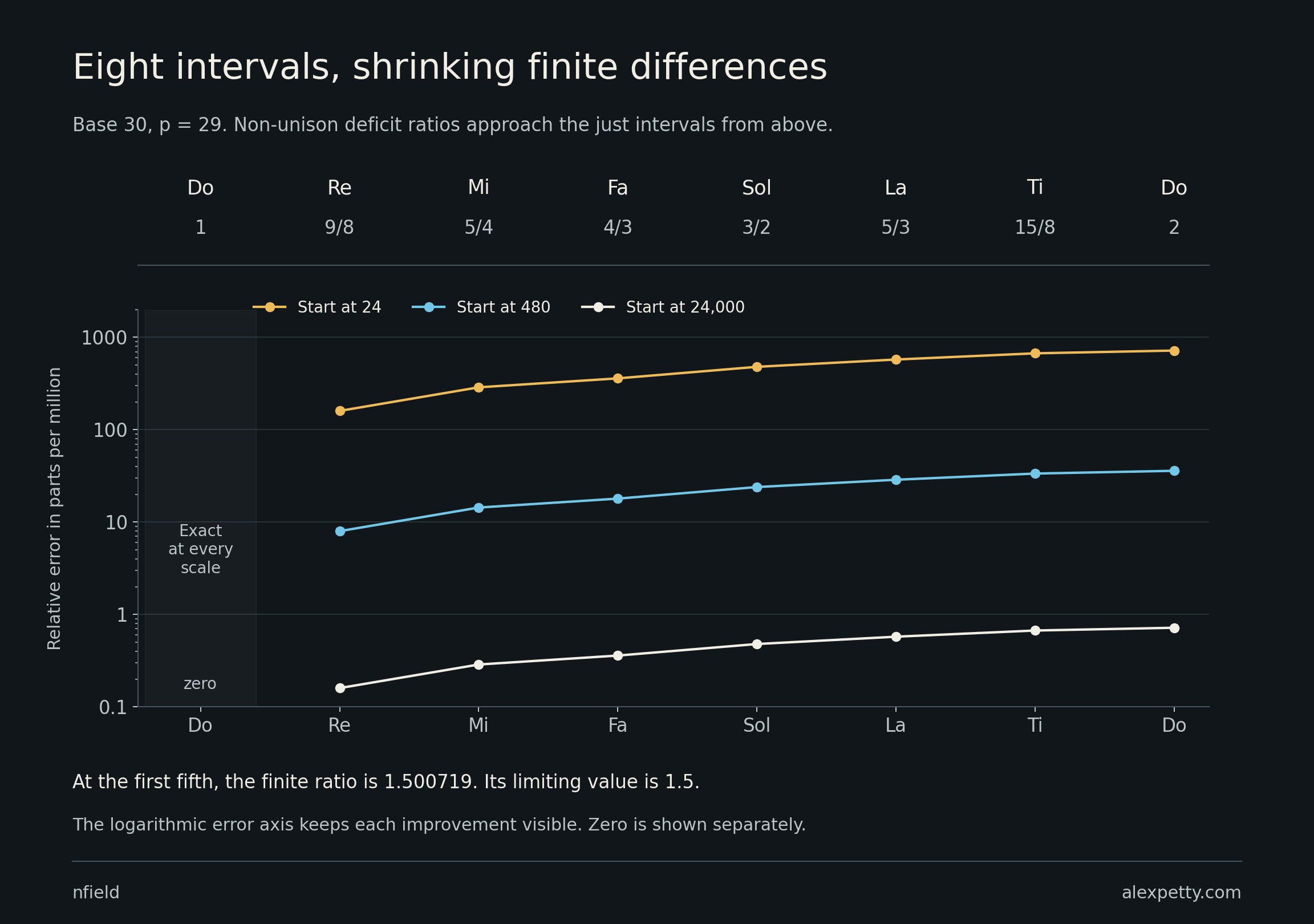
The finite column in the table below comes straight from the deficits. Divide the deficit at 24 by the deficit at each note and you get . For the fifth, , and
That extra makes this fifth a little wide. Every note above unison is a little wide, and the octave is the widest, off by just under 0.072 percent.
Multiply both ends of the fifth, 24 and 36, by the same allowed factor and the excess becomes
Each tenfold increase in buys roughly another decimal place, and the same holds for every interval in the scale.


An octave-wide plot would hide most of the change, so the lower panel measures relative error in parts per million on a logarithmic scale. Follow Sol down the three curves and you can watch the fifth close in on . Do has no error at all, since its deficit is divided by itself.
A seventh in base 210
The primes in the base decide the grid. Bases 6, 12 and 24 all have 2 and 3, so they share the Pythagorean intervals in the limit. Bases 30, 60 and 120 have 2, 3 and 5. Their finite values can differ, because the prime enters the formula too, but the limits agree.
Base keeps all of that and adds 7. With , which divides 209, the deficit ratios at and approach the harmonic seventh, , the low seventh that barbershop quartets lean into. The pair and approaches the septimal whole tone, . Neither interval exists without the 7.
The tuning lattice is classical, and any positive function that behaves like a constant divided by would recover its limiting ratios. What is particular here is where this one comes from, a count of repeating tails, with an exact correction at every finite step. To my knowledge, this coordinate has not been previously described.
At the fifth, that count gives . Subtract the musical ratio and exactly remains. We can account for that fraction and make it as small as we please by scaling the two integer points together.
I wanted a connection that would survive contact with the mathematics. Here, even the part that is still out of tune has an exact value.
The one-digit count in any supported base
Let be prime with , and let be a positive integer whose prime factors all divide . Choose a clearing length with . Among the proper fractions , there are terminating rows. Each receives a whole credit by convention.
For the other rows, multiplication by preserves the remainder modulo , since . Their cleared tails repeat a single digit. The rows with share the tail of . The remaining rows do not. Thus
For example, take base 12, and . The denominator is 22. After one digit, repeats the digit 6. Rows 1 and 12 match that tail; row 11 terminates. The alignment is , and its deficit from is .
The exact difference from a limiting ratio is
It is positive when . The finite interval approaches its target from above. The limit is taken along allowed factors , such as successive powers of any prime dividing the base.
Exact scale values and the fifth’s convergence
The last column is . The just interval in the middle column is its limit when both points are scaled together.
| Note | Just interval | Finite ratio | |
|---|---|---|---|
| Do | 24 | ||
| Re | 27 | ||
| Mi | 30 | ||
| Fa | 32 | ||
| Sol | 36 | ||
| La | 40 | ||
| Ti | 45 | ||
| Do | 48 |
For a selected point between 24 and 48, the relative error after scaling by is . Its maximum occurs at 48 and equals . At , the bound is . The fifth’s absolute error is also at this scale, but its relative error is .
Here is the fifth at six starting points. The displayed decimal values are rounded.
| Starting point | Deficit ratio at |
|---|---|
| 24 | 1.500719 |
| 240 | 1.500072 |
| 2400 | 1.500007 |
| 24000 | 1.5000007 |
| 240000 | 1.50000007 |
| 2400000 | 1.500000007 |
Twelve windows into the tuning lattice


Three more views of the lattice
These plots cover the same ground as the figures above, one frame each for the bases, the comma, and the scale’s errors.
Further reading
The prime-based description of tuning has a long history. Euler’s work, Helmholtz’s On the Sensations of Tone, and Barbour’s Tuning and Temperament provide historical background. The following accounts develop the arithmetic used here.
- Benson, Music: A Mathematical Offering, including the Pythagorean comma and temperaments.
- Kurenniemi, Chords, Scales, and Divisor Lattices, including the prime-exponent lattice and the integer representation of the just major scale.
- Archibald, Mathematics and Music (1924), an earlier survey of the subject.
The Alignment Deficit Lattice and Musical Tuning supplies a coordinate derived from long division on an established lattice. It is not a claim that the classical intervals or the major-scale integer sequence are new.
Discussion
Sign in to join the discussion.