Alignment
The Three-Tier Theorem

A batting average is hits over at-bats, and across enough players and enough seasons it lands on nearly every value in its range, which is what averages usually do. Alignment is an average too, taken over all the proper fractions of a denominator, and there are infinitely many denominators to try. Yet no denominator of any size has an alignment strictly between and , and one over the golden ratio, about 0.618, sits in the middle of that empty band. Six and twelve are the only denominators that touch its edges.
That empty band is why the golden threshold in Three and the Golden Ratio is not a knife-edge. Every denominator lands clearly on one side of the line or the other. The proof also settles a case that The Alignment Limit for All Primes had to leave open. The formula there needs the repeating part of the denominator to be a single prime, so a denominator like fell outside it. The argument here rests on a pairing that anyone who has subtracted a repeating decimal from one has already seen, and the pairing doesn’t care whether that part is prime.
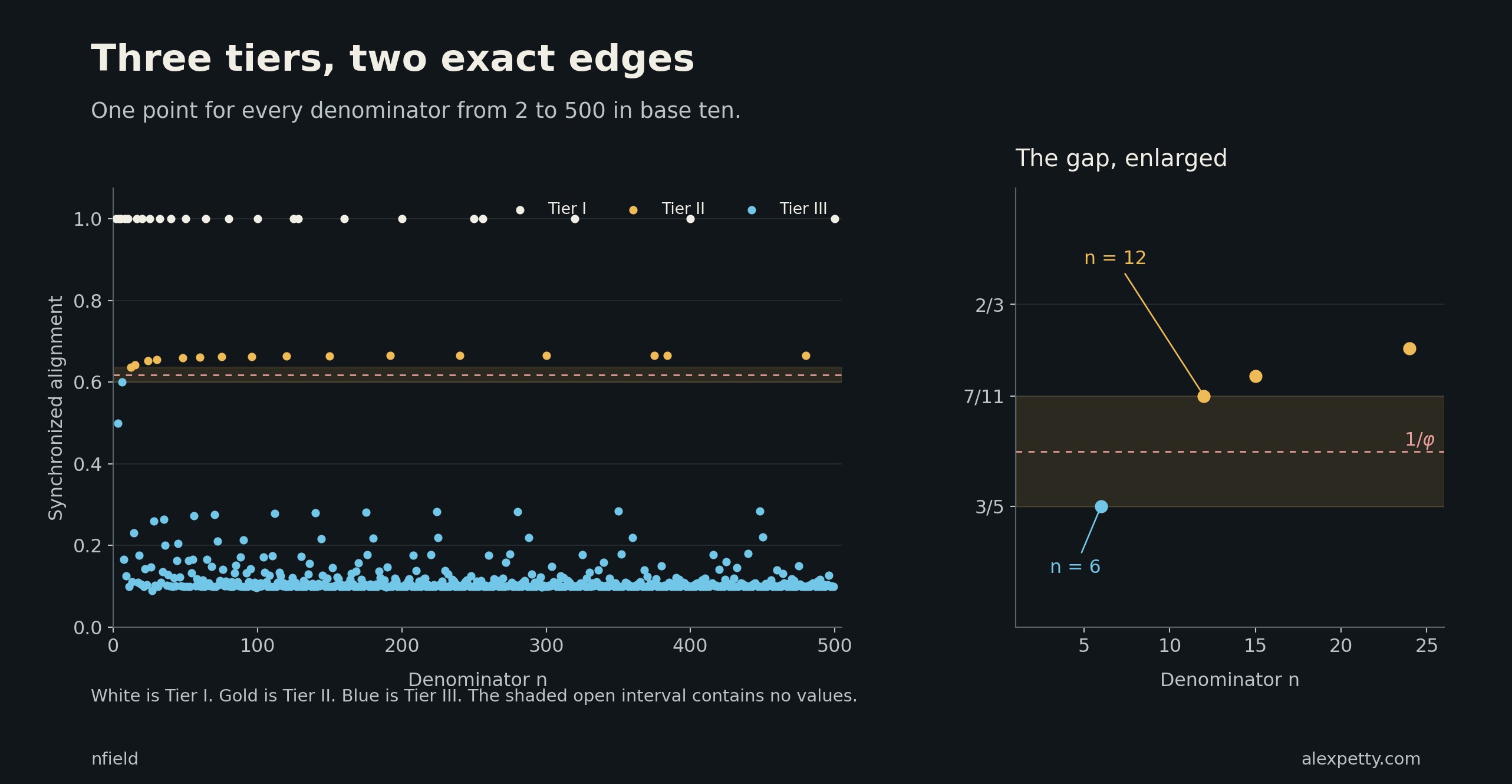
Here is every denominator from 2 through 500, each plotted at its alignment. Most of the points settle near a tenth, which is about what you would expect if each fraction’s digits agreed with the reference by chance, one time in ten. A row of them sits at exactly 1. These are the denominators built from twos and fives, whose fractions all terminate. A small second family, 12, 15, 24, 30 and so on, climbs toward two thirds.
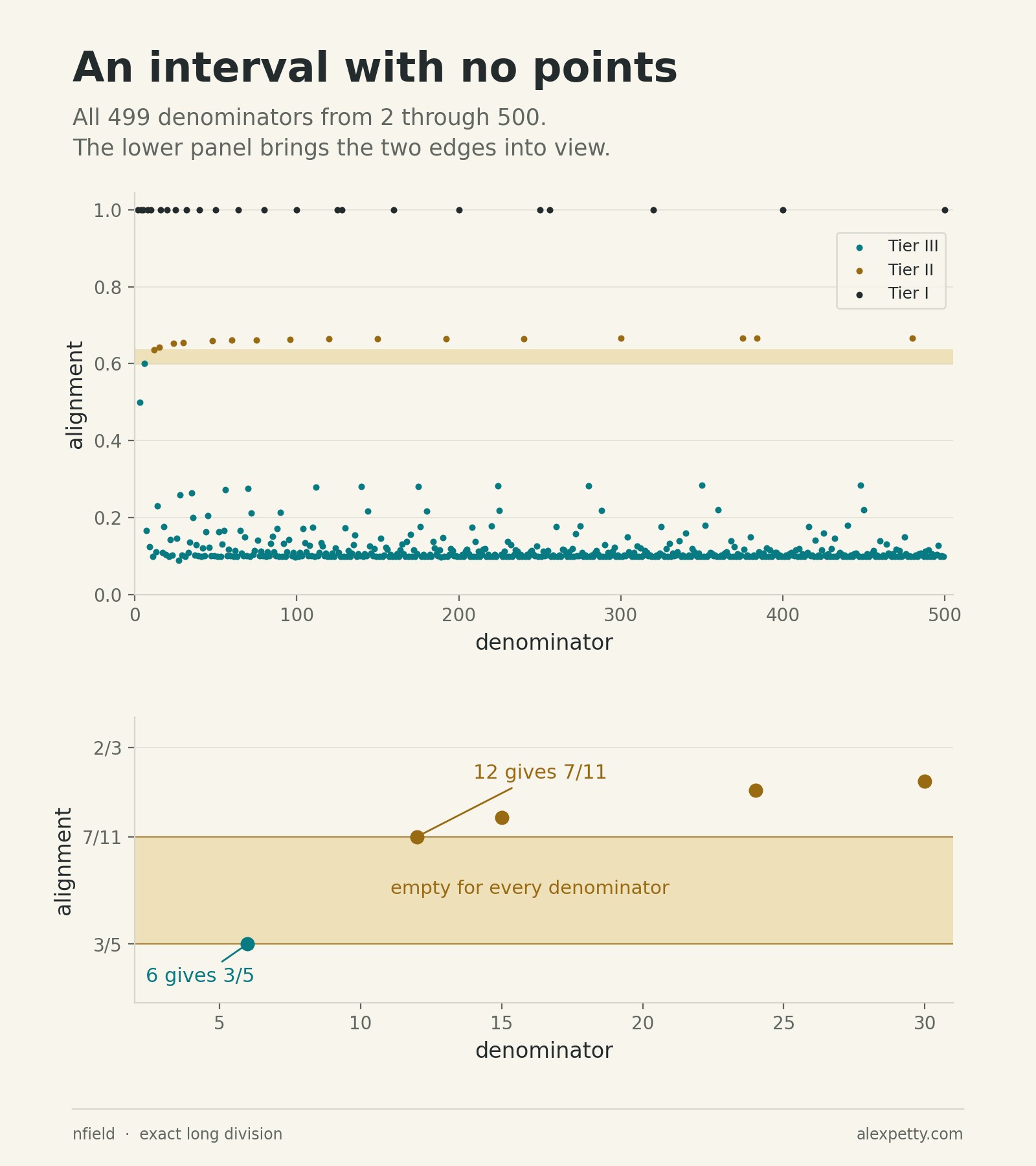
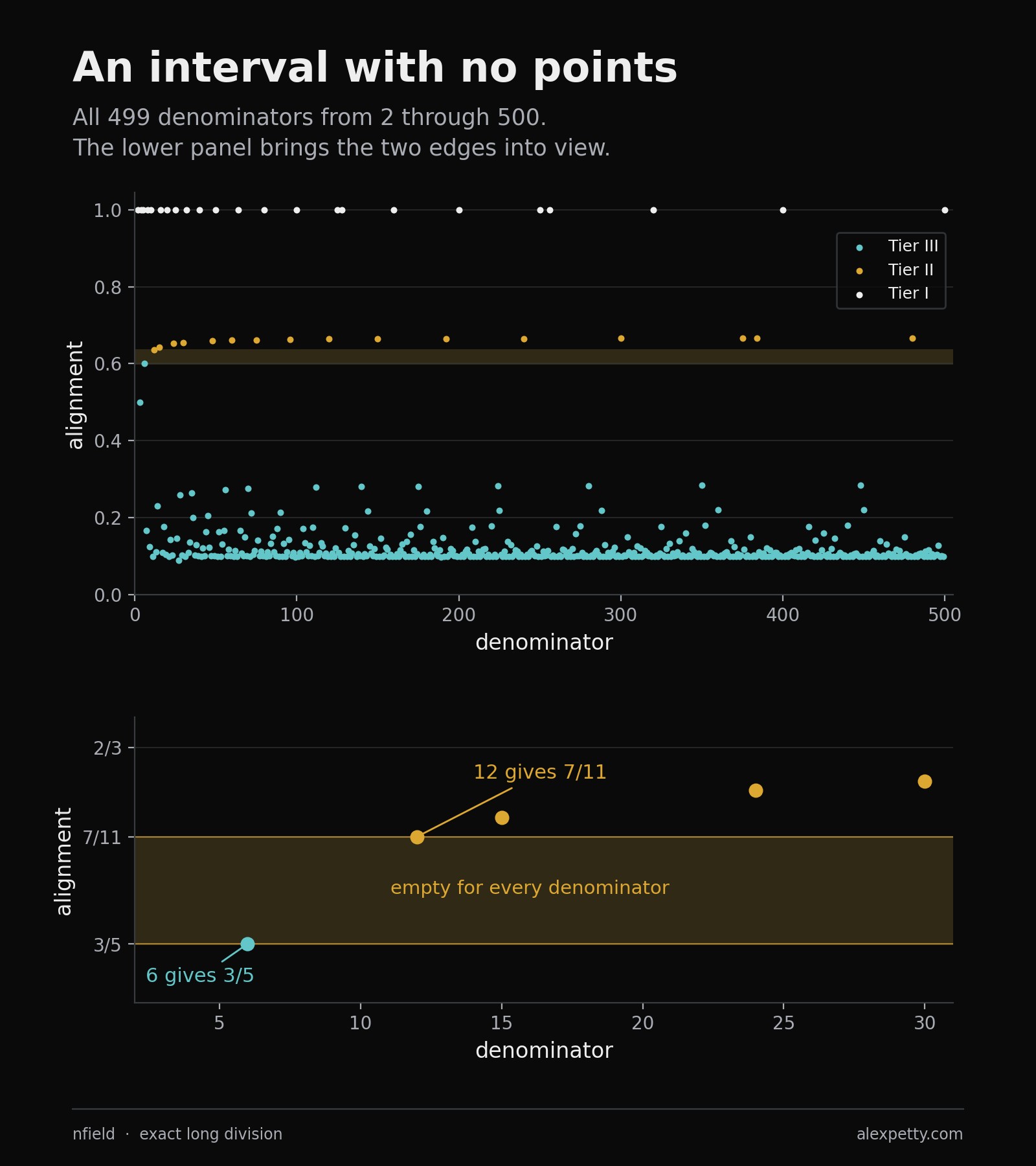
The band between 0.600 and 0.636 is empty, with six sitting exactly on its floor at and twelve on its ceiling at .
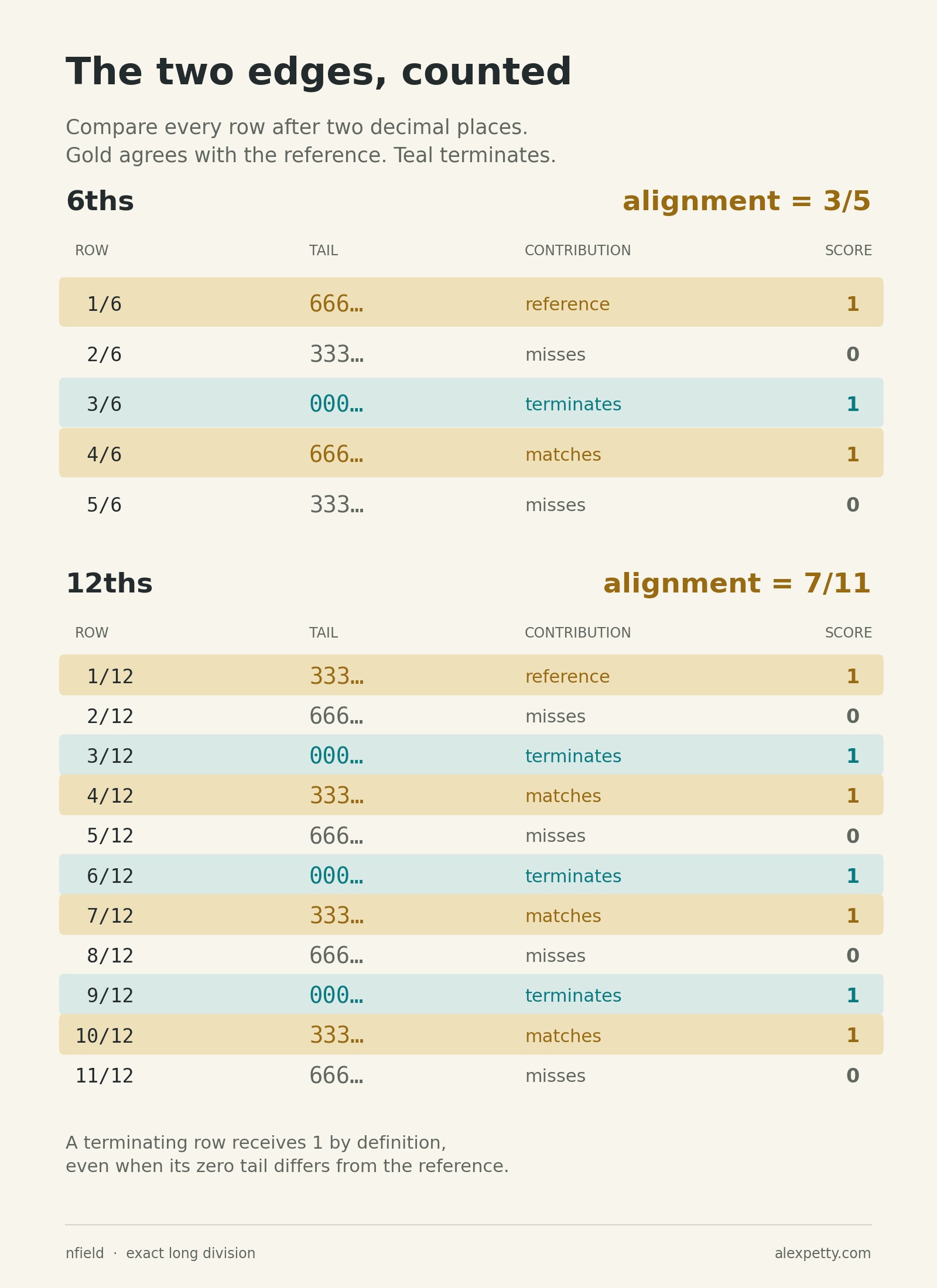
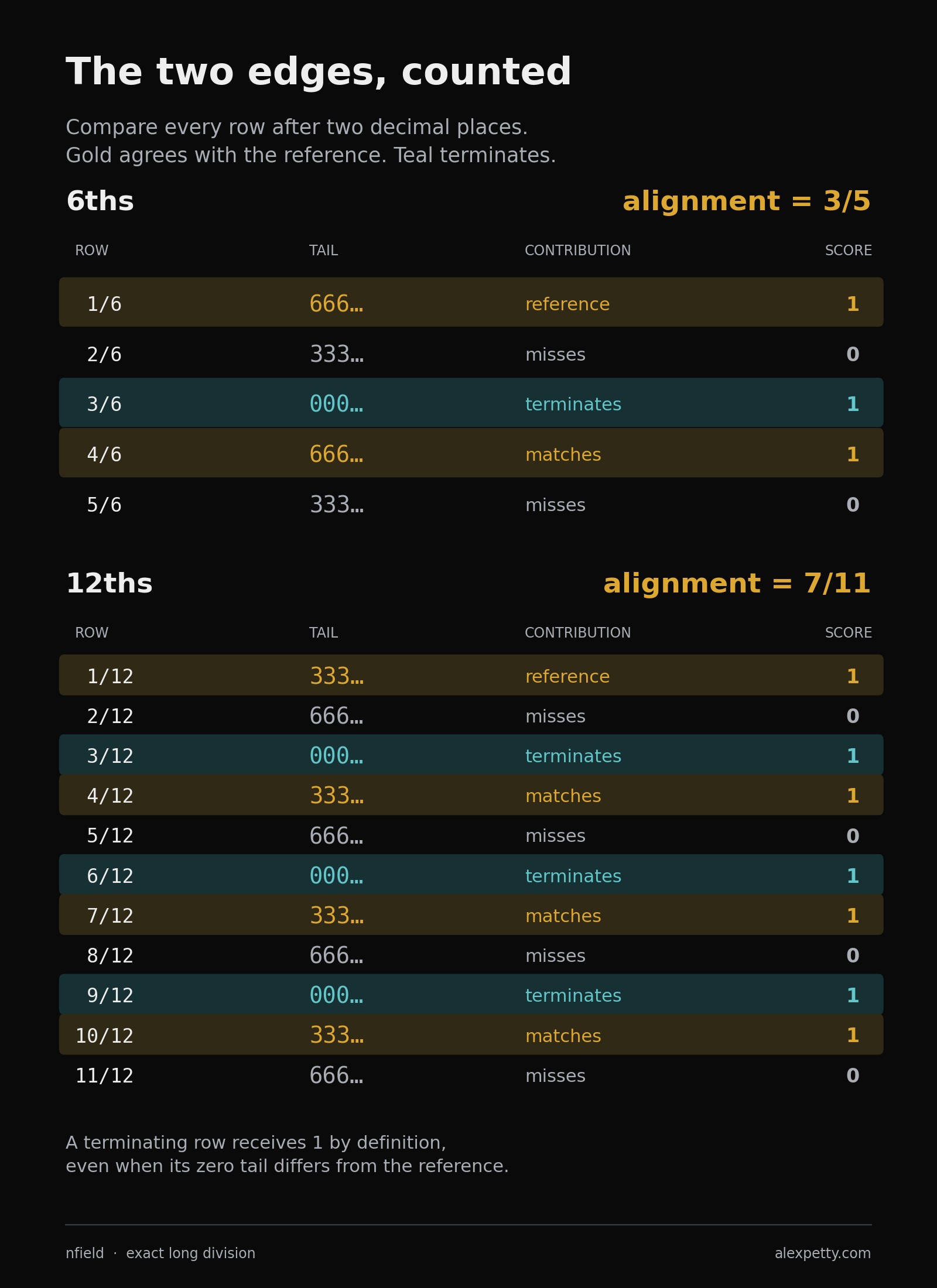
The edges themselves come from two small tables. For the sixths, the reference is . Once the first two decimal places have passed, two rows repeat its digit 6, two repeat 3, and one has terminated. For the twelfths, the reference is , and after the same two places four rows repeat its 3, four repeat 6, and three have terminated.
Each repeating row gets its proportion of agreements with the reference, and the reference row of course agrees with itself. A terminating row gets a score of 1, as the alignment convention requires, even though its zero tail differs from the reference. Averaged over all the proper fractions, the sixths collect three credits among five rows and the twelfths seven among eleven.
To control denominators of every size, including those whose repeating part is composite, we first have to separate the part of a denominator that terminates from the part that repeats.
The part that stops and the part that repeats
Forty is made entirely of twos and fives, so enough multiplications by ten absorb its whole denominator. All thirty-nine proper fortieths terminate, every row scores 1, and the average is 1.
At 60, the base can absorb a factor of 20, but a factor of 3 remains. At 84, it can absorb a factor of 4, leaving 21. That remaining factor need not be prime.
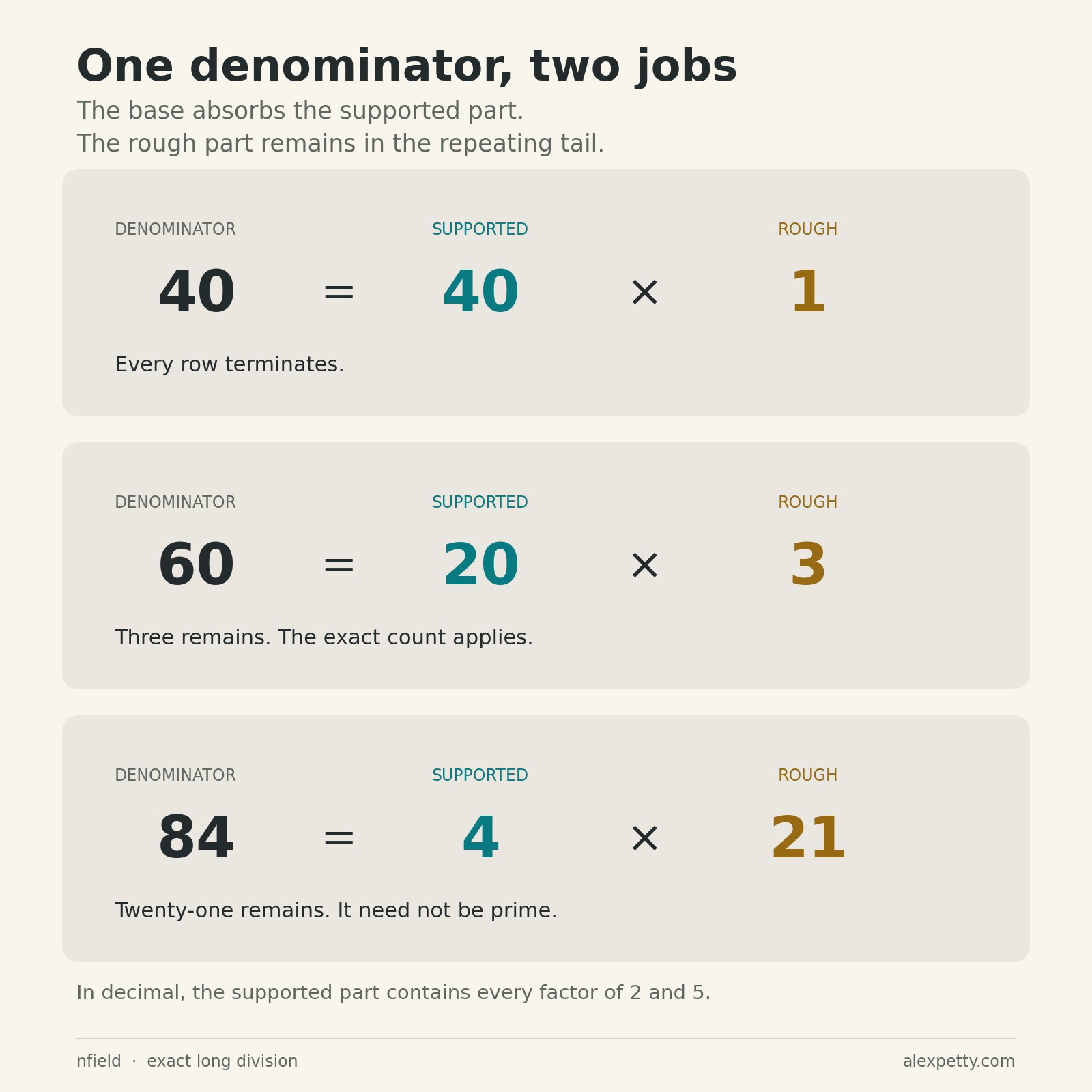
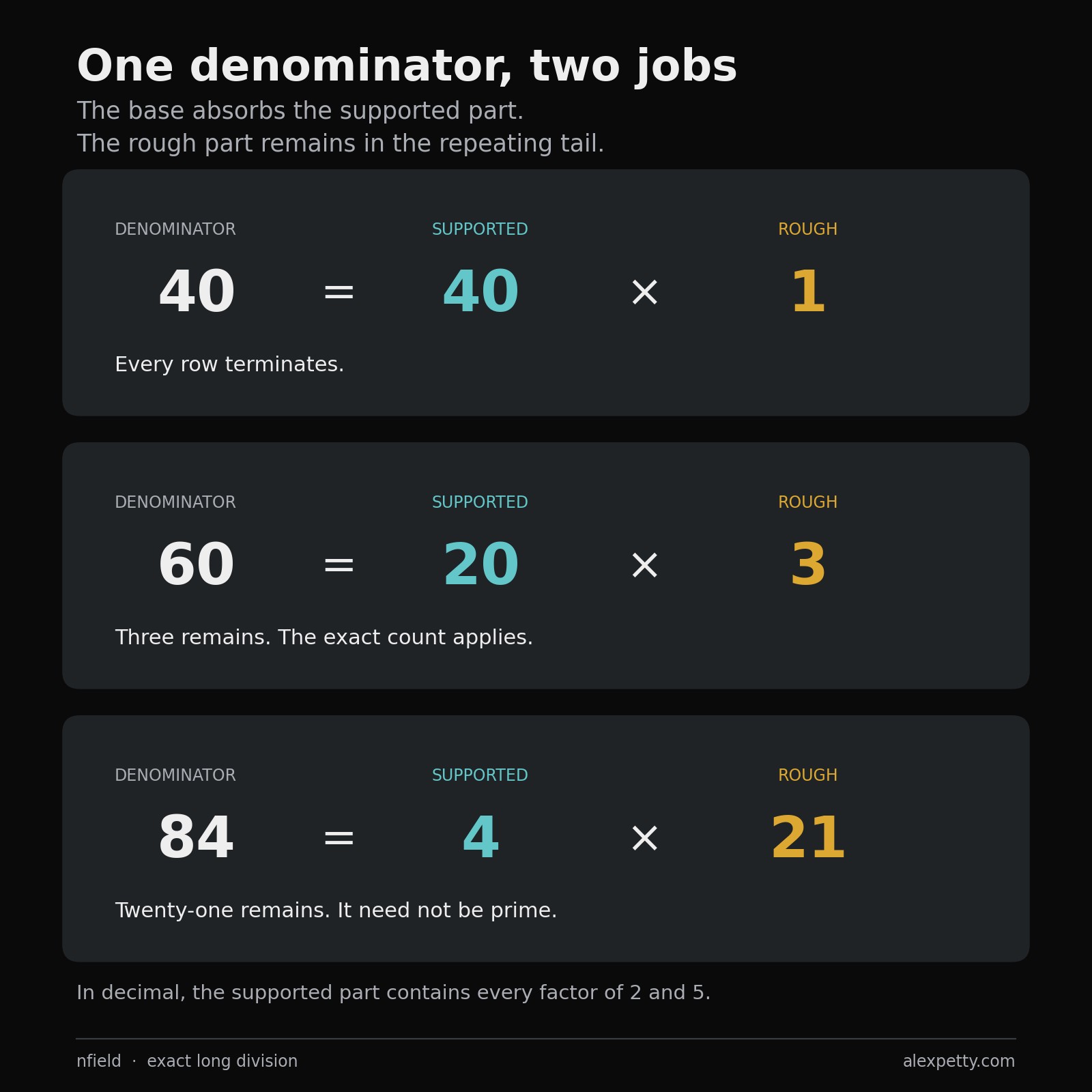
Write this separation as . The supported part contains every factor supplied by the base. In decimal, those are the twos and fives. The rough part is what remains, relatively prime to ten.
A row terminates exactly when its numerator cancels the whole rough part. Its numerator must therefore be one of
There are such rows. Of the proper fractions, the other repeat.
We compare those repeating rows on a common clock. Choose enough initial decimal places to clear the supported part from every row, then compare over a full period of the reference. A shorter tail repeats as many times as needed to fill that period. Starting each row at a separately chosen rotation would change the question.
When the rough part is prime, the formula from The Alignment Limit for All Primes counts these agreements exactly, through the remainder cycle the clock selects. With a composite rough part the reduced fractions can have different periods, and there is no single cycle to follow. We can still bound their total without finding a separate formula for each one.
A partner for every repeating row
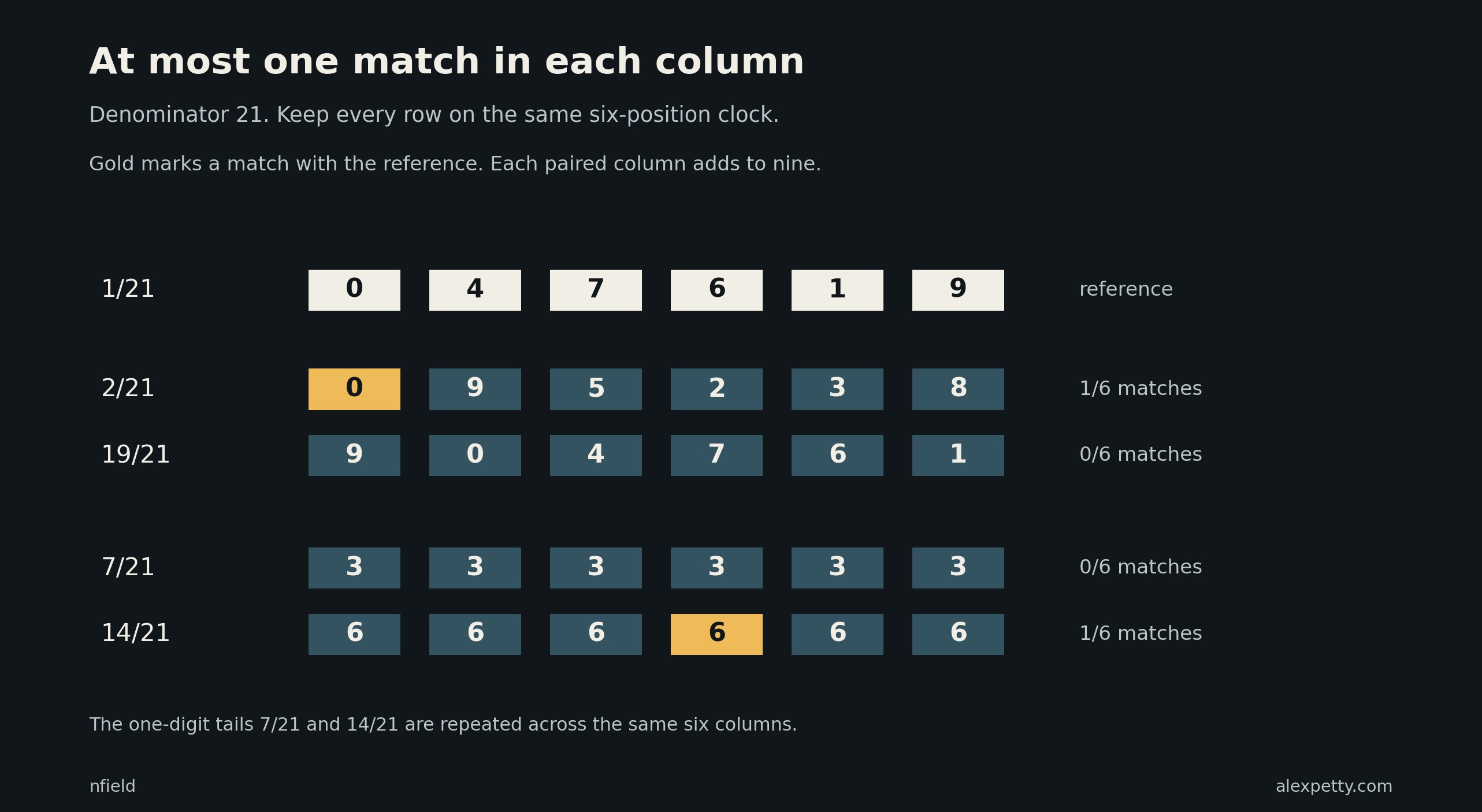
At denominator 21, take and . Their sum is one. Their repeating blocks are
 3/21 = 0.142857142857…
18/21 = 0.857142857142…
Each column adds to nine. Now set the reference above them. The first row matches its 4 and the second matches its 7, so both rows score, but never in the same column, because two equal digits can’t add to nine.
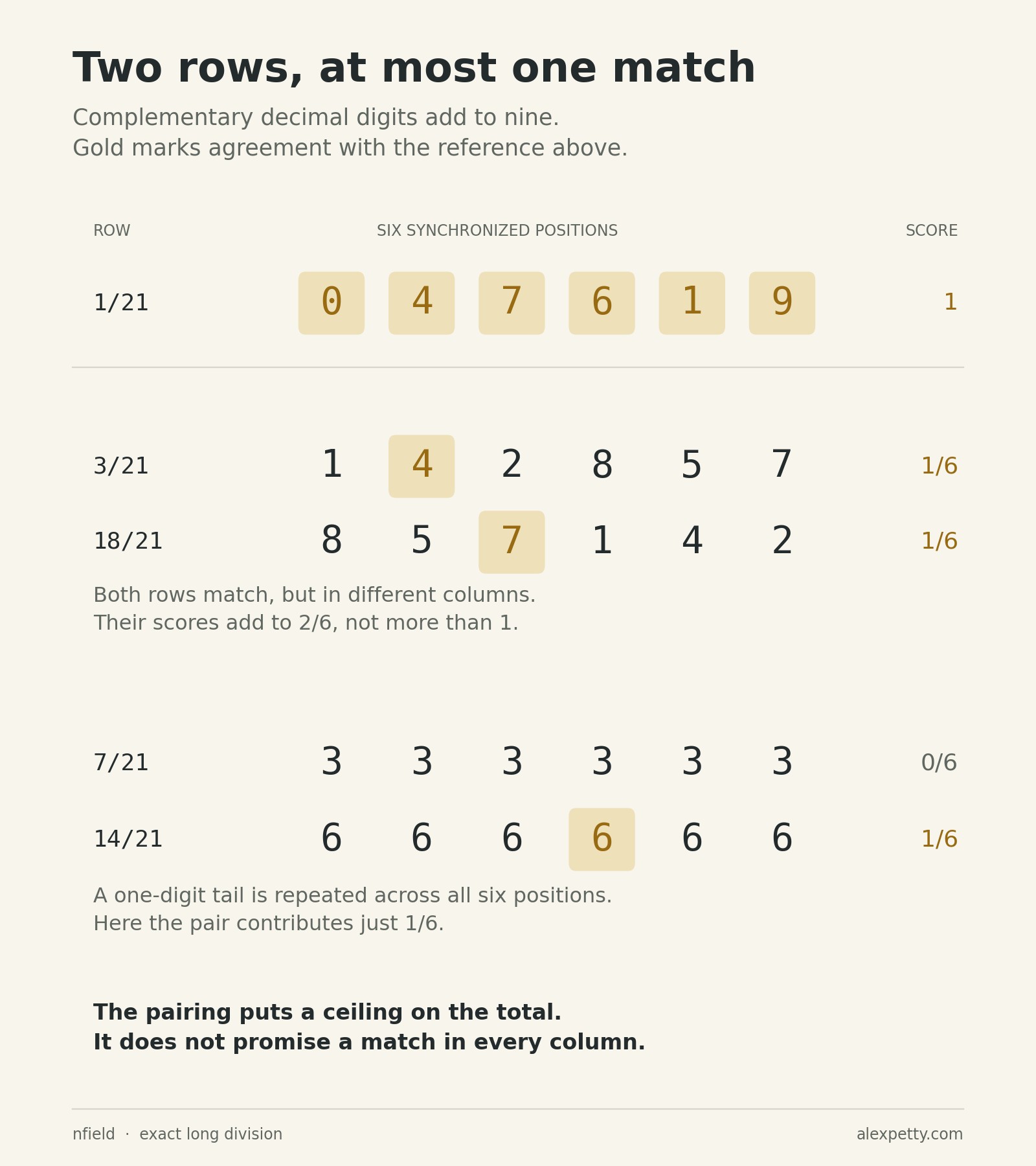
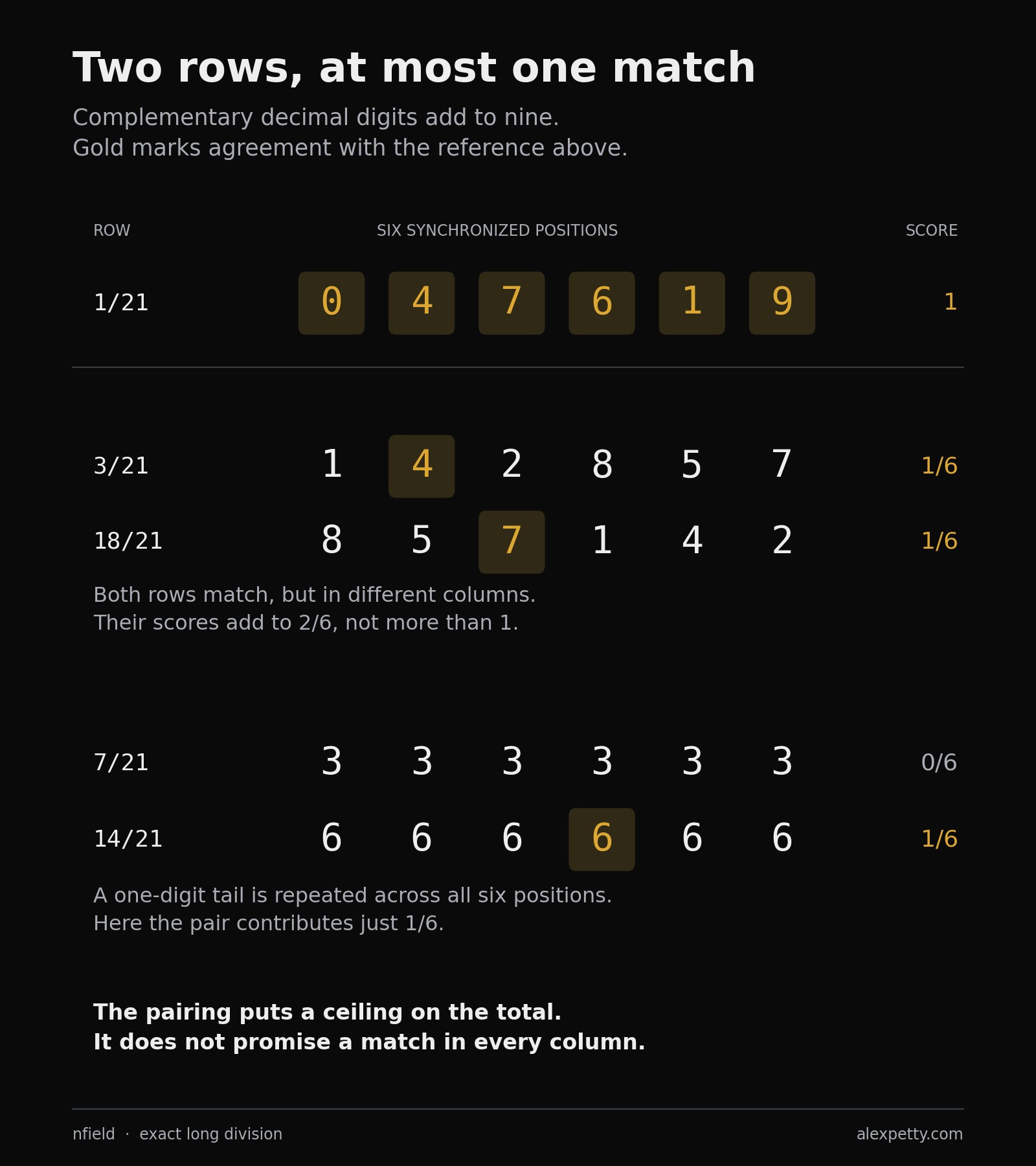
The shorter rows obey the same rule. Seven twenty-firsts repeats 3 and fourteen twenty-firsts repeats 6, so across the reference’s six places the first has no match and the second has one. A pair may leave many positions unmatched. All the argument needs is that it can never supply two matches at the same position.
The argument works for every nonterminating row and its partner . Their tail digits add to nine, so their alignment scores add to at most 1. No repeating row is left without a partner. The only fraction that could be its own partner is , and that one terminates in decimal.
Consider 84 again. Three of its eighty-three proper fractions terminate. The other eighty form forty pairs. Even if each pair supplied a whole credit, the total could not exceed forty-three.
Its actual alignment is , far below the bound. Pairing throws away a lot of detail on purpose, and in exchange it gives an estimate that doesn’t care how long or complicated the repeating blocks become.
For any rough part , the same count gives
The first numerator counts the terminating rows individually and the repeating rows in pairs. The last inequality is strict for every finite .
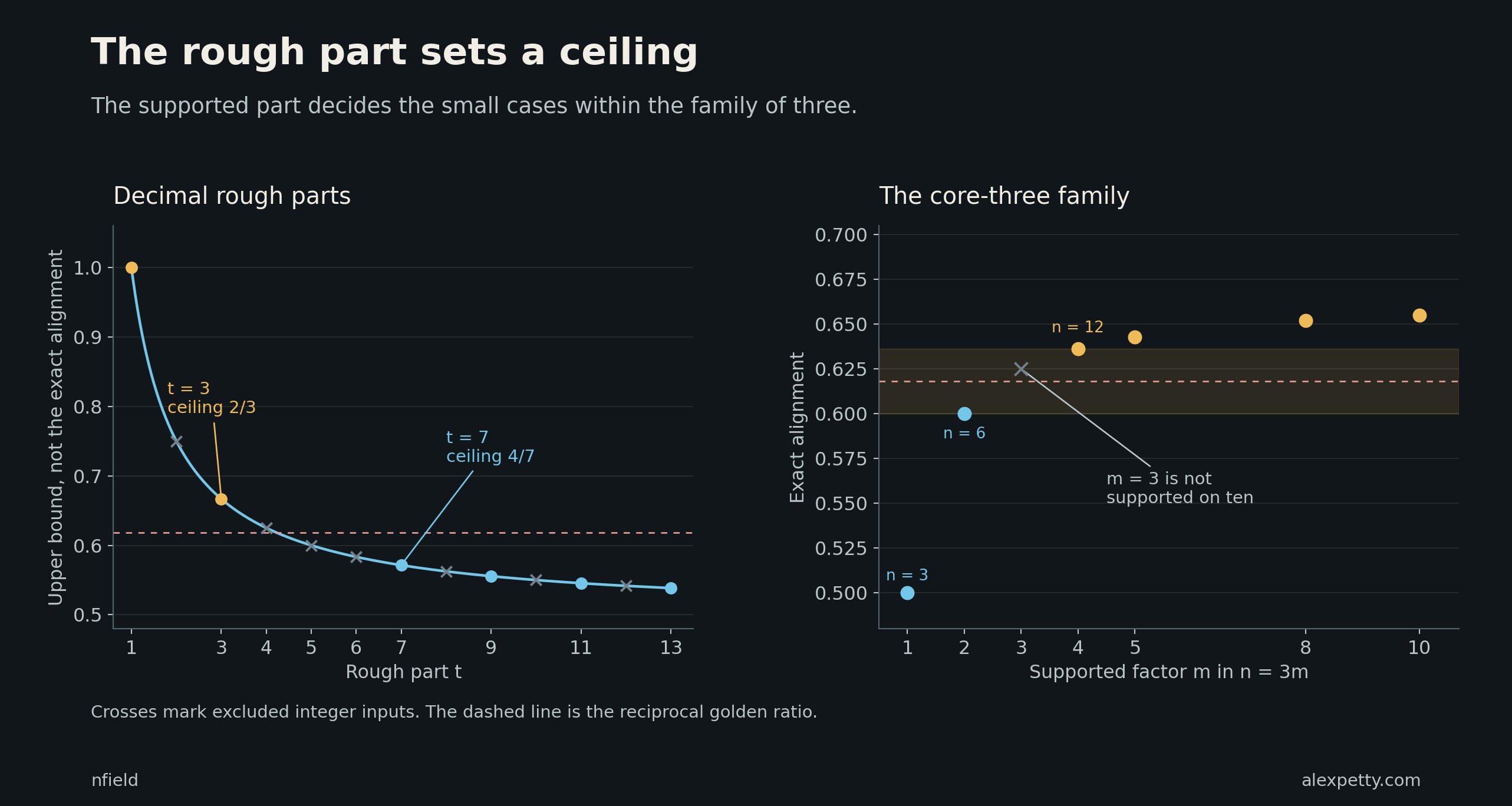
After twos and fives have been removed, the decimal rough parts begin . Apart from 1 and 3, they are all at least 7. Consequently every such denominator satisfies
None of them can reach , so only the family with rough part 3 remains to be counted.
The missing multiplier
When and contains only twos and fives, clearing the prefixes leaves thirds. There are rows that match the reference tail, with the opposing tail, and that terminate. The sixths and twelfths were the first two tables large enough to show all three groups.
Their count extends without change.
At it gives and at it gives . The next permitted multiplier is 4, which gives .
Three is missing because it is not built from twos and fives. Substituting into the formula would produce , right inside the gap, but the substitution would violate the condition under which we obtained the formula. Denominator 9 has rough part 9 and supported part 1. Its actual alignment is .
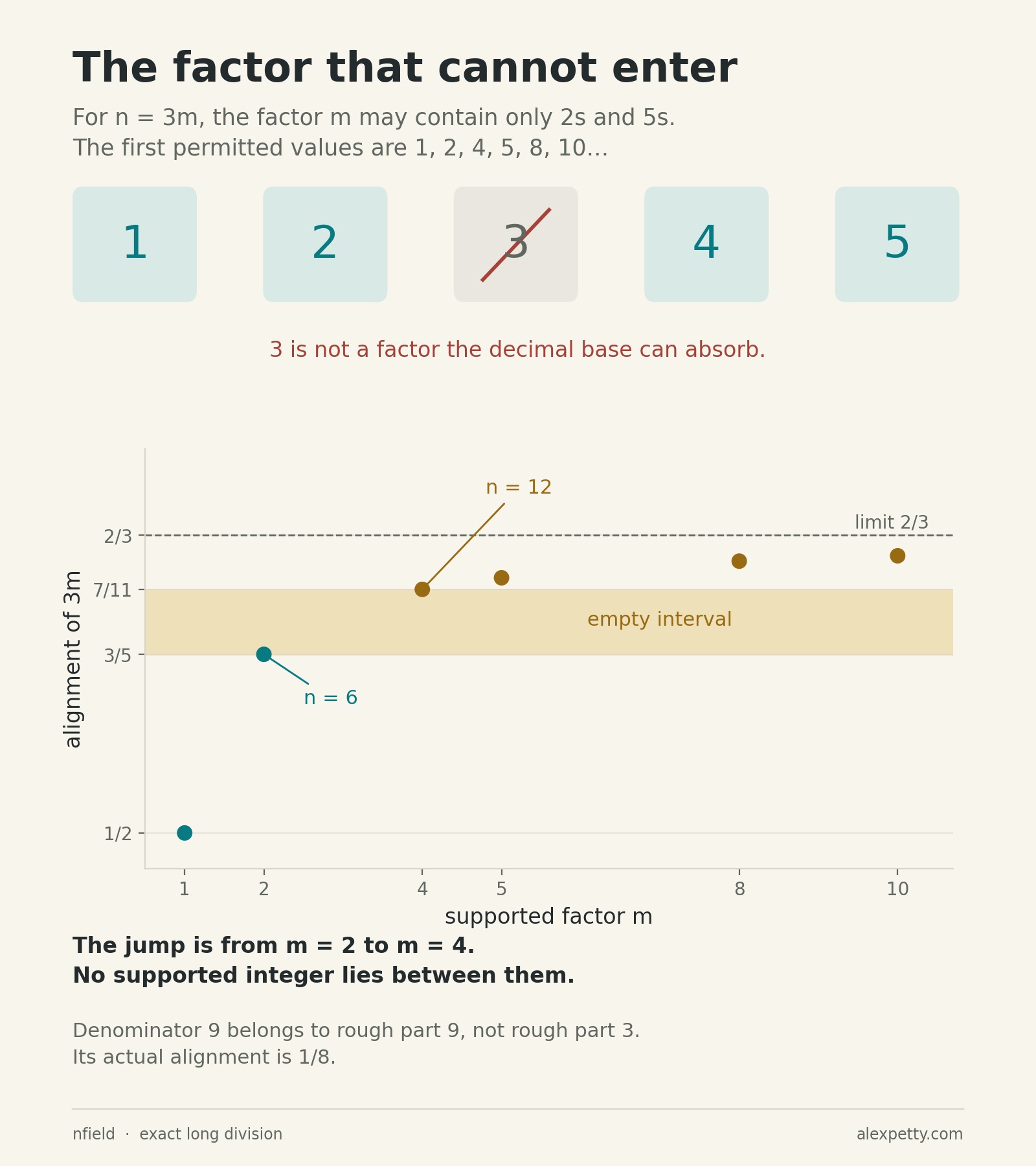
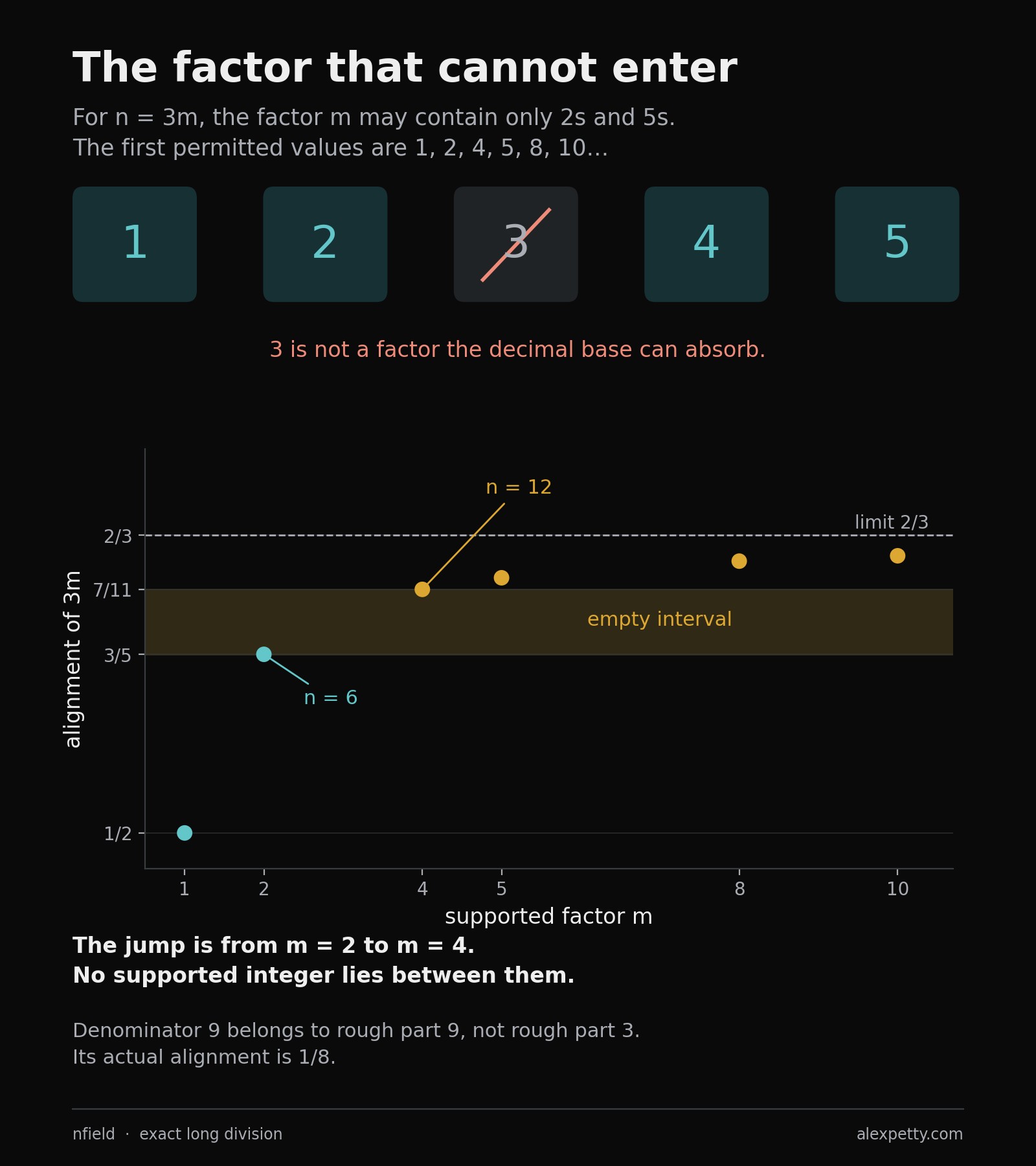
For the permitted values of , the scores increase toward . One rearrangement shows both the direction and the distance remaining.
As grows, the subtracted amount shrinks, but it never vanishes. From onward, the family stays at or above and strictly below .
We can now account for every point in the plot.
| Tier | Denominators in decimal | Alignment |
|---|---|---|
| I | Only factors of 2 and 5 | |
| II | , with supported on ten and | From up toward , never reaching it |
| III | Every other denominator | At most , attained only at 6 |
Three and six belong to the lowest tier, although their rough part is 3. The supported multiplier decides which side of the gap that family occupies. For instance, 75, 96, and 120 all leave 3 after their twos and fives are removed, and their supported multipliers are all at least 4. They belong to the middle tier. The number 45 leaves 9. It does not.
An even base has no middle digit
Nothing in the pairing depends on the names of the decimal digits. In base , complementary tail digits add to .
If the base is even, that sum is odd, so two identical digits still can’t produce it, and still terminates. The pairing and its bound survive intact.
Now suppose three does not divide the base. The rough part 3 is still available and its family has the same exact count. Because the base is even, the multipliers 2 and 4 are available, and because three doesn’t divide it, the multiplier 3 is not. The jump from 2 to 4 survives.
Every other rough part is an odd integer at least 5. Its alignment is therefore strictly below . Decimal gives the stronger bound because five has already been removed, but the stronger bound is not needed to keep the band empty.
Thus every even base not divisible by three has the same forbidden interval
with the same unique edge denominators 6 and 12. In the three-tier classification, “supported on ten” simply becomes “supported on the chosen base.”
An odd base changes the arithmetic at exactly the point the proof uses. It has a middle digit, , equal to its own complement. In base three, is its own partner and agrees with itself everywhere, and more generally two complementary rows can both match a reference that writes the middle digit. That is why the theorem asks for an even base.
A threshold inside the gap
The reciprocal golden ratio lies strictly between the two edges.
It separates the lowest tier from the other two. In each of the stated bases, a denominator reaches that threshold exactly when all its factors are supported on the base, or when its rough part is 3 and its supported part is at least 4.
Any threshold strictly inside the band makes the same selection, so the gap by itself doesn’t single out the golden ratio. Its special role comes from the profile in Three and the Golden Ratio, where the curve crosses at exactly . What the gap adds is a margin. No denominator comes closer to the line than 6 and 12, one just under it and one just over, each about 0.018 away.
The plot can now run as far as we like. Longer periods rearrange the partial agreements, but every repeating row still has its complement, and larger supported factors only add terminating rows to the same exact count. Nothing can put a multiplier between 2 and 4, and the band stays empty for reasons already visible in the sixths and twelfths.
The same results, drawn another way
These three plots show the same results in a different style, at full resolution.
Complementary decimals and further reading
Complementary repeating decimals have a long history. Shrader-Frechette surveys their patterns. Kak and Chatterjee study complement structure and digit-sequence correlations, while Lewittes and Armstrong and Armstrong develop related period and repetend arithmetic. The Three-Tier Theorem applies the pairing across all proper fractions of a denominator, including those with composite rough parts, to obtain the finite bound and the complete classification.
Discussion
Sign in to join the discussion.