Collisions
The Collision Fluctuation Sum

Euler proved that the reciprocals of the primes add up to infinity, and yet all the primes below ten million manage only about 3.04 between them. The sum grows like , and The Character Structure of the Collision Fluctuation ran into exactly this kind of growth. It weighted each prime’s collision deviation by , split the total four ways by last digit, and stopped at finite cutoffs, because nothing yet said what happens as the cutoff grows. For the total, this article settles it. The deviation at each prime stays within a few units of zero, and yet the weighted sum falls without limit, at exactly minus nine tenths of . The nine tenths comes from forty small integers, one for each two-digit ending a large prime can have, and it is settled before any prime enters the sum.
The integers come from a picture like this one. Write the first two decimal digits of each fraction from through and put each fraction in a square, with its first digit choosing the row and its second digit choosing the column. Of the sixteen fractions, only two land on the diagonal.
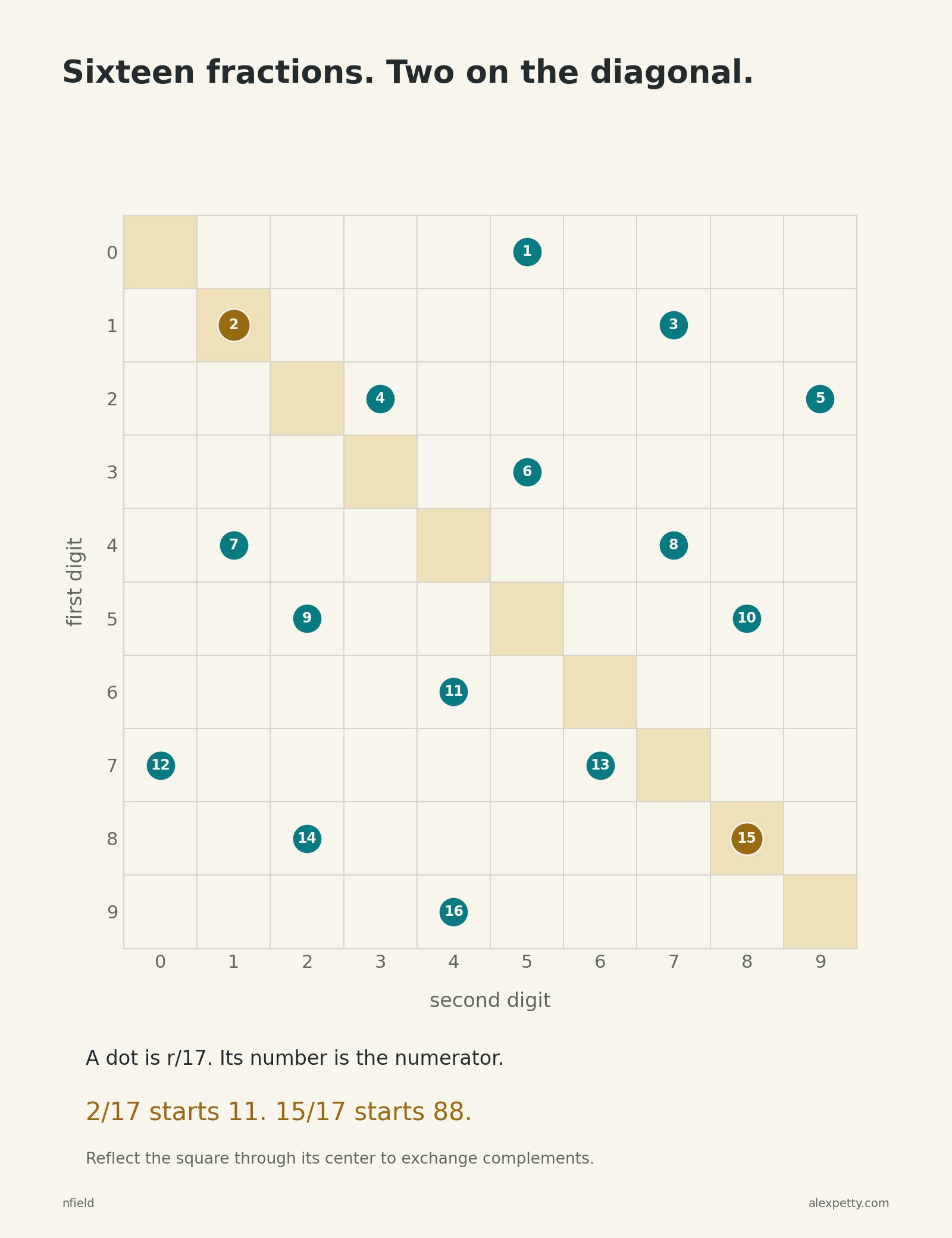
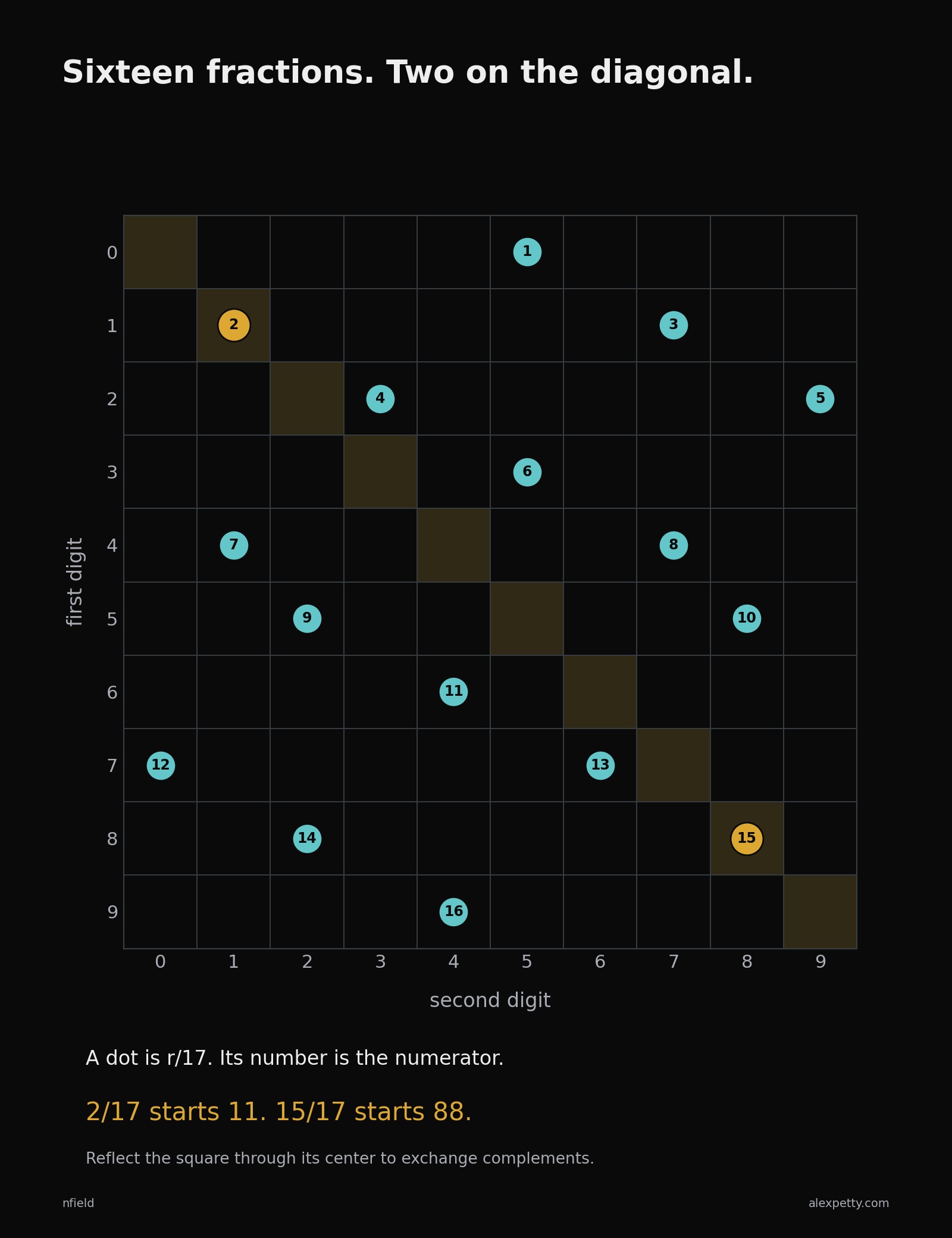
They are and , each with the same digit in its first two places, so the collision count is two.
The two fractions sum to one, and their digits complement each other, turning eleven into eighty-eight. That is why collisions come in pairs. If multiplication preserves the digit of a remainder , it also preserves the digit of , and at an odd prime those remainders are distinct, so every match has a different partner.
We count every nonzero remainder, not just those visited by the repeating block of . Multiplication by ten advances long division one place, and the matching beginnings are .
A total that will not settle
A larger prime has more remainders available to match, so compare its count with a reference level. Test every multiplier except the identity, discard the zero counts, and take the mean of the positive ones. Bin Derangements and the Gate Width Theorem gives this constructive mean from the bin sizes.
Subtract that mean from the count for multiplication by ten and call the difference . A negative deviation means ten preserves fewer digits than the average constructive multiplier, and the mean exists for decimal primes greater than eleven.
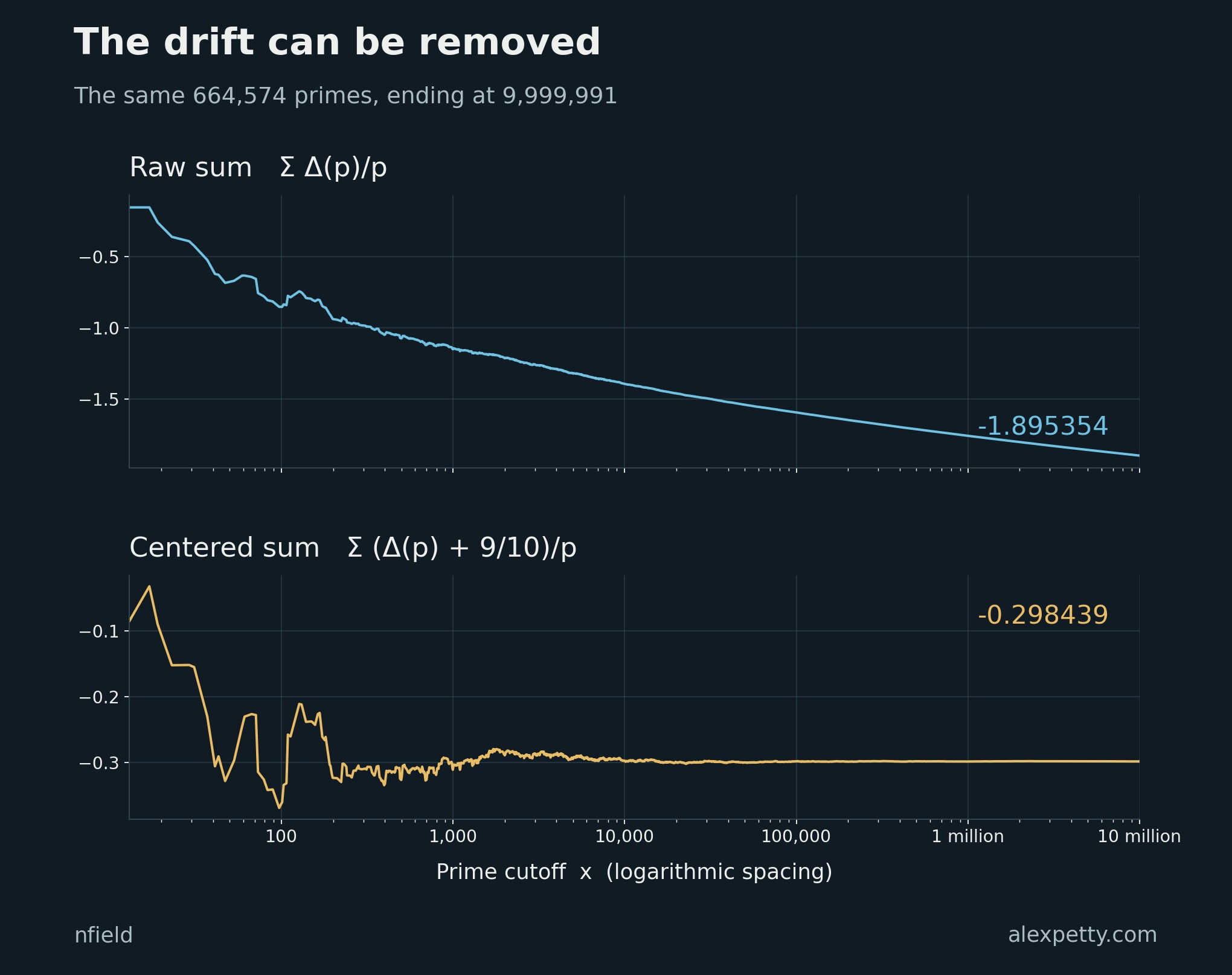
Now add over those primes. The first thousand terms total about , ten thousand give , and through the primes below ten million the total is . Positive terms interrupt the descent but cannot stop it, and the exact rate of that descent can be calculated without adding a long list of primes.
The last two digits are enough
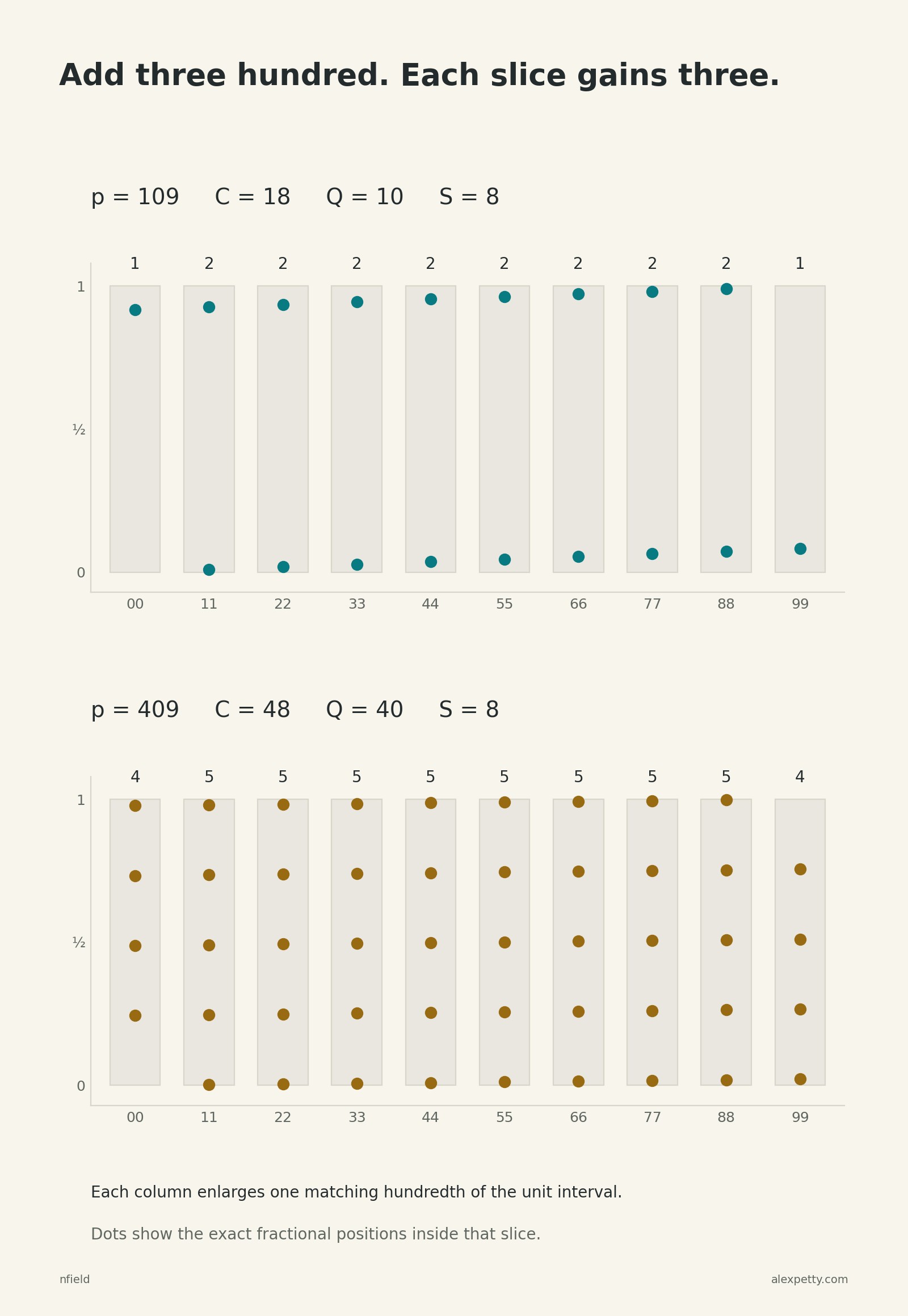
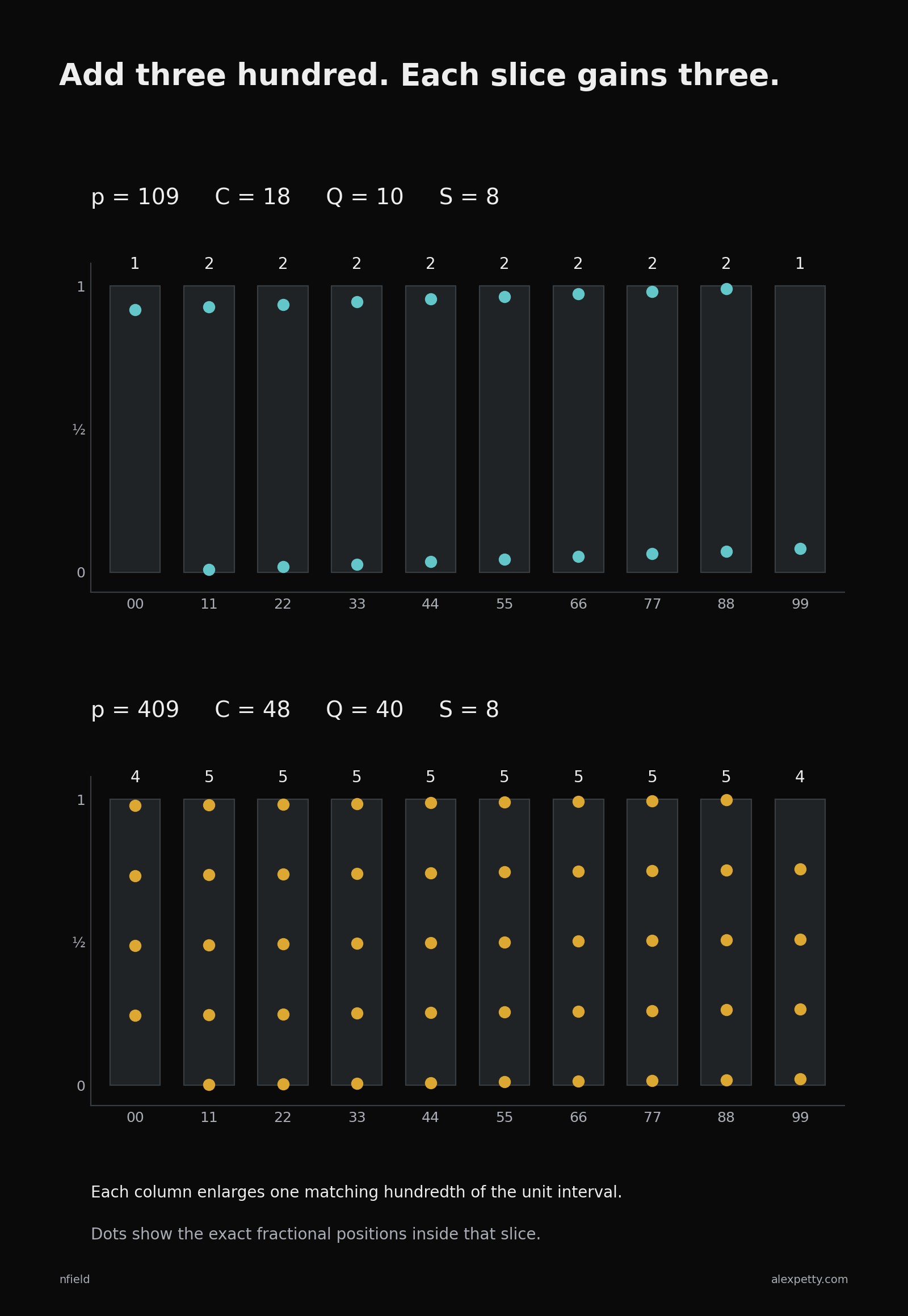
Write , so that the ten digit bins contain either or remainders, and subtract the smaller size from the collision count.
At 191 the count is ten and the smaller bin size is nineteen, a difference of . At 109, eighteen matches minus ten gives .
For every prime above one hundred, the last two digits determine this integer. End in and the answer is , and end in and it is , however large the prime becomes.
Each matching beginning occupies one hundredth of the interval from zero to one, so adding one hundred to the denominator adds one numerator to each of the ten matching slices. The count rises by ten, rises by ten as well, and their difference stays put.
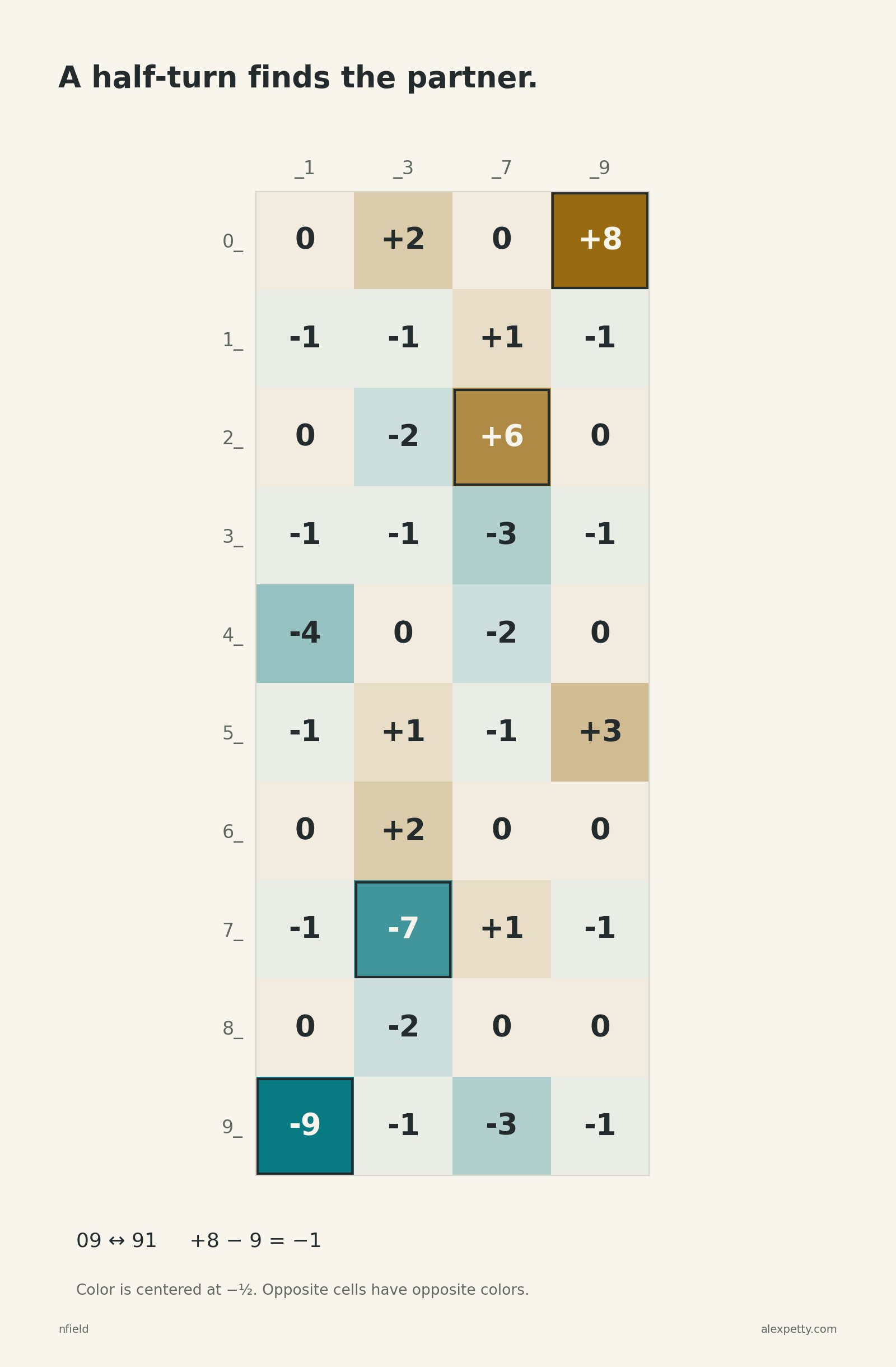
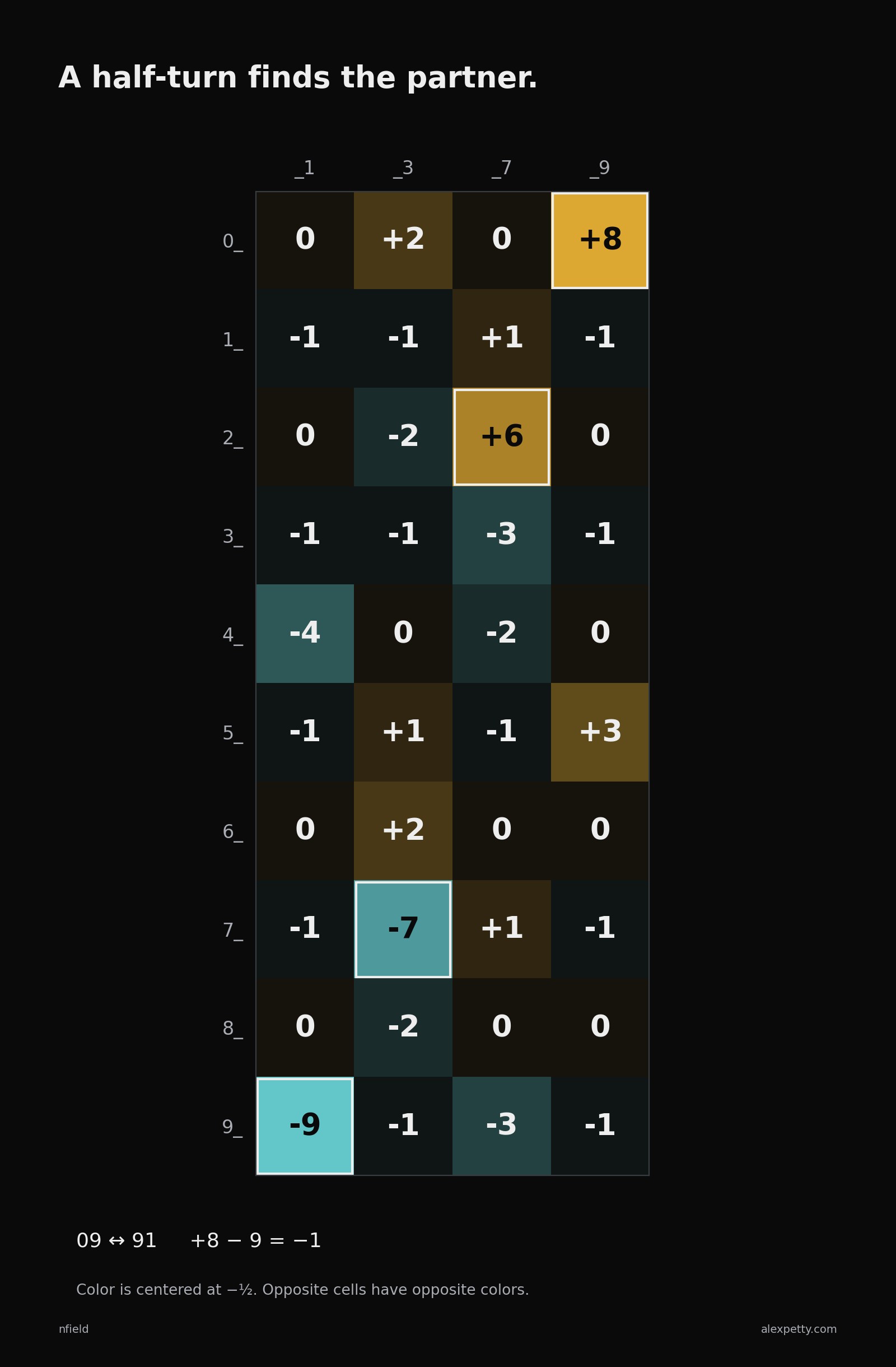
There are forty possible prime endings. Arrange them by their tens and units digits.
The forty integers, as data
Choose the tens digit at the left and the units digit across the top. A row labeled zero includes endings , , and .
| Tens | 1 | 3 | 7 | 9 |
|---|---|---|---|---|
| 0 | 0 | 2 | 0 | 8 |
| 1 | -1 | -1 | 1 | -1 |
| 2 | 0 | -2 | 6 | 0 |
| 3 | -1 | -1 | -3 | -1 |
| 4 | -4 | 0 | -2 | 0 |
| 5 | -1 | 1 | -1 | 3 |
| 6 | 0 | 2 | 0 | 0 |
| 7 | -1 | -7 | 1 | -1 |
| 8 | 0 | -2 | 0 | 0 |
| 9 | -9 | -1 | -3 | -1 |
To compute an entry, let be the ending and let run through . Define
Then for primes with ending . The floor differences count the numerators in each slice, and since the final slice includes the endpoint , which is not a nonzero remainder, we subtract one. Writing contributes to each of the ten slices and to , and those contributions cancel.
One negative left in every pair
Turn the table halfway around. Ending meets , with entries and , ending meets , giving and , and ending meets , giving zero and . Every pair falls one short of zero.
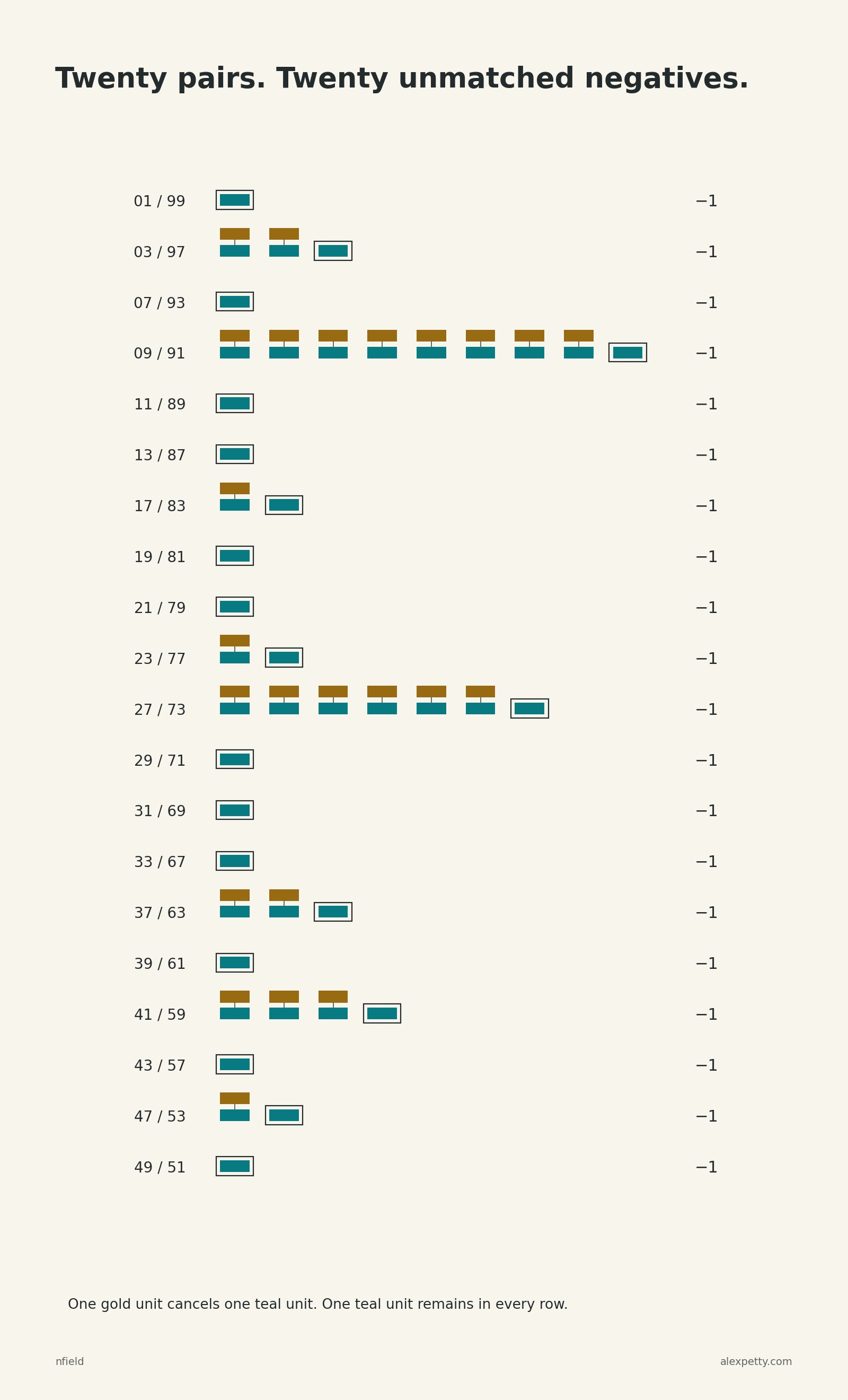
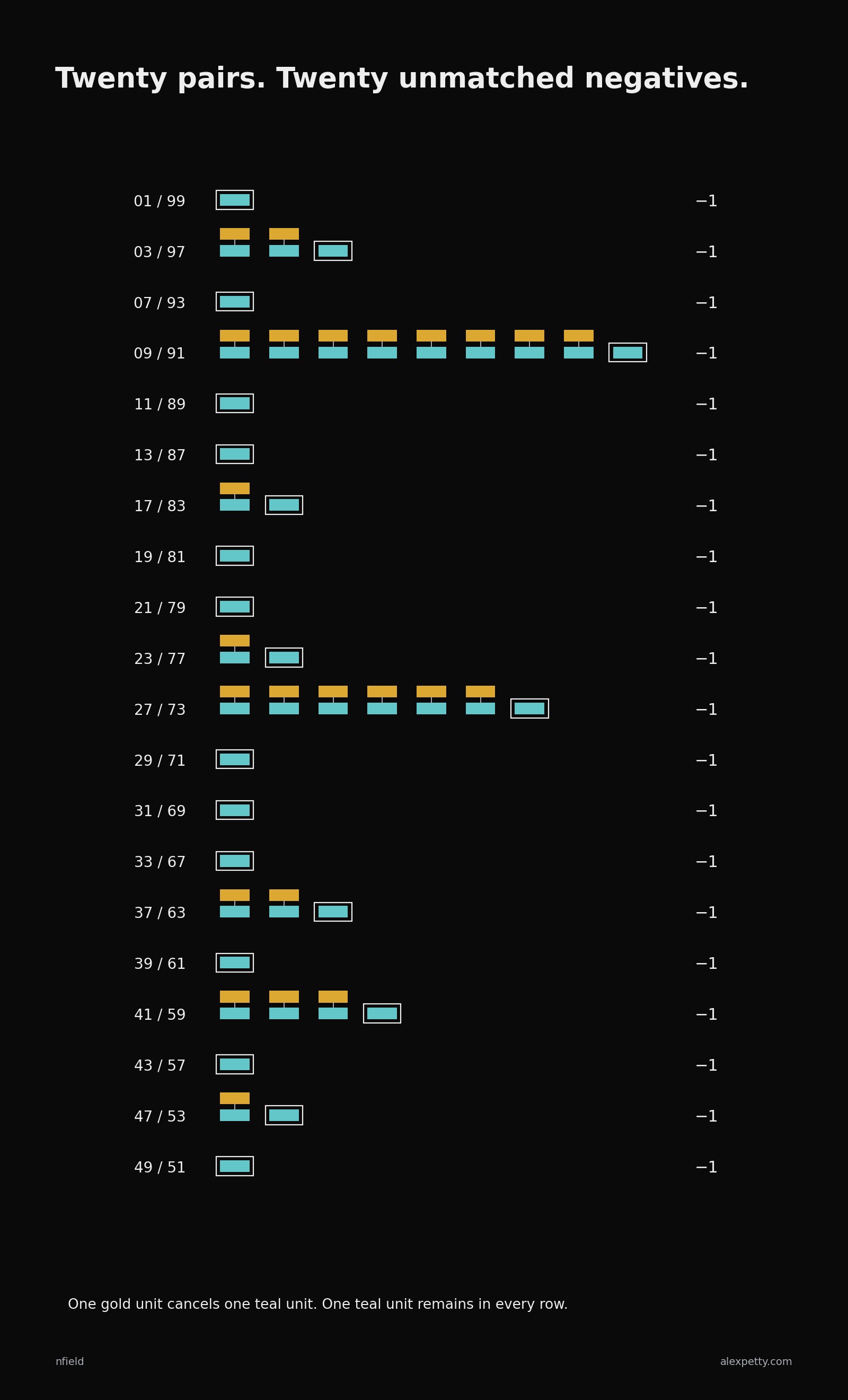
Twenty pairs leave twenty negatives, so the forty entries sum to and their mean is .
The endpoint count behind the missing one
Use the floor differences above. For each of the eight interior matching slices, neither endpoint is an integer, and
The slice at zero contributes zero to the combined count and the slice at ninety-nine contributes two, so eight ones, a zero and a two total ten. Meanwhile,
Each table entry also contains its own minus one, so adding the two formulas for gives . That proves the reflection rule without inspecting the forty answers individually.
The extra places in the bins
The opening sum subtracts the constructive mean, not just . That mean is
The extra term tends to . The four final digits give , so the limiting corrections are , with mean .
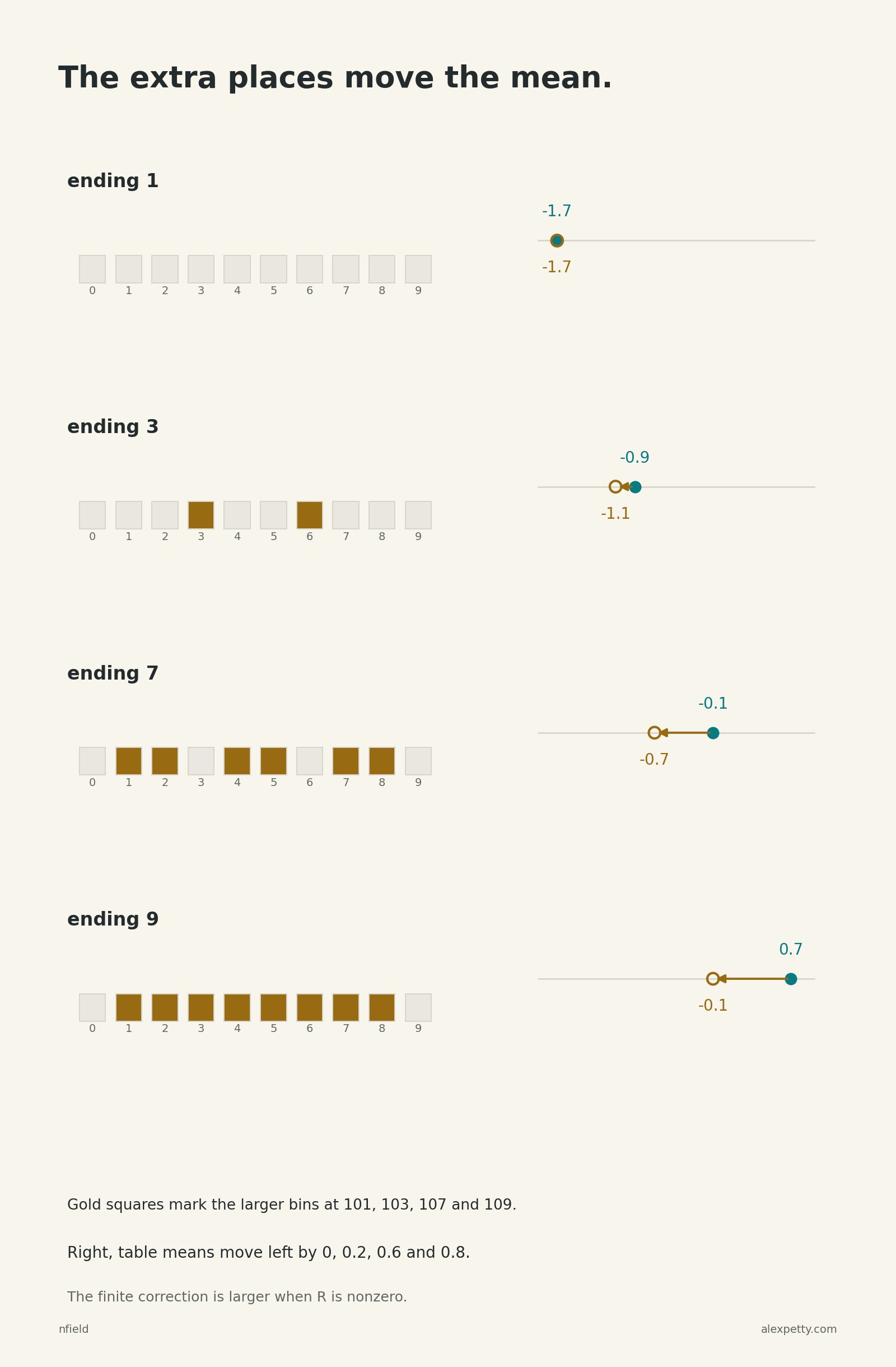
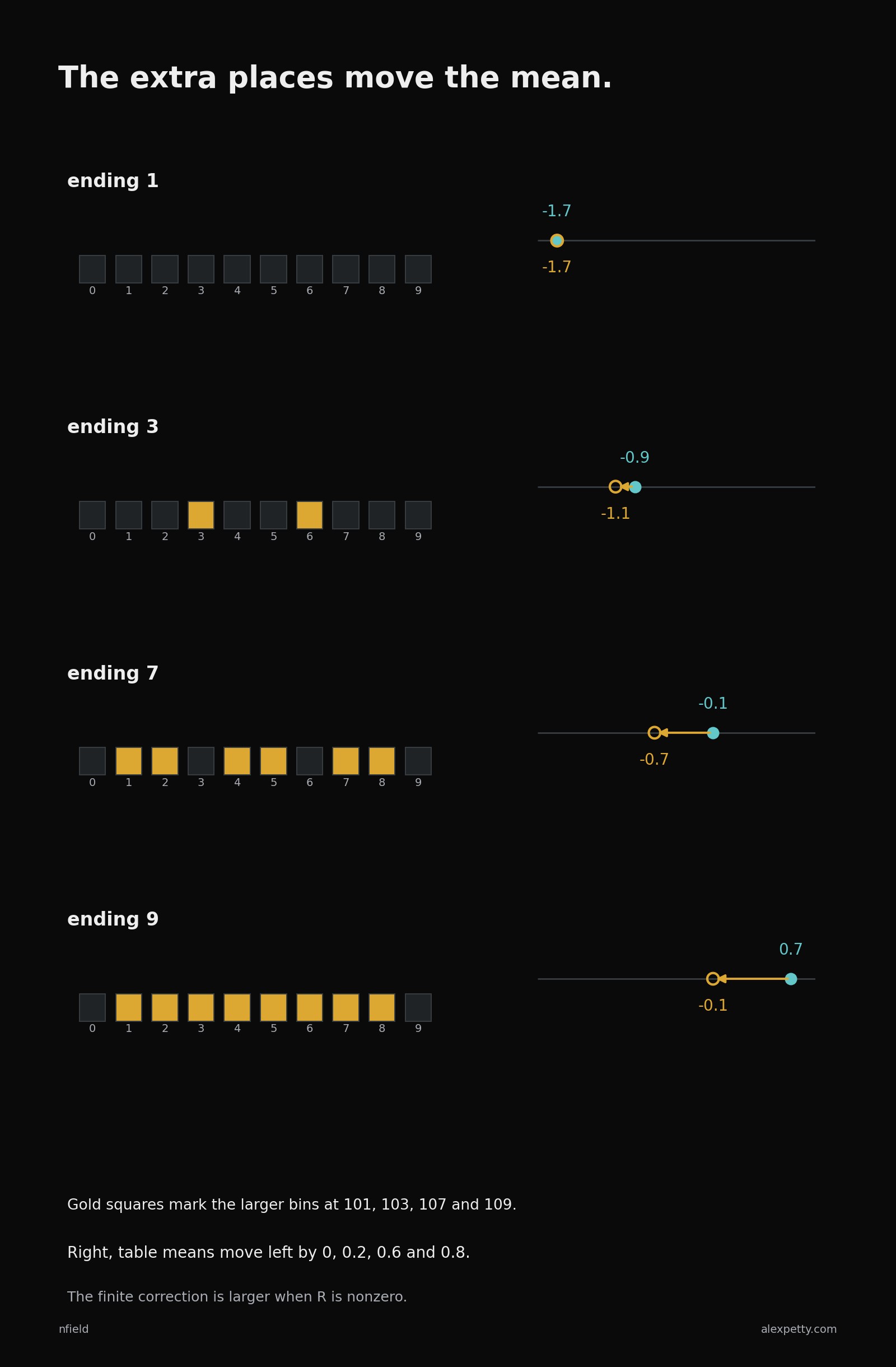
The reflection contributes minus one half and the larger benchmark subtracts another four tenths.
That is the coefficient, and the finite table supplies all of it.
Forty copies of the same growth
The table fixes the bias, and what remains is how much reciprocal-prime weight each ending receives.
Let add over primes above one hundred, up to , ending in . Mertens’ theorem in arithmetic progressions gives
Each class has the same leading growth, a class-dependent constant and an error tending to zero. That is the classical input, supplied by Williams’ theorem, not a conclusion drawn from the collision data.
Give ending its limiting deviation . The forty values have mean , so they sum to , and multiplying each class’s prime sum by its value and adding, the growing parts contribute
The forty constants give one constant, and the forty vanishing errors still tend to zero.
One correction remains. The exact deviation differs from by a quantity of order , so after the extra division by its terms are of order and their absolute sum converges. The finitely many primes below one hundred change only the constant too.
Write for the original weighted sum. We have proved
The raw sum tends to negative infinity, though its path need not go down at every step.
The exact correction and the small primes
The finite correction splits as
Thus , where . For , dividing by gives a term bounded by a constant times , which proves absolute convergence of the correction and not merely that its individual terms tend to zero.
The sum starts at thirteen, and its twenty terms through ninety-seven form a fixed finite contribution, so no claim about those small primes is needed to establish the coefficient at infinity.
Nine tenths in every term
Add to each deviation before dividing by its prime. The forty limiting coefficients now sum to zero, their copies of cancel exactly, and only constants, vanishing errors and the convergent correction remain, so the centered sum converges.
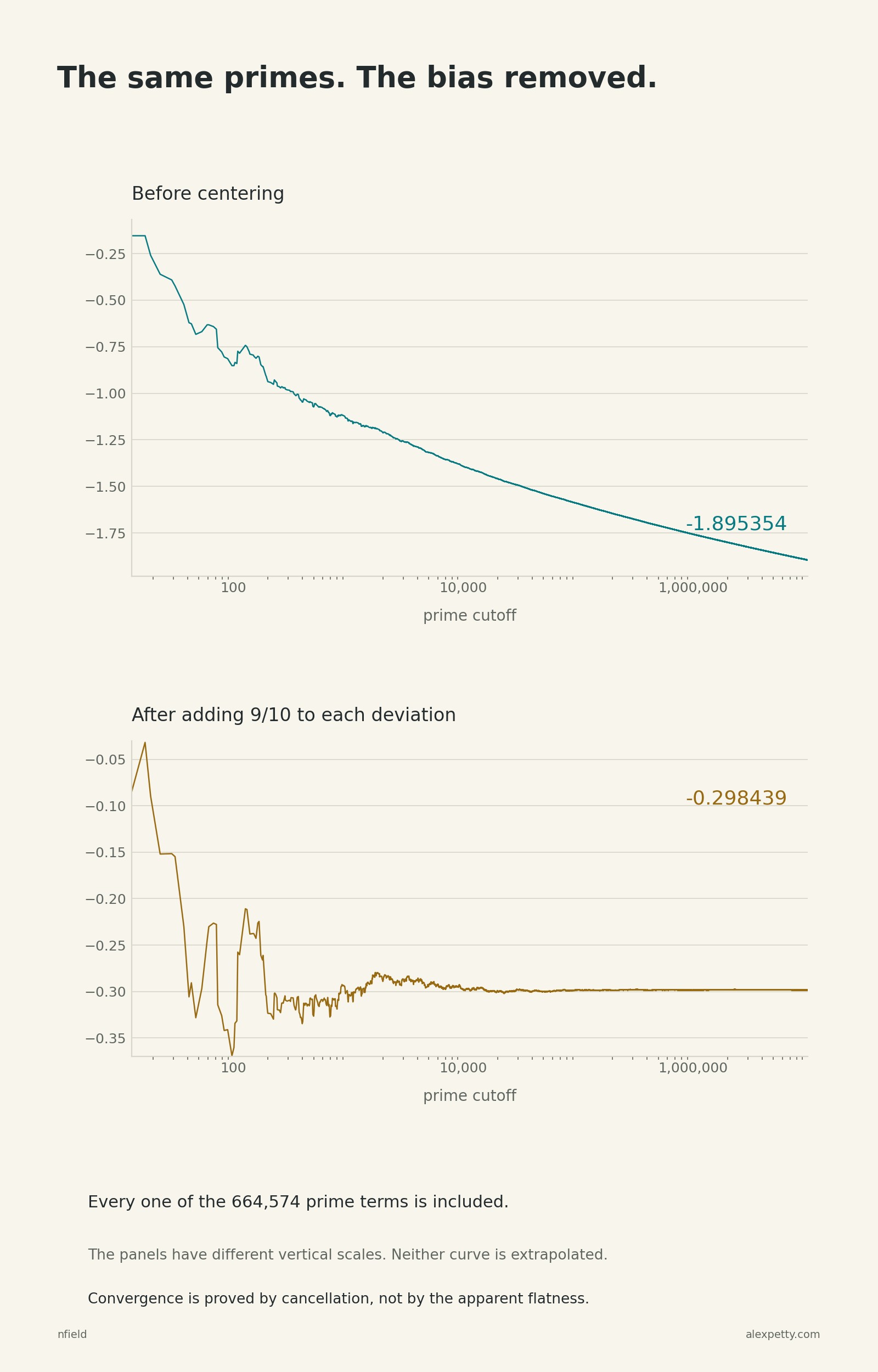
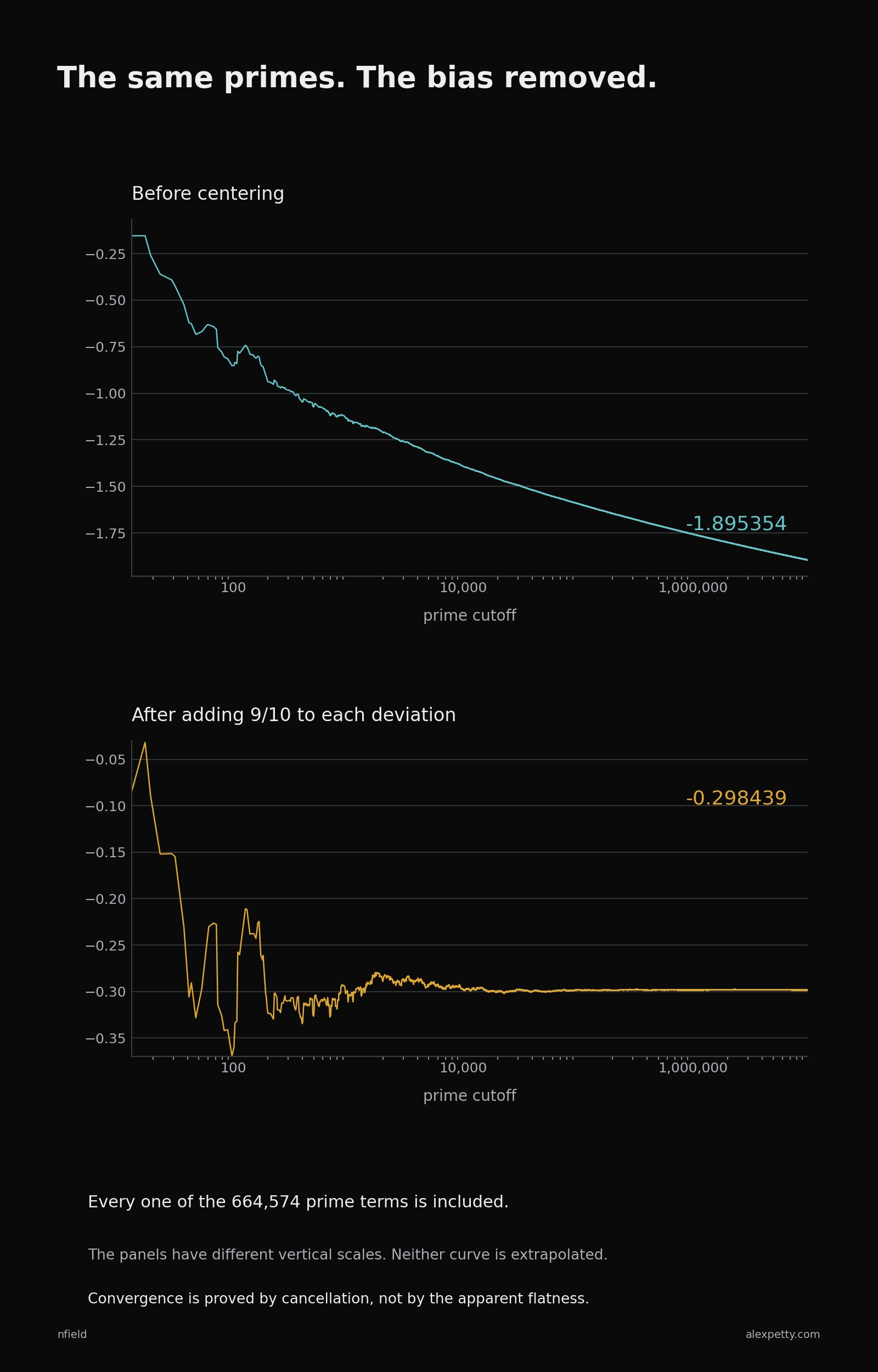
At the last plotted prime the centered value is about , a finite value rather than a certified evaluation of the limit. Convergence comes from the cancellation above, not from how level the curve looks.
The checkpoints and two different constants
| Terms | Last prime | Raw | Centered |
|---|---|---|---|
| 1000 | 7951 | -1.367764 | -0.295916 |
| 10000 | 104779 | -1.596580 | -0.298594 |
| 100000 | 1299811 | -1.773479 | -0.298335 |
| 664574 | 9999991 | -1.895354 | -0.298439 |
All eligible primes below ten million are included. Integer collision counts and rational corrections are exact, and the accumulated decimals use long-double arithmetic and are rounded here.
Adding to the raw sum is a different centering. Its last value is about , not . The difference is
which tends to a nonzero constant. Both procedures remove the drift, but they do not produce the same limiting value.
At the largest plotted cutoff, is only about , because the additive constant is still visible, and extrapolating that ratio is a poor substitute for counting the finite table.
The signed contrast loses its drift too
Average each column of the table and subtract its limiting correction.
| Ending | Table mean | Correction | Deviation |
|---|---|---|---|
| 1 | -1.7 | 0.0 | -1.7 |
| 3 | -0.9 | 0.2 | -1.1 |
| 7 | -0.1 | 0.6 | -0.7 |
| 9 | 0.7 | 0.8 | -0.1 |
The signed recipe in The Character Structure of the Collision Fluctuation keeps endings one and nine and reverses three and seven. The combined family means on its two sides are equal.
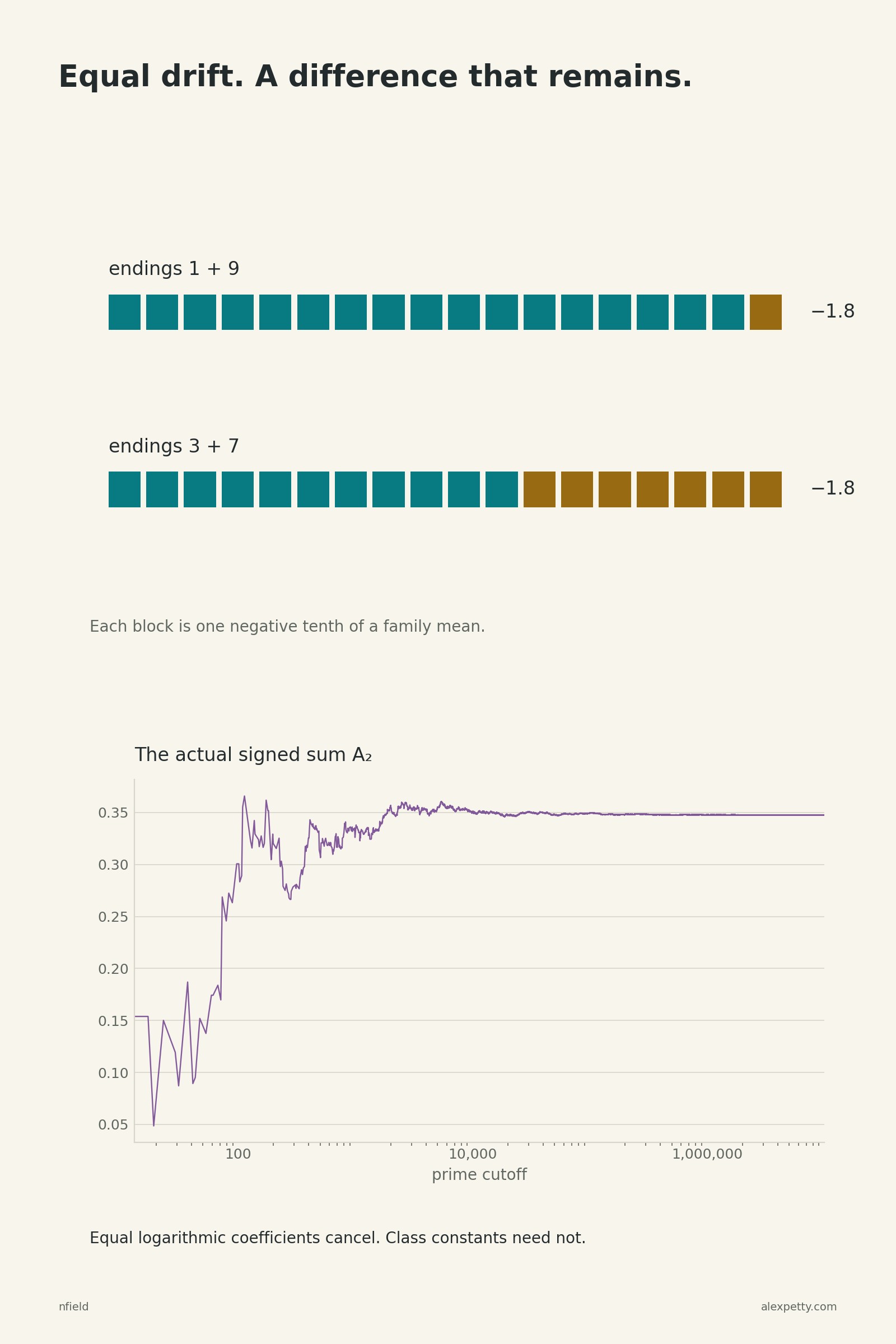
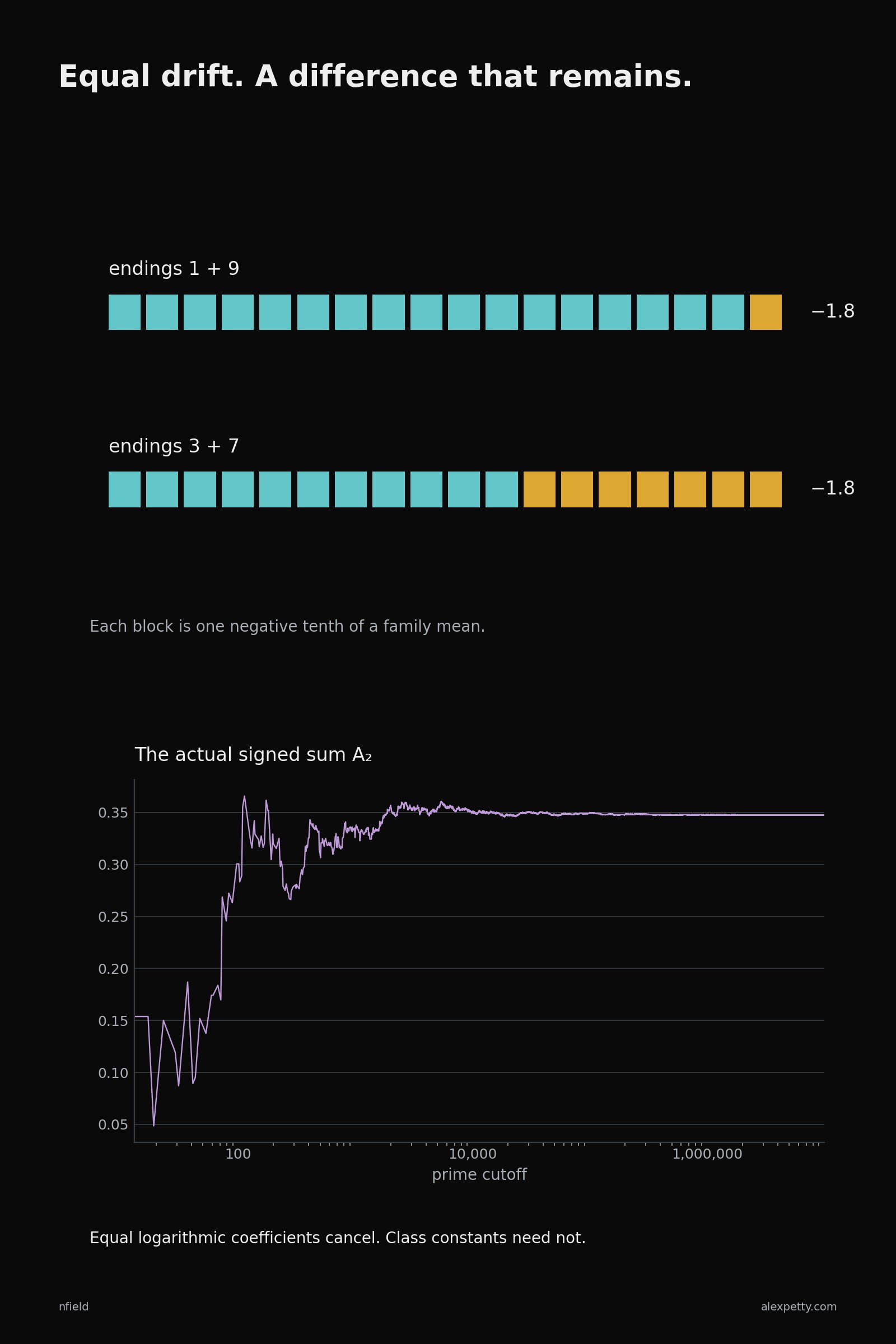
Each final-digit family receives one quarter of the leading prime harmonic growth, these equal coefficients cancel in , and the same argument proves convergence of this particular contrast as well.
Its remaining value includes class constants, the finite correction and the initial primes, so it is not merely a vanishing error. Nor does this calculation say that every character component converges. The real part of , for example, compares the unequal family means at endings one and nine.
The decimal coefficient belongs to a general rule. In every fixed base , reflection leaves a table mean of and the mean correction is , so the drift coefficient is . The Collision Fluctuation Sum proves this for each fixed base.
Turn the table in other bases


For base , write an allowed ending as , with coprime to . Rows list and columns list the allowed in increasing order. Negation reverses both orders, so every cell meets its partner under a half turn.
Color represents . The added half centers the reflection, division by the base puts all panels on the same scale, and a symmetric logarithmic color scale brings out the small deviations without hiding the large ones. Opposite cells have opposite colors, and every entry is present.


Base 256 has 32,768 entries and base 257 has 65,792. Their shapes differ, but the same half turn reverses every centered value, and the image opens at full resolution.
Seventeenths, the forty entries and the two sums
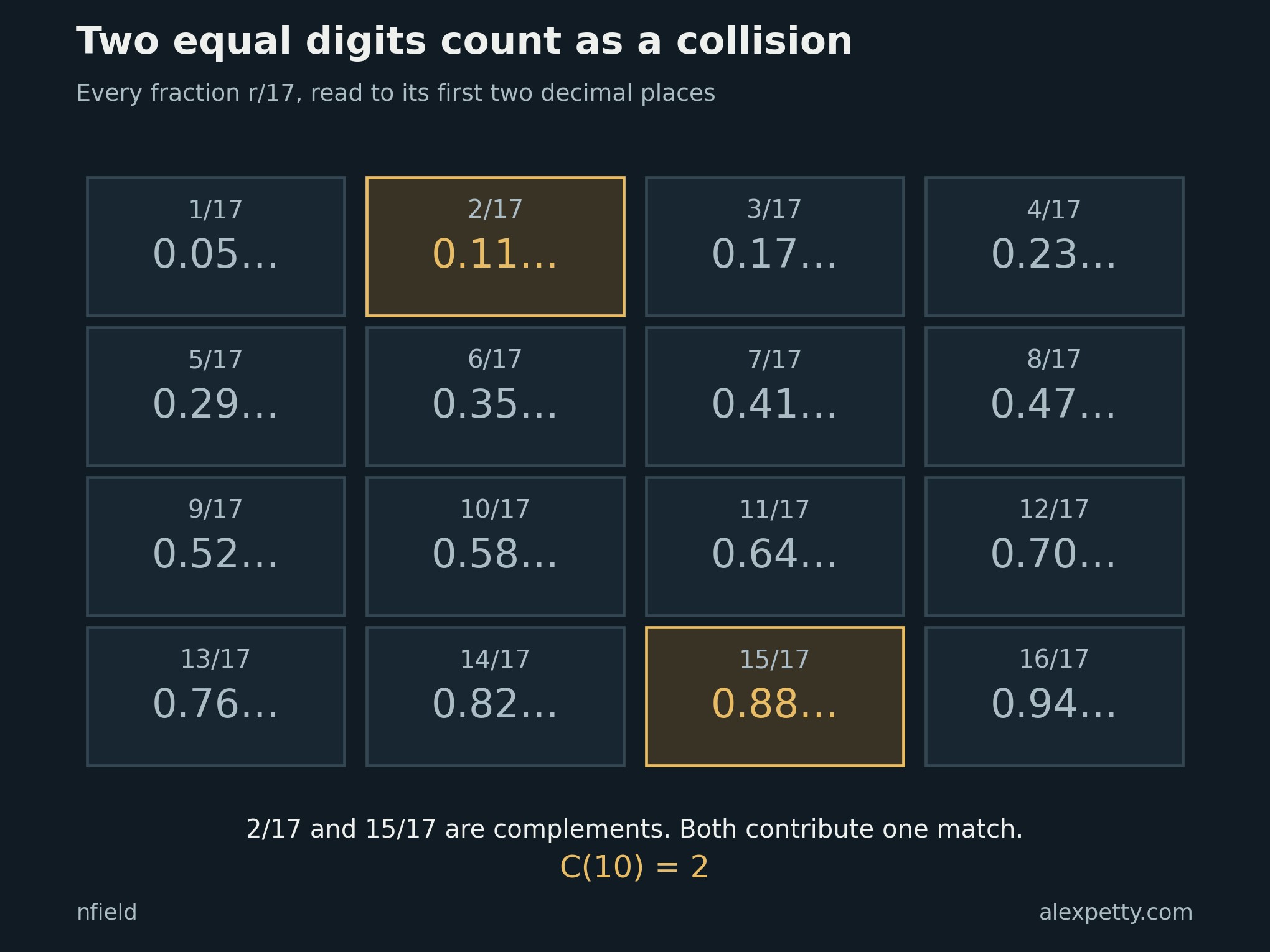
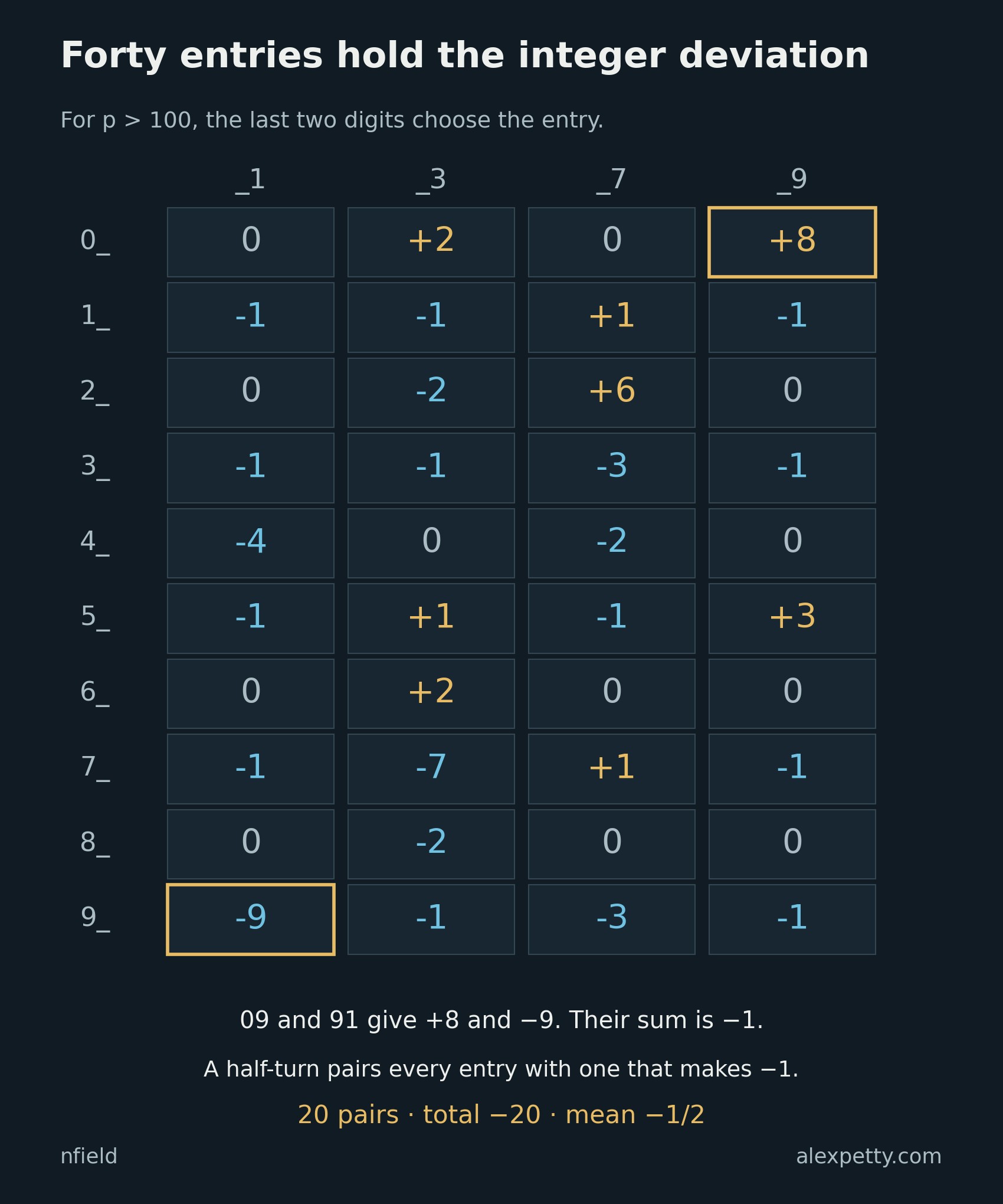
At and , eight positive units meet nine negative ones and one negative is left over, and every reflected pair in the table leaves the same deficit. Those twenty deficits, with four tenths more from the extra places in the bins, make up the whole of the minus nine tenths, a coefficient the primes below ten million still only hint at.
Discussion
Sign in to join the discussion.