Avoidance
The Collision Spectrum and the L-Function Landscape

Averages of over families of Dirichlet characters are classical objects in analytic number theory, closely tied to class numbers. At the single modulus twenty-five, one fourth-power average of that kind can be computed exactly from long division, a fixed-modulus identity that rests on a cyclotomic relation special to base five. Add the fourth powers of over the eight primitive odd characters modulo , eight values of infinite series, and they total exactly . The number underneath it is , the sum of the squares of twenty fractions in the centered base-five collision table.
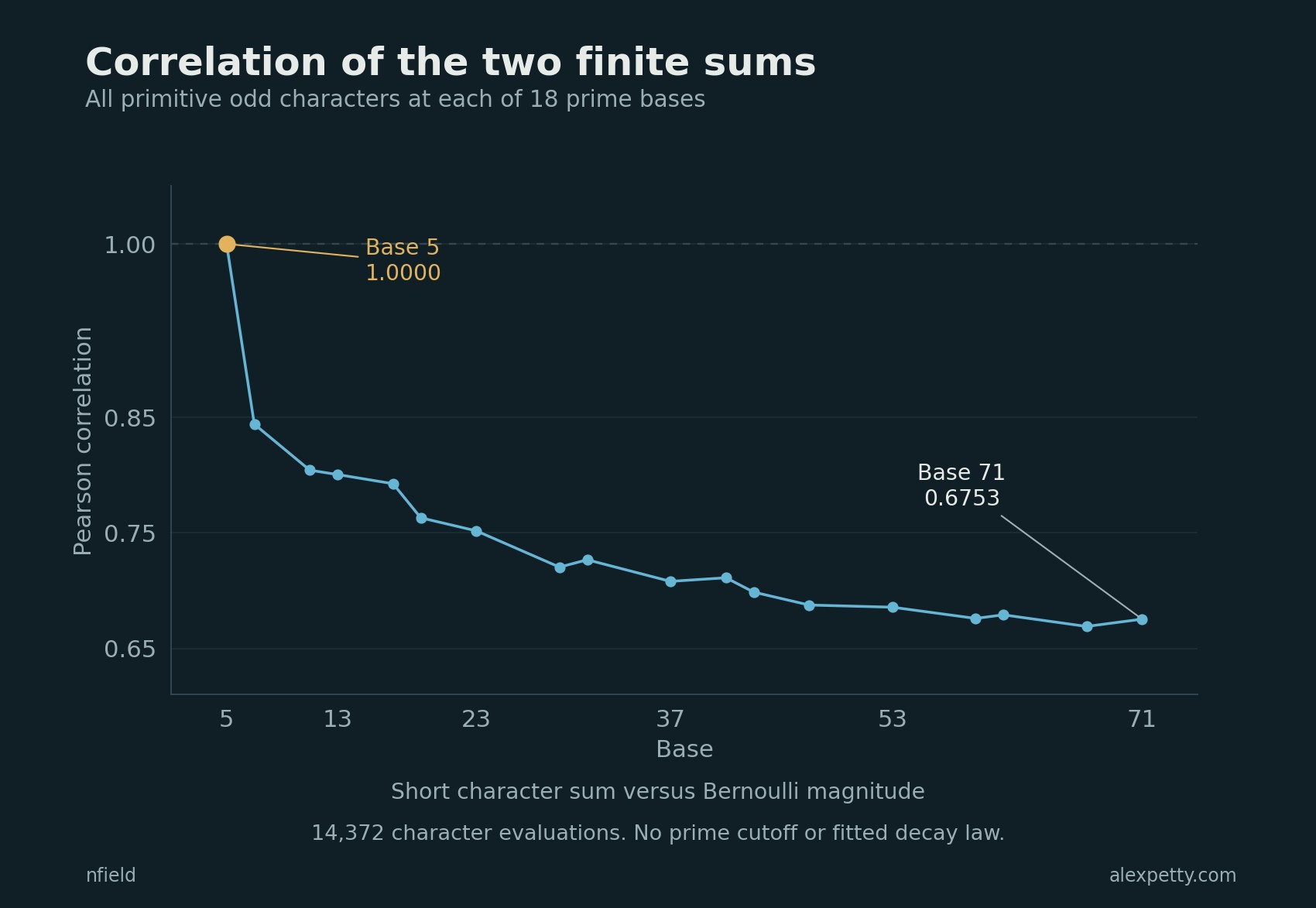
The comparison in The Spectral Repulsion set each collision coefficient against a sum over primes. Inside a single coefficient there is a cleaner structure. It factors exactly into two finite sums. One is a generalized Bernoulli number, which is up to a known constant, and the other is a four-term character sum from the diagonal of equal digit pairs. At base five the two factors are locked in a fixed ratio of . Every coefficient is then a fixed multiple of , and squaring the table turns into the fourth moment. At larger bases the lock loosens. The correlation between the two factors falls from at seven to at seventy-one and stays positive across all eighteen bases checked.
Twenty fractions
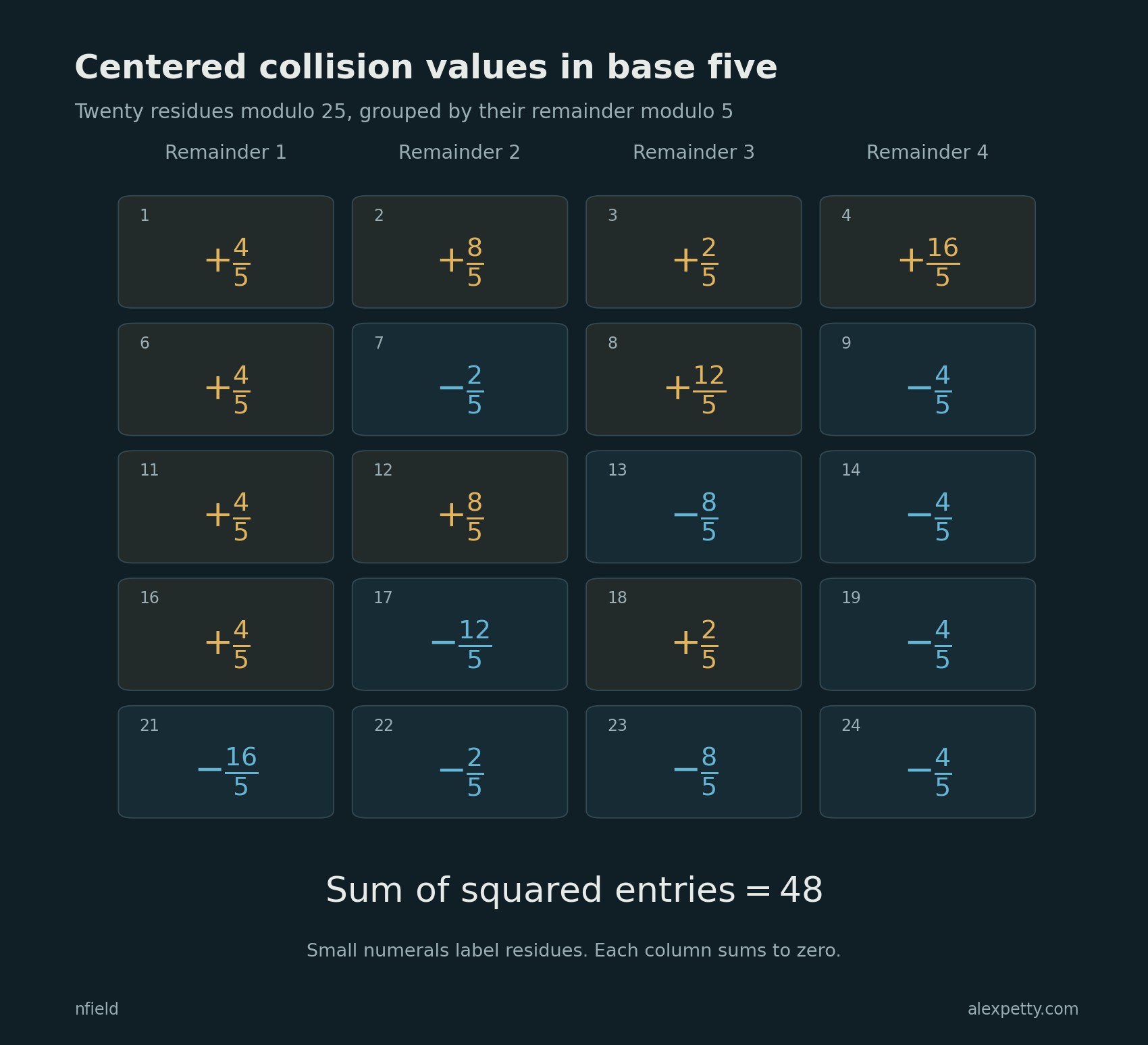
The table comes from The Centered Collision Sum. For each denominator, count the fractions whose first two base-five digits agree, take away the smaller bin’s size, and then subtract the average for the denominator’s final-digit family. For primes past the result is fixed by the remainder modulo , so twenty entries cover them all.


The four columns are the four remainders modulo five, and each one sums to zero, teal against violet. Squaring throws the signs away, so the cancellation stops helping. The first column has four copies of and one at , and that single violet cell supplies most of the column’s . The second and third columns give apiece and the fourth another . The row of squares at the bottom sorts the twenty squared entries by size, from four small squares at to the two large ones at , and together they add to
The twenty entries, ready to add
| Quotient | Remainder 1 | Remainder 2 | Remainder 3 | Remainder 4 |
|---|---|---|---|---|
| 0 | (at 1) | (at 2) | (at 3) | (at 4) |
| 1 | (at 6) | (at 7) | (at 8) | (at 9) |
| 2 | (at 11) | (at 12) | (at 13) | (at 14) |
| 3 | (at 16) | (at 17) | (at 18) | (at 19) |
| 4 | (at 21) | (at 22) | (at 23) | (at 24) |
The first column contains four copies of and one . Its sum of squares is
The second gives
Reflection supplies the other two. The entry at is the negative of the entry at , so their squares agree.
Eight patterns out of twenty
A Dirichlet character modulo gives each allowed residue a complex number of size one, and it respects multiplication. Since generates all twenty allowed residues, the character’s value at settles everything, and there are twenty choices, . Comparing a character with the table gives its Fourier coefficient,
where the bar reverses the phase and is the set of residues not divisible by five.


Each row of the figure is one character, its colors cycling through the phases as the powers of two go by. Twelve rows are faded, and the bars beside them are empty. Ten of those characters give and equal values. The table gives those two residues opposite values, so the coefficients cancel. Two more are constant down each column of the table, and every column sums to zero. The eight bright rows are the primitive odd characters. Odd means reflection reverses their sign, and primitive means a prime’s remainder modulo five isn’t enough to know their value. Their bars are far from equal. Characters and carry the longest, and the shortest, and in the dial underneath each conjugate pair mirrors across the horizontal axis.
Twenty terms and four
Each of those eight coefficients factors into two finite sums. The first runs over all twenty residues,
and it is the generalized Bernoulli number . The name is classical, and the definition on the page is an ordinary finite sum. The second comes from the digit boundaries. In base five the two-digit words with equal digits are , , , and , which are the integers , , , and . Adding up the change in the character across each of those five intervals gives a sum , and reflection folds it in half,


In the figure the gold cells mark the diagonal, the five places with matching digits. Beneath it, for the character with , the left path adds twenty weighted arrows that wander out and back before landing at . The right path adds only four unit arrows, the character at , , and , and reaches . The coefficient multiplies the two,
phase included. The proof turns each floor difference in the collision count into the same Bernoulli factor, after which the endpoint and bin-size terms cancel and only the diagonal factor is left. The Collision Spectrum and the L-Function Landscape carries out that accounting for every odd prime base, with replaced by .
The five boundary intervals and the exact product
Extend the character by zero at multiples of five. With ,
The left endpoints are . Reflection modulo sends the right endpoints to . Oddness reverses their character values. Thus
The factor at rotates the short sum without changing its length. For the character with , the two factors and their product are approximately
The product formula gives the same coefficient as averaging all twenty weighted table entries directly.
The infinite series enters
For a nontrivial character the values cancel enough for
to converge, and the classical functional equation ties that value to the finite Bernoulli sum. For primitive odd characters modulo ,
So one factor in every collision coefficient carries an -value, and the other is still the four-term sum from the digit diagonal. At most bases both have to be carried along.
Five has an extra relation. For each of its eight characters
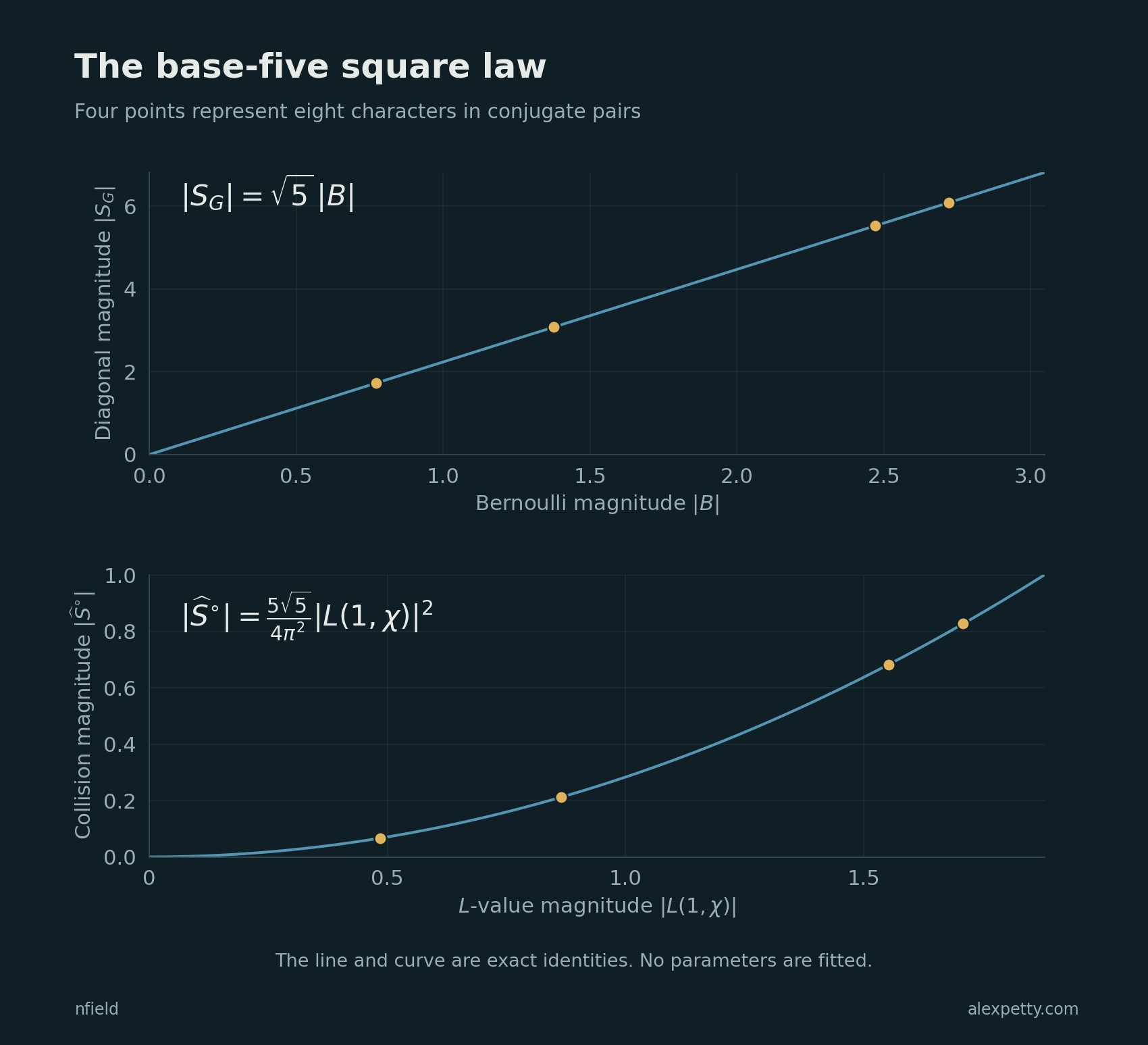
and the arrows above bear it out, since is times . With the two factors locked together, both carry the same -value, and their product is a square,


Each conjugate pair gets a square whose side is , from for the pair and up to for and . Below, the four pairs sit exactly on the curve , and nothing about the curve is fitted. Powers of a twentieth root of unity give both finite sums, and an exact polynomial identity forces the ratio of their sizes.
The identity behind the square law
Put . For the eight primitive odd characters, runs through the primitive twentieth roots of unity. Since and , the four-term sum is
Pairing opposite residues in the Bernoulli sum and reducing powers with gives , where
The exact certificate is
with
At , the right side is zero and . Hence . Together with , this gives the claimed factor .
| Exponents | ||||
|---|---|---|---|---|
| 1 / 19 | 2.470410 | 5.524004 | 1.552204 | 0.682328 |
| 3 / 17 | 2.720773 | 6.083832 | 1.709512 | 0.827636 |
| 7 / 13 | 0.772914 | 1.728289 | 0.485636 | 0.066791 |
| 9 / 11 | 1.377344 | 3.079834 | 0.865411 | 0.212099 |
Each row names a conjugate pair by its exponents in . The two characters in a pair have equal magnitudes. The decimals are rounded, while the identity is exact.
Spend the forty-eight
Fourier coordinates describe the same table in a different basis, and the total squared size doesn’t change. With the averaged coefficients used here, Parseval gives


The top panel is the table’s twenty squared entries, and the tall bars at and are the two copies of , squared. The bottom panel is the same spread over the eight surviving characters, twenty times each squared coefficient. The pair and takes about apiece and the pair and about , while and barely register. Each coefficient already contains , so every bar in the bottom panel is a fixed multiple of . Keeping the normalization visible,
and the exact fourth moment at modulus is
It adds the eight fourth powers outright, with no averaging. The fractions supply , the Fourier normalization supplies , and the factors of come in through the classical -value identity. Nothing is estimated from a sample of primes.
The weighted moment at every odd prime base
Write . The factorization and Parseval give
The diagonal factor is the weight in this second moment. Base five’s additional identity turns that weight into another squared -value, producing the unweighted fourth moment above. The general factorization does not remove the diagonal factor.
The line opens into a cloud
At seven the two factors no longer sit on one line. The comparison covers every odd prime base from five through seventy-one, all primitive odd characters, counting conjugate partners separately.


Each panel plots the Bernoulli size across and the short-sum size up, both divided by their own root-mean-square size so the panels share a scale. At five the four pairs sit on the dashed diagonal. At seven nine pairs scatter to both sides of it, at nineteen eighty-one pairs form a loose band, and at seventy-one the pairs make a cloud that still leans along the diagonal. The correlation drops from at five to at seven and at seventy-one. The curve at the bottom shows the decline isn’t steady, since its four teal segments are steps up, from twenty-nine to thirty-one, thirty-seven to forty-one, fifty-nine to sixty-one and sixty-seven to seventy-one.
Both magnitudes come from finite sums, so these are complete families with no prime cutoff to push further. The open question is how the four-term sum, then the six-term sum, then the longer initial character sums behave against the Bernoulli factor as the base grows, and eighteen families don’t settle it.
All eighteen families, at full resolution


| Base | Characters | Correlation |
|---|---|---|
| 5 | 8 | 1.000000 |
| 7 | 18 | 0.844014 |
| 11 | 50 | 0.804214 |
| 13 | 72 | 0.800442 |
| 17 | 128 | 0.792520 |
| 19 | 162 | 0.763013 |
| 23 | 242 | 0.751734 |
| 29 | 392 | 0.720323 |
| 31 | 450 | 0.726701 |
| 37 | 648 | 0.708004 |
| 41 | 800 | 0.711126 |
| 43 | 882 | 0.698702 |
| 47 | 1,058 | 0.687538 |
| 53 | 1,352 | 0.685638 |
| 59 | 1,682 | 0.675935 |
| 61 | 1,800 | 0.679046 |
| 67 | 2,178 | 0.669012 |
| 71 | 2,450 | 0.675317 |
The two magnitudes are each divided by their own root-mean-square size within a family. This puts every panel on the same scale without changing its correlation. One dot represents a conjugate pair. The ledger counts both characters. The diagonal in each panel is a reference line of slope one.
Factoring the coefficient places the value at one inside it, beside a finite weight from the digit diagonal, and says nothing yet about the -functions elsewhere in the critical strip. At five the account is exact. Twenty squared fractions sum to , and times equals the sum of over the eight primitive odd characters modulo twenty-five.
The table, the square law and the ledger in their first drawings
Discussion
Sign in to join the discussion.