Spectra
The Cross-Alignment Matrix

The back of an old road atlas has a mileage chart, a triangle of numbers giving the distance between every pair of cities. The average of all those numbers tells you almost nothing about the country. The chart itself is enough to redraw the map, and there is a standard way to do it. Classical multidimensional scaling turns the distances into a table of inner products and reads the map off that table’s eigenvectors.
The Coherence Decomposition reduced the agreement among a denominator’s fractions to a single average. At thirteen that average is , and it can’t say which fractions agree or how the agreements are arranged. So here I keep the whole chart, one entry for every pair of fractions, and look at it the way that method does, through its eigenvalues. The chart turns out to be a table of inner products too, so none of its eigenvalues can be negative, and they carry the arrangement the average threw away. Seven has one eigenvalue level, thirteen has two, and seventeen has nine. The change from seven to thirteen lives entirely between thirteen’s two multiplication cycles, where neither cycle can see it on its own.
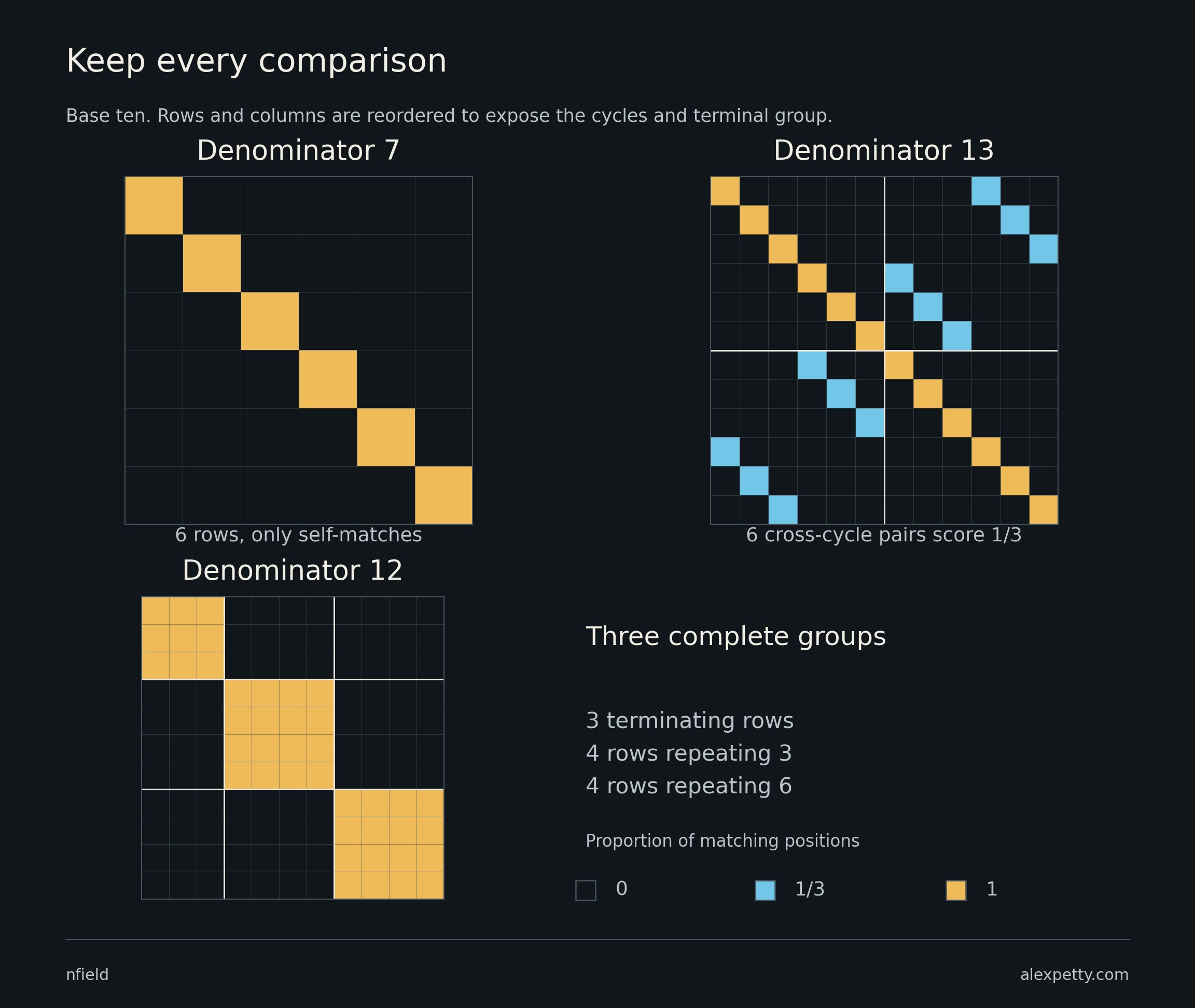
Start with the six fractions through . Compare every row with every other row, digit by digit, and put the proportion of matches in a square table. Each row matches itself perfectly, and no two distinct rows agree at any position, so the table has six ones down its diagonal and zeros everywhere else. In the language of linear algebra it is the identity matrix .
At thirteen, something appears off the diagonal.
 1/13 = 0.|076923|
11/13 = 0.|846153|
The third and sixth digits agree, so the square where these two fractions meet contains , and so does the square on the other side of the diagonal, where their order is reversed. Five other pairs do the same.
Three fields, three shapes
Call the table , the cross-alignment matrix for denominator in base . The row and column labels are the numerators through . Entry records the agreement between and .
As before, the digits stay on a common clock. Every row moves past the same clearing depth and is compared over a common period, and no row is rotated to agree better with another. Two terminating rows score one, and a terminating row paired with a repeating row scores zero.
Seven gives the identity, and thirteen gives an identity with six extra matching pairs. Twelve gives solid blocks. After two decimal places, its eleven rows fall into the terminating group of size three, the repeating threes of size four, and the repeating sixes of size four. Put each group together and the matrix becomes
where is an square of ones. Every comparison within a group succeeds and every comparison between groups fails.
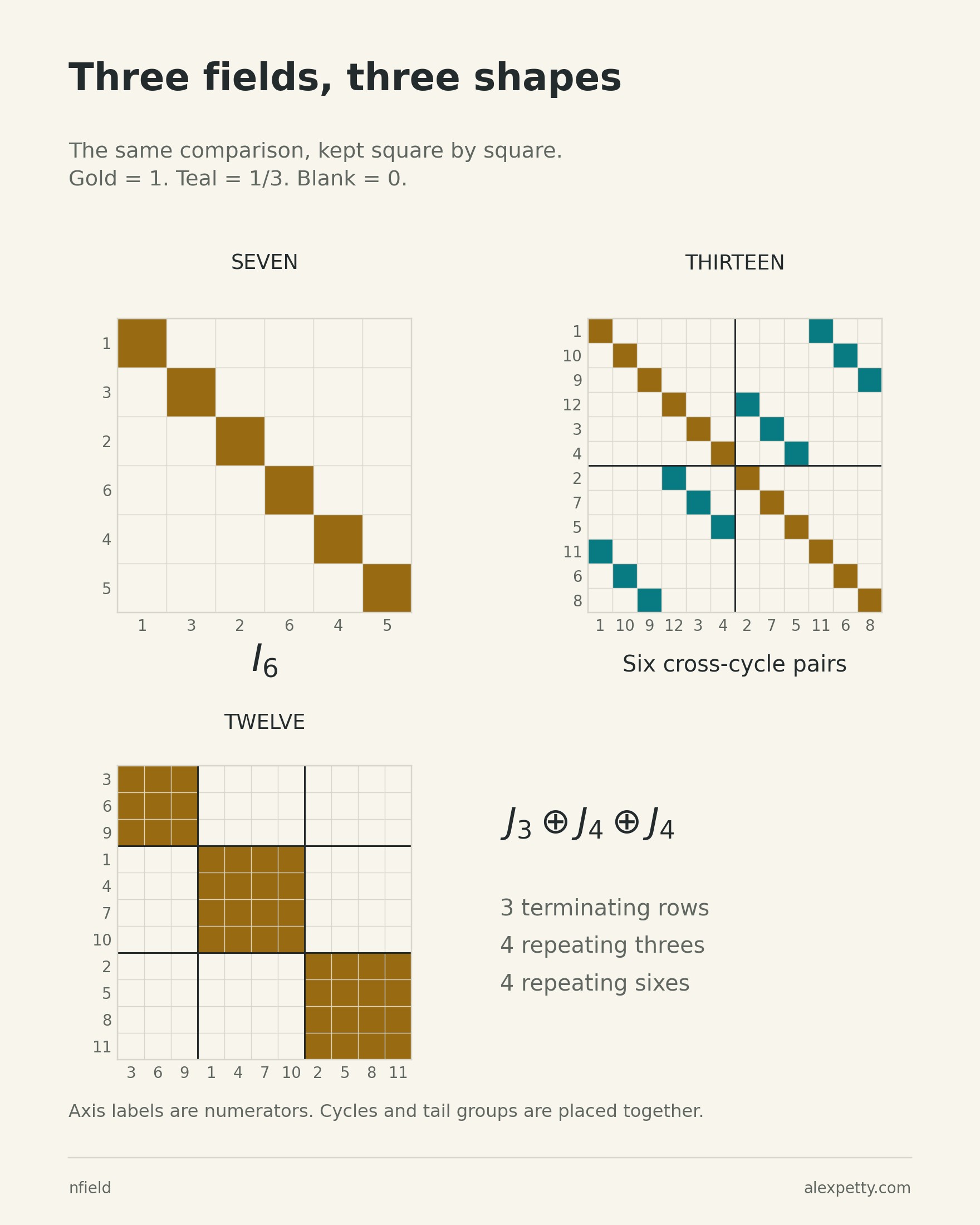
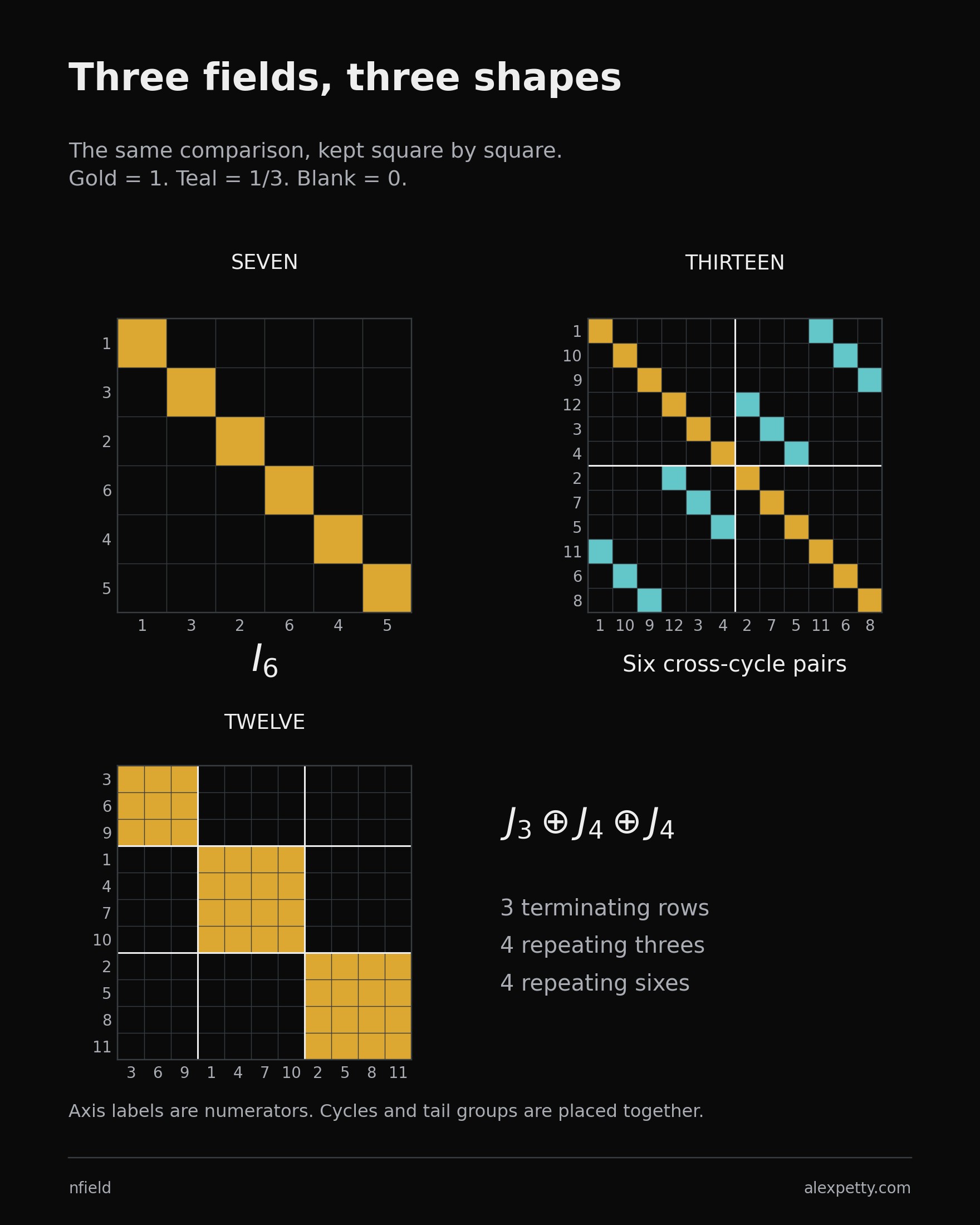
Reordering rows and columns together changes where the squares sit, but not which fractions agree. This modest freedom will make the arithmetic much easier to see.
The three averages, recovered from the table
For , the mean above the diagonal is . The symmetric mean below it gives the same number. Self-matches belong to neither average.
Recovering also requires the marked reference row and the termination convention. Write , where is coprime to the base and every prime factor of divides the base. If , the reference row of the matrix gives zero to each of the terminating rows. The reference score gives them full credit. Thus
Then . If , all rows terminate and both averages are one.
At twelve, the reference row sums to four. Add the three terminating rows and divide by eleven to recover . The off-diagonal mean is , leaving . Those are the counts from The Coherence Decomposition, and here they serve as checks on the table rather than the destination.
Ten slots per position
There is a reason these tables have well-behaved eigenvalues. Each is a table of inner products, a Gram matrix.
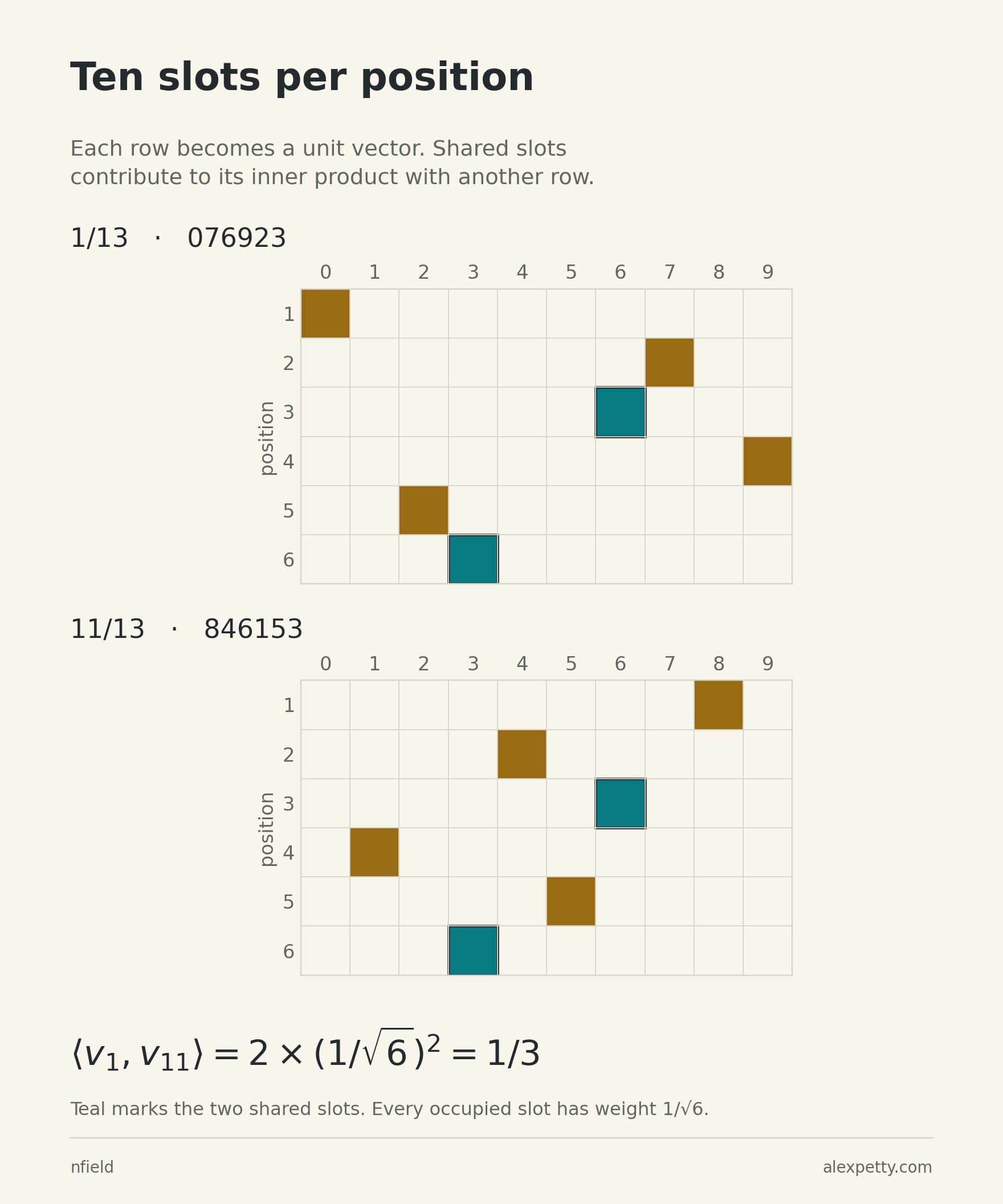
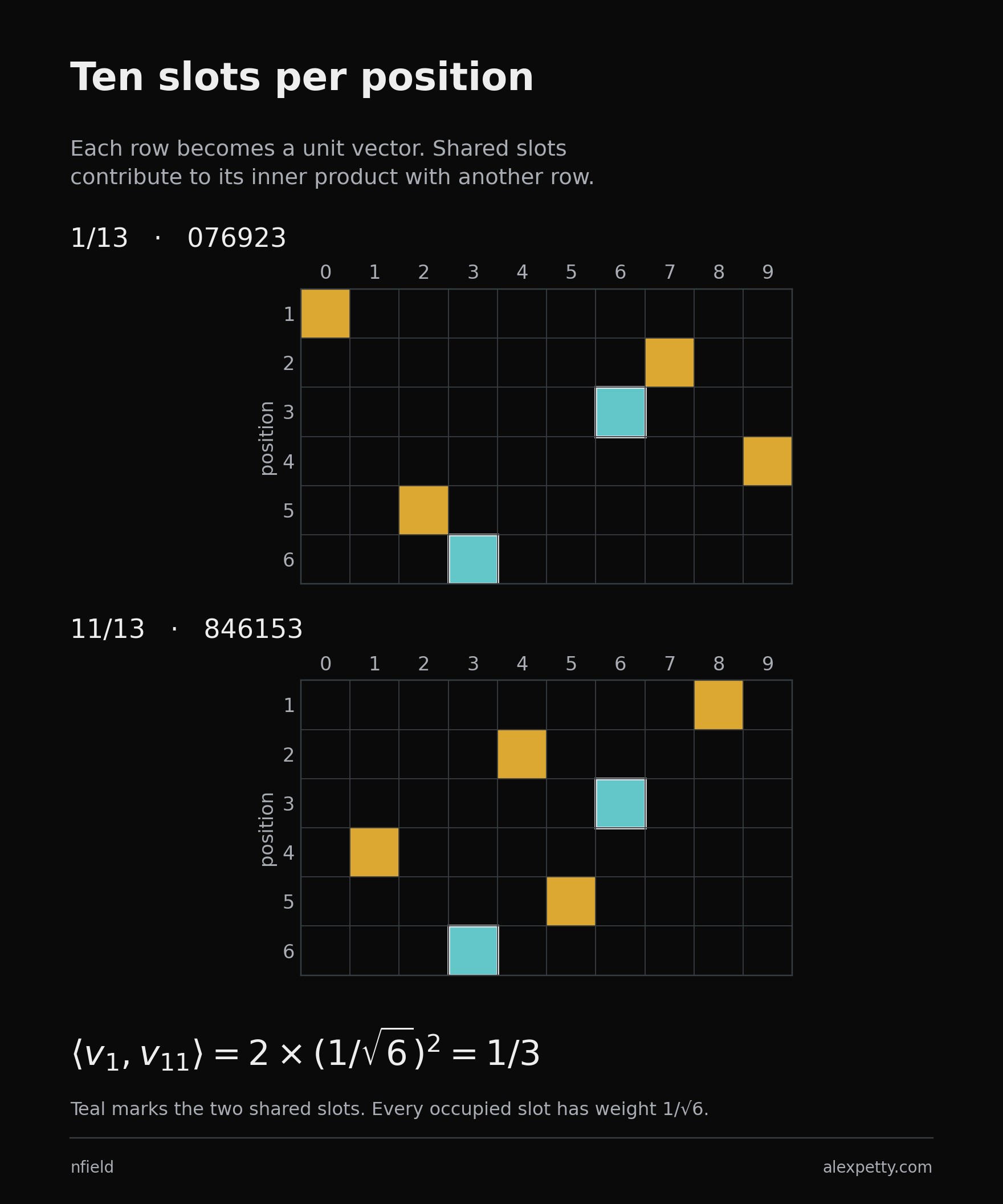
To build the vectors, give each decimal position ten slots, one for each possible digit. A six-digit word gets sixty slots. Occupy one slot at each position, according to the digit there, and give every occupied slot weight . The resulting vector has length one.
Two such vectors overlap only where both the position and the digit agree. For and , exactly two slots are shared. Their inner product is .
In base with common period , use slots and weight . All terminating rows receive the same separate unit vector, perpendicular to the digit slots, which carries out the termination rule exactly and keeps a terminated row from being mistaken for a row of repeating zeros.
The construction gives
Every vector has length one, so the diagonal entries are one. More importantly, a Gram matrix is positive semidefinite, which means its eigenvalues cannot be negative. We have reached a constraint on the whole spectrum without calculating a single eigenvalue.
For a prime not dividing , the identity case is precisely the digit-partitioning case of Digit-Partitioning Primes and the Alignment Formula.
At or below that boundary, different nonzero remainders always emit different digits, so their vectors occupy disjoint slots. Above it, two remainders must emit the same digit somewhere, which puts a positive entry off the diagonal. In decimal, eleven is the last prime with an identity matrix and thirteen is the first departure.
One pair, two directions
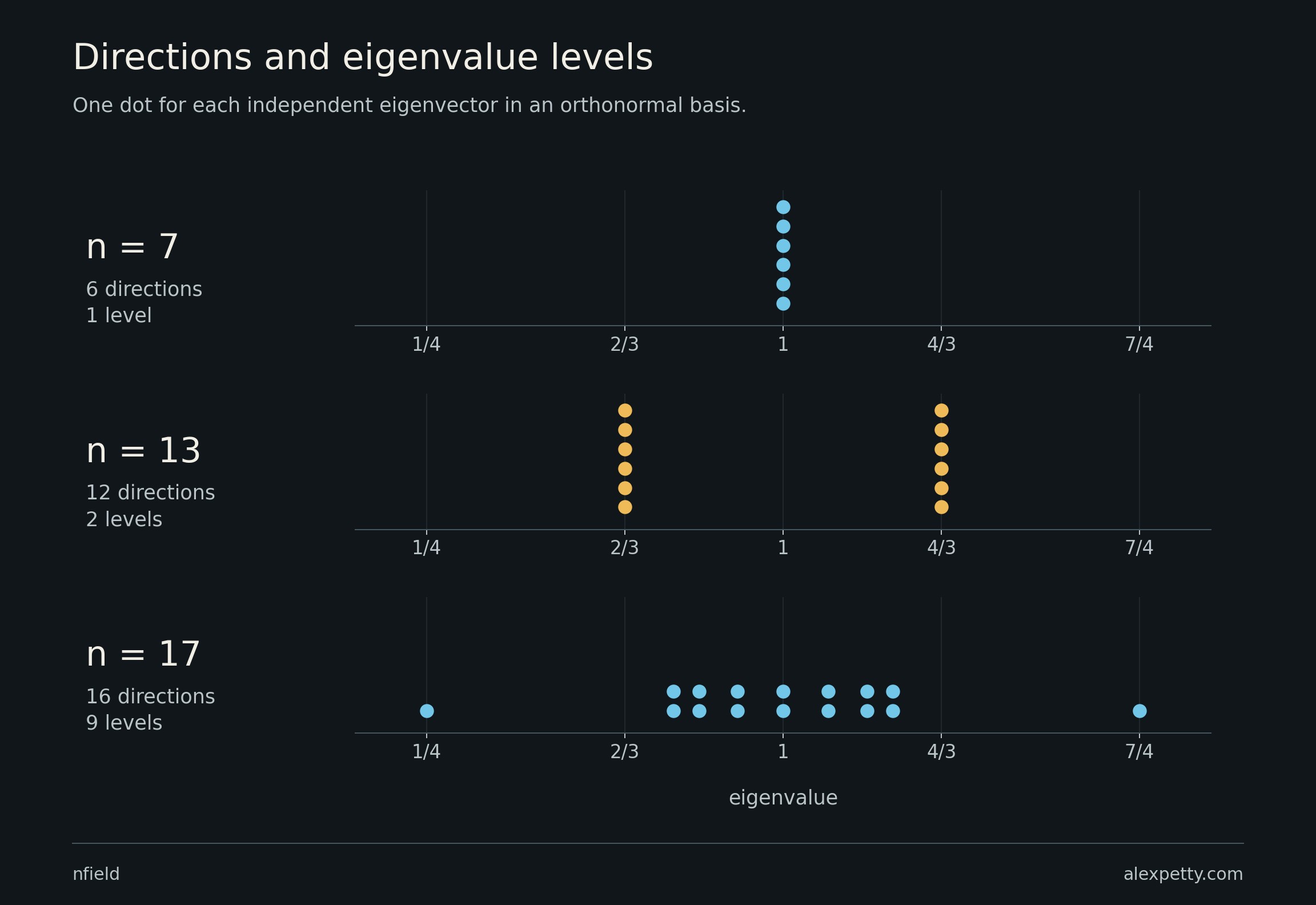
An eigenvector is a direction that a matrix scales without turning. Its eigenvalue is the scale factor. The identity at seven leaves every direction unchanged, so its six eigenvalues are all one.
Thirteen is only a little harder. Its six matching pairs are disjoint. Place the two members of each pair next to one another, and the twelve-row matrix separates into six copies of
Give the two rows equal weights and multiplication by raises both to . With opposite weights , the magnitudes shrink to and the signs stay as they were. The sum grows and the difference shrinks, but neither changes direction.
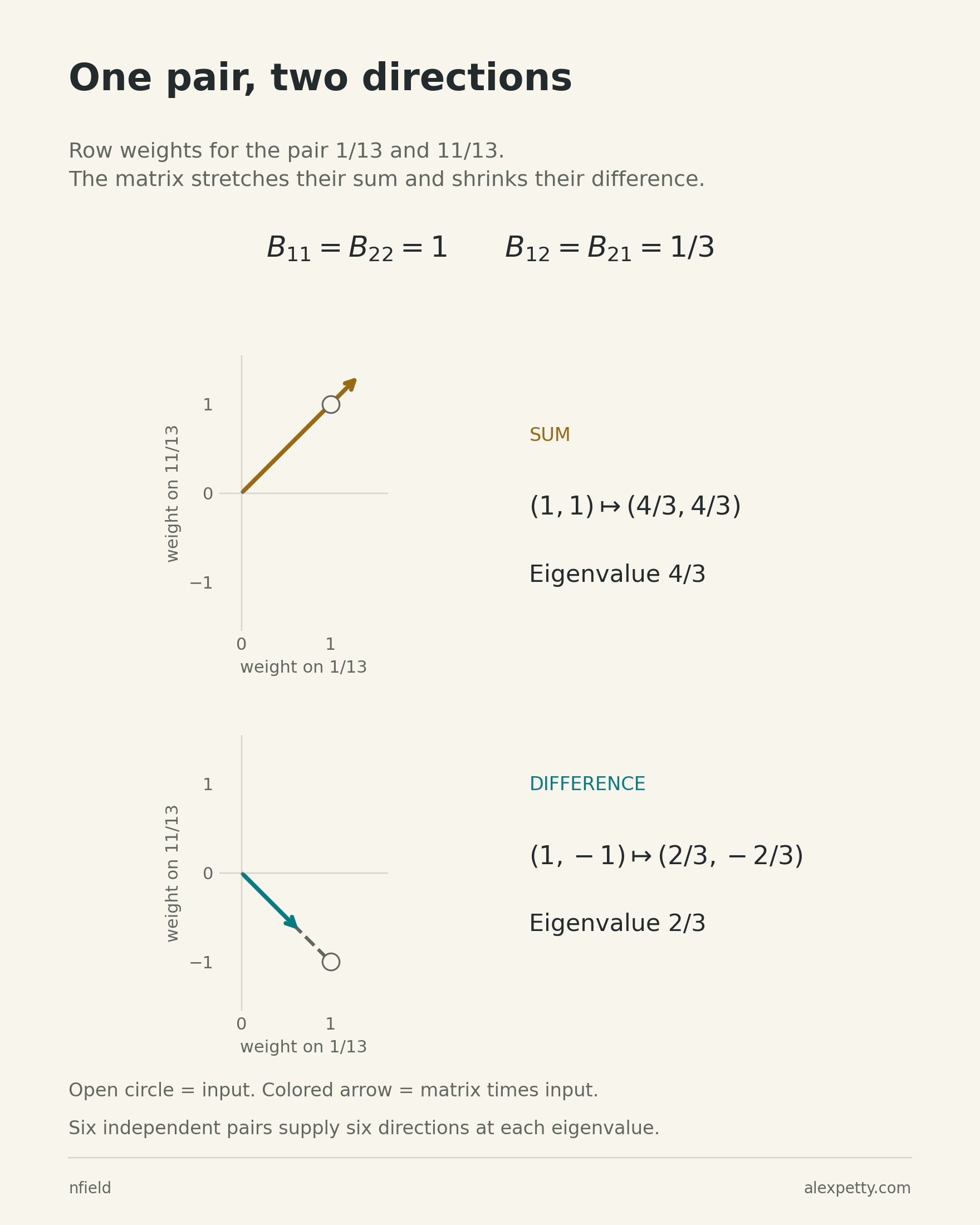
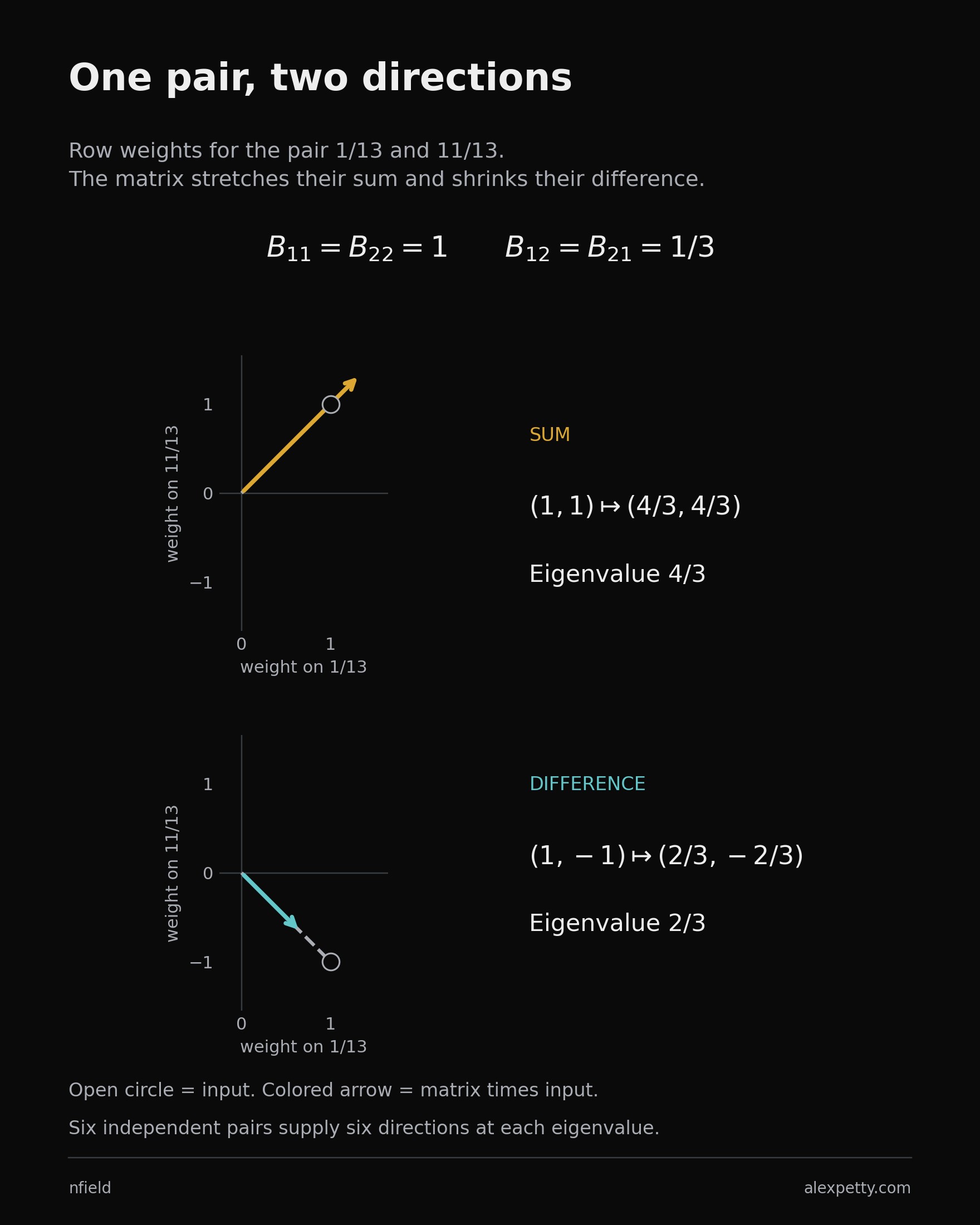
Each pair supplies one direction of each kind, so across six pairs the eigenvalues are six times and six times. All twelve directions survive, but the single level at seven has split in two.
Twelve behaves differently. Within each solid block only the sum of the row weights survives multiplication, and differences within a group disappear. The three blocks give eigenvalues 3, 4 and 4, and the other eight eigenvalues are zero, so eleven rows leave only three surviving directions.
The block spectrum for a digit-partitioning core
Take , where is prime, , , and every prime factor of divides . Group the rows by their eventual tails. The matrix becomes
For , its nonzero eigenvalues are once and repeated times. There are zeros. Multiplying the denominator by a larger supported factor adds rows within these groups, while the rank stays at .
At , the terminating block is absent and the matrix is . The rank there is .
Slide the six digits
The six-pair calculation settles thirteen’s eigenvalues. To understand why the pairs occur, return to long division.
Multiplying a numerator by ten modulo the denominator advances its repeating word by one place. At seven this visits all six nonzero numerators, so the six rows are the six shifts of .
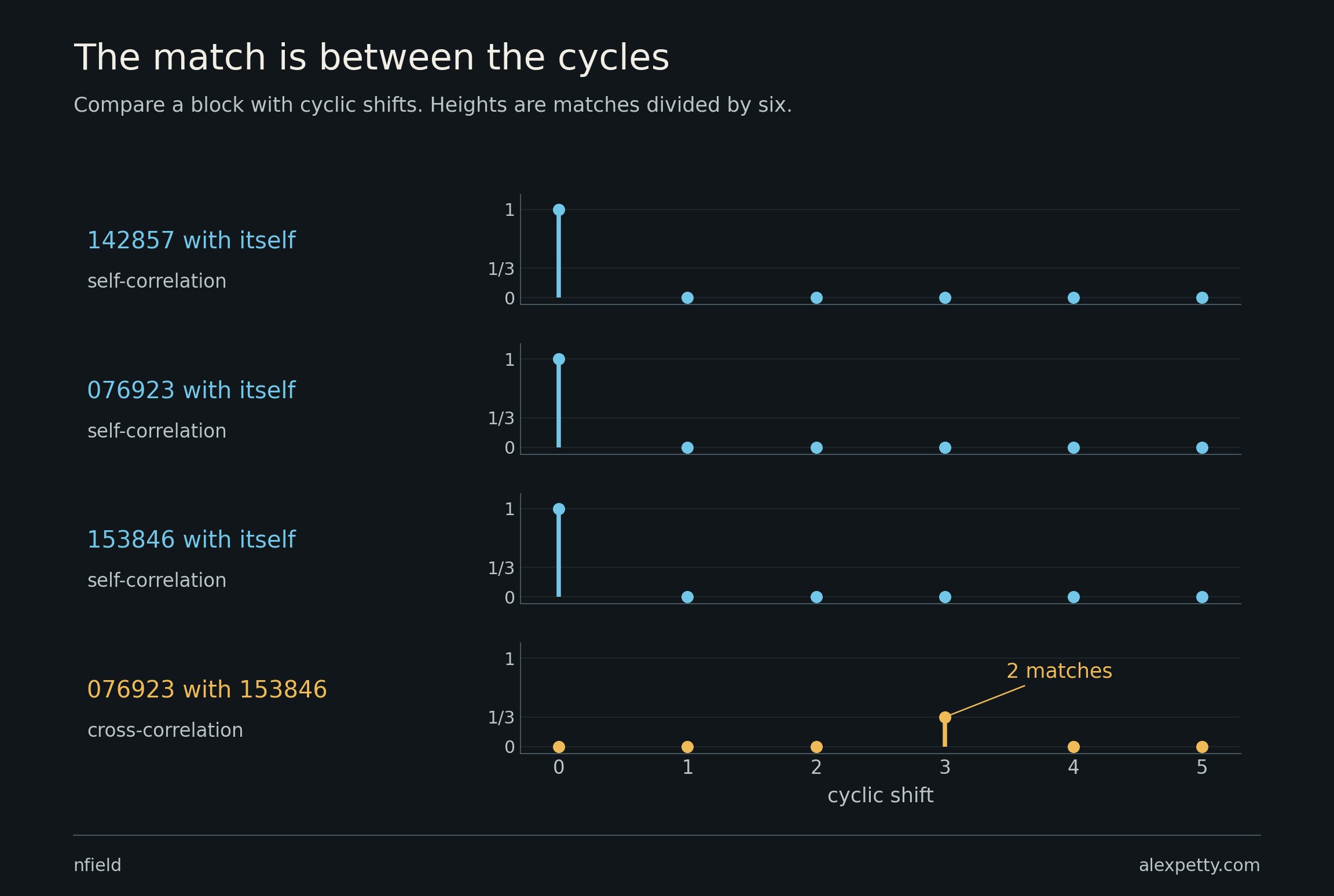
Slide that word against itself and count equal digits. At shift zero all six agree, and at every other shift none do. This list of six counts is its digit-equality autocorrelation. Divide by six and the list is
Its discrete Fourier transform is six ones, the spectrum of . Equality is the test throughout, and each digit has its own occupied-or-empty channel, just as in the slot construction.
Thirteen has two cycles, represented by and . Each word contains six distinct digits, so compare either one with its own shifts and the counts are exactly those at seven. Look only within a cycle and nothing has changed.
Now compare the cycles with each other. Shift three places and it becomes , the word for , whose third and sixth digits agree with . At every other shift there are no matches.
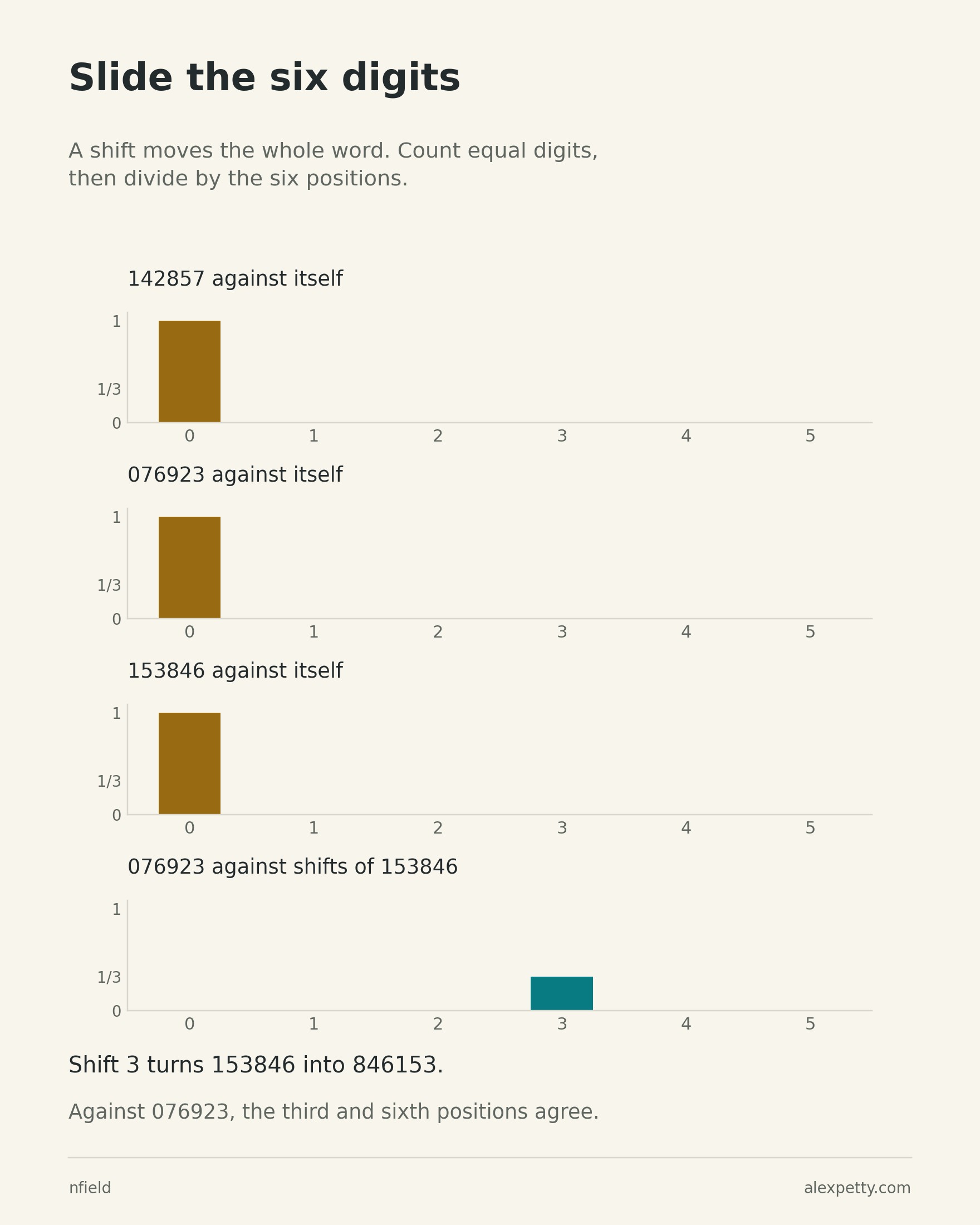
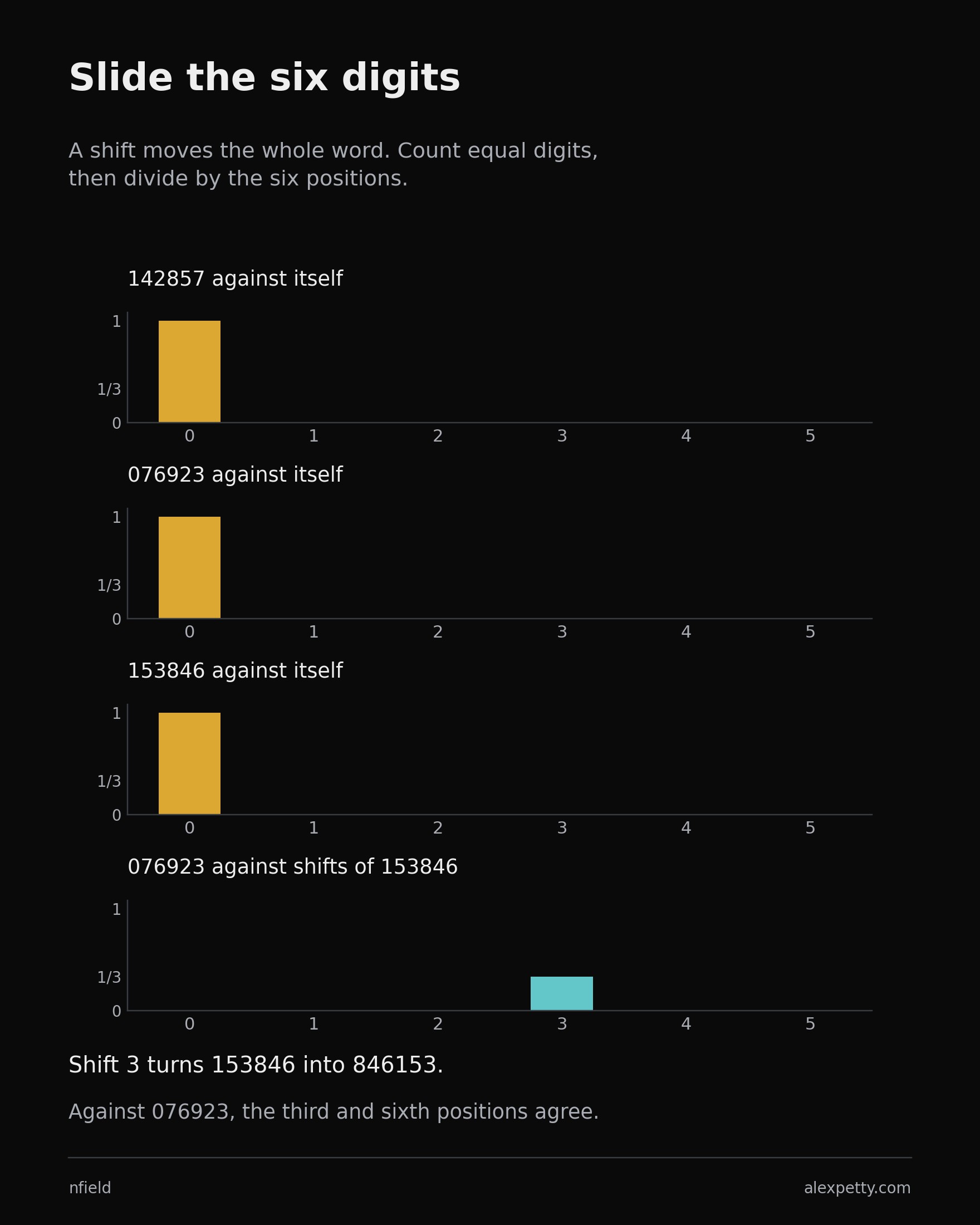
The change at thirteen lives entirely between the two cycles, where their individual autocorrelations cannot see it.
Two cycles, six small matrices
Order the numerators by those cycles.
 1, 10, 9, 12, 3, 4
 2,  7, 5, 11, 6, 8
The matrix now has four six-by-six blocks. The two diagonal blocks are , and the other two record the half turn that brings the matching digits together. If shifts six coordinates by one place, these blocks are .
The symbol here means that rows and columns have been reordered together. Each block is circulant, with successive rows obtained by cyclic shifts, and Fourier coordinates diagonalize those shifts. In frequency , a half turn contributes , leaving the small matrix
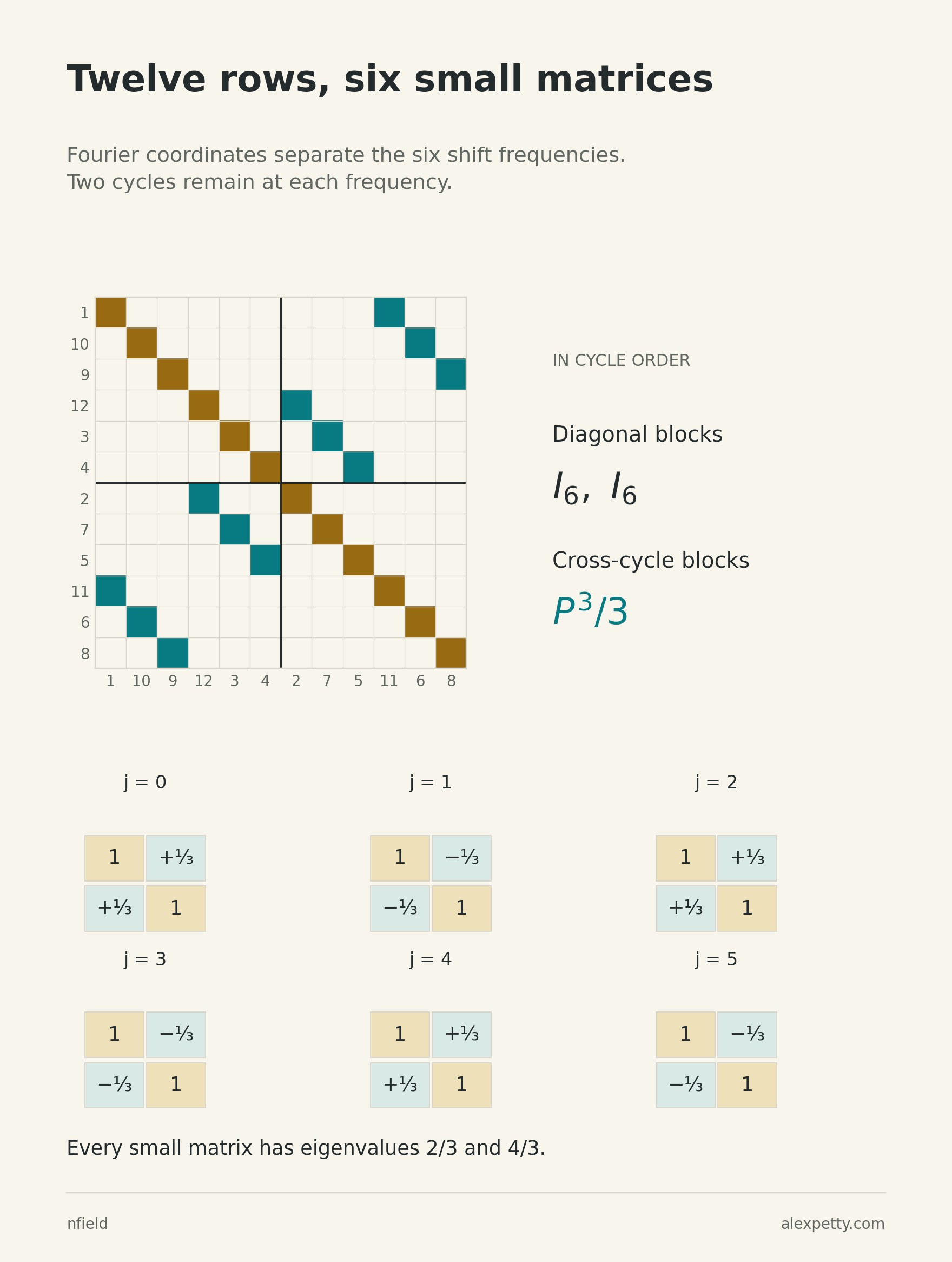
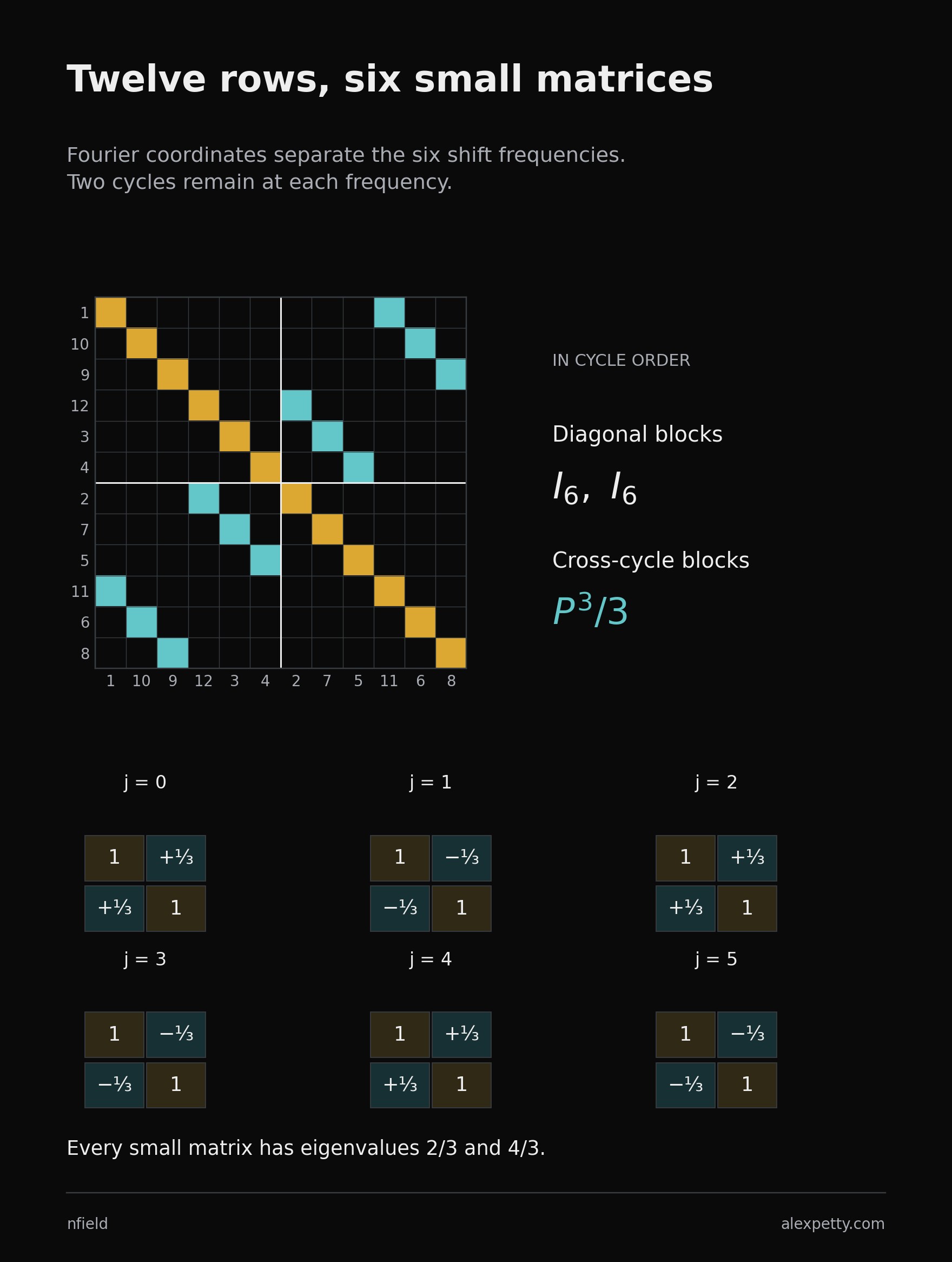
The sign alternates, but each has the same two eigenvalues, and . We recover the six-pair answer by a route that works beyond six isolated pairs.
For a general prime , let be the repeating period and the number of multiplication cycles. Arrange the matrix by those cycles. Fourier transformation reduces its circulant blocks to matrices of size . Together, their eigenvalues give the full spectrum.
No primitive-root assumption is needed. With only one cycle each small matrix is just a number, and with several cycles the cross-correlations stay in the calculation. Two cycles don’t generally mean two eigenvalue levels either. At thirteen the six frequency matrices happen to share their eigenvalues, and elsewhere the levels can vary with frequency.
The digit channels behind the Fourier calculation
For cycle and digit , let be one when position contains , and zero otherwise. Use the unnormalized Fourier transform
With a consistent Fourier convention, the frequency matrix has entries
This is another Gram matrix, now of complex Fourier coefficients. It is Hermitian and positive semidefinite. With one cycle, it reduces to the sum of the squared magnitudes of the digit-channel coefficients, divided by .
Sixteen directions, nine levels
Seventeen supplies one cycle, long enough for repeated digits to enter the word.
1/17 = 0.|0588235294117647|At shift zero all sixteen positions agree. At shifts , and modulo sixteen exactly two agree, and every other nonzero shift gives none. The normalized autocorrelation is therefore one at zero and at those six shifts.
Take its Fourier transform. Pairing each positive shift with its negative gives
These sixteen eigenvalues occupy nine distinct levels, from to .
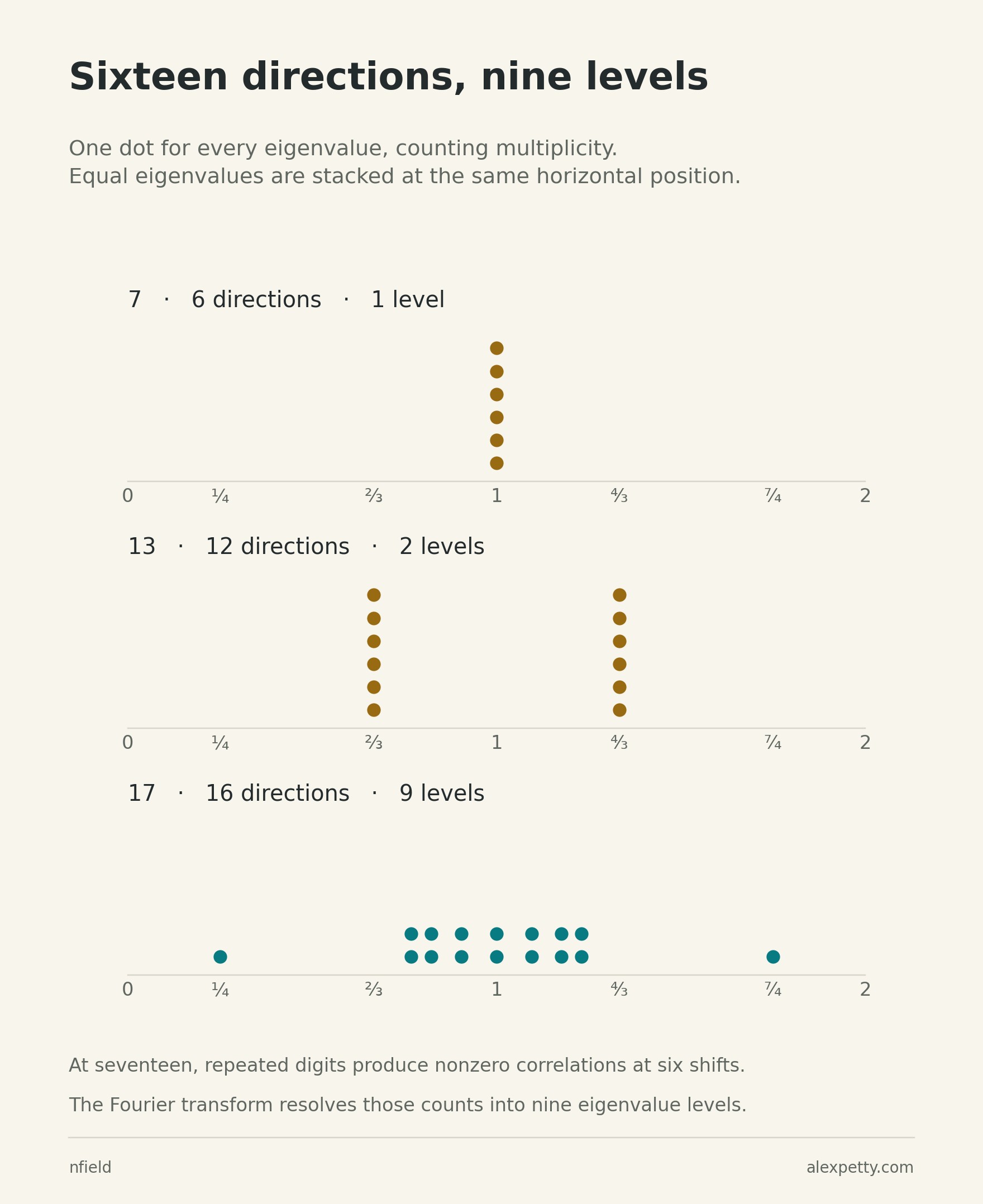
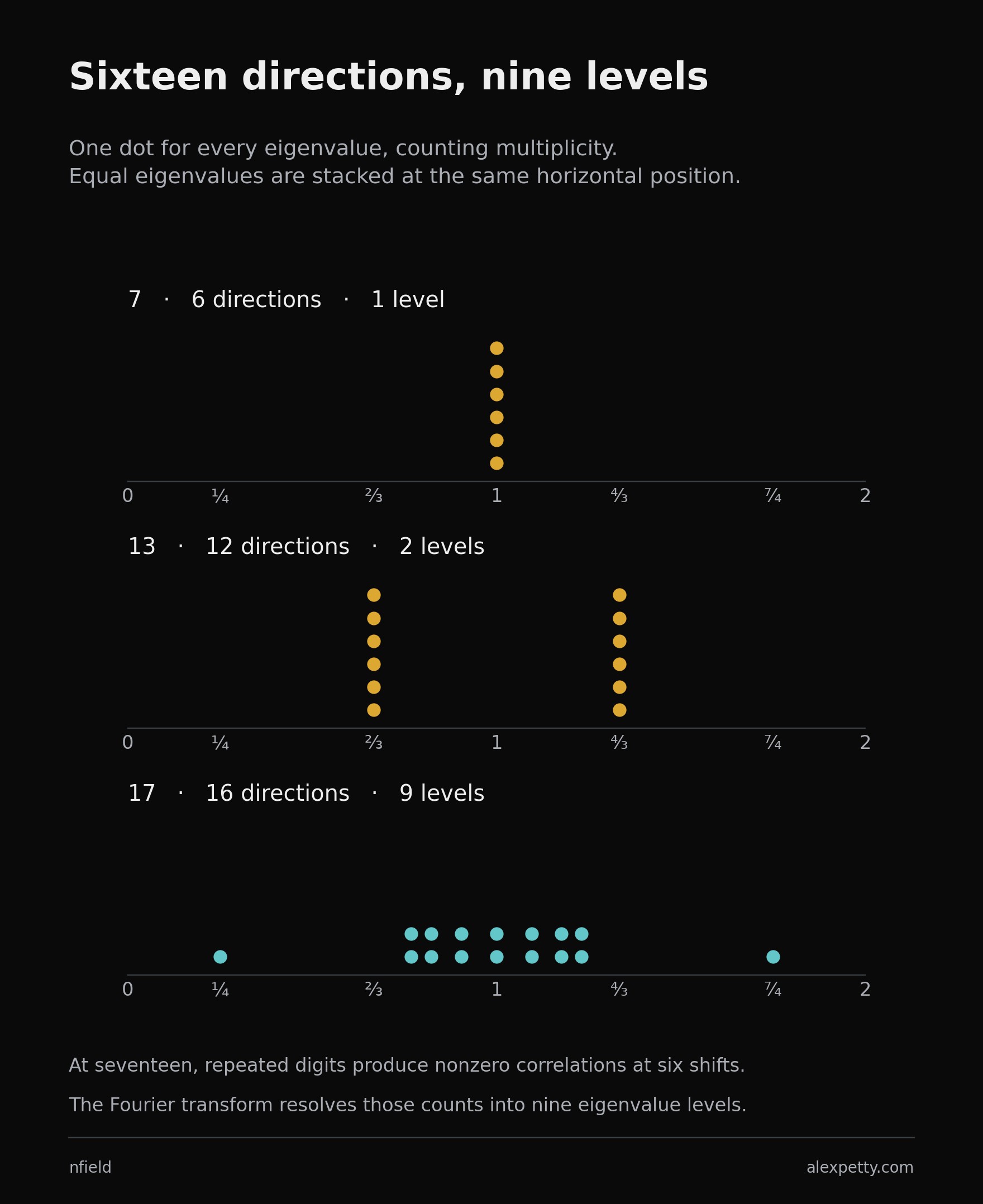
The spectrum counts multiplicities as well as heights. Seven has six directions at one level, thirteen has twelve at two levels, and seventeen has sixteen at nine. A pair average can register an increase in agreement, but it cannot recover this splitting of directions.
Thirty rows to a thousand, in two orderings
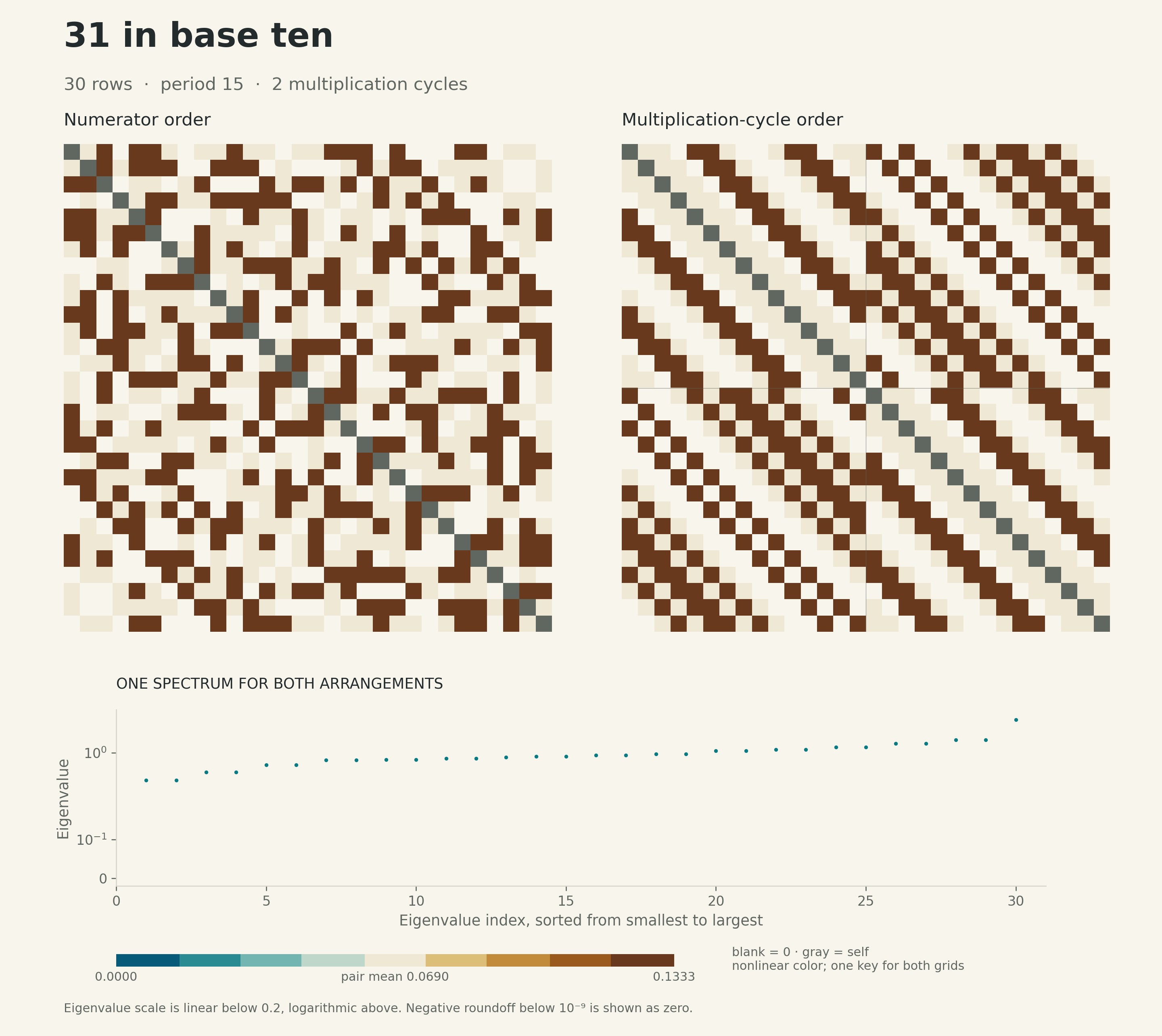
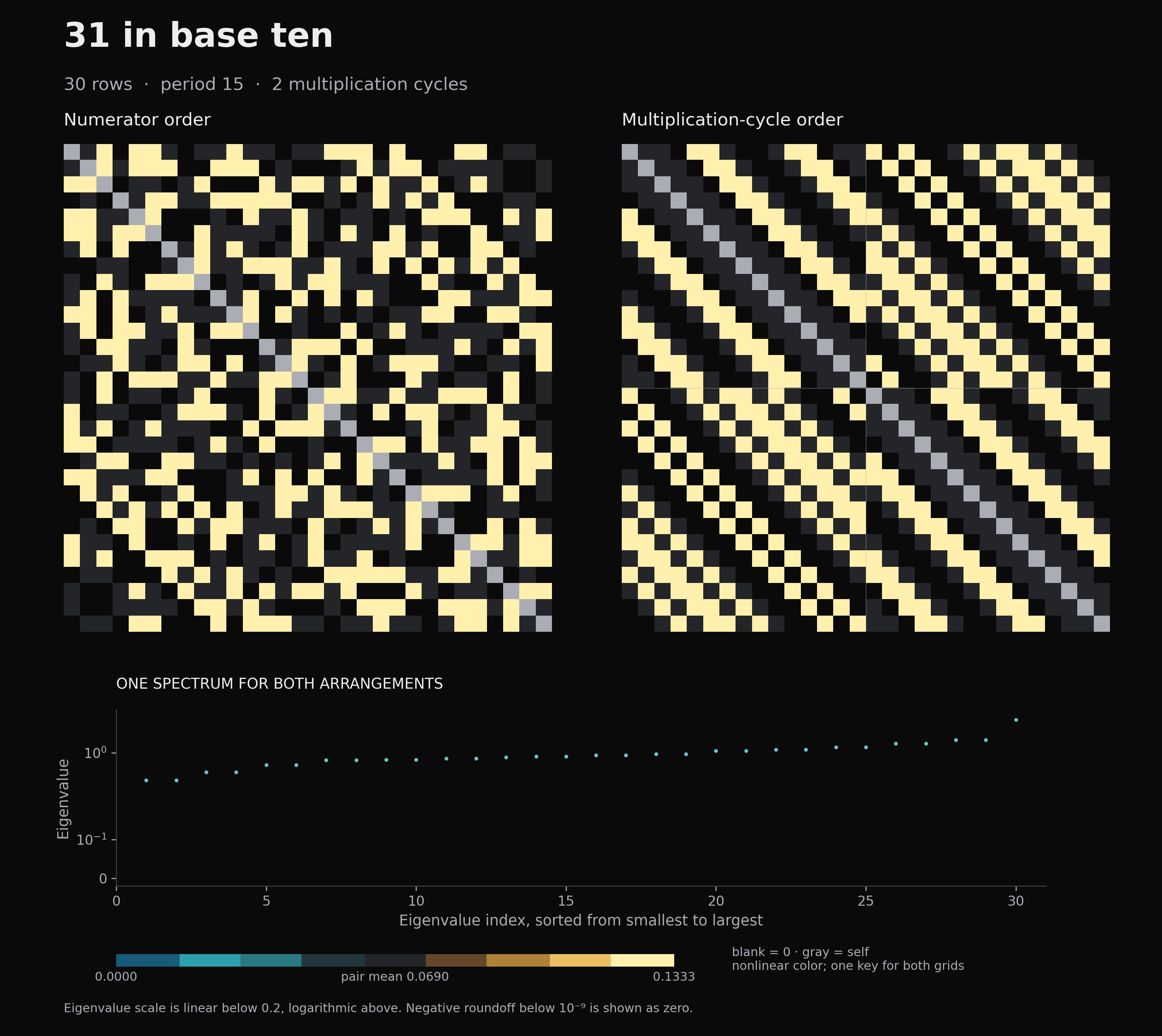
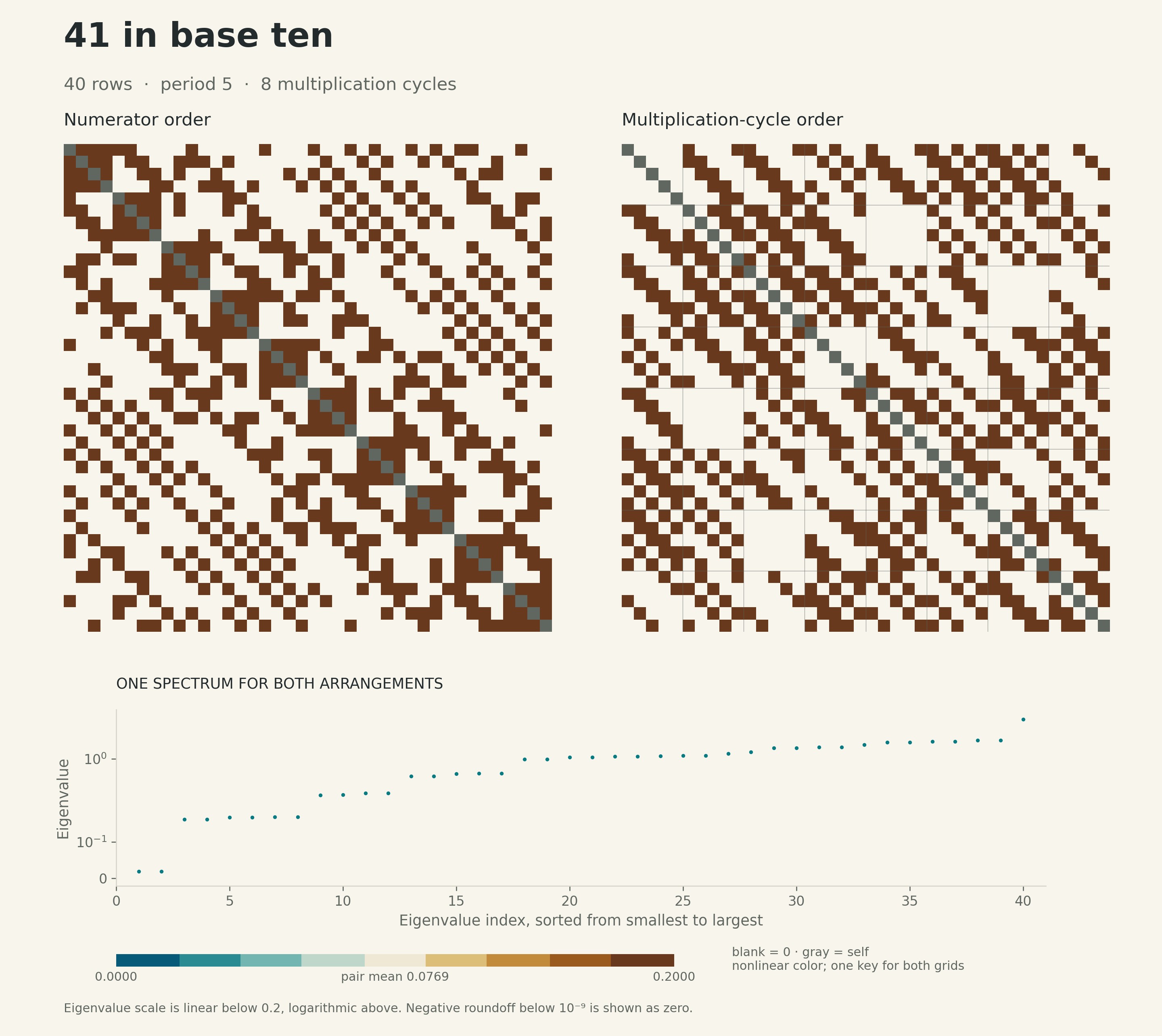
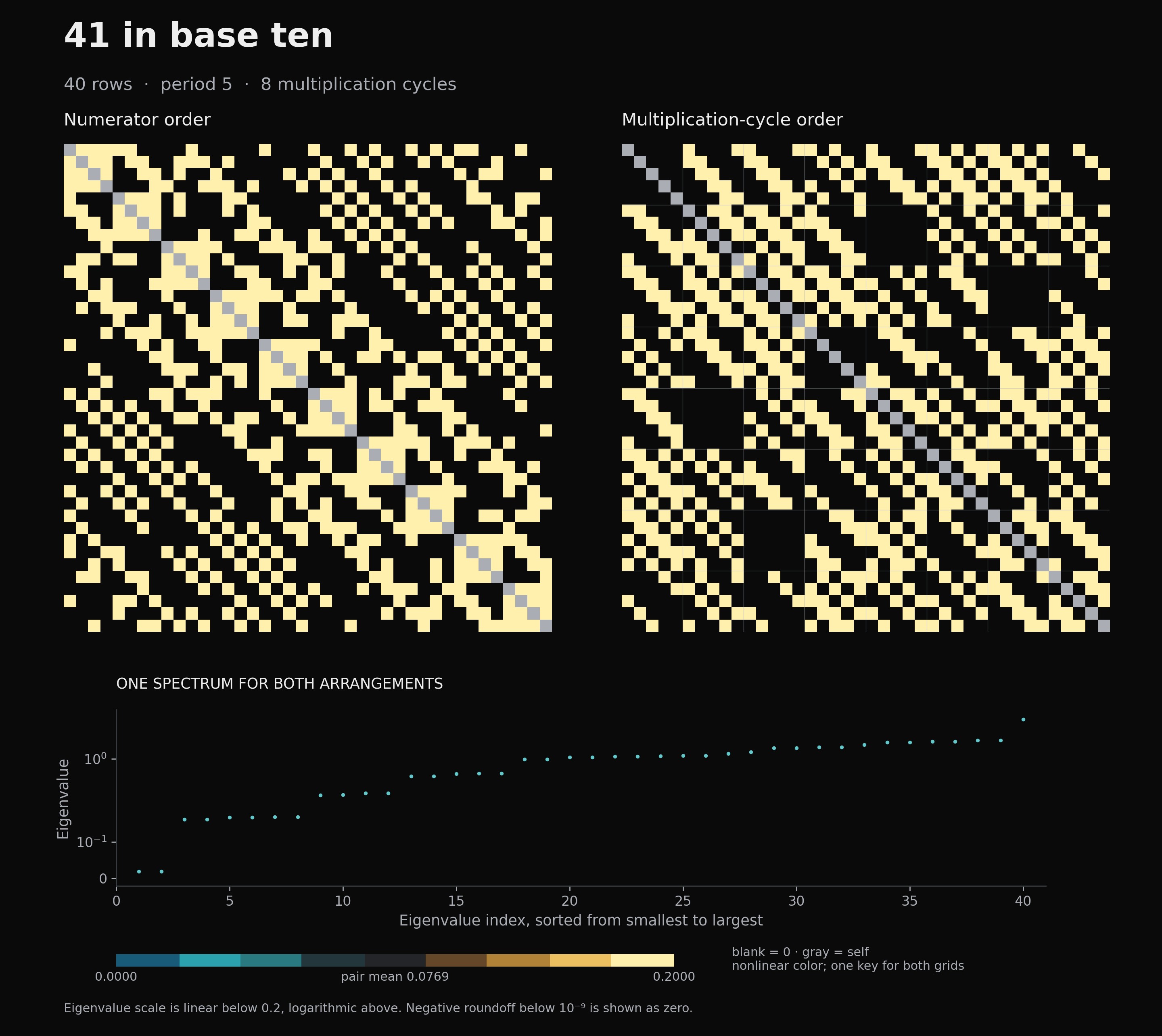
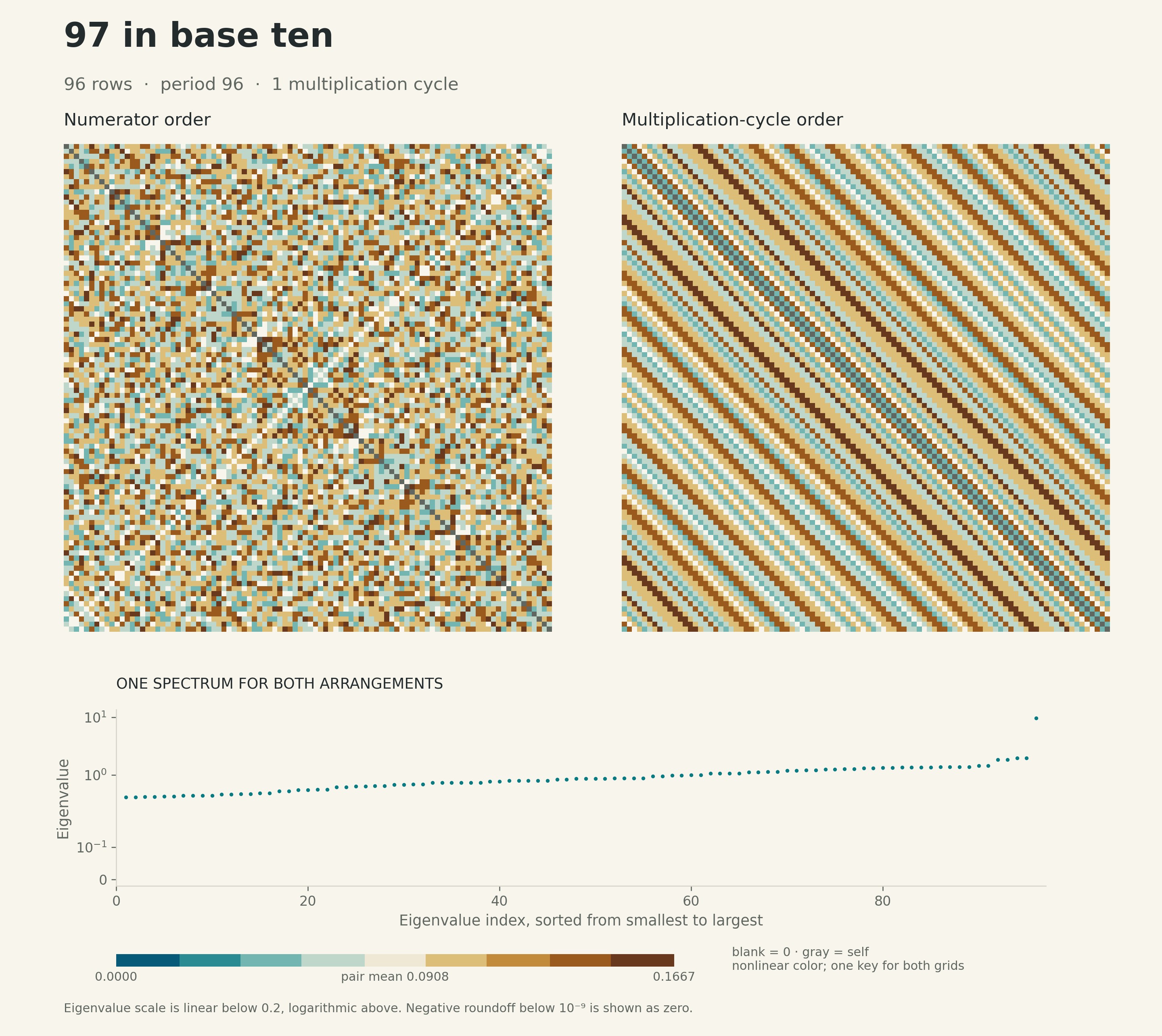
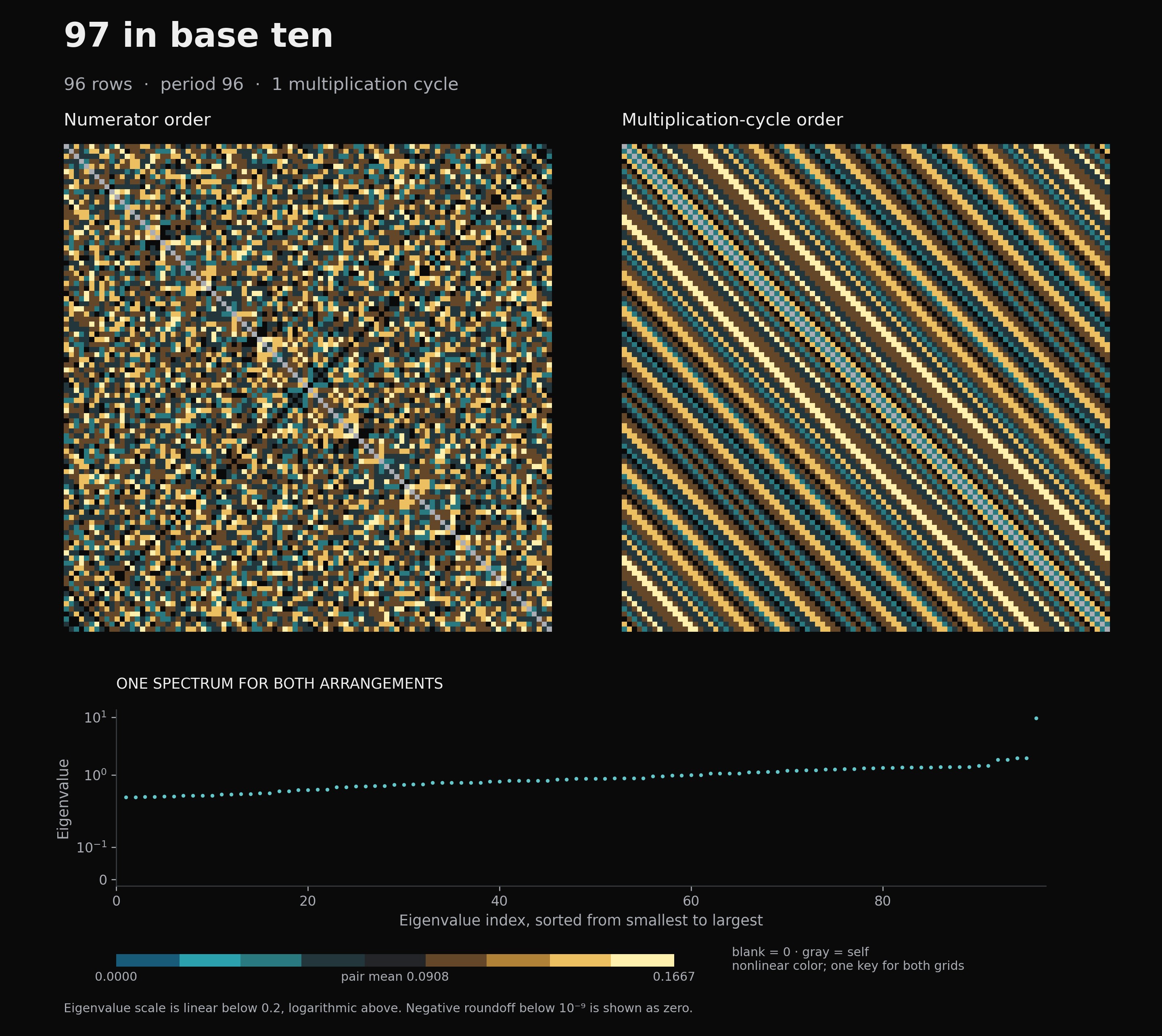
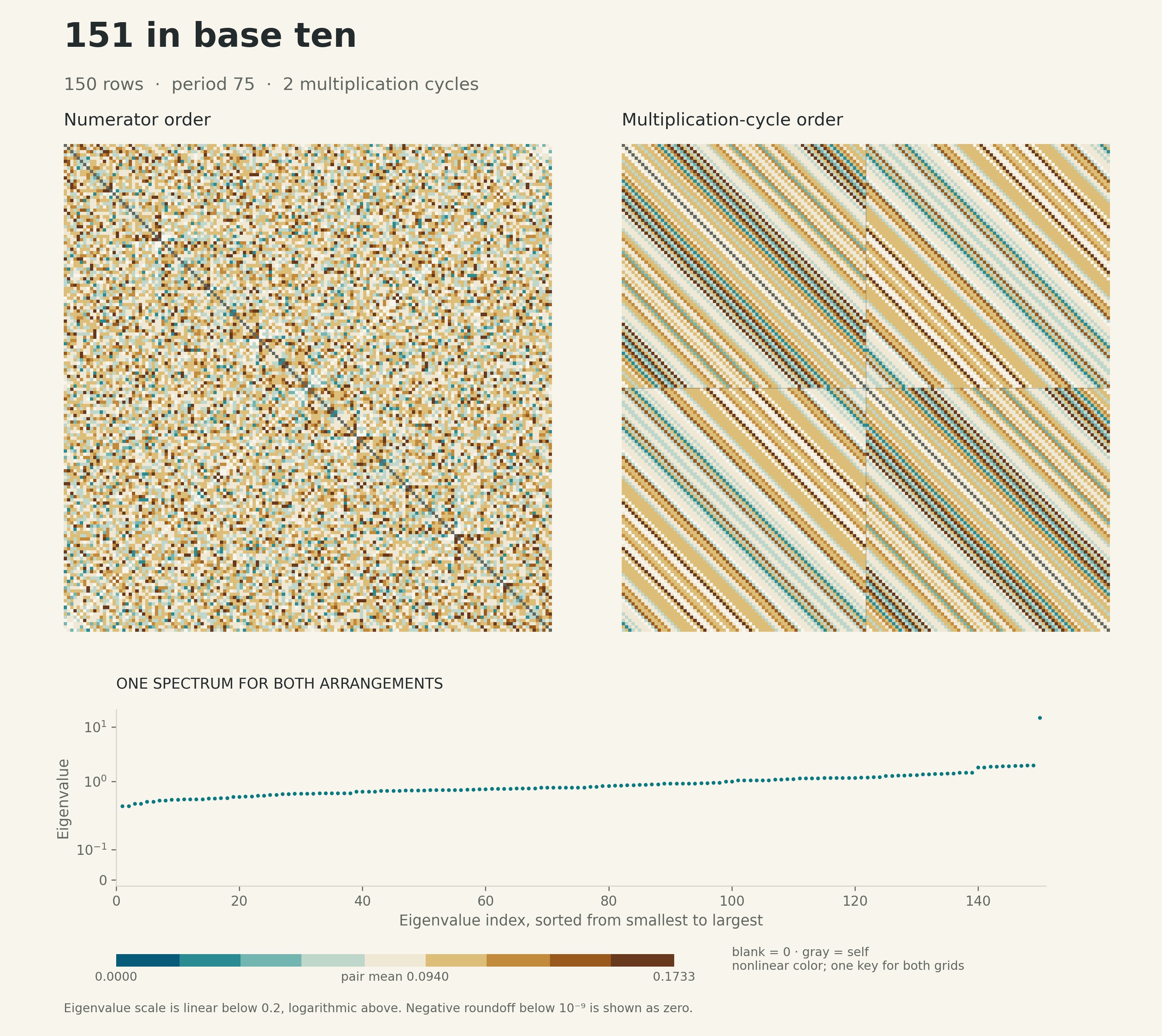
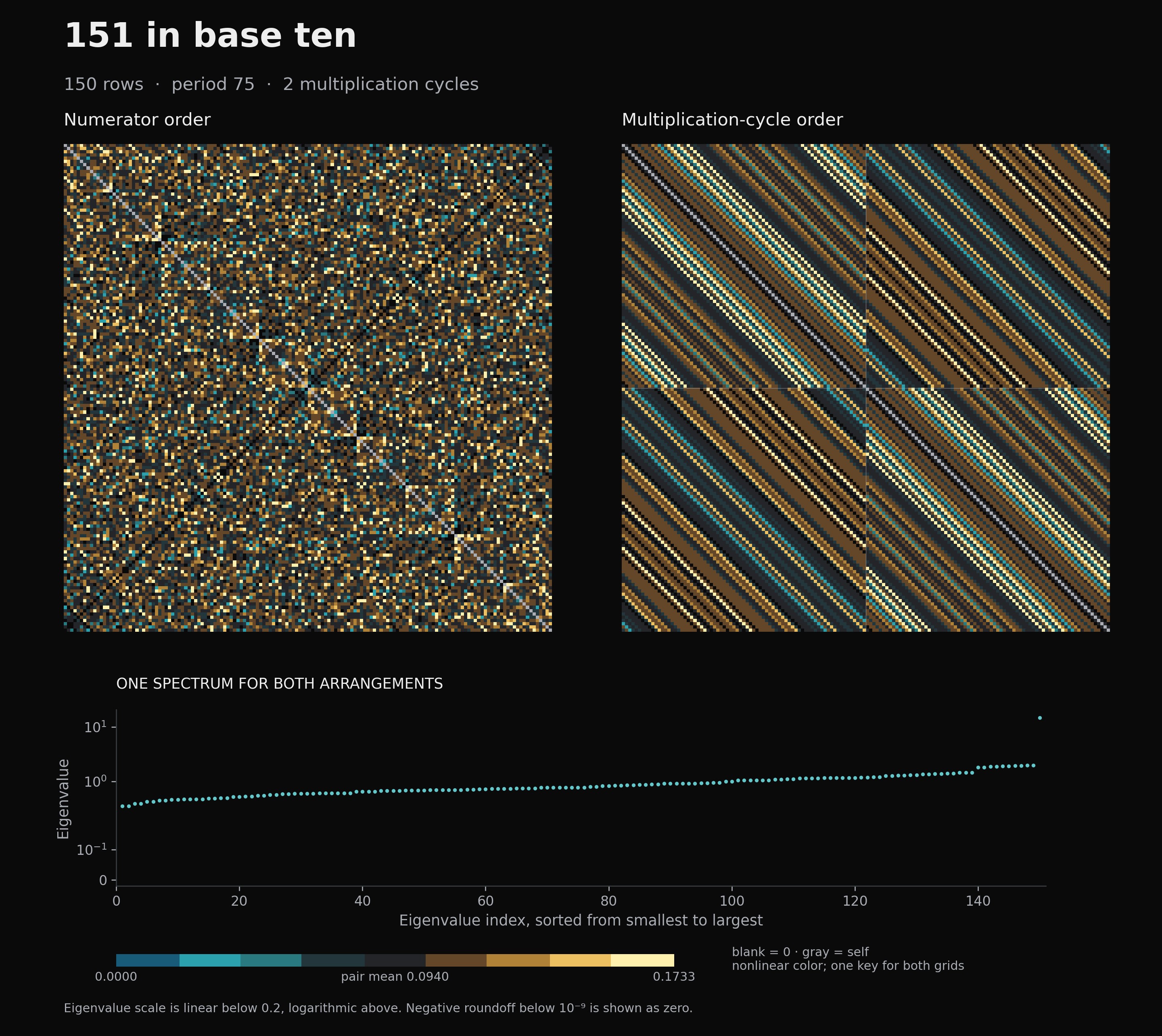
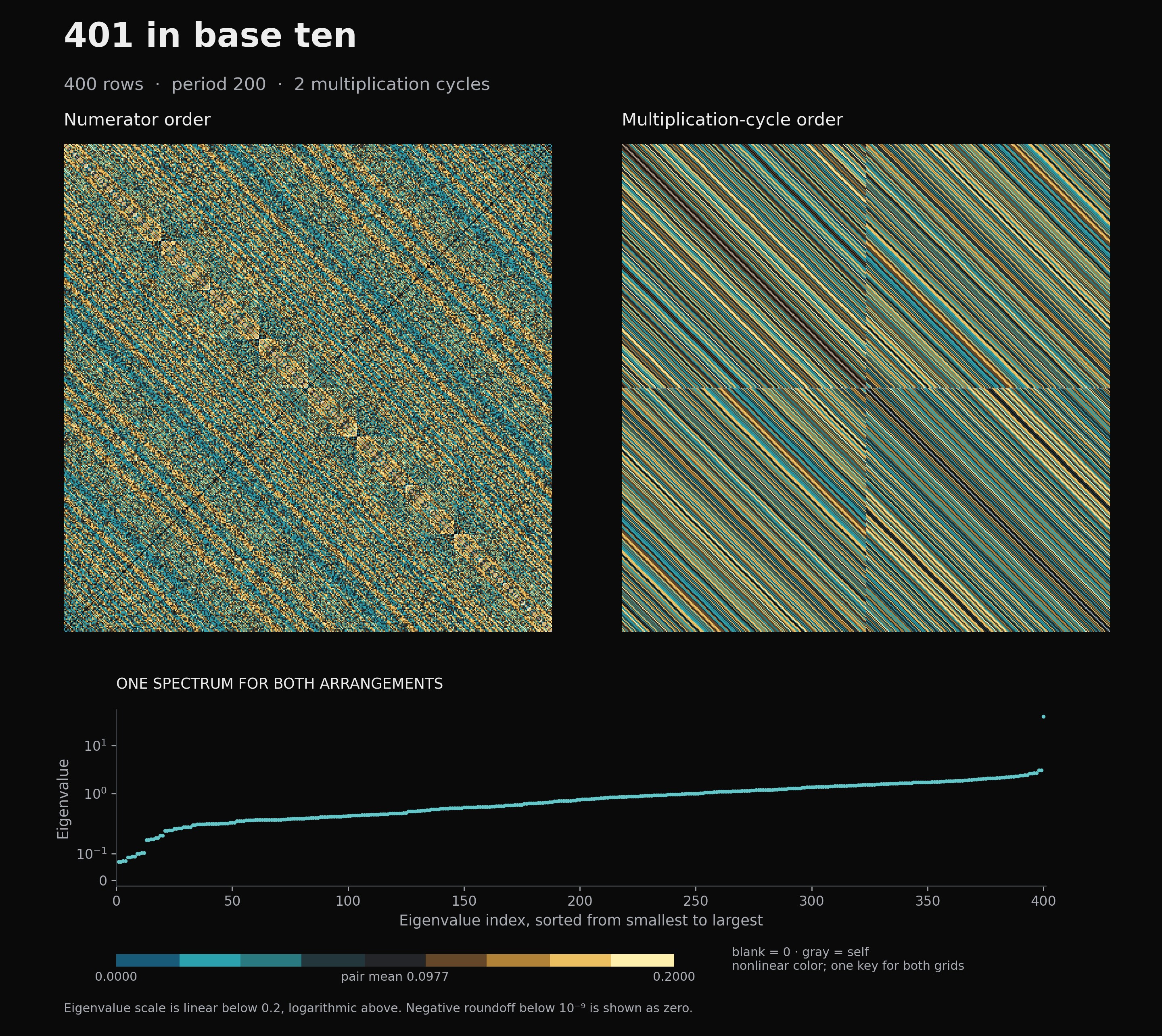
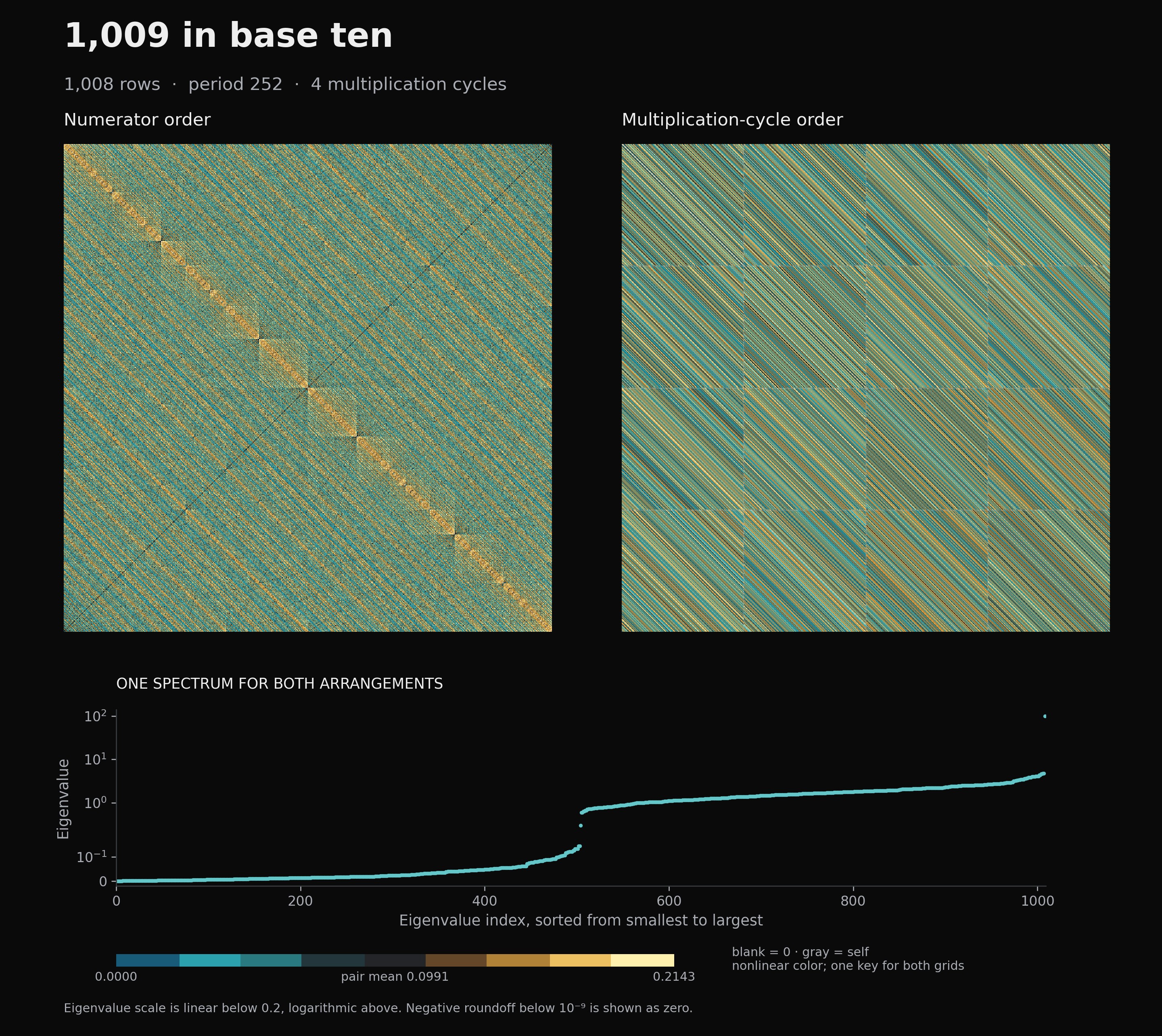
Each plate below shows the same exact matrix twice. On the left, numerators run in their ordinary order. On the right, multiplication cycles sit together, exposing the circulant blocks. The eigenvalues beneath them belong to both arrangements. Relabeling a matrix does not change its spectrum.
The color key is shared within each plate but changes between denominators, and a nonlinear contrast brings out small differences around the pair average. Blank cells score zero and the self-match diagonal is gray. The eigenvalue axis is linear below and logarithmic above it, so a large leading eigenvalue does not hide the rest.
These are computed examples, not further theorems. Open a plate to inspect either grid at full resolution.
Thirty to ninety-six rows
One hundred fifty to one thousand eight rows
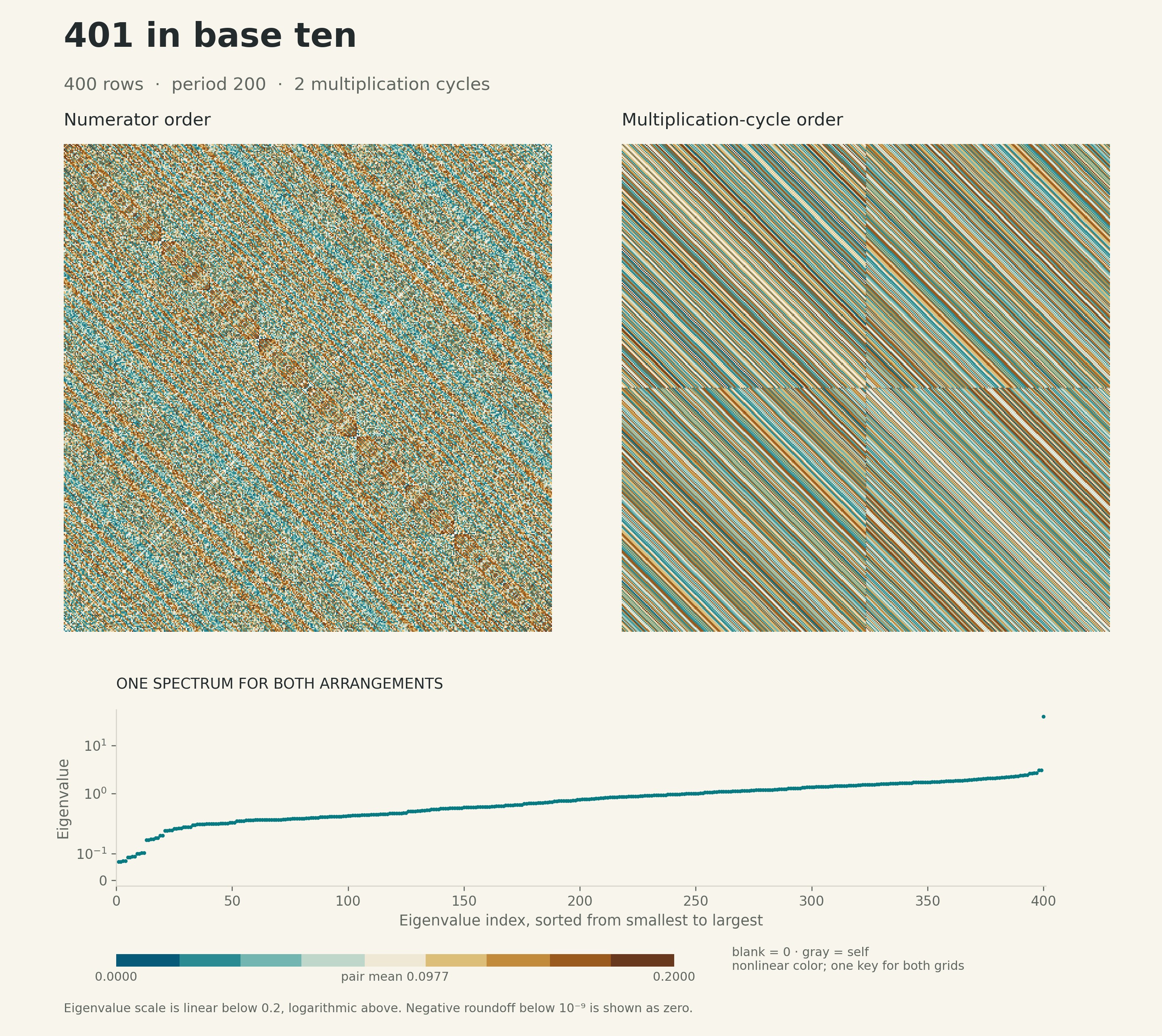
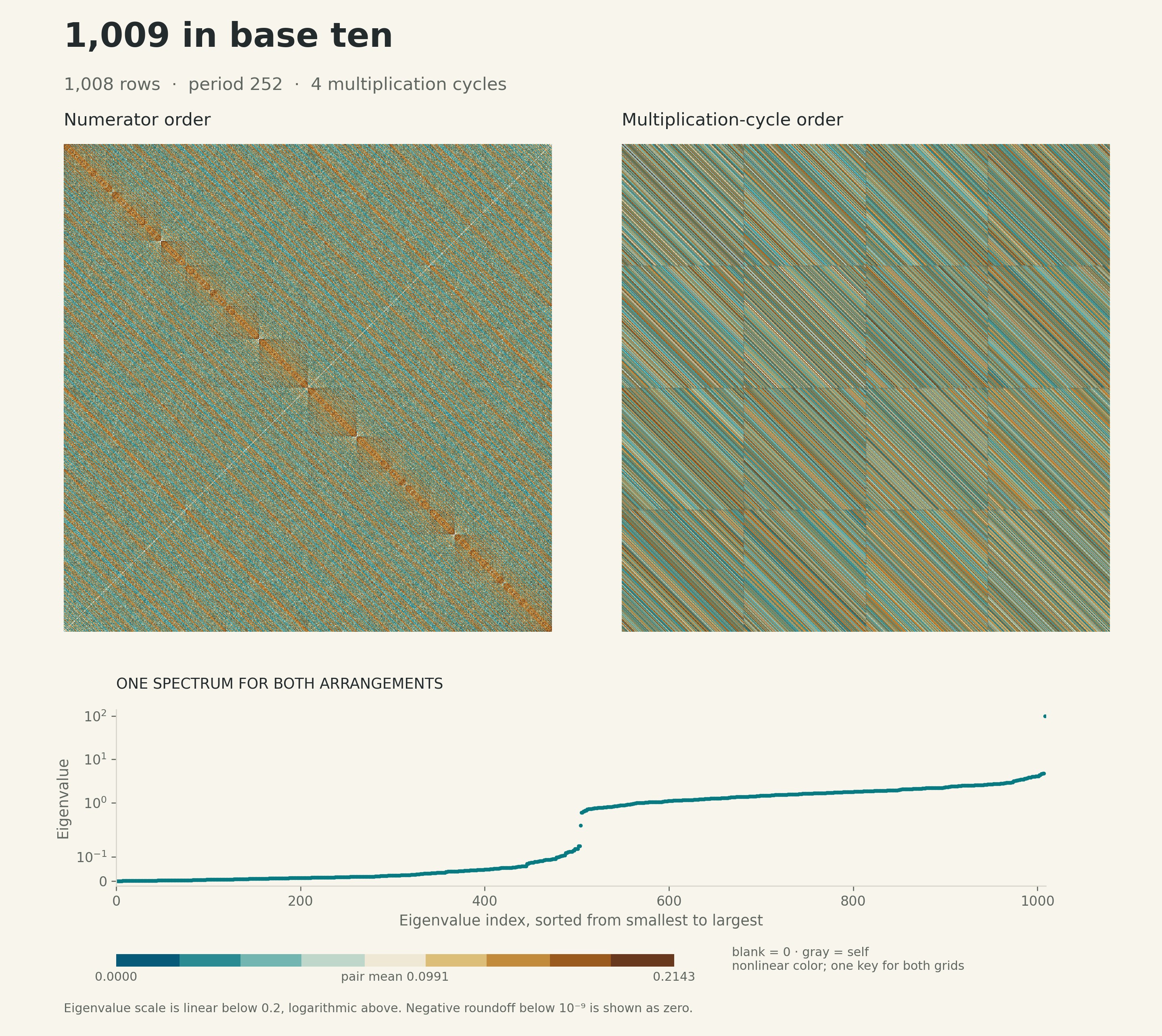
Three matrices, shift counts, and exact spectra
These wider plates collect the small examples for side-by-side comparison.
The matches between the cycles
The ingredients have precedents. Lempel and Greenberger studied cyclic Hamming correlation, and Kak and Chatterjee studied correlations in reciprocal digit sequences. Armstrong and Armstrong described the multiplication structure of repetends. Gram matrices and the Fourier diagonalization of circulants are standard linear algebra, treated by Horn and Johnson and Davis.
The Cross-Alignment Matrix assembles the synchronized comparisons across the whole fractional field, including every multiplication cycle and the terminating rows. It gives the digit-partitioning boundary a matrix form, yields exact block spectra for the supported families, and keeps the cross-cycle terms when the base does not generate all nonzero residues.
At thirteen, either cycle on its own still gives an identity matrix. Put the two together and the six matching pairs split one eigenvalue level into two, and , and all of the difference comes from how the two cycles line up against each other at a half turn.
Discussion
Sign in to join the discussion.