Capacity
The Distance Between Opposites

Opposite contributions can balance exactly and still leave something expensive between them. One arrives now. The other arrives later. Until they meet, the difference is present at every intervening address.
This matters when we build a constant reading from clocks that never stop moving. A period-three clock reads one third, two thirds, zero, then starts again. Combine many such clocks with positive and negative coefficients, and their moving parts can hold a reading at one through a long initial stretch of integers. The same coefficients keep acting beyond that stretch. A perfect beginning does not tell us the cost of everything that follows.
The question in signed capture is how much a new collection of clocks actually improves the fit. Here I want to follow the cancellation itself. Where do opposite contributions meet? How much remains between them? What changes when many such intervals overlap?
A balance with a length
Let a contribution of plus one arrive at address four and its opposite at address eight. The accumulated reading is one at four, five, six and seven. At eight it returns to zero.
Give address the weight
These are the lengths of the intervals between successive reciprocals. They fill one whole, and the tail beginning at address has weight . I call this the native measure because it belongs to the original clock-approximation problem. We keep it when we rearrange the arithmetic. A uniform average over a complete clock cycle would answer a different question.
Square the reading and add it with those weights. For the pair at four and eight, the energy is . Move both contributions to twice their addresses. The energy falls to . Keep the first at four and delay only the second to sixteen. The energy rises to .
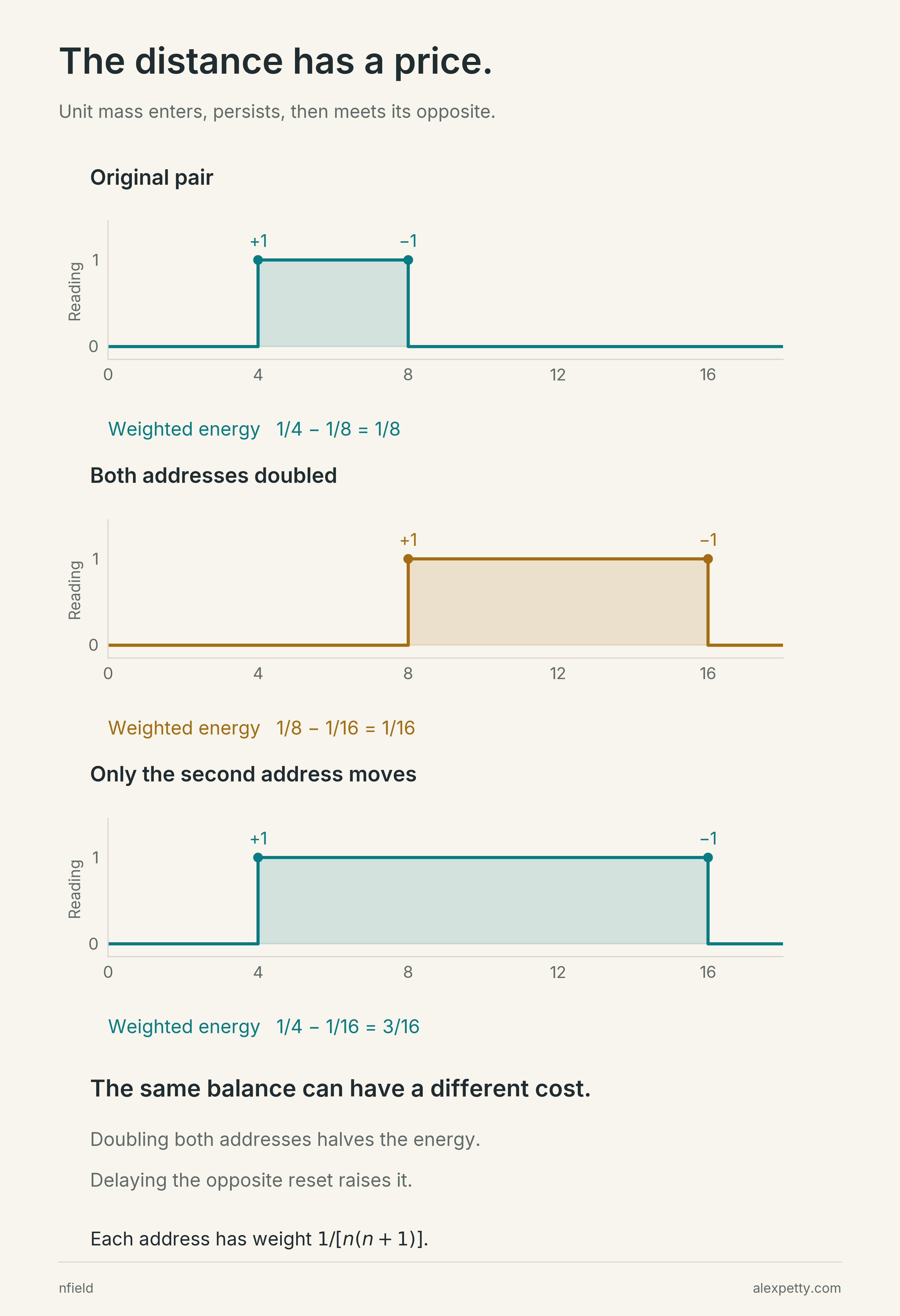
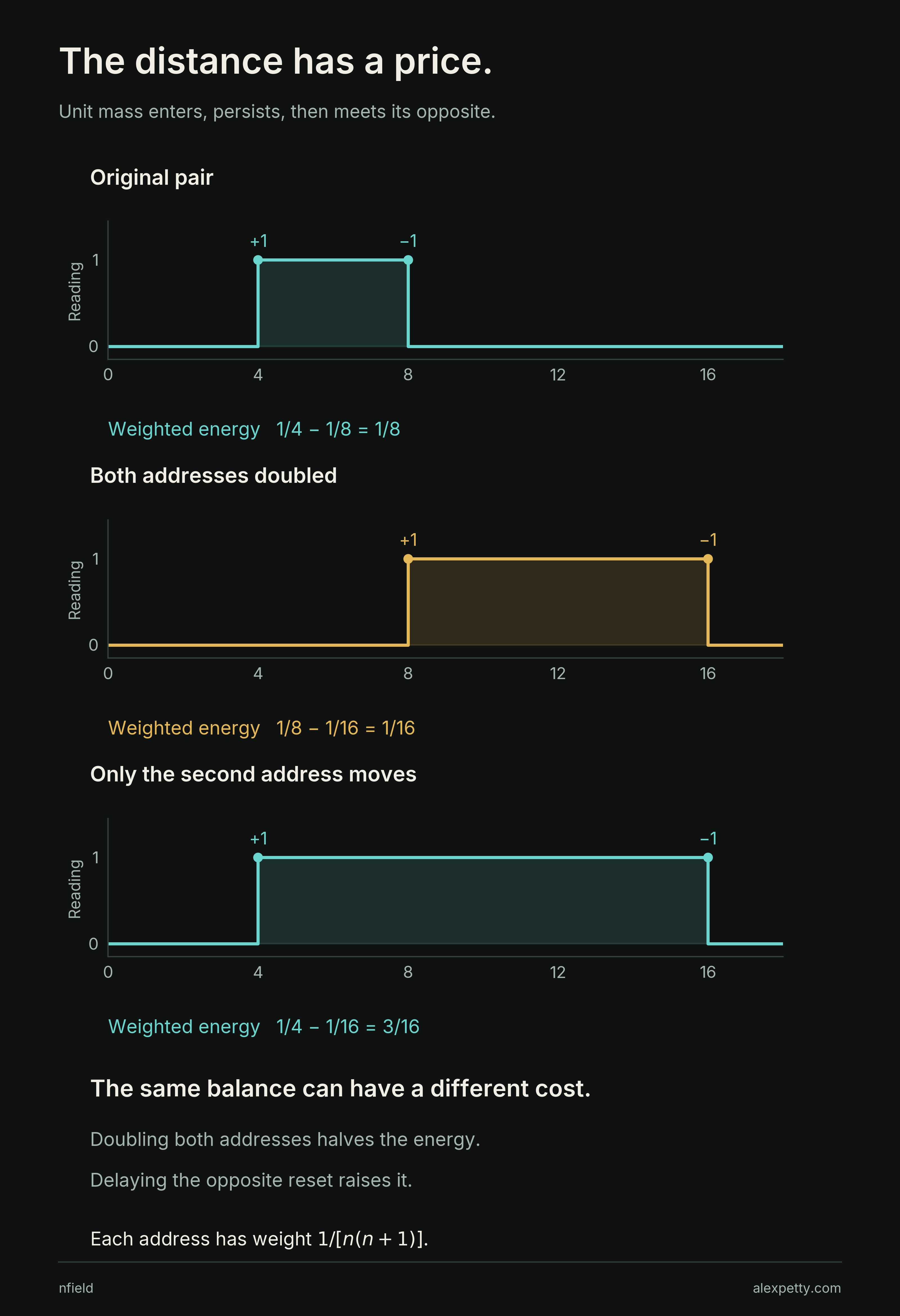
For equal and opposite mass at addresses , the exact cost is
The final balance is zero in every case. Its price depends on the amount, the separation and the place where that separation occurs.
The overlap changes the bill
Now take a positive pulse from four through eleven and a negative pulse from eight through fifteen. Each has its own cost. But from eight through eleven their readings add to zero.
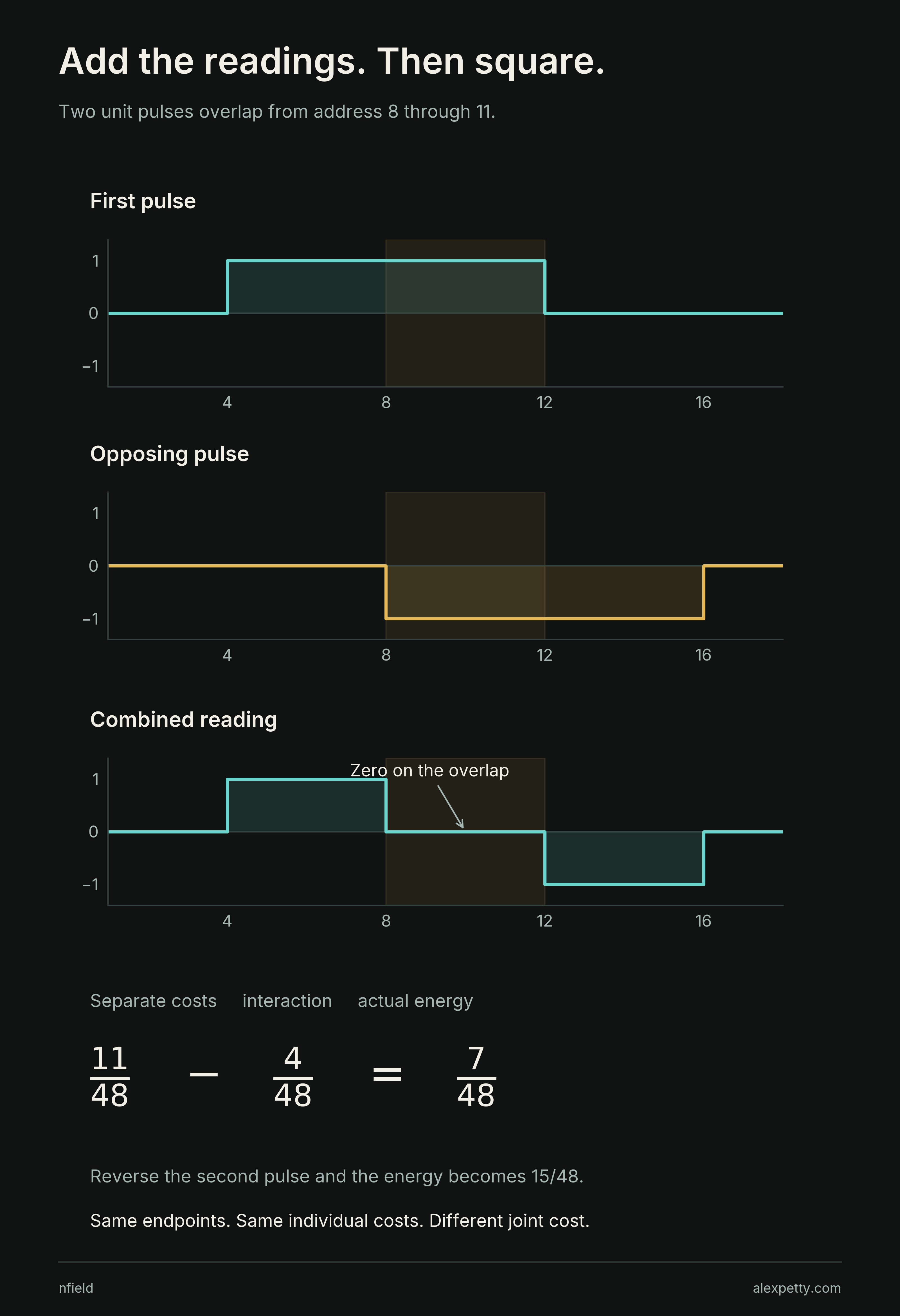
Adding the two separate energies gives . The energy of the combined reading is only . The missing is the signed interaction on the overlap.
Reverse the second pulse. Nothing changes about its endpoints or its individual squared cost. Now the two readings reinforce each other, and their joint energy becomes .
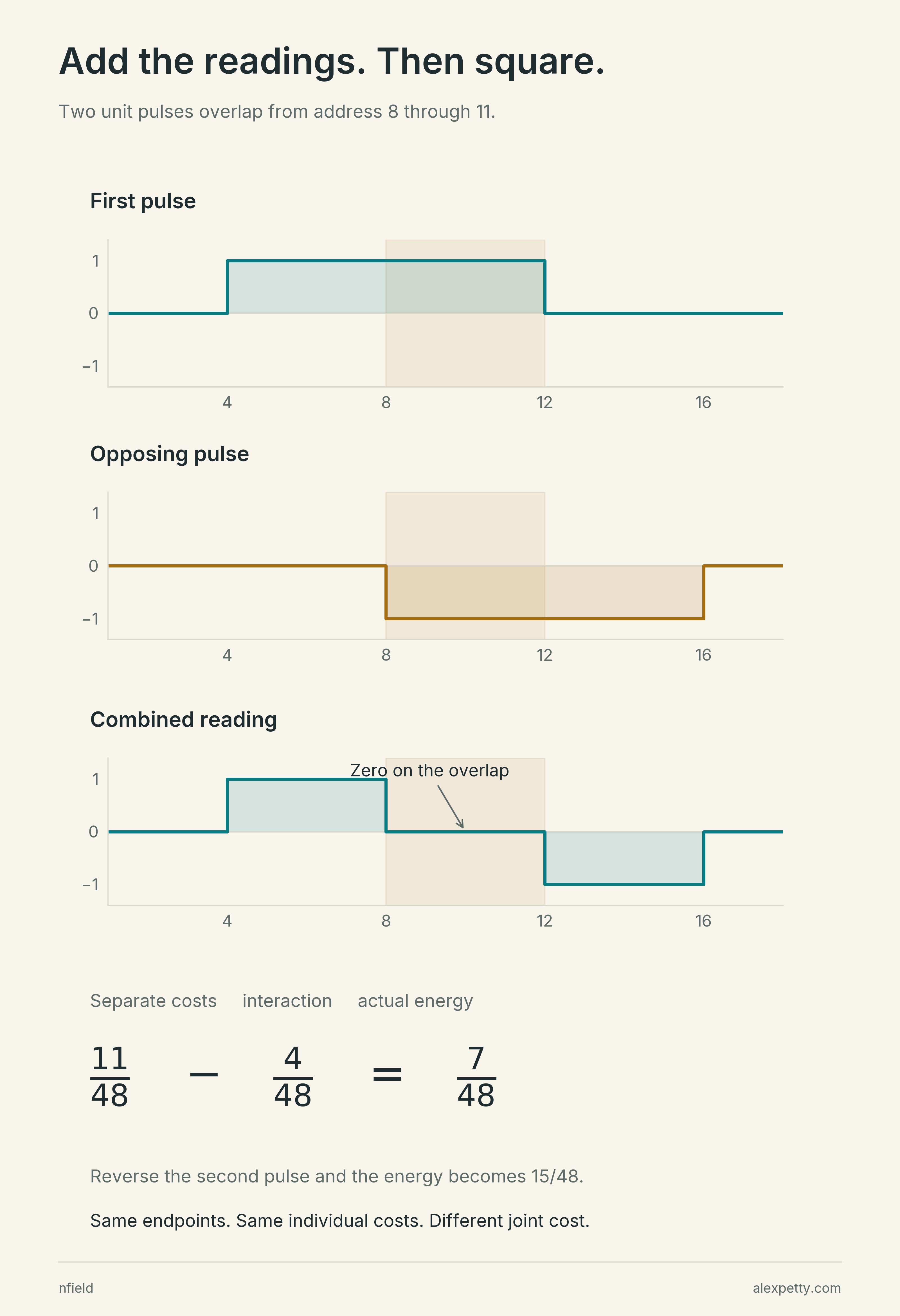
This is why signs have to survive the calculation. A bound that replaces every contribution by its magnitude can count a large cost where the assembled reading is zero. It can also conceal where several small contributions reinforce one another.
In a clock sum, every step includes the ordinary advance of the clocks and the resets at divisors of that address. Collect those changes first. Their sum is the signed reset source. Pairing applies to the actual positive and negative source at each address, after all contributions there have combined.
There is a useful estimate for a whole matching. Its cost charges each matched amount for the squared separation relative to its starting address, together with the full source strength there. The complete packet energy is bounded by four times this matching cost plus a fixed tail allowance. Overlapping intervals are included in the proof; they are not assumed independent.
That estimate gives distance a quantitative job. It does not say that any convenient pairing will be cheap. Finding enough opposite mass is one question. Reaching it at an affordable cost is another.
The same pair at a finer scale
Doubling both endpoints of a pair preserves their relative separation. Doubling an integer also preserves its odd divisors. These two facts work together when an existing matching is carried to a finer resolution.
The inherited part has a controlled budget. New pairings can still be needed where the changed source no longer fits the inherited assignment. Their cost has to be counted too.
Grouping neighboring addresses gives a second way to see this distinction. A group has an average reading and differences around that average. The local differences can be bounded while the averages of entire groups continue to move. Quiet detail does not mean a quiet total field.
The conserved remainder clocks already teach a related lesson. Fixed mass constrains the accounting, but it does not fix every reading. Here the shrinking mass at large addresses makes some distant costs affordable. The location and overlap of the readings still decide how much is spent.
Keep the relatives together
Arithmetic supplies more structure than an arbitrary list of positive and negative pulses. The coefficients come from the Möbius function. A squarefree integer has sign plus or minus according to whether it has an even or odd number of distinct prime factors; an integer containing a squared prime has coefficient zero.
For the divisors of six, the signs are
Equal counting makes that cancellation immediate. Our contributions arrive at different scales and have different reciprocal coefficients. We must keep their scaled responses together, rather than substitute the simpler count for them.
One way into the calculation is to follow the complete weighted mean error of the prescribed clock fit as its cutoff changes. Average that scalar over one doubling of resolution, then differentiate with respect to logarithmic scale. This gives a response built from dilated copies of one source, .
This is a new observable derived from the fits. Its energy is measured across resolutions, not across the original integer addresses. An estimate for it must be stated in its own measure.
For a core index coprime to thirty, keep the eight relatives
The corresponding completed source is
Each term retains its sign, reciprocal coefficient and first activation. The full source has zero signed area. Its accumulated area tends back to zero, with magnitude at most once .
That is a stronger statement than saying the signs add to zero. It controls how much signed area is still unbalanced after the response has run to a specified scale.
Why thirty appears
Multiplication becomes translation on a logarithmic scale. Multiplying the resolution by a prime moves its logarithmic coordinate by . Pair a source with the appropriately weighted copy at that scale, and its action on a test polynomial becomes a finite difference.
One difference kills a constant. Two kill a linear profile. Three kill a quadratic profile.
For this source, the order is exact. A completion using distinct primes has its first logarithmic moments equal to zero, and its next moment is nonzero. So a family that cancels total signed area, a linear trend and curvature in logarithmic scale needs at least three distinct primes.
The smallest choice is two, three and five. Their product is thirty.
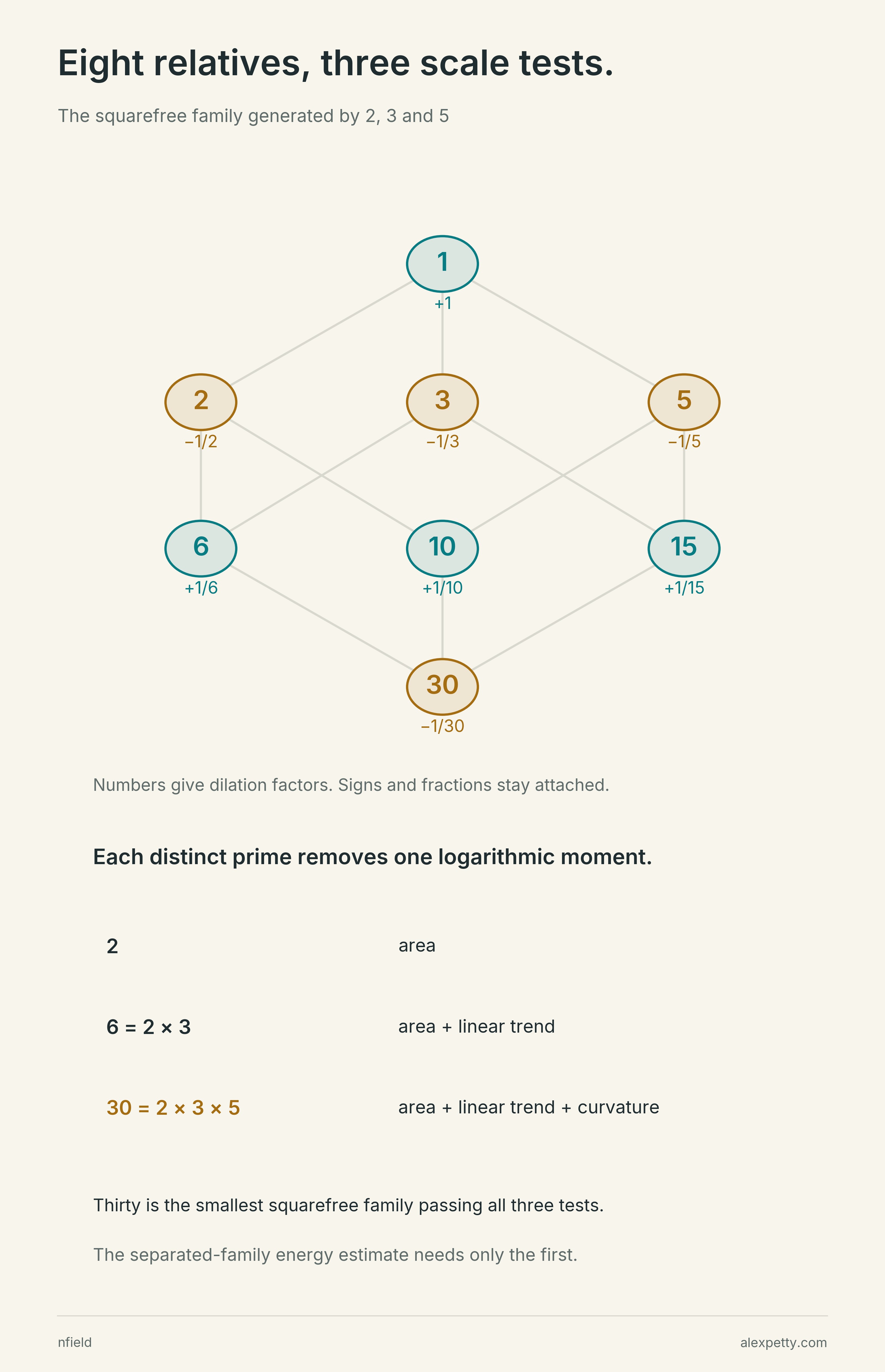
This is a specific minimality result. Among the squarefree families supplied by the Möbius coefficients, thirty is the smallest completion passing all three tests. The three-test requirement is an additional choice of what we want to balance. It is not a theorem that every successful approximation must use thirty.
In fact, the interaction estimate below needs only the first cancellation, zero signed area. A one-prime family already has that property. The extra moments describe more structure, but their use in controlling the full response is still open.
Separation pays for an infinite region
Consider two completed families at scales . Once the larger one first activates, the smaller family’s accumulated signed area may already be small. Integration by parts turns that fact into a saving in their interaction.
For , the resulting bound is a constant times
Here the response is measured with the resolution weight , and is fixed and positive. The bound holds no matter where we stop the observation. The jumps at activation and all later endpoints stay in the calculation.
This saving can be summed over an infinite region. Reduce each pair of family indices by their common factor. For all admissible reduced pairs with , the sum of the absolute interactions is finite, including the common-factor copies.
There is a simple reason the extra factor matters. At a fixed larger index , the smaller indices in this region satisfy . Their values add to at most . Multiplying by leaves a summable series of order . The few rows outside the initial separation threshold have their own finite allowance.
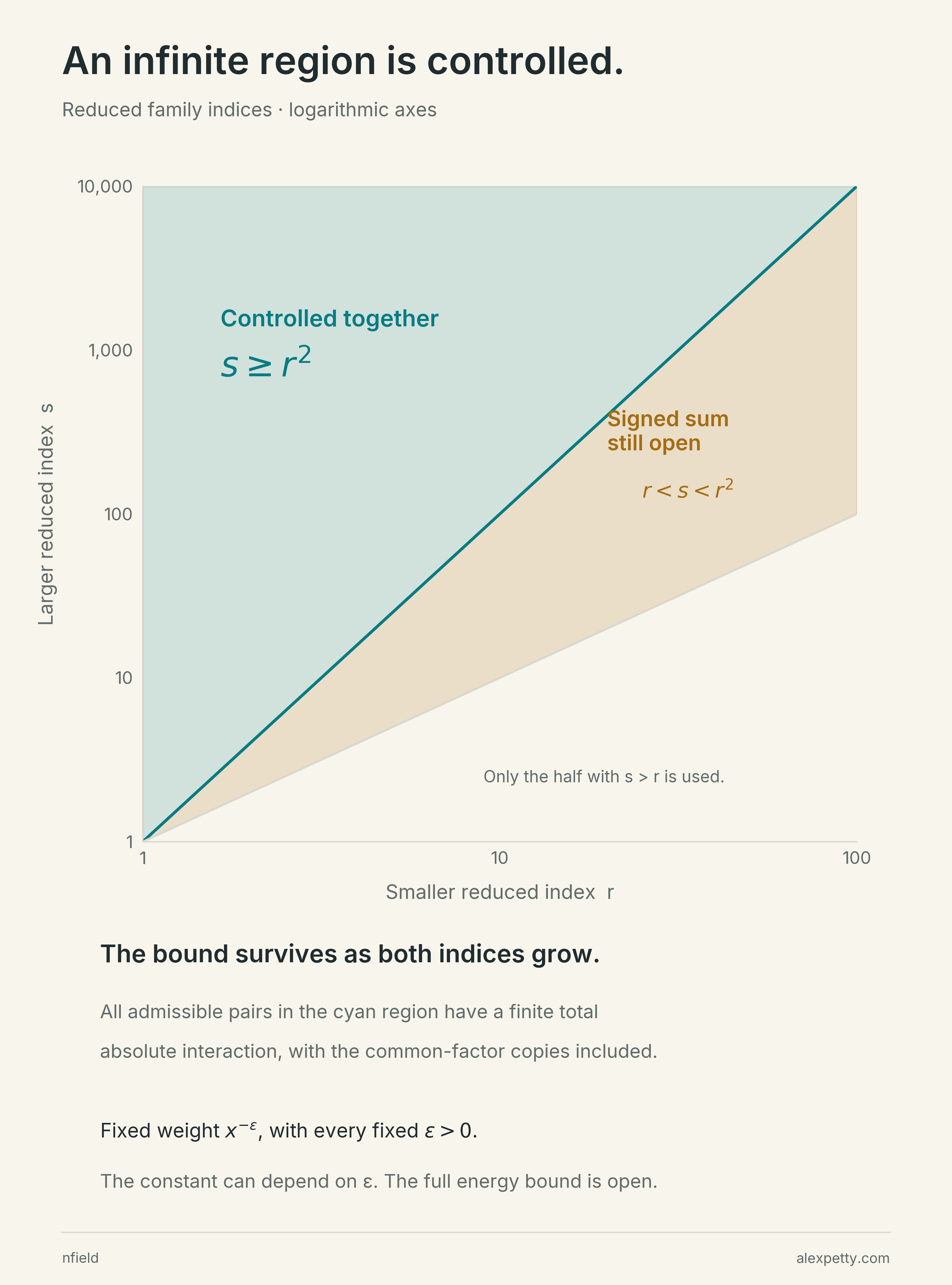
Both family indices can grow without limit. The estimate therefore removes a whole infinite region from the place where uncontrolled energy could accumulate. It does not rely on numerical behavior through a finite cutoff.
The constant may depend on . We cannot set that damping to zero without another argument. And the region left to control still grows with the cutoff,
Its actual Möbius signs remain joined in the sum. A uniform bound there is open.
The mathematical treatment, The Cost of Cancellation under Arithmetic Refinement, is undergoing independent review. The distinction that guides it is already concrete. An eventual balance, a cheap individual contribution and a bounded joint response are different things.
A pair tells us where cancellation ends. The distance between its endpoints tells us what it costs before it gets there.
Discussion
Sign in to join the discussion.