Capacity
The Clocks Beneath Collision Energy
The Secondary Term of the Cubic Law measures the shortfall in the continuous collision energy. At resolution the energy falls short of by a deficit , and the deficit grows like . That settles its size. It says nothing about what the deficit is, or how it moves from one integer to the next. Here I want to get inside it and watch it change.
A size is a summary. The questions it leaves open are about particular integers and particular primes, and they can’t be approached without knowing what the deficit is made of and how it moves.
Watch it for a few steps and it does something a smooth quantity has no business doing. From five to six the resolution goes up and the deficit goes down, from to .
The explanation is a set of clocks. Every period gets a clock whose hand shows the remainder of on division by . The collision calculation gives each clock a fixed weight, the weights add to exactly one, and the deficit is two thirds of the weighted average position of the hands. As advances, no weight is created or lost, and only the hands move. It works like a conservation law, a fixed total that never changes while its parts move around, and it sets the rules of motion. At six, the clocks of two, three and six all reset at once, and together they pull the average back further than the advance pushed it forward.
That turns the deficit into a dynamical system, and I follow it in three steps. I give every compatible setting of the clocks equal weight, which puts them on the profinite integers, the classical adding machine of dynamics. I subtract each clock’s average position and show that the centered readout converges, with finite variance. And I show that its one-step changes cancel over any stretch of time down to the endpoints, so blocks of steps never pile up variance the way independent steps would.
The catch is that all of that convergence is an average over every compatible setting, and the ordinary integers are a set of measure zero in that space. At every integer we actually count with, the centered readout runs off to minus infinity. Number theory knows this trap well. Émile Borel proved in 1909 that almost every real number is normal, with every string of digits turning up equally often in its expansion, and no one has yet proved it for or . A statement about almost every point can say nothing at all about the points you care about.
Down at six
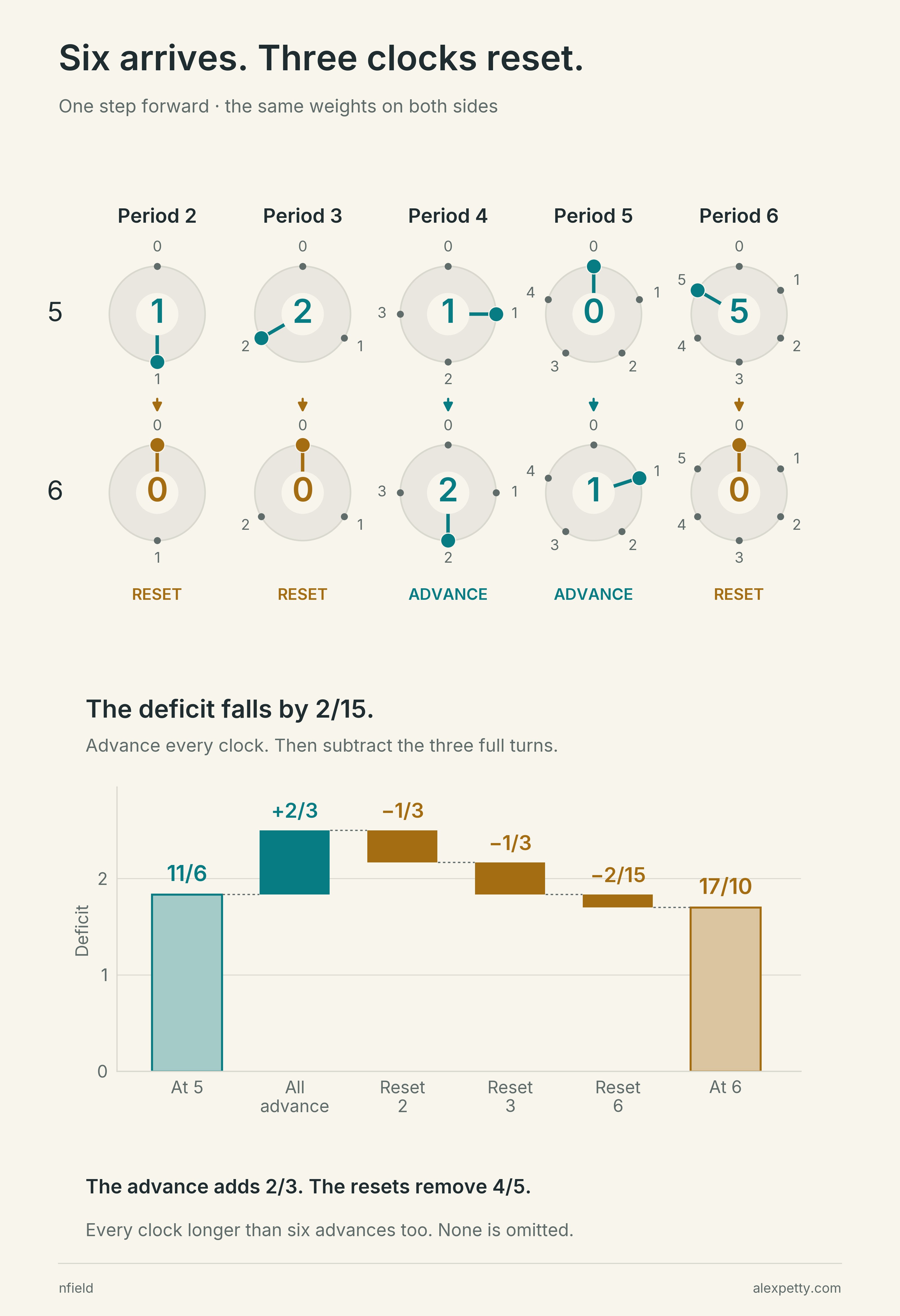
Make a clock with six marks, numbered zero through five. Advance its hand once for every integer. At five it reaches the last mark. At six it returns to zero.
A clock with three marks resets at the same instant. So does a clock with two. The clocks with four and five marks keep going.
Those three resets account for an exact drop in collision deficit. The deficit goes from to . Down by , with nothing left over to explain.
A fixed share for every clock
Give every period its own clock, well beyond the five drawn above. Period shows the remainder after division by . A clock longer than the current integer has not made its first turn.
The collision calculation assigns each clock a fixed positive weight. Period two gets of the total. Three gets . Four and five get each. Six gets . The rest goes to the longer clocks. Altogether the weights add to exactly one.
Multiply each clock’s position by its weight, add, and take two thirds of the result. That is the deficit.
This is an exact identity, with nothing fitted to the graph. The weights come from reducing the pairs in the original energy sum by their common factor. The derivation is below.
If every hand could advance without wrapping, the readout would gain , because the weights total one. A resetting hand instead loses a full turn. At six, those subtractions are , and . Together they remove . The resets take more than the advance adds.
At a large prime, only that prime’s clock resets, and the rise approaches . An integer with enough small divisors can produce a deep fall. The mass on the clocks is conserved, and their weighted positions are free to change.
Four settings out of eight
The clocks cannot be set independently.
Suppose the four-clock points to three. Then the two-clock must point to one. Both are reading the same integer, and an integer that leaves three on division by four is odd.
Two choices on one dial and four on the other appear to allow eight settings. Only four can occur. By contrast, the two-clock and three-clock visit all six of their possible settings.
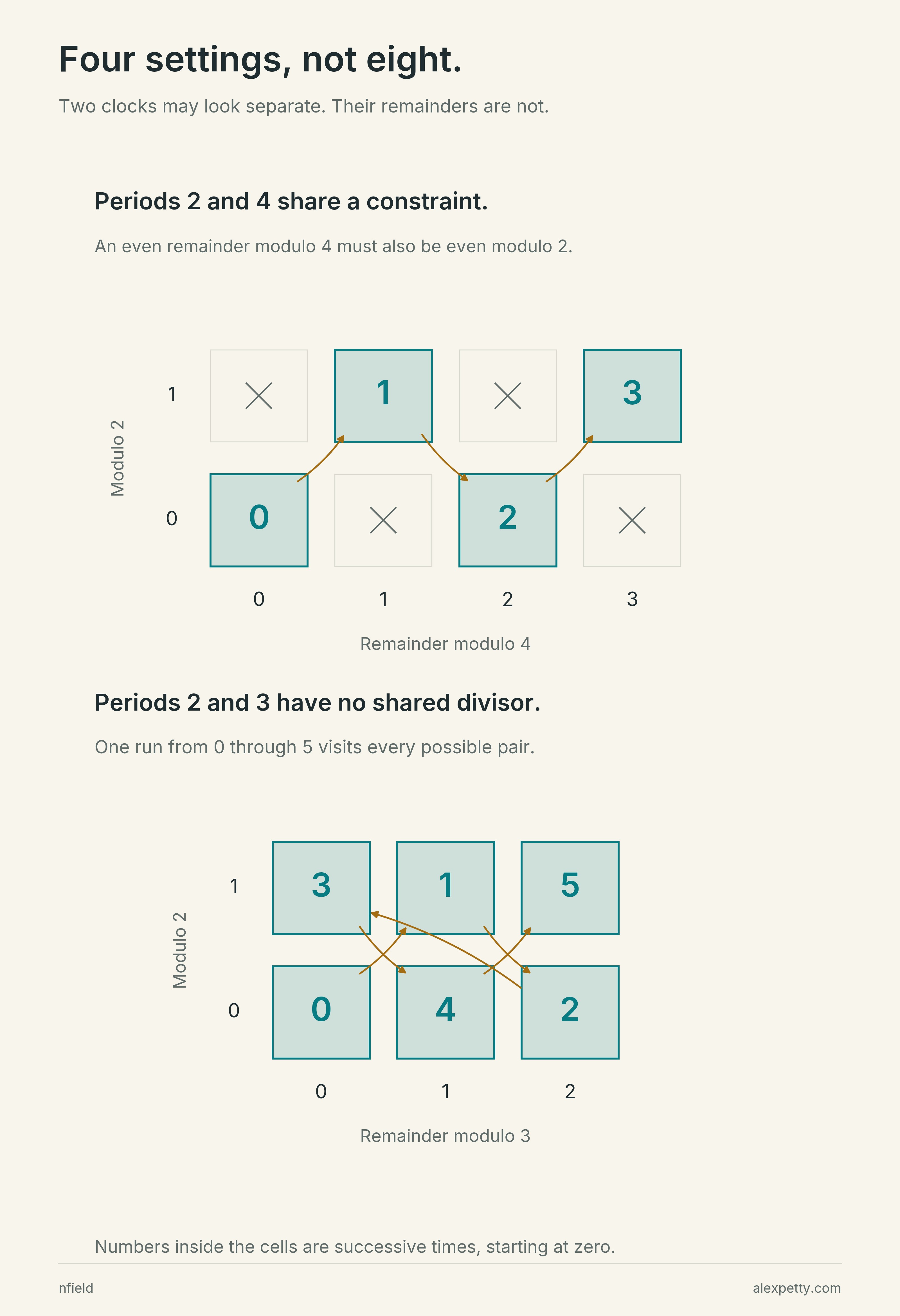
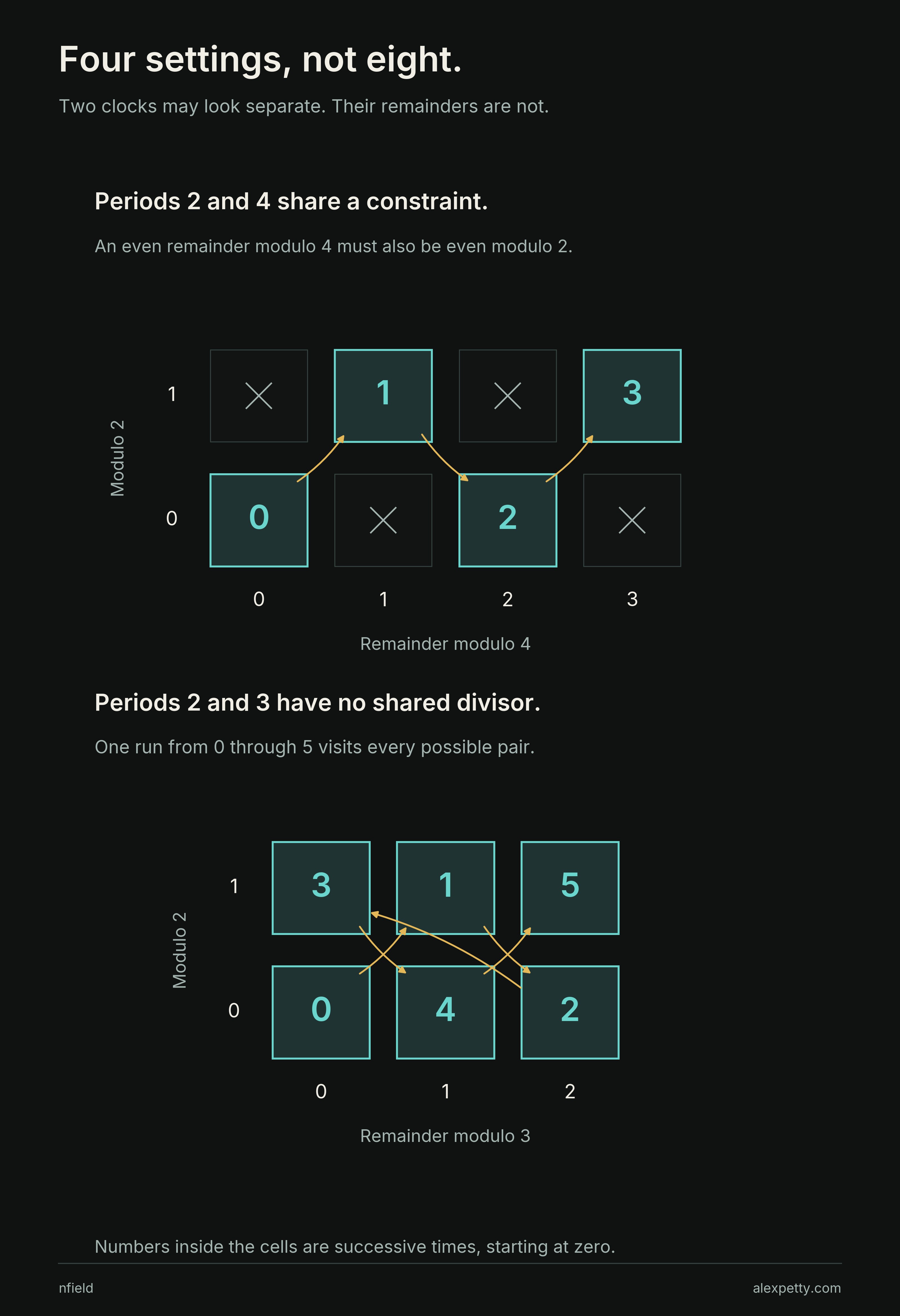
Carry this consistency requirement through every period. The resulting space is the profinite integers. A point specifies all the remainders at once. Adding one advances every hand.
To average over a finite collection, run it through a complete cycle. The clocks through six repeat together after sixty steps. Give each of those sixty settings equal weight. The infinite construction keeps these finite averages consistent as more clocks enter.
Nothing here requires random motion. We choose a setting uniformly, then the arithmetic takes over.
Remove the age. Keep the motion.
A six-clock spends equal time at zero, one, two, three, four and five. Its average position is . For period , the average is .
Add the weighted average positions through period . This stationary mean age grows like , the same leading coefficient found in The Secondary Term of the Cubic Law. A finite total mass can have an infinite average age if enough of it sits on very long clocks.
Subtract each clock’s average position before adding. Call the centered readout .
Now the infinite limit exists in mean square over compatible settings, with positive finite variance. In plain terms, the average squared error from omitting the long clocks tends to zero. The raw average age keeps growing, but the fluctuations around it settle into a limiting law.
The next picture uses only periods two through six, so every value is a fraction we can check.
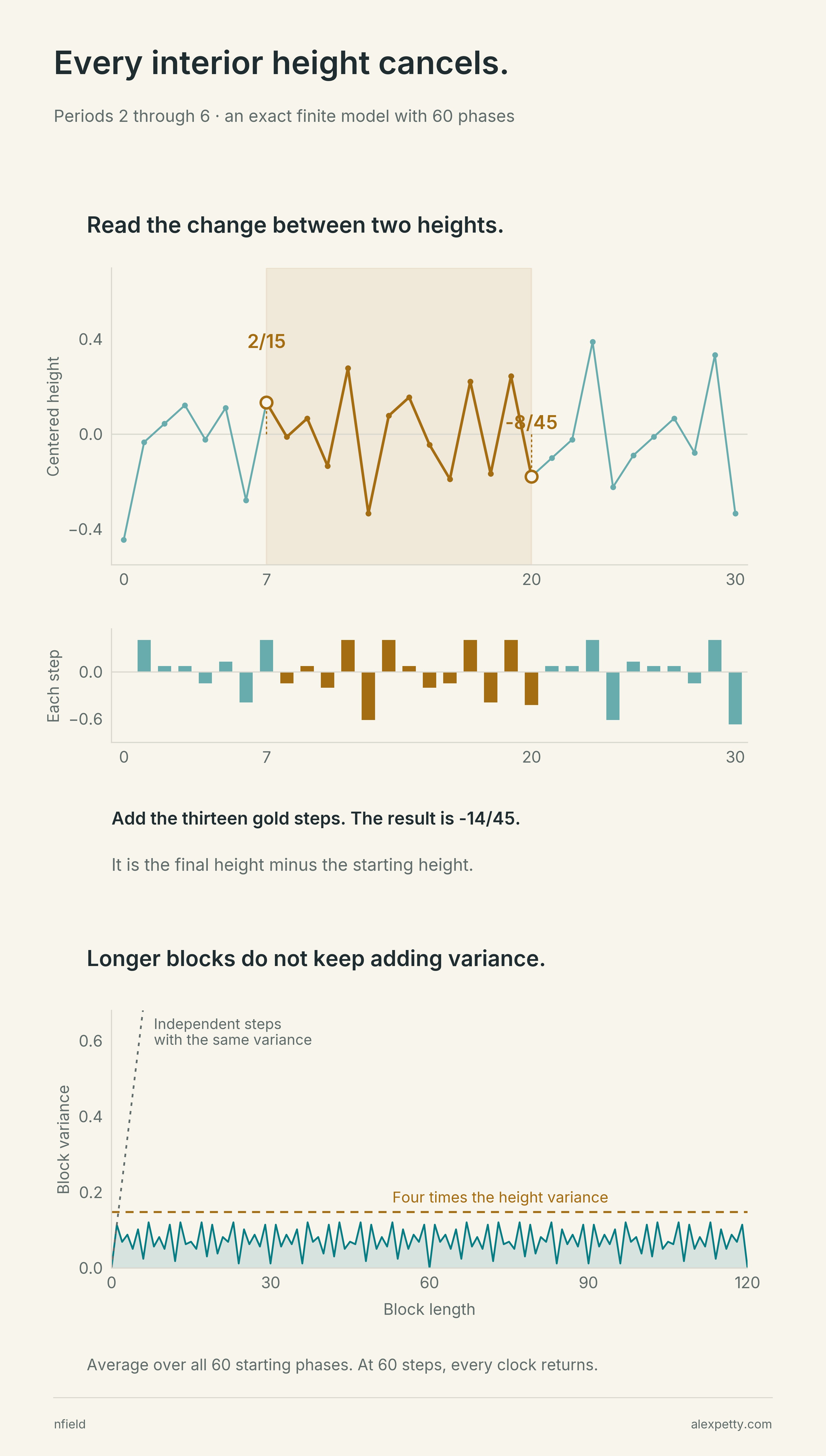
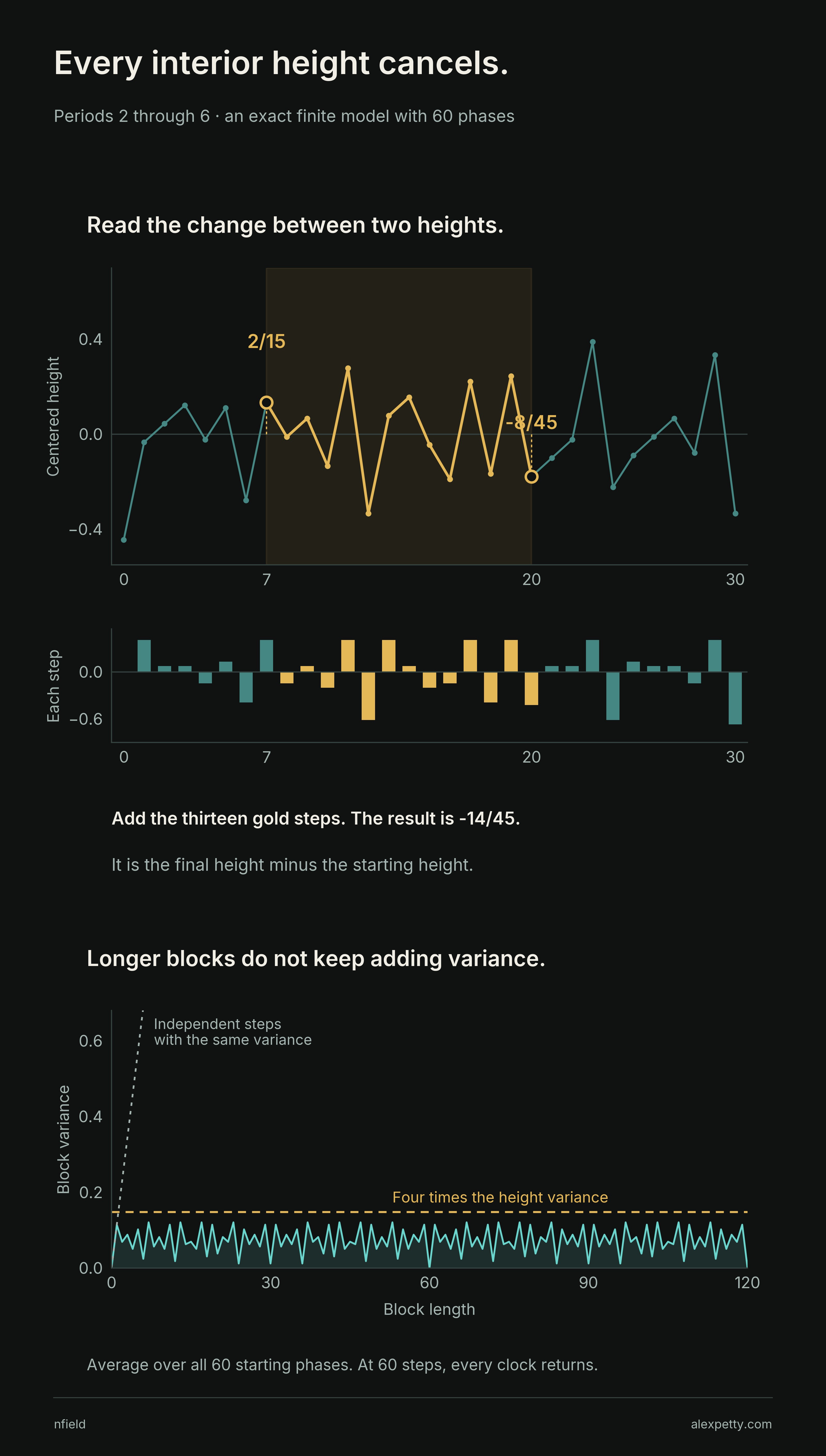
From phase seven to phase twenty, the readout rises and falls thirteen times. Add those changes. Every interior height appears once with a plus sign and once with a minus sign. Only the endpoints remain.
The infinite theorem preserves that cancellation. If is the one-step change and the limiting centered readout, then
Independent steps would keep adding variance. These steps cannot. Their stationary block variance stays below four times the variance of , regardless of block length.
This bounds an average over starting settings. Individual excursions can still be large, since the limiting distribution reaches arbitrarily far in both directions.
Stand at five
There is a trap in taking the average back to the integers.
Fix the integer five and admit longer clocks. On the hundred-clock the hand still points to five, far below its average position of . On the thousand-clock it again points to five, while the average position is .
Each sufficiently long clock adds another negative centered contribution. The weights shrink, but not fast enough to stop their accumulated pull. The centered readout tends to minus infinity.
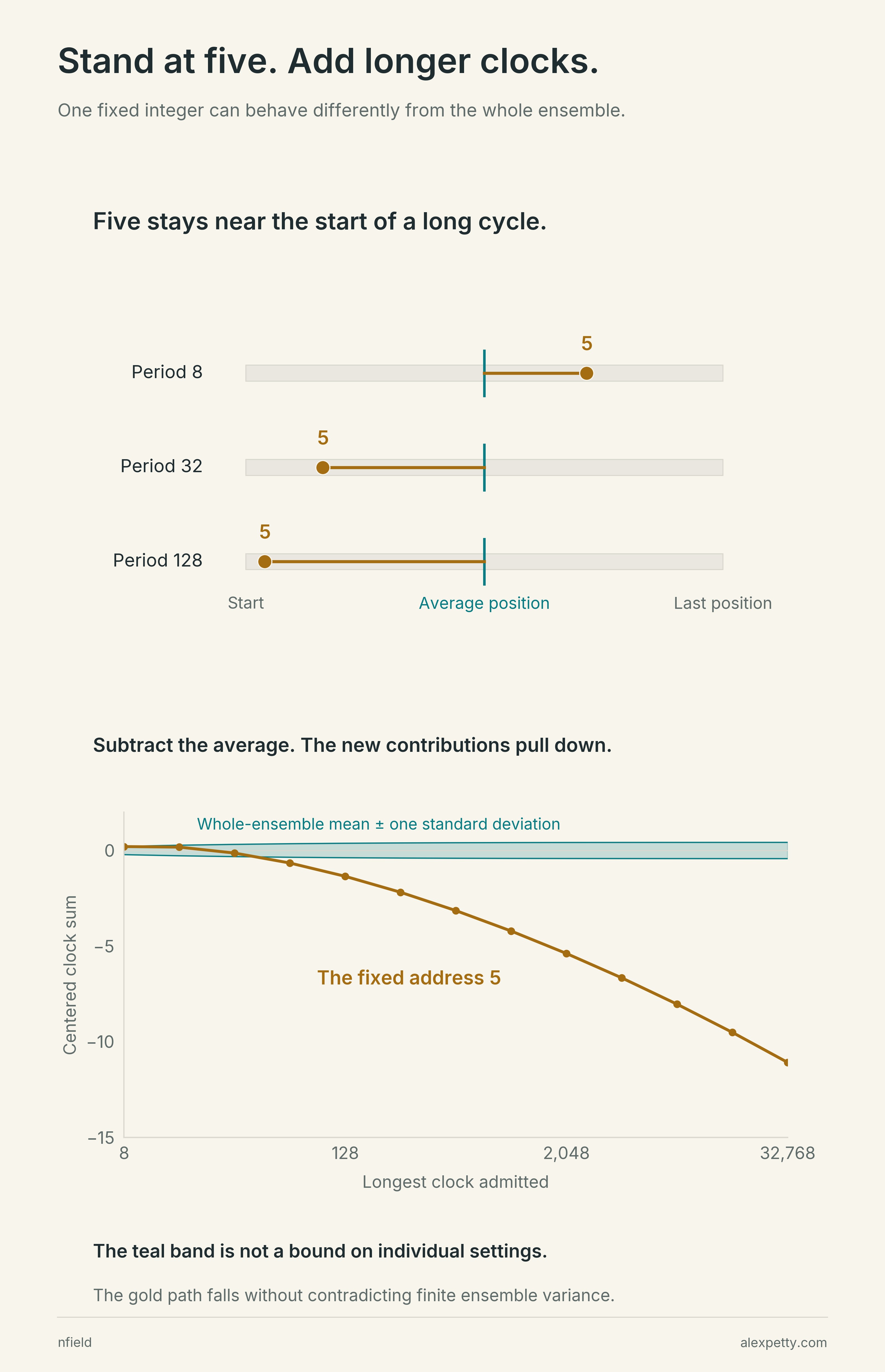
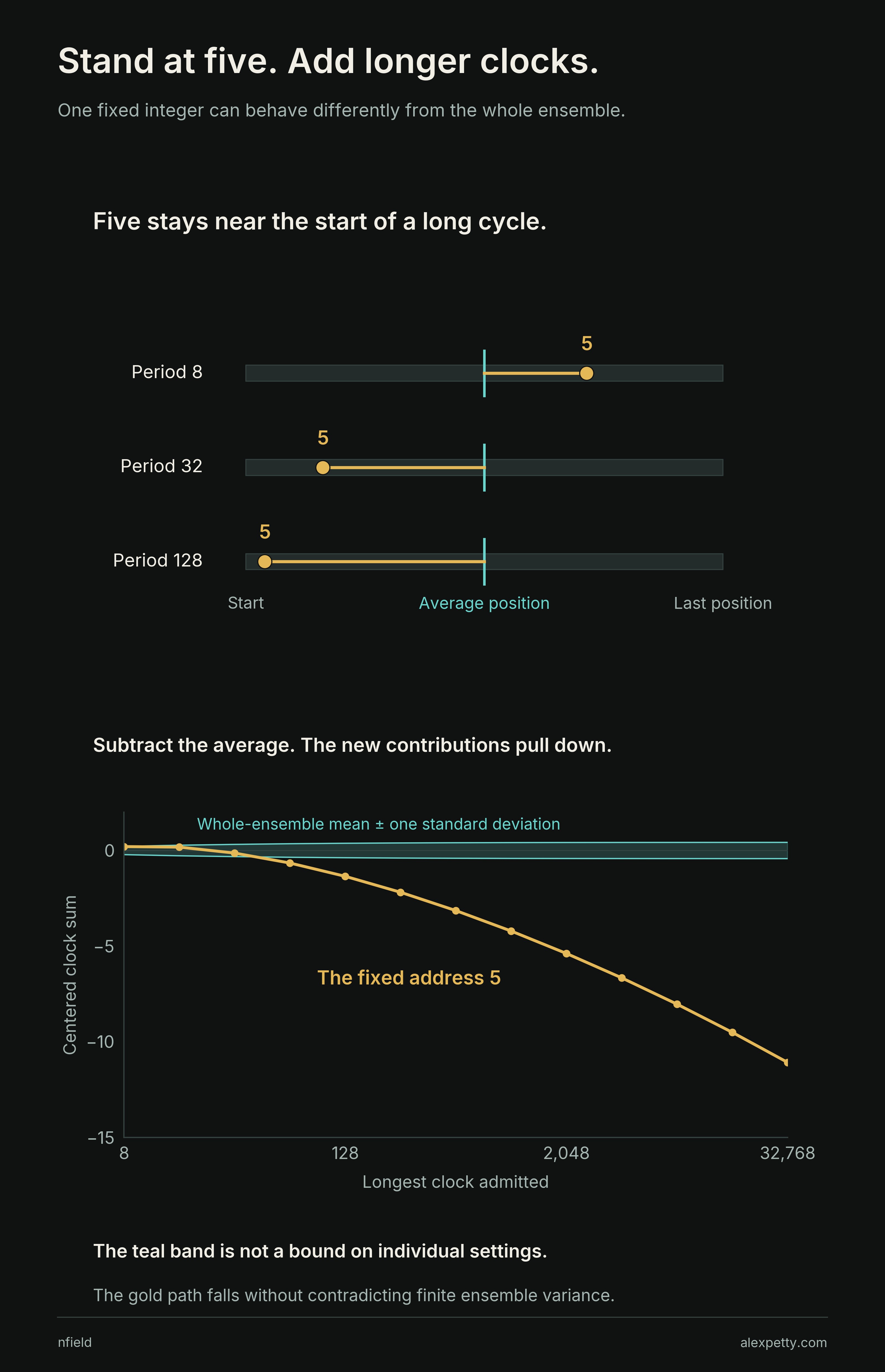
In the lower panel the gold path leaves the teal band before the clocks reach 128 and never comes back. There is no contradiction. Mean-square convergence averages over the whole space of compatible settings. The ordinary integers form a set of measure zero inside it. The theorem can permit bad behavior at every one of them.
The actual energy calculation advances the integer and the resolution together. It reads , changing both the setting and the collection of clocks. Following that moving observation requires estimates that stay valid as the collection grows. The stationary theorem alone does not supply them.
Five is not an isolated exception. Fix any nonnegative integer and its centered readout also falls forever. Five itself, with every clock through 32,768 admitted, is down to about , while the stationary spread at that cutoff is about . That puts one of the most ordinary integers there is twenty-six standard deviations below the middle of the law, and the next clock will push it lower.
The weights the collision calculation chooses
The continuous capacity is
The diagonal contributes . For an off-diagonal pair, write and , with and . Its value is , and it occurs once for each . Include both orders of the pair. Grouping by gives
where
For period four, this is .
The normalization is an exact theorem. One proof splits a coprime pair into its two descendants and . For
the parent minus the two descendants is . Summing down the tree telescopes. The remaining boundary tends to zero, giving total two before the symmetry factor of one half. The resulting mass is one.
Now use to obtain the deficit identity. The long clocks must stay in it. For their position is , even though they contribute zero to the floor sum for .
The increment identity follows immediately,
The same unit-mass accounting gives , hence . Each fixed clock contributes a vanishing fraction of , and the remaining mass can be made arbitrarily small. Passing from continuous capacity to the original cubic digit energy also requires the separate sampling estimate. Conservation does not settle the finer sampling-defect limit.
The average and the finite-variance theorem
Write for the period- position. The stationary average is
The centered readout is
The uniform compatible-state measure is Haar probability. Under it, two centered clock positions have covariance
Thus clocks of coprime lengths have zero covariance, while shared divisors leave an exact dependence. Summing with the collision weights proves in mean square, with error .
The finite picture uses , whose variance is exactly . Its one-step variance is . Averaging over all sixty phases gives the plotted block variances, bounded by . The dotted comparison is , the variance that independent mean-zero steps with the same individual variance would have. No random simulation is used.
The finite increments are those of the truncated readout. They are not the full deficit increments, which also include every longer clock. The infinite identity holds in mean square. For each fixed block length, the corresponding mean square along the ordinary integers agrees with the stationary value. This does not give a uniform theorem with the block length and cutoff growing together.
At any fixed nonnegative integer , once ,
The tail tends to zero and grows without bound. This proves the descent at five and at every other fixed nonnegative integer. The fourth figure computes both the fixed-address path and the stationary standard deviation at thirteen finite cutoffs through 32,768. The shaded band is one standard deviation, not the range of the distribution.
The manuscript also determines the rational-frequency amplitudes, their spectral tail and finite alignment extrema. It proves a symmetric, atomless stationary law with unbounded support and finite moments of every order. Those statements concern the stationary law, not a pointwise value of its mean-square limit at each integer.
Open the clock atlas
Keep the same 1,024 consecutive integer positions and add more clock rows. The first panel stops at period sixteen. The last contains every period from two through 512.
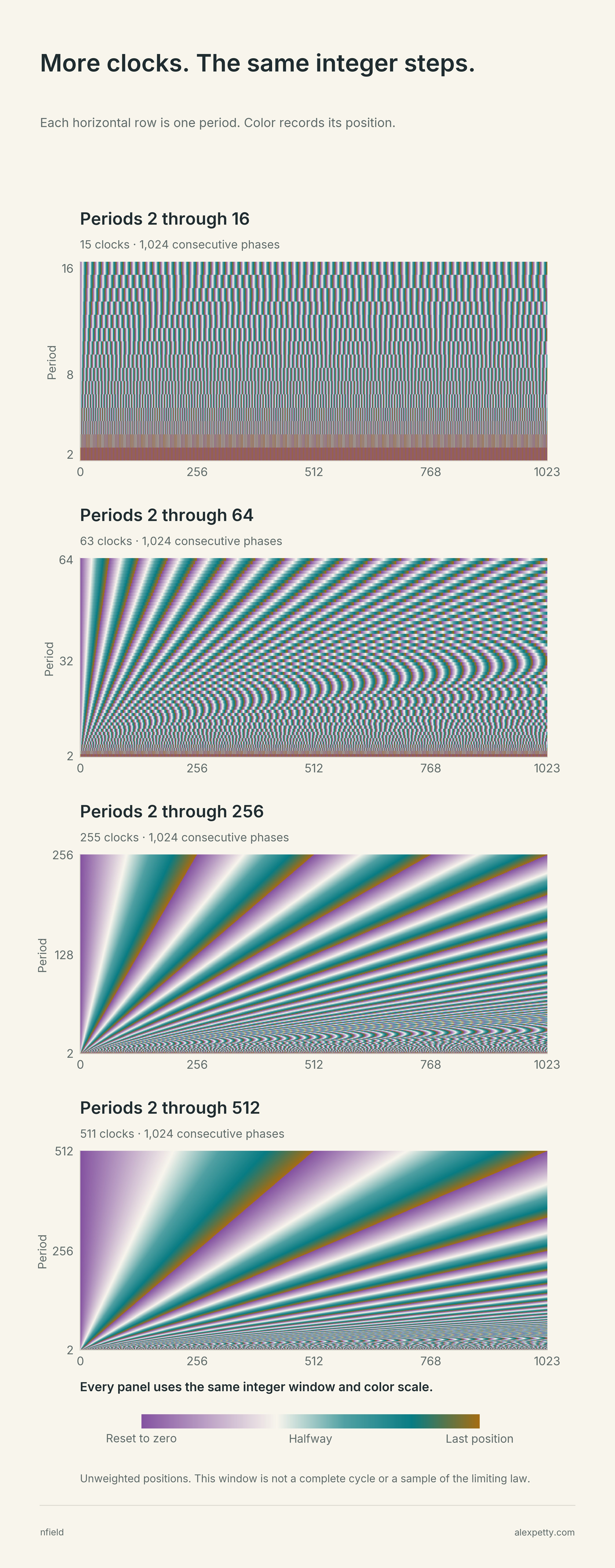
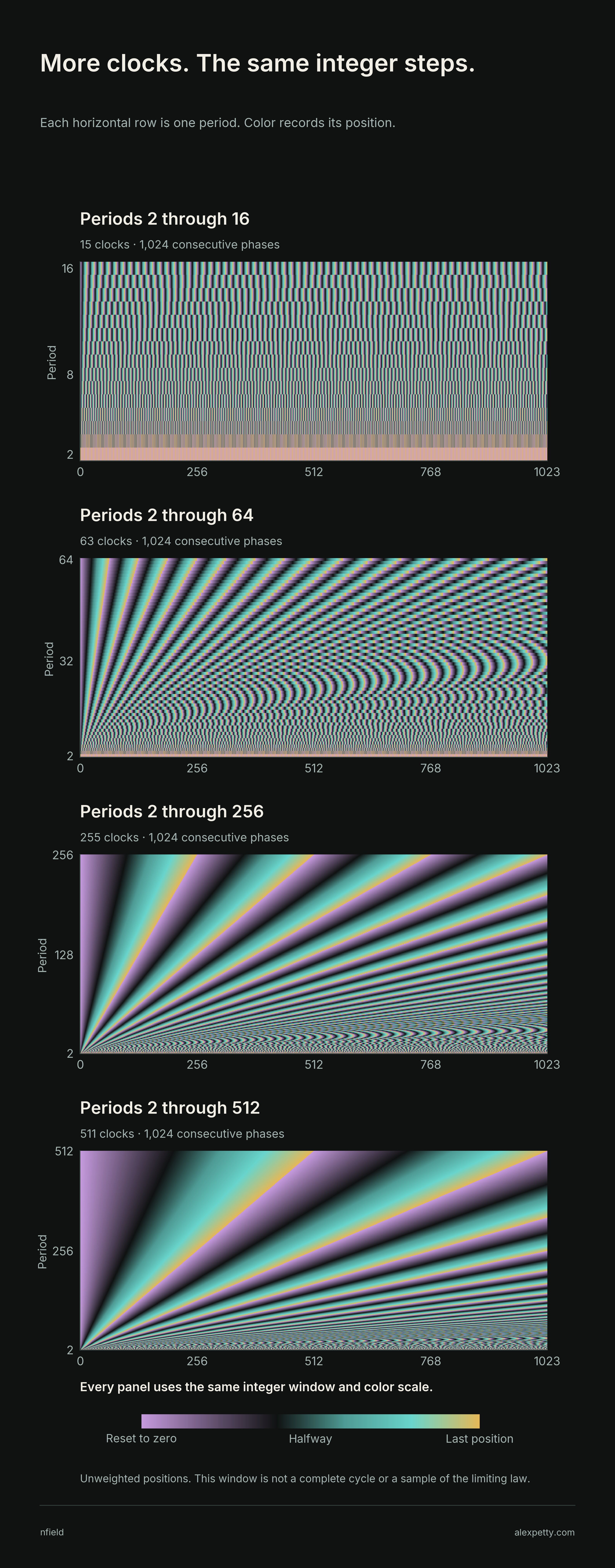
Color shows a hand’s position as a fraction of its journey from zero to the last mark. Gold is the last position before a reset. Violet is zero. The color scale is identical in all four panels. These are unweighted remainders, not energy contributions.
The sloping boundaries are the reset lines . Follow one across periods and the synchronized returns become visible. At reading size, the shortest periods are too densely packed to distinguish every cell. Open the image at full resolution to inspect them.
This is an integer window, not a full cycle through all compatible settings. It illustrates the clock geometry without claiming to sample the limiting stationary law.
Individual clocks and the exact accounting
These complementary views separate the clock positions, the deficit arithmetic and the centered path. Each uses the same five-to-six or seven-to-twenty examples as the main figures.


The paper and its context
The full proofs are in Conservation and Profinite Dynamics in Digit-Collision Energy. The paper separates the exact clock identities, the stationary theorems and the limits that require control along the growing integer resolution.
The profinite adding-one system is classical. The collision calculation selects its particular mass distribution and spectral amplitudes. The leading gcd-sum asymptotic is also classical, due to Hilberdink, Luca and Tóth. Its second term is found in The Secondary Term of the Cubic Law. The conserved-clock construction gives a direct arithmetic route through these quantities.
The cubic energy law itself comes from Digit Collisions and the Cubic Law.
Discussion
Sign in to join the discussion.