Origins
The Effect of Base on Numeric Fields
Divide one by three and the threes run on forever. Most of us grow up thinking that is just what one third looks like. The Babylonians would have found that odd. They counted in sixties, so for them one third was twenty sixtieths, a single digit and done. We still borrow their sixties every time we read a clock. Twenty minutes is a third of an hour, and nobody has ever needed a string of threes to say so.
By the summer of 2010 I had spent a long time drawing numbers in decimal, the nine-spoke circle, the digit sums, the palindromes in Arithmetic Foundations, and that started to bother me. Some of those patterns had to belong to the numbers. Others might belong only to base ten, the way the endless threes do, and from inside decimal I had no way to tell which was which.
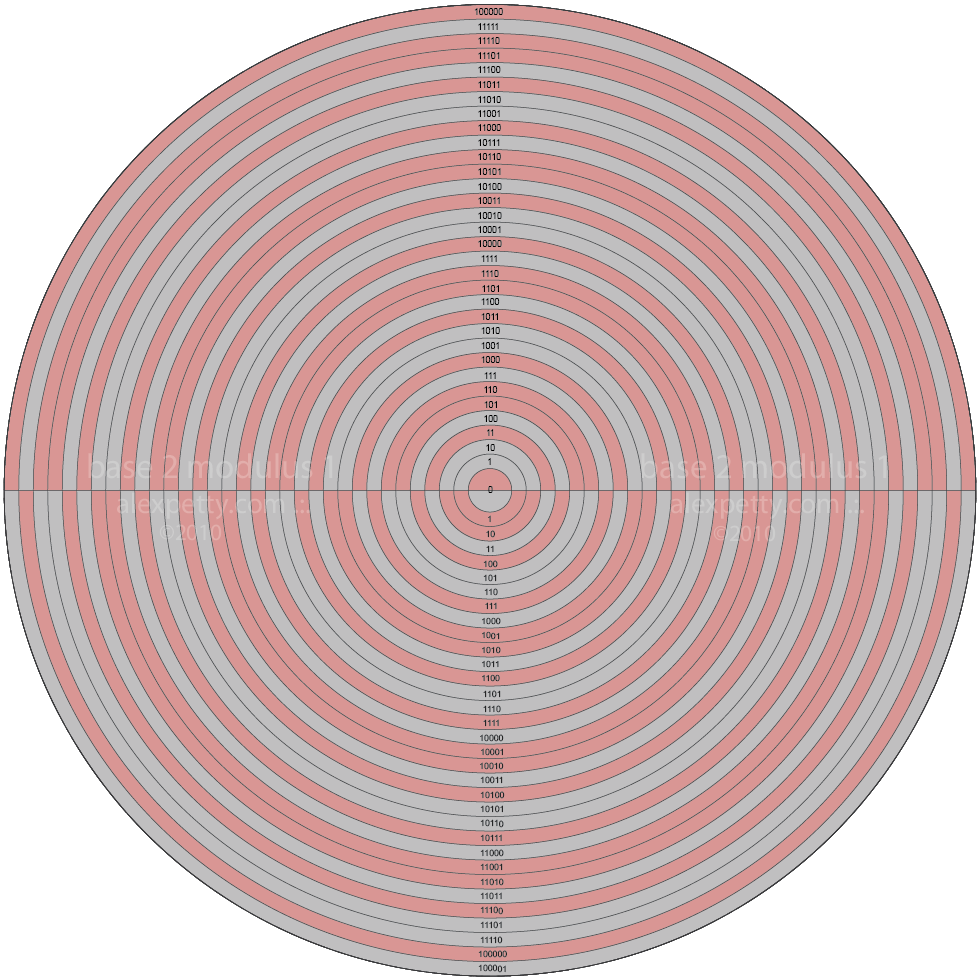
The nine-position decimal circle had become familiar territory. That was a reason to try other bases. I worked down from base nine to binary, keeping the circular format and changing the arithmetic inside it. The two ends of that experiment are below.
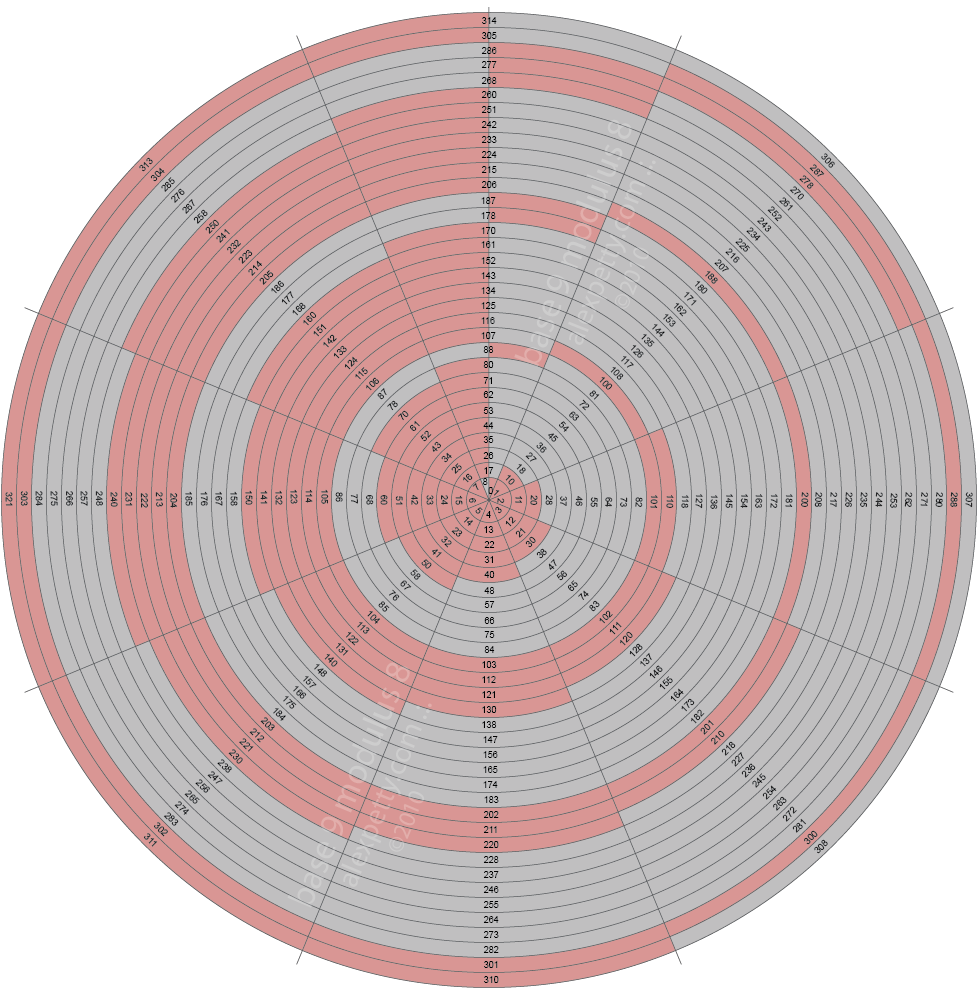
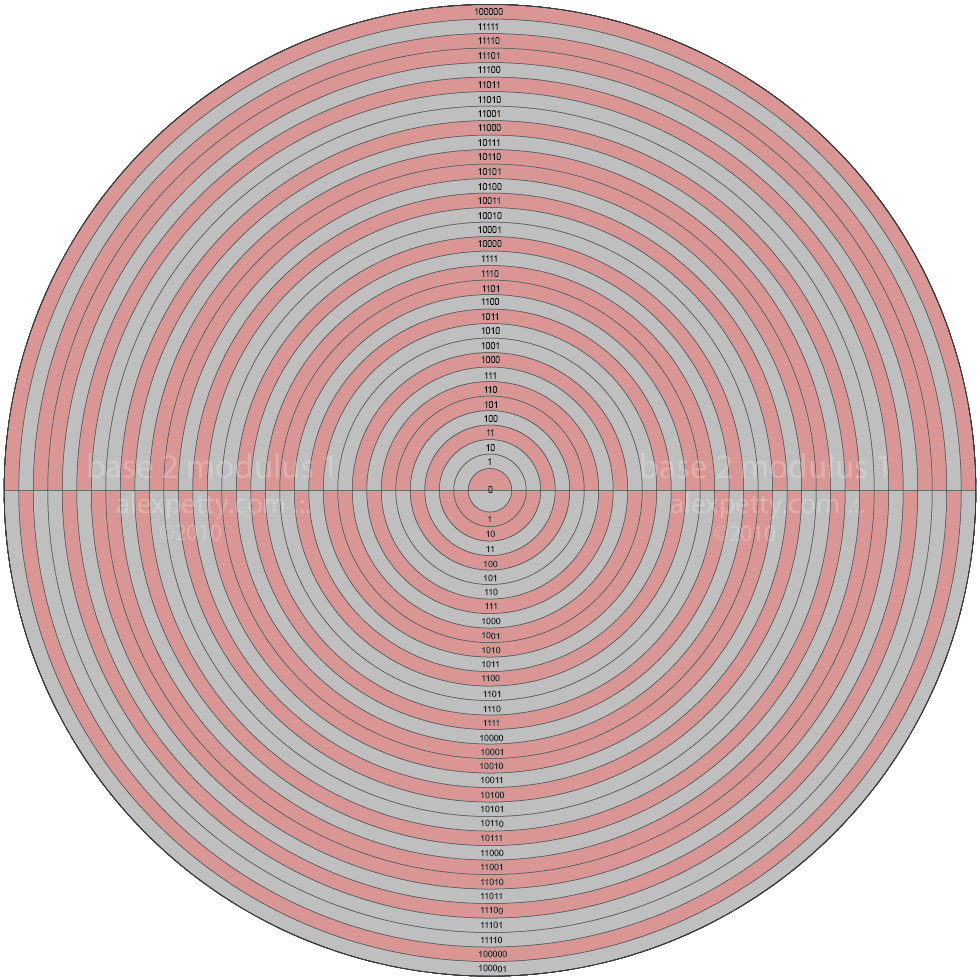
The circles occupy the same space on the page. Their contents differ. Even the binary picture still has bands, written numbers, and two colors. There is more going on here than the count of residue classes.
One ray, seven integers
Base five gives us a manageable place to start. Its digits are zero through four. After four comes 10, meaning one group of five and no units. The numeral 23 means two fives and three units, or thirteen in decimal.
For these drawings I paired each base with the modulus one less than itself. In base five that is four. Integers with the same remainder modulo four share a ray.
Follow the ray containing one. Each step adds four to the integer. The worksheet also adds the digits of its base-five numeral.
| Integer in decimal | Written in base five | Sum of those digits | Remainder modulo four |
|---|---|---|---|
| 1 | 1 | 1 | 1 |
| 5 | 10 | 1 | 1 |
| 9 | 14 | 5 | 1 |
| 13 | 23 | 5 | 1 |
| 17 | 32 | 5 | 1 |
| 21 | 41 | 5 | 1 |
| 25 | 100 | 1 | 1 |
The integer keeps increasing. Its digit sum rises and then falls. At twenty-five, the numeral becomes 100 and the sum returns to one. The carry has changed the written arrangement while leaving the remainder alone.
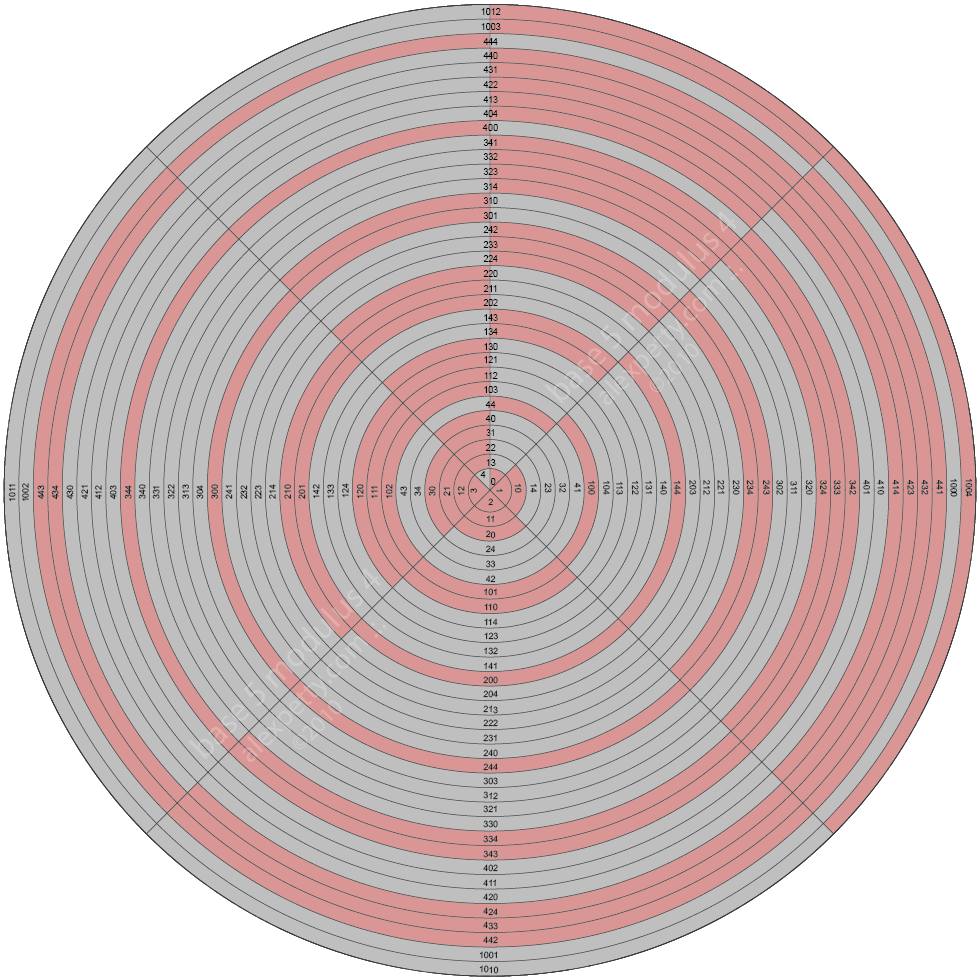
This was the sort of reversal I was trying to understand. The drawing held several such sequences together, so I could compare the changes along one ray with those along its neighbors.
Read the original base-five worksheet
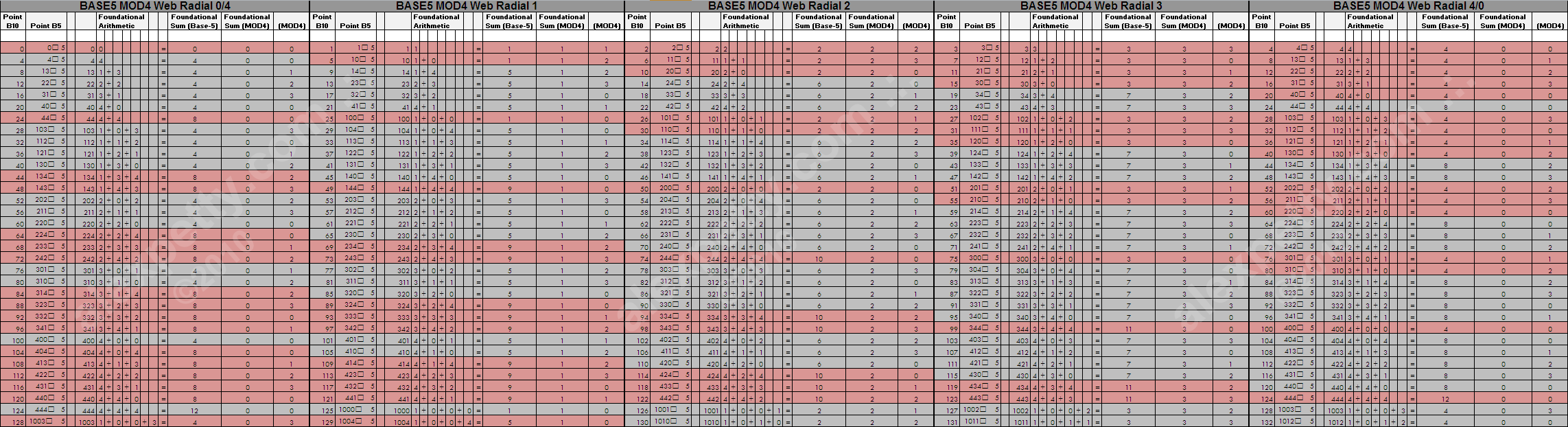
The panel headed Web Radial 1 contains the example above. Follow Point B10, Point B5, Foundational Arithmetic, and Foundational Sum. The column headed Foundational Sum (MOD4) gives the residue used here.
One less than the base
The choice of modulus gives the digit sum a useful property. Five leaves remainder one when divided by four. So do twenty-five, one hundred twenty-five, and every higher power of five. Modulo four, every place in a base-five numeral therefore contributes its digit with the same weight.
Thirteen makes the calculation small enough to do in a line.
The same reasoning works in every base. If denotes the sum of the base- digits of an integer , then
The familiar decimal digit-sum check modulo nine is one instance of this rule. Changing the base changes the modulus along with it.
Each original worksheet gives 33 entries per ray. In base five, the first panel runs through zero, four, eight, and so on to 128. The next begins at one and ends at 129. The last panel repeats the zero residue with a one-step offset, beginning at four, to record the closing side of the circle. Its labels 0/4 and 4/0 mark the seam. Zero and four occupy the same position, approached from the two sides of the return. There are four residue classes, even though the sheet has five panels.
The information left in the sum
The reduced sum stays at one along our chosen ray. The unreduced sum distinguishes the rows. In both the worksheet and the circular chart, sums zero through three are red, four through seven are gray, and eight through eleven are red again. The colors retain a distinction that reduction modulo four removes.
Zero and four make the seam particularly clear. They return to the same position, but zero is red and four is gray. Eight returns to red. Position and color together keep the digit sum modulo eight, while position alone keeps it modulo four.
Red and gray were my early polarity colors. I used expansion and contraction to describe the changes I saw. The table gives those words a specific example. A growing integer can have a falling digit sum, and a fixed remainder can accompany both.
Binary makes the separation especially plain. Its only nonzero digit is one, so adding its digits means counting its ones.
| Integer | Binary numeral | Number of ones | Remainder modulo one |
|---|---|---|---|
| 0 | 0 | 0 | 0 |
| 1 | 1 | 1 | 0 |
| 2 | 10 | 1 | 0 |
| 3 | 11 | 2 | 0 |
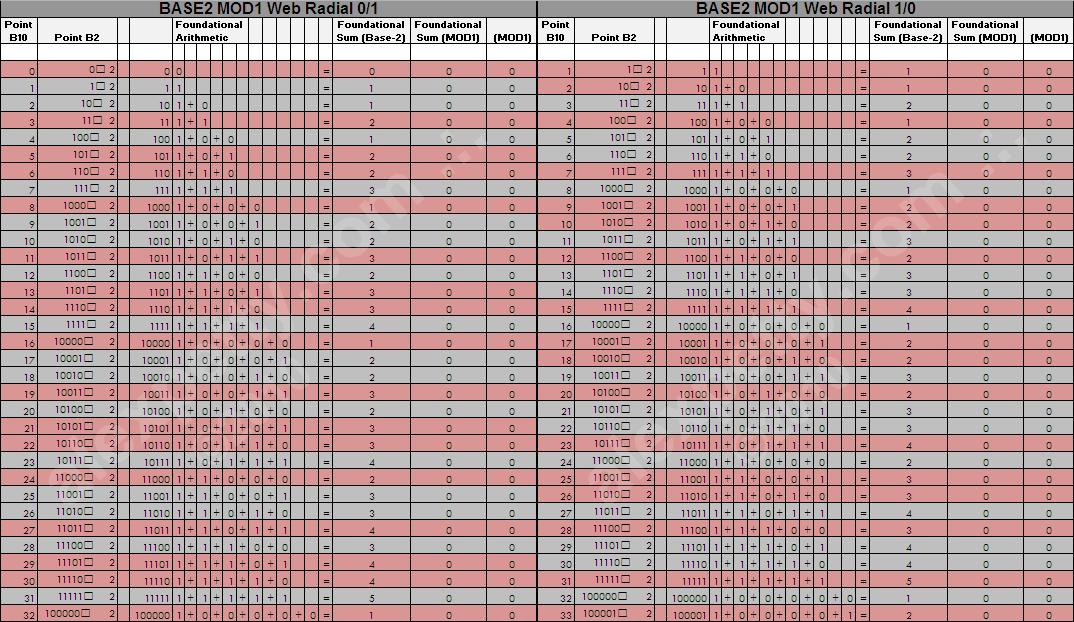
Modulo one, everything is zero. The written numerals and their digit sums remain different. Red records an even number of ones, gray an odd number. The position has lost every distinction, while the color still keeps one. That is why the original binary image can contain a pattern even with only a single residue class.
Read the original binary worksheet
Both reduction columns are zero throughout. The digit-sum column still varies, and its rows retain the two colors. The two panels begin at zero and one respectively.
An exact mirror
The recurring reflections also have a simple arithmetic counterpart. Fix the number of digit places, including leading zeros when needed, and pair each digit with its complement to the largest digit in that base.
With two base-five places, the largest numeral is 44, or twenty-four in decimal. Thirteen and eleven are complementary parts of that total.
Their digit sums are five and three, adding to eight. Each place contributes four to the combined sum. More generally, complementary numerals occupying places have digit sums totaling .
The same rule works in binary, decimal, or any of the bases shown here. The total depends on the base and the number of places. Specifying both tells us exactly where the reflection lies. This is a precise relationship to examine alongside the mirrored bands in the original drawings.
A common frame, different arithmetic
Keeping the circles the same size made comparison possible. It did not make their arithmetic identical. Base nine modulo eight has eight residue classes. Base five modulo four has four. Binary modulo one has one. The drawing frame stays fixed because I kept it fixed.
Long division makes the effect of a changed base equally clear. One third repeats as 0.010101… in binary, terminates as 0.1 in base three, and repeats as 0.111… in base four. The fraction is unchanged. Its digit process is different.
I was interested in unity and in the persistence of a whole through changes in its internal arrangement. These comparisons gave that intuition something to work against. Some features belonged to the display, some to the base, and some to relationships that could be stated for every base. Finding the distinction became part of the work.
Later, Digit-Partitioning Primes and the Alignment Formula made the base’s role explicit in the way remainders produce digits. The Structure That Survives proved a reflection law of its own, for a finite table of collision counts. Those results required their own calculations. The early drawings had supplied questions worth keeping.
Changing the base makes a familiar pattern answer for itself, and one third answers first. Its endless threes belong to base ten. In base three, or in the sixties the Babylonians counted in, the same third is a single digit and done.
Compare the original fields
All sixteen original images are below. The circles share one display size, and their tables hold the calculations. Open a group, then select an image to read the original at full resolution.
Base nine · eight residue classes
Compare this sheet with the base-nine circle at the beginning. Successive entries on a ray differ by eight. The closing panel repeats the zero residue one step later.

Base eight · seven residue classes
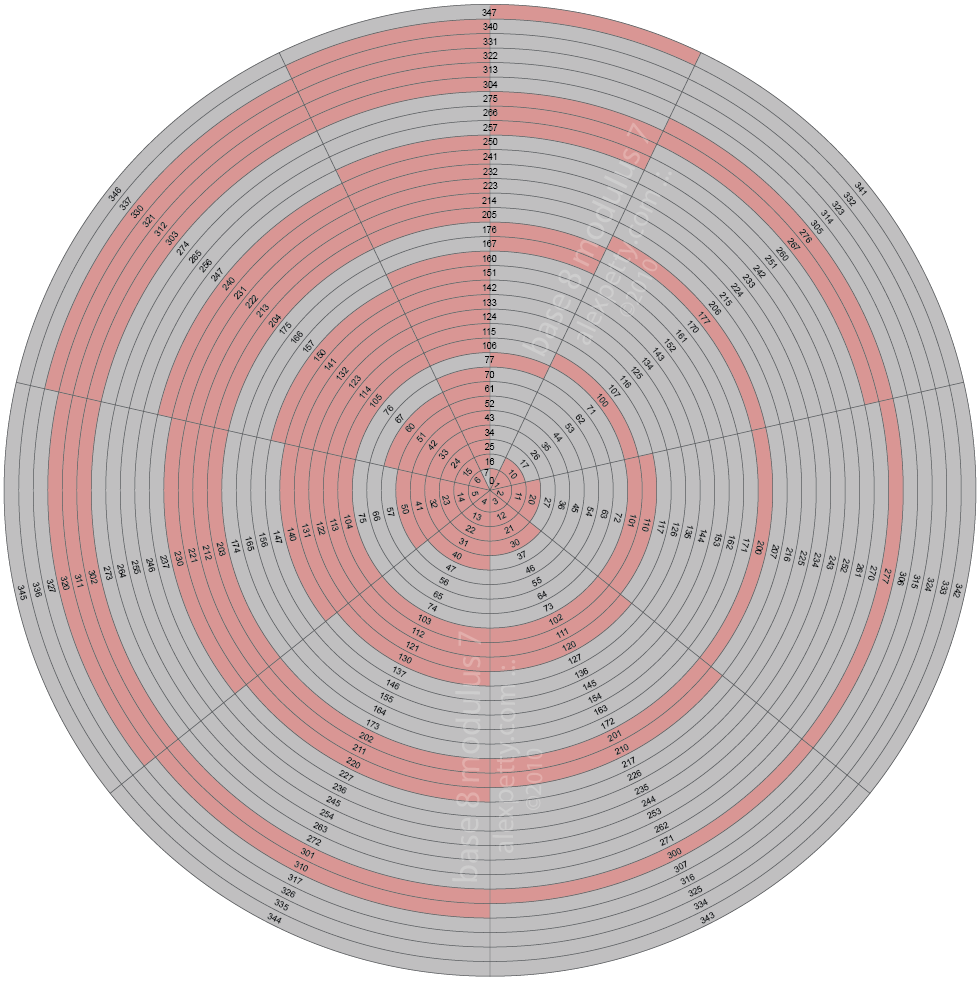
The seven residue positions form a different angular arrangement from their neighbors in this series. Each ray advances by seven.

Base seven · six residue classes
Six residue positions supply the rays. Follow the written numerals and their digit sums across the table to distinguish a change of color from a change of residue.

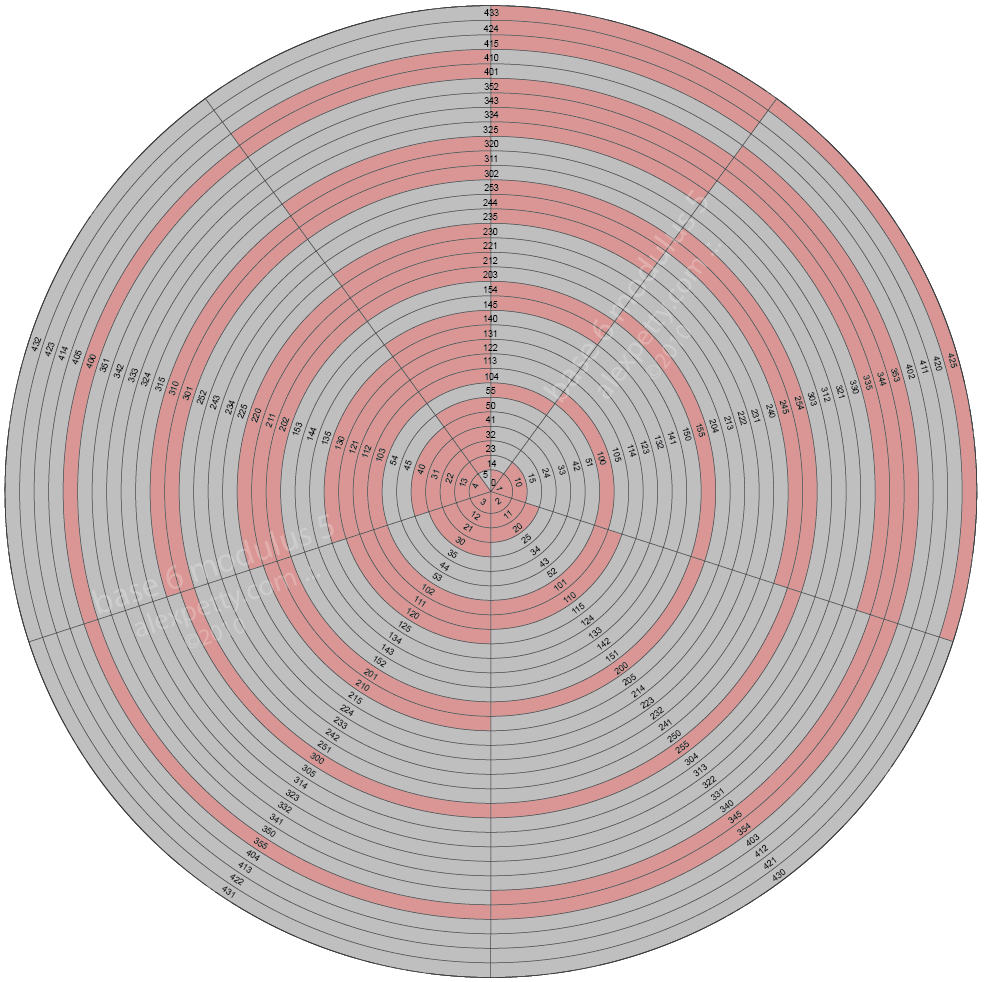
Base six · five residue classes
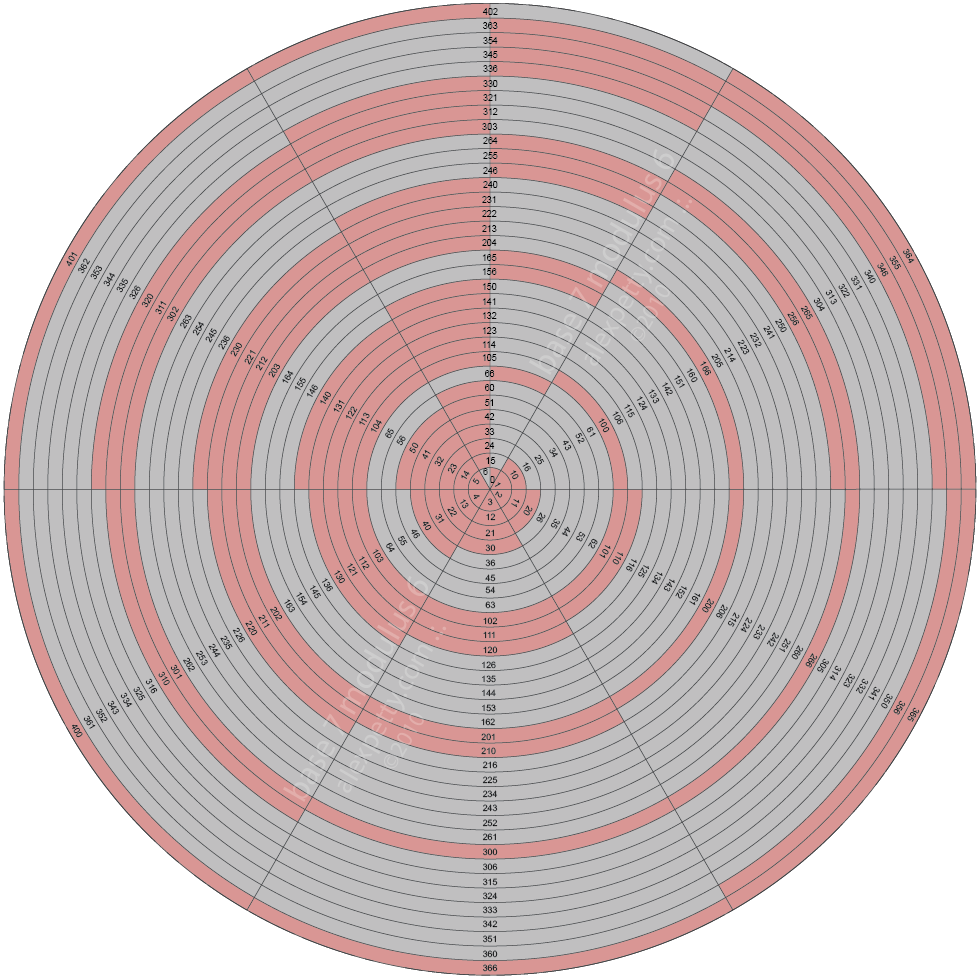
The modulus is five. The same digit-sum congruence holds, with a different set of digits and a different spacing of carries.

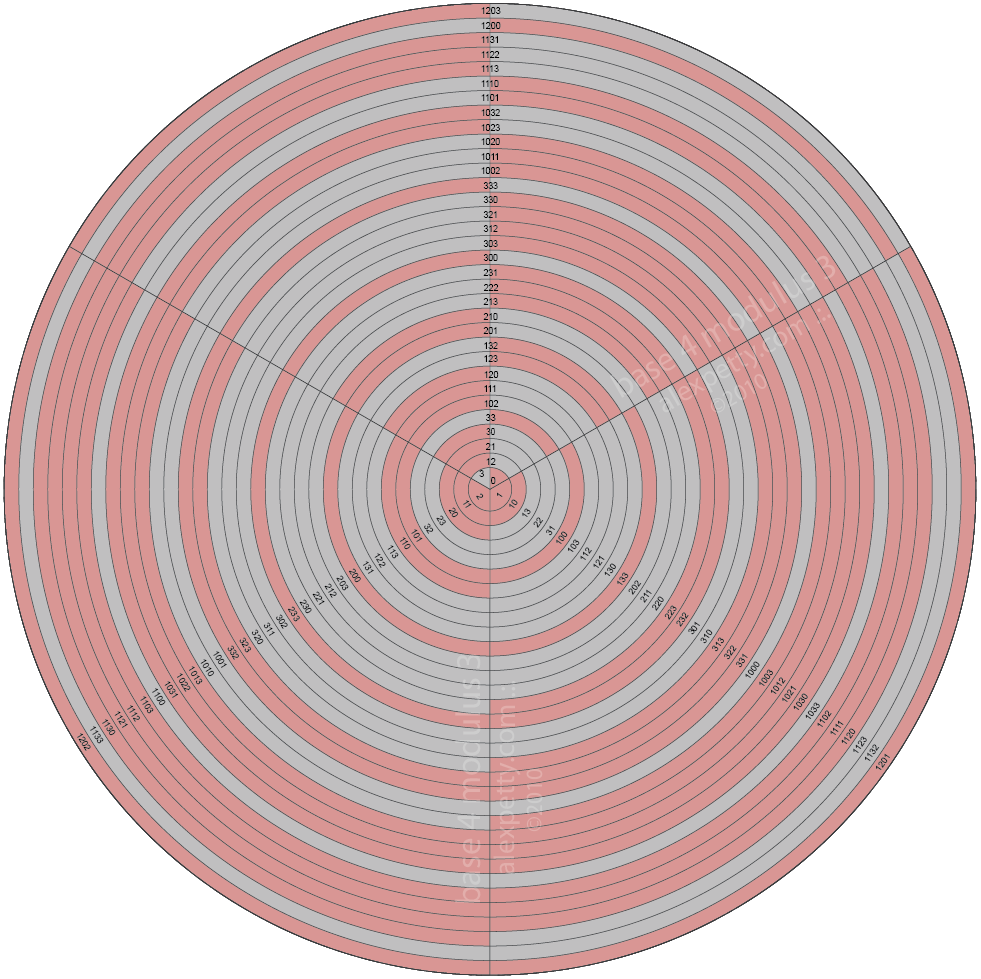
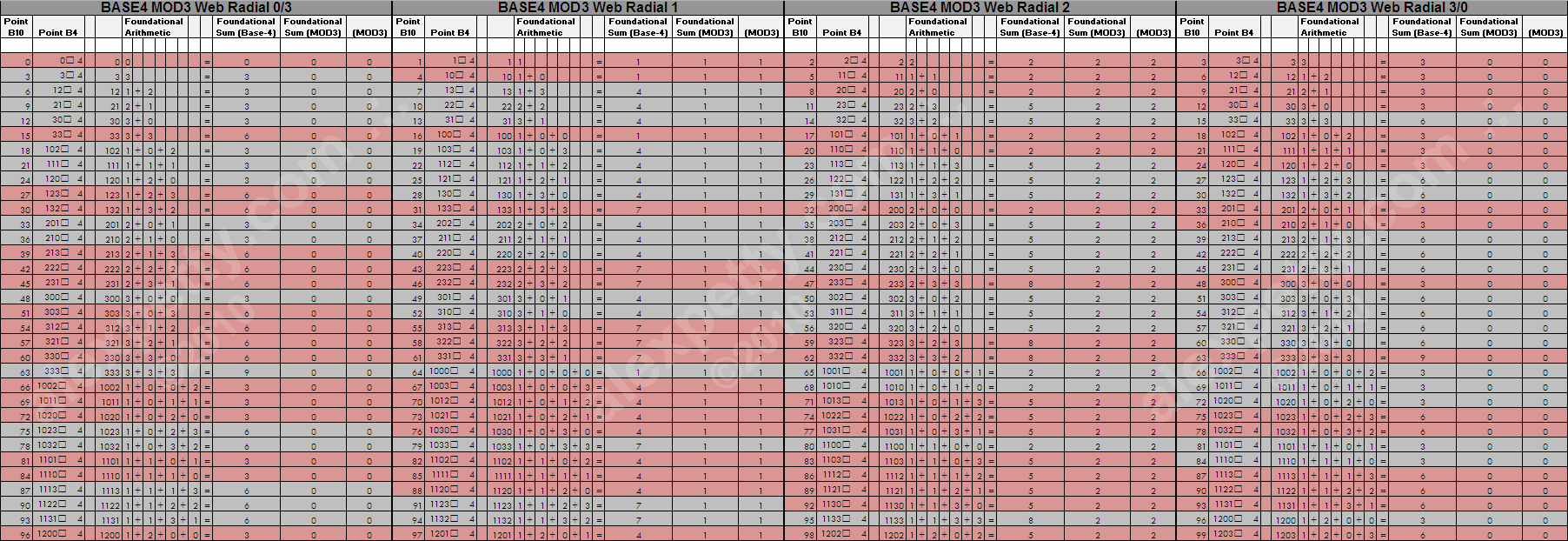
Base four · three residue classes
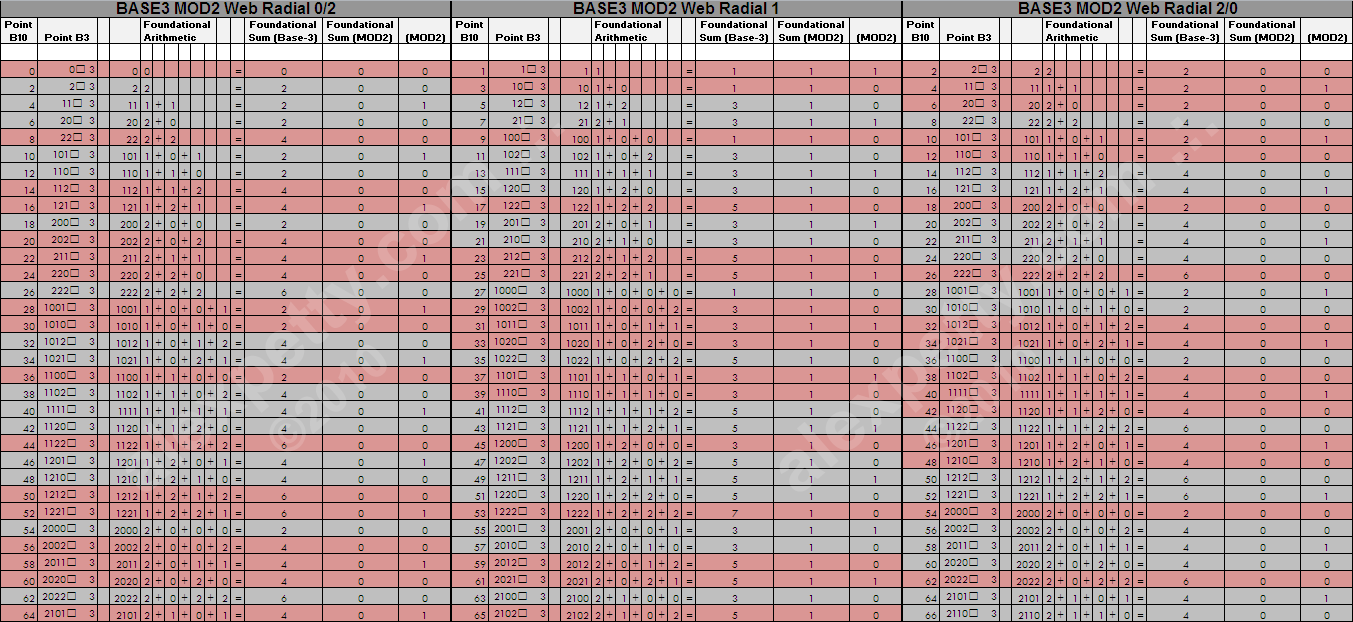
Three residue positions produce the three-ray arrangement. The worksheet records successive entries thirty-three times along each ray.
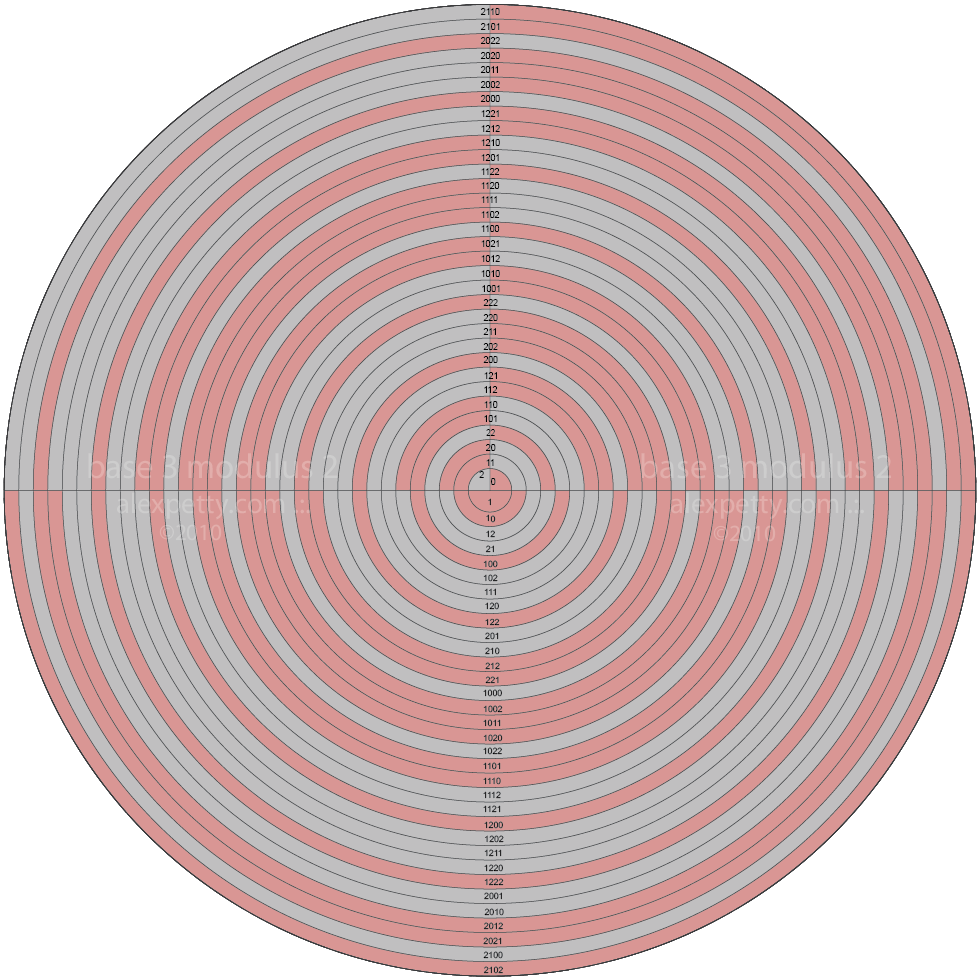
Base three · two residue classes
The residues alternate between zero and one as the integers increase. The digit sums and the original colors keep additional information, just as in the worked examples.
First written in August 2010, and rewritten in September 2026 around the original drawings.
Discussion
Sign in to join the discussion.