Collisions
The General Neutrality Theorem

Number theorists sort primes by congruence conditions all the time, keeping only the primes that leave one on division by four, or by thirty, or by twenty-five. Sort the collision weights the same way and some of the sorted sums tilt. The primes leaving one on division by twenty-five are exactly the primes ending in or , whose centered weights are and . Divided by , their sum climbs without end, like . The Neutrality Theorem showed that division by three can’t do that to either of its two groups. The general theorem finds the line. Any collection of conditions modulo distinct primes leaves every group neutral, so each restricted sum converges on its own at , whatever the base and lag. Twenty-five falls on the wrong side because its prime factor appears twice.
Four is just as much a square as twenty-five, and the general theorem has nothing to say about it. In decimal it does no harm anyway. Primes congruent to one modulo four and primes congruent to three are each neutral, thanks to a cancellation the general argument can’t see. Finding it takes a separate calculation with floors, and the calculation comes down to two numbers, and .
Ten stops around a circle
Thirty is squarefree, two times three times five, so the theorem covers it. Past a hundred, the first primes leaving one on division by thirty are these six.
| Prime | Centered collision weight |
|---|---|
| 151 | |
| 181 | |
| 211 | |
| 241 | |
| 271 | |
| 331 |
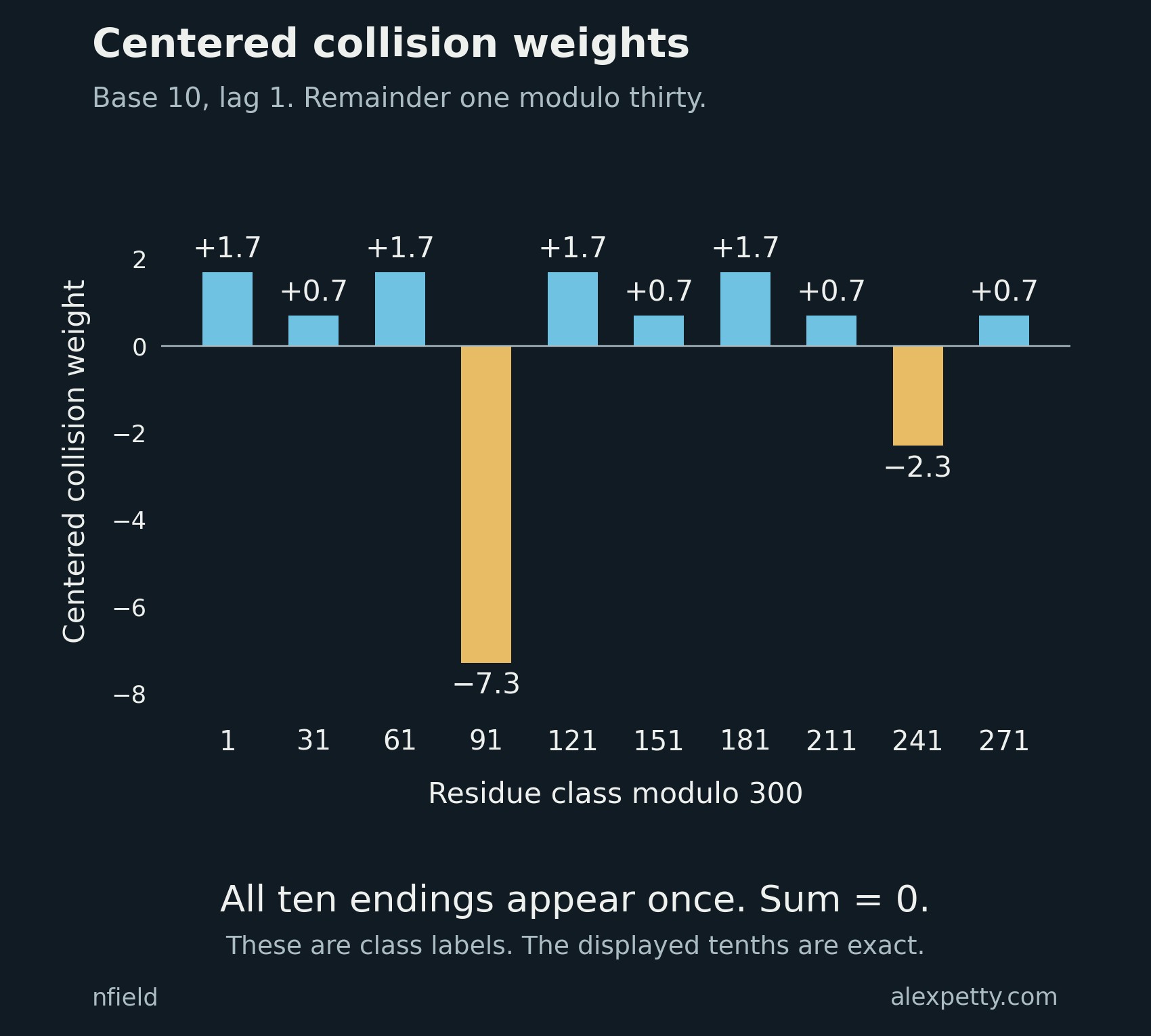
Their weights add to . Each weight comes from the decimal collision table of The Centered Collision Sum. At , fourteen of the fractions open with two equal digits, one short of the bin size of fifteen, so the table entry is . Primes ending in average , so the centered weight of is .
The balance lives in the classes these primes come from. The table repeats every hundred and the condition every thirty, so both repeat every three hundred. Within one such cycle, the numbers congruent to one modulo thirty are
Their last two digits run through , every ending in exactly once. Adding thirty shuffles the order of the column without leaving a hole in it.
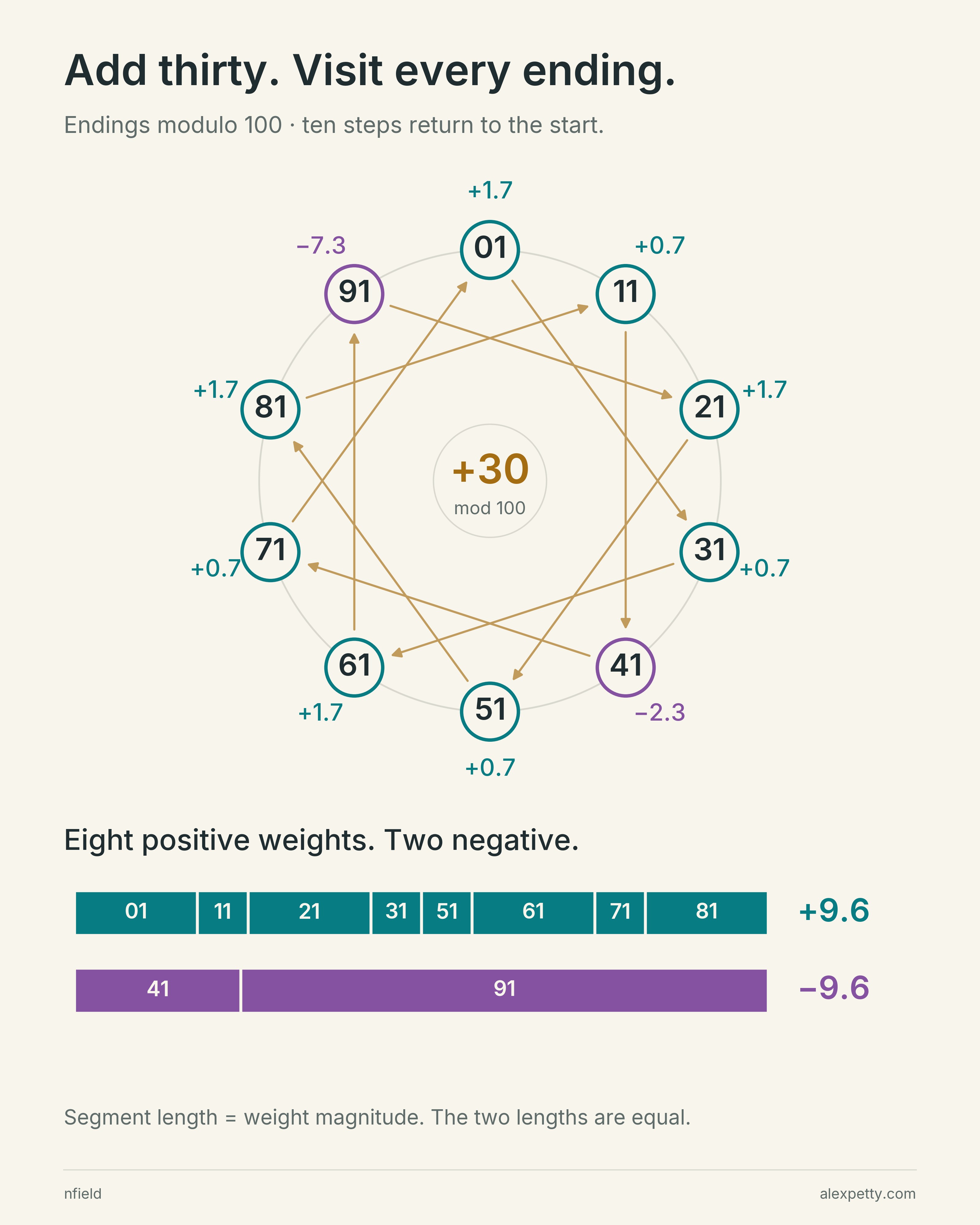
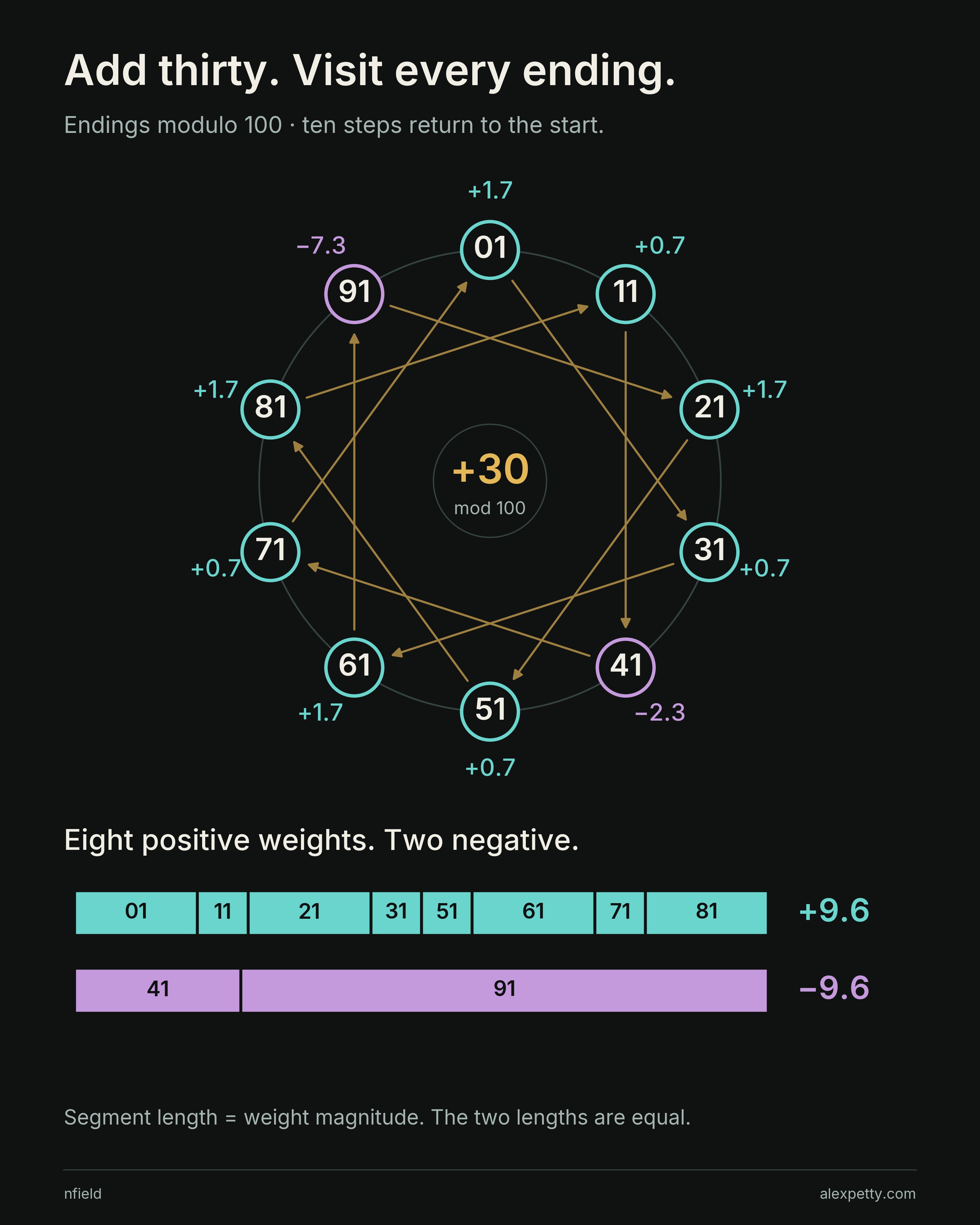
Centering subtracts the column’s average from each of its ten entries, so the column sums to zero. So do these ten classes modulo . The six primes above haven’t reached , , or yet. Those four endings add to exactly , most of it from the at .
A whole column or the whole table
Now require remainder one modulo twenty-one, which imposes conditions modulo three and seven at once. Twenty-one shares no factor with a hundred. Fix any of the forty decimal endings and step forward by hundreds, and exactly one of the next twenty-one numbers meets the new condition. Every ending occurs once in the combined cycle of length .
So the condition modulo thirty keeps one complete column and the condition modulo twenty-one keeps the complete table, and both sums are zero. The Chinese remainder argument behind them, the one from The Neutrality Theorem, works in every base. A prime that divides the base selects whole final-digit families. A prime that doesn’t adds an independent coordinate. Combining such conditions never cuts a centered family into unbalanced pieces.
In general, take base and lag , so the centered table has modulus . Let be squarefree, let be coprime to , and put . Then
Squarefree means no prime factor occurs twice, and the restriction matters. Modulo , the condition keeps only the endings and of the decimal table, with weights and and a sum of . The condition reads both digits of the address at once and lands on two cells of a column that balances only as a whole. That , spread over the forty classes modulo a hundred, is the in front of .
Open the congruence atlas, from forty entries to four thousand
The same three conditions act on the decimal tables at lags one, two and three. Conditions modulo 21 and 30 keep whole balanced pieces at every lag, while modulo 25 leaves fragments whose sums are , and .


Each group pays its own way
The finite balance decides what happens when the weights in one allowed group are divided by their primes and added up. For each reduced class modulo , Mertens’ theorem in arithmetic progressions gives
Every class gets the same growing term. Weight each class’s sum by its collision weight and add over the allowed classes, and the coefficient of is the finite sum just proved to be zero. Only constants and errors that tend to zero remain, so the restricted collision sum converges at reciprocal weight. Starting past only drops finitely many terms.
Different groups can converge to different values, and nothing says those values are zero. Each group cancels its own logarithmic drift, which is all neutrality promises. With in place of the finite balance is unchanged, but the convergence argument no longer applies. The large primes count for more, and the order in which they visit the table starts to matter.
Four signs, one unexpected zero
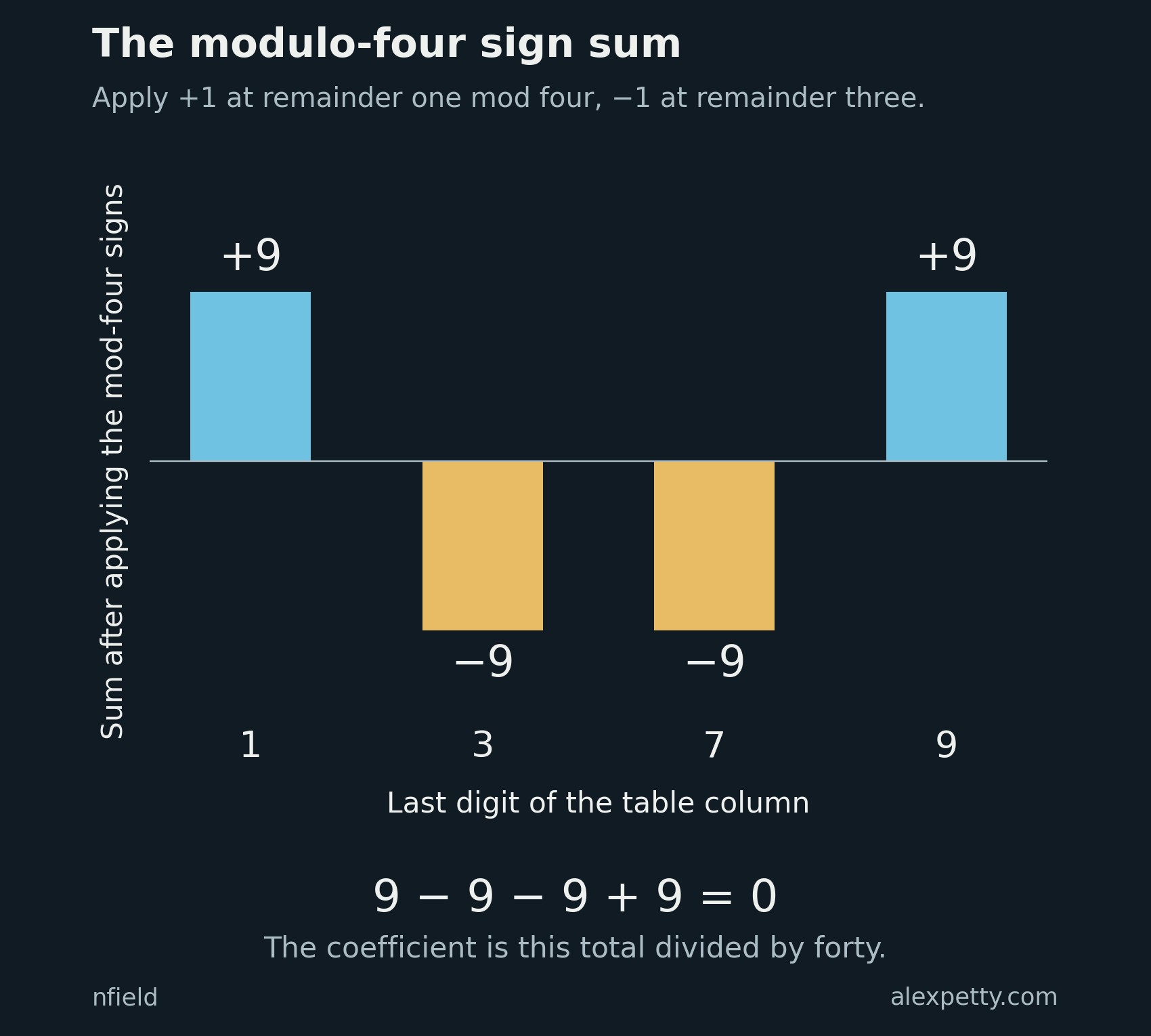
Give a plus sign to the odd numbers leaving one on division by four and a minus sign to those leaving three. The signs multiply correctly, so together they form the Dirichlet character . Multiply each centered weight by its sign, and the four decimal columns total , , and .
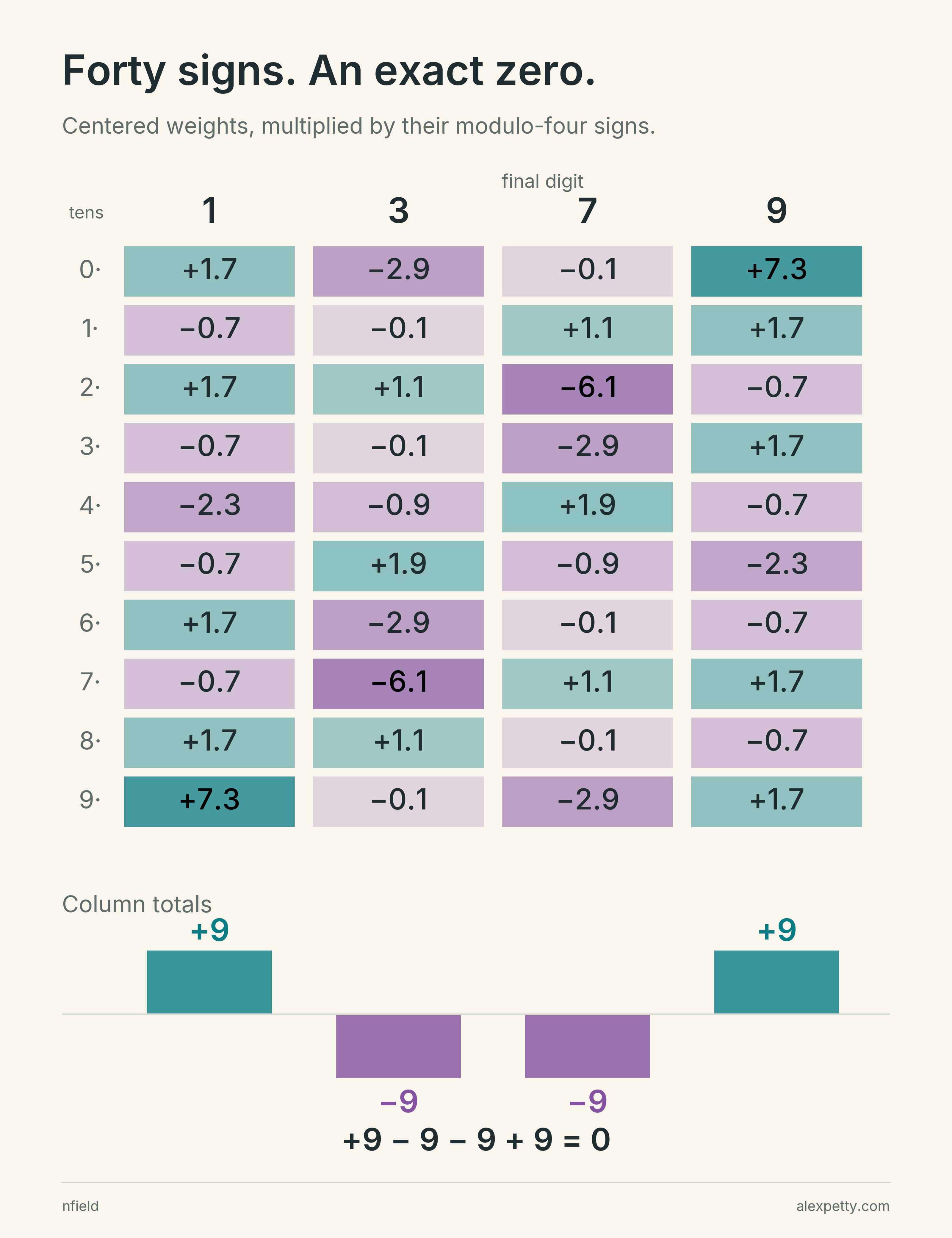
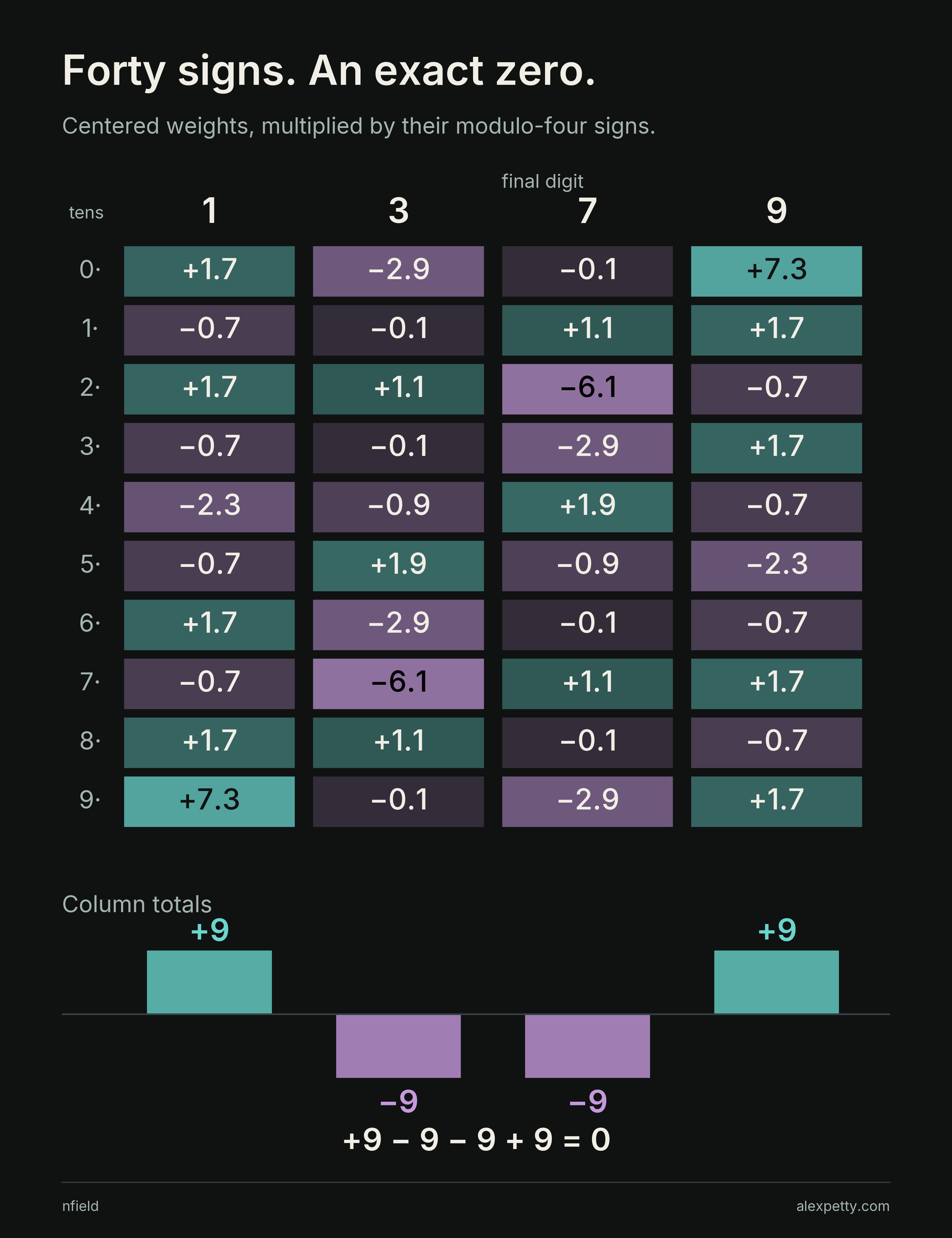
The forty products add to exactly zero, so
where is the set of forty endings coprime to a hundred. In terms of primes, the group congruent to one modulo four is half the collision sum plus half its twist. The group congruent to three is half the sum minus half the twist. With the twist coefficient at zero, both groups are neutral.
Neither of the two usual rules from The Centered Collision Sum explains this zero. Reflection kills every even character, and . Centering removes the characters that depend only on the final digit, and gives opposite signs to and . The zero needs its own calculation.
Twenty-five and seventy-five
Define a signed floor sum
For it has exactly two nonzero values,
and every other value is zero. The proof is collapsed below the next figure. First, look at where the collision count calls on this function.
Two adjacent decimal digits agree in the intervals , , through . Numbering the hundred intervals from zero, their left endpoints are
Counting fractions inside those intervals takes a floor at each end. After multiplying by the modulo-four signs and summing over the table, the raw collision deviation becomes
The baseline asks for , and the intervals ask for and . None of them asks for or .
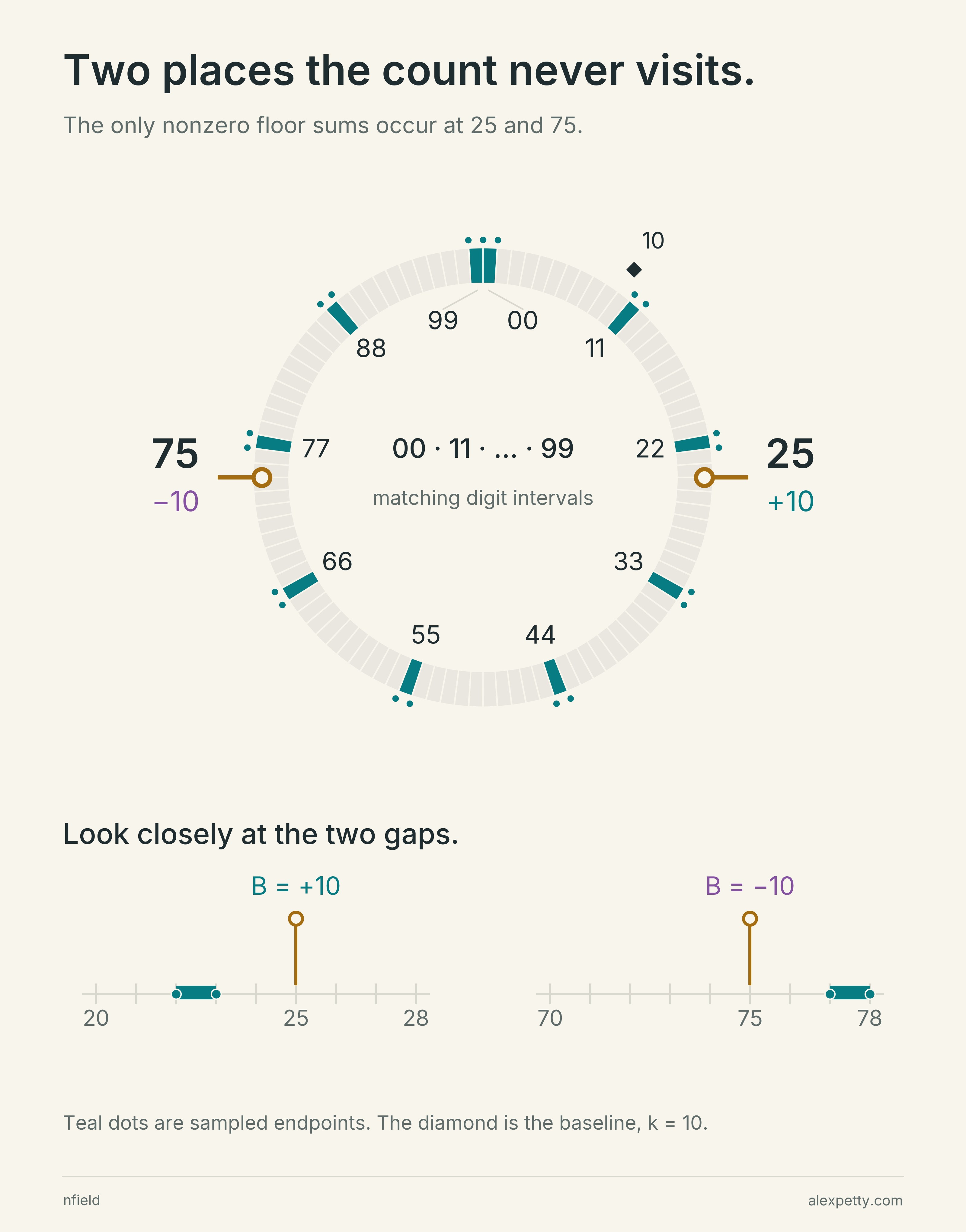
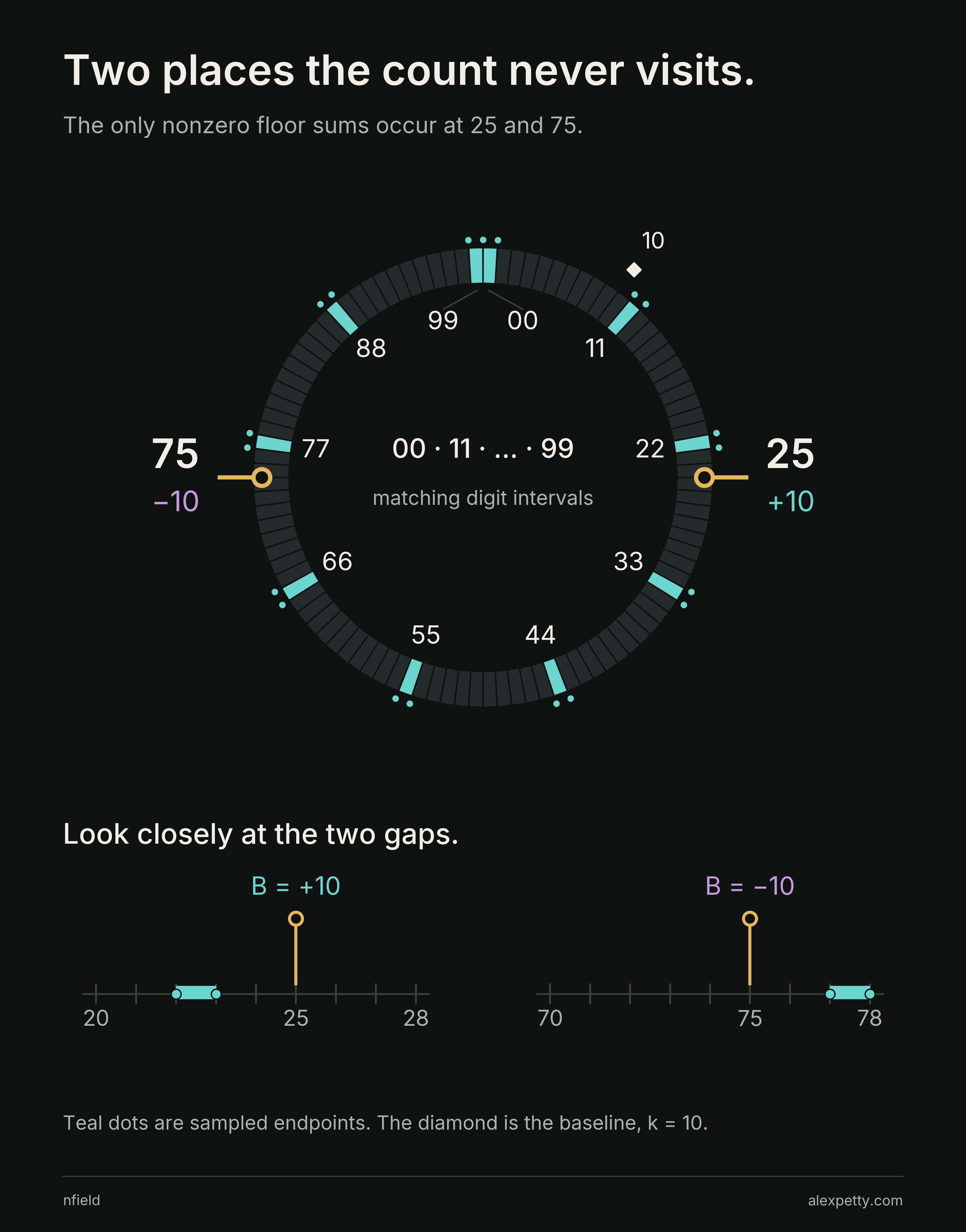
So every term is zero by itself. Subtracting the family averages changes nothing, since each column holds five plus signs and five minus signs, and the centered table inherits the zero.
The two nonzero values of the signed floor sum
The twenty positive-sign endings and the twenty negative-sign endings both sum to 1,000. Hence
Writing a floor as its argument minus its fractional part gives
If is coprime to 100, multiplication by permutes the forty endings. The last sum becomes times the same signed fractional-part sum at . It is zero by the two balances above.
If is odd and divisible by 5 but not 25, reduce to modulus 20. Each unit modulo 20 has five lifts in , all with the same sign. The positive-sign units sum to 40. So do the negative-sign units . The same permutation argument gives zero.
If is even, pair each ending with . Their signs are opposite and their floors differ by the constant . The signs among the twenty lower endings sum to zero, so the paired contributions cancel.
Only and remain. At 25, the positive-sign fractional parts are all and the negative-sign ones all . Thus
At 75 the two fractional parts exchange places, giving . This is the finite floor-sum version of the sawtooth calculation in The General Neutrality Theorem.
The seventeen that remain
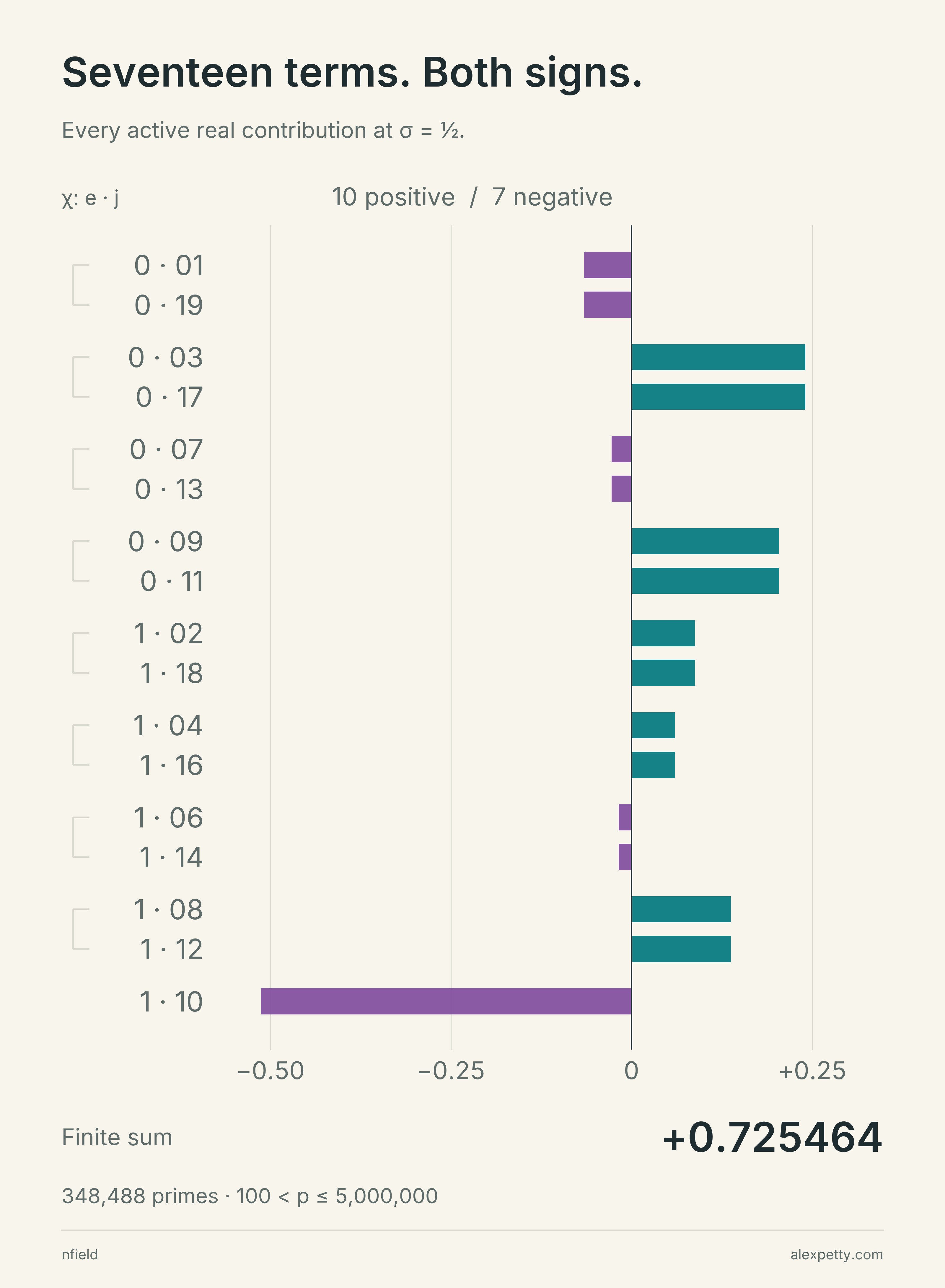
There are forty characters modulo a hundred. Reflection removes the twenty even ones, family centering removes the two odd ones that depend only on the final digit, and the calculation above removes . That leaves seventeen nonzero coefficients, eight conjugate pairs and one real coefficient, every one of them fixed by the forty-entry table.
Give each active character its own prime sum
Fourier inversion gives the exact finite identity
The left side adds the weights directly, and the right side adds the same weights in character coordinates. No infinite series enters the equality.
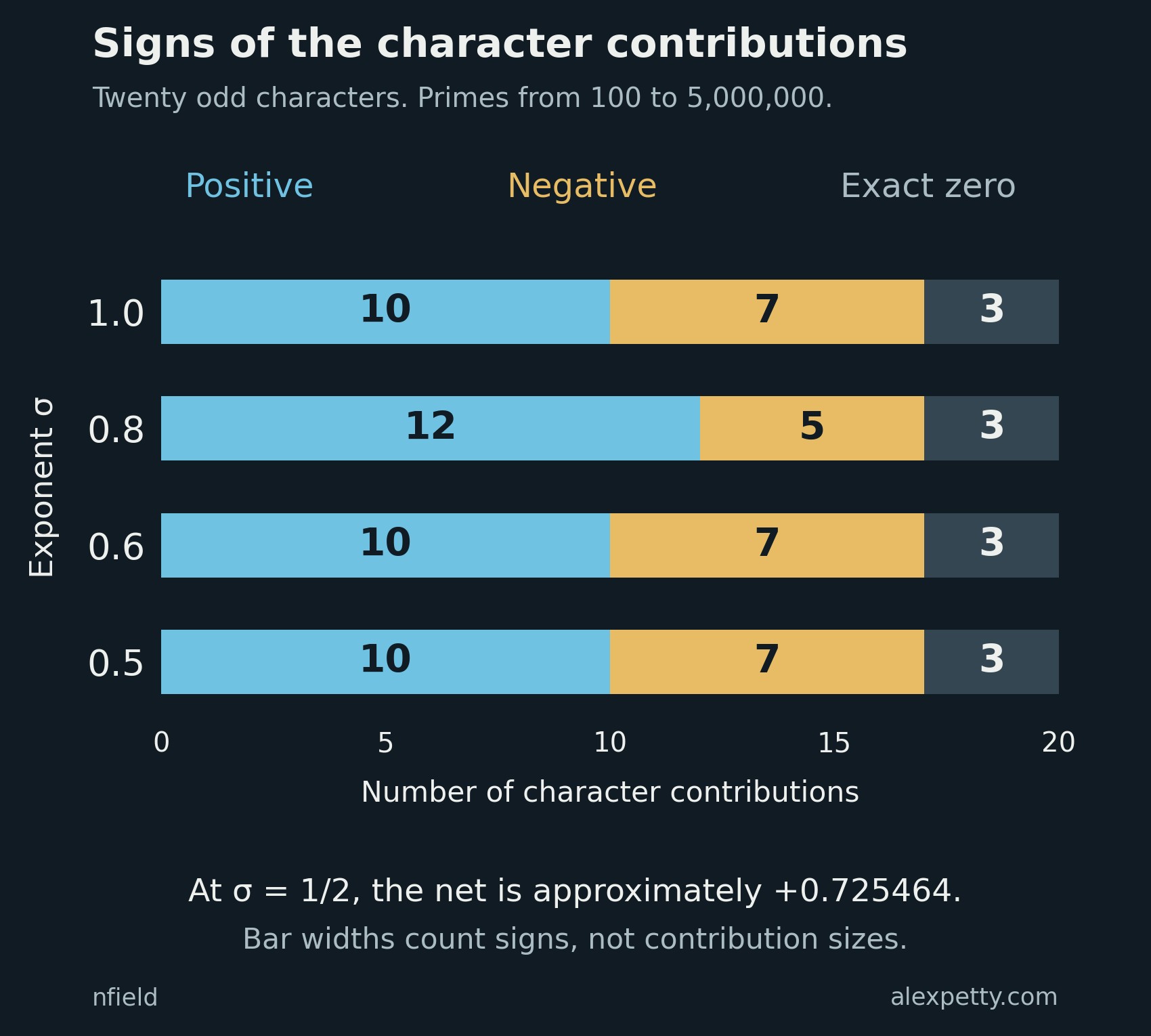
Take all primes between and five million. At , ten of the seventeen contributions have positive real parts and seven have negative ones, the imaginary parts cancel in conjugate pairs, and the net is about . The largest single term is the real one, a little over .
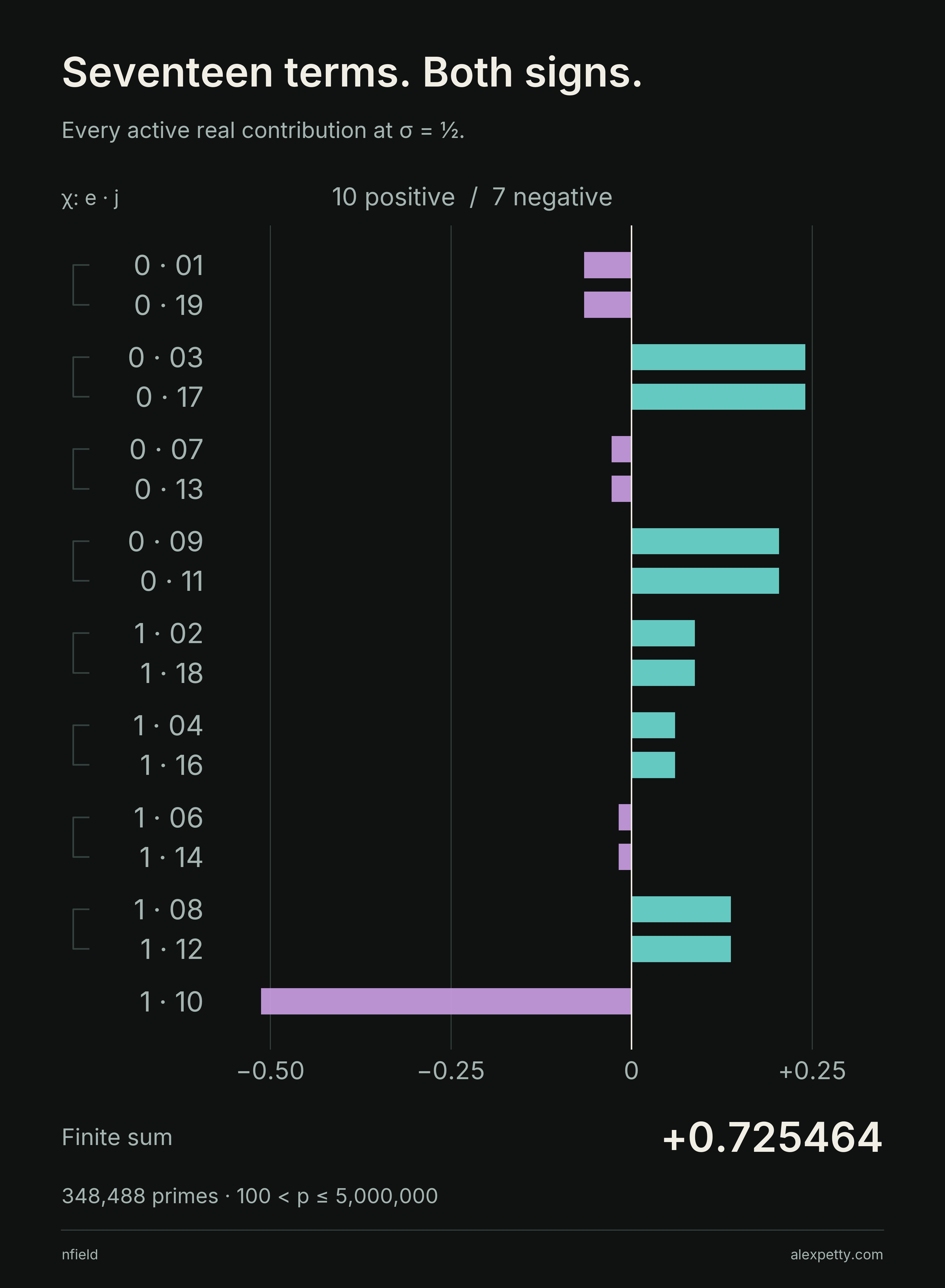
Open the complex and magnitude views
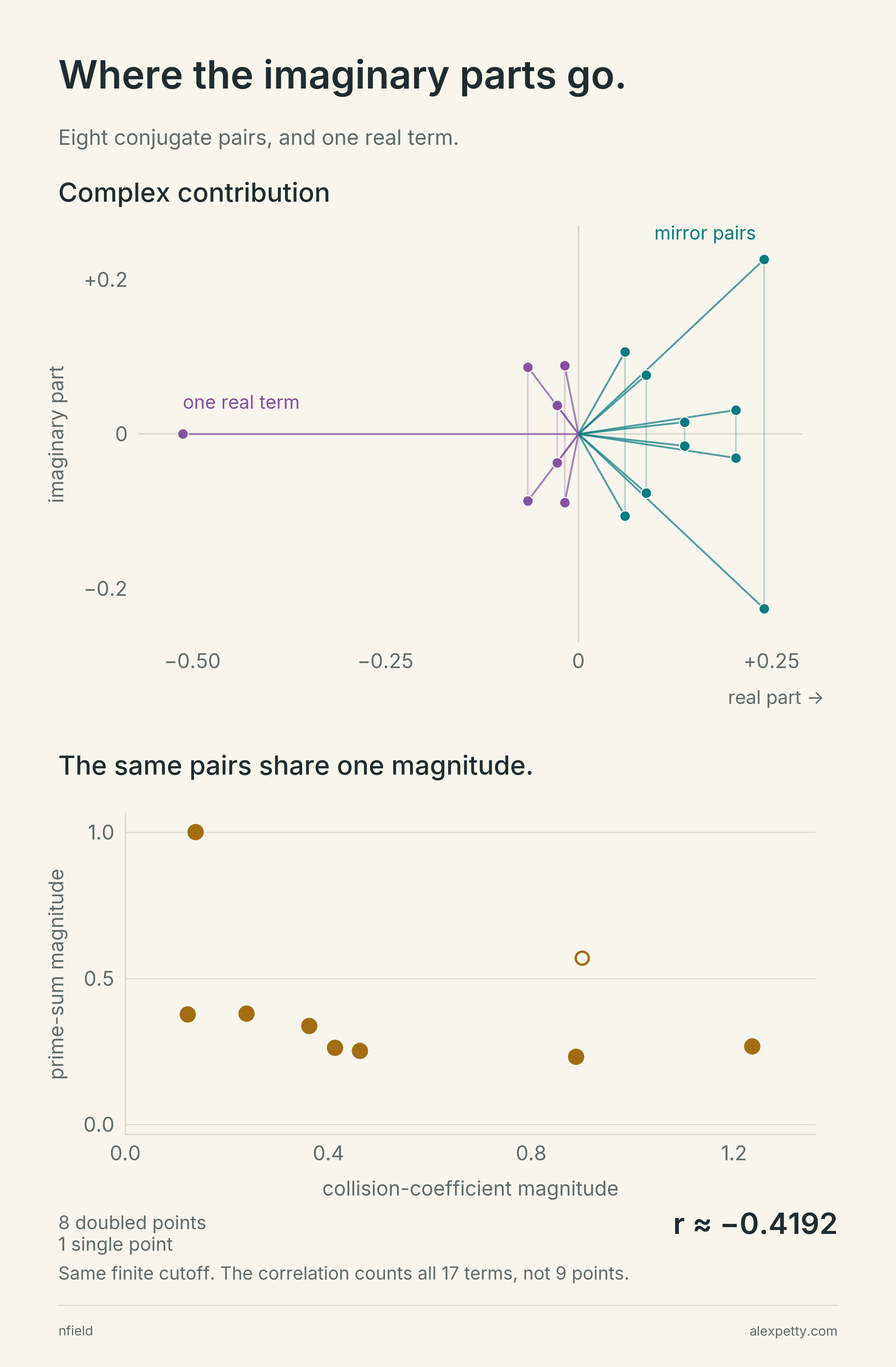
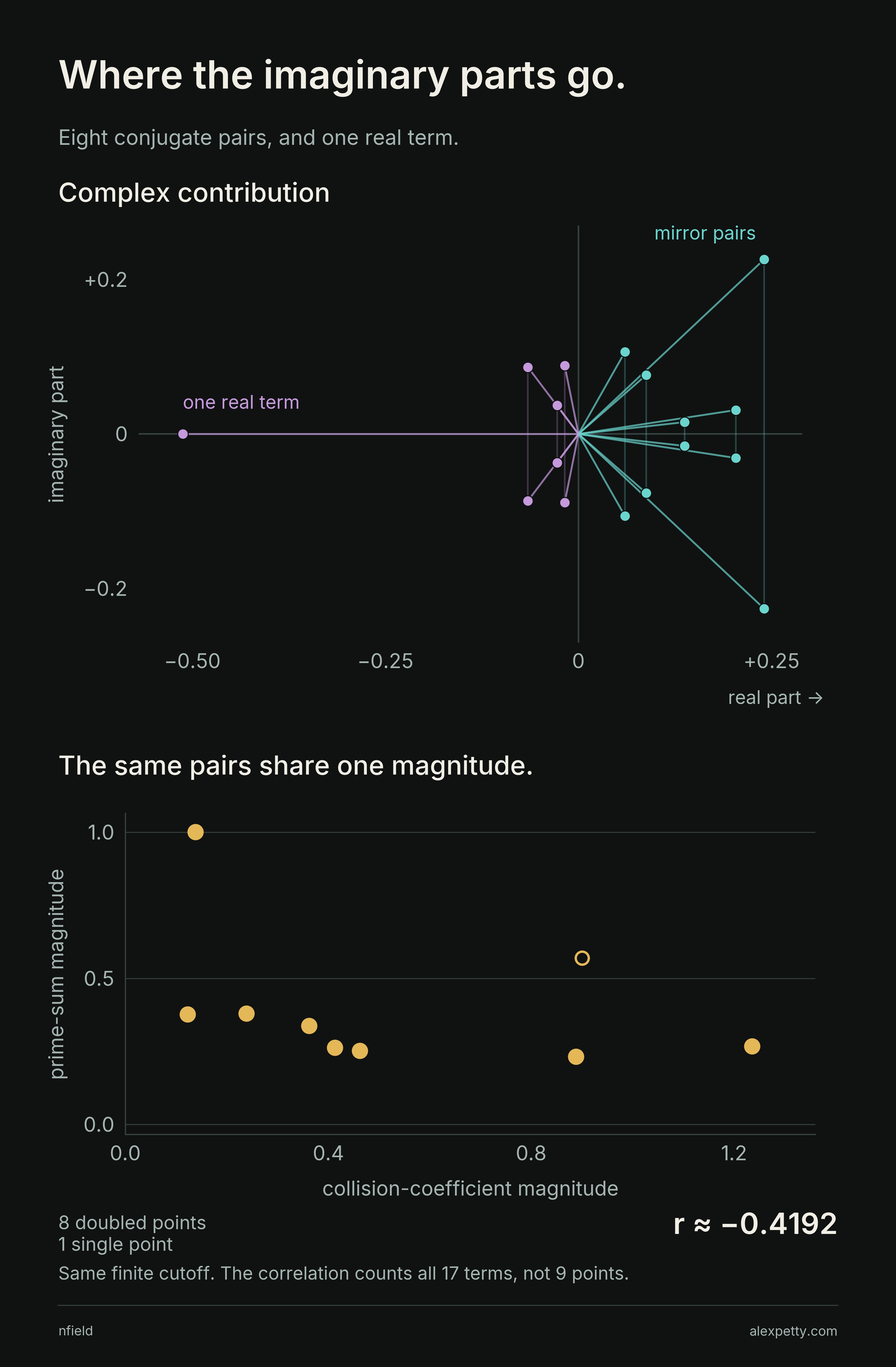
In the magnitudes, the larger collision coefficients tend to meet the smaller prime sums. Conjugate partners share their magnitudes, so the seventeen terms make only nine distinct points. At the cutoff of five million, the correlation between the two sizes is negative at all four exponents tested, at , at , at and at one half.
Character labels and all four numerical checks
Every unit modulo 25 is a power of 2. Write . The labels in the figure mean
with and . Odd characters have odd. The family-constant zeros are and , and the additional zero is . All other odd coefficients are nonzero, as exact reduction in twentieth roots of unity verifies.
| Signs | Net | Correlation | |
|---|---|---|---|
| 10 / 7 | |||
| 12 / 5 | |||
| 10 / 7 | |||
| 10 / 7 |
All four rows use the same primes, . The three proved zeros are excluded from the positive and negative counts and from the correlations.
The circle, the four columns and the sign counts, drawn again
Discussion
Sign in to join the discussion.