Collisions
The Neutrality Theorem

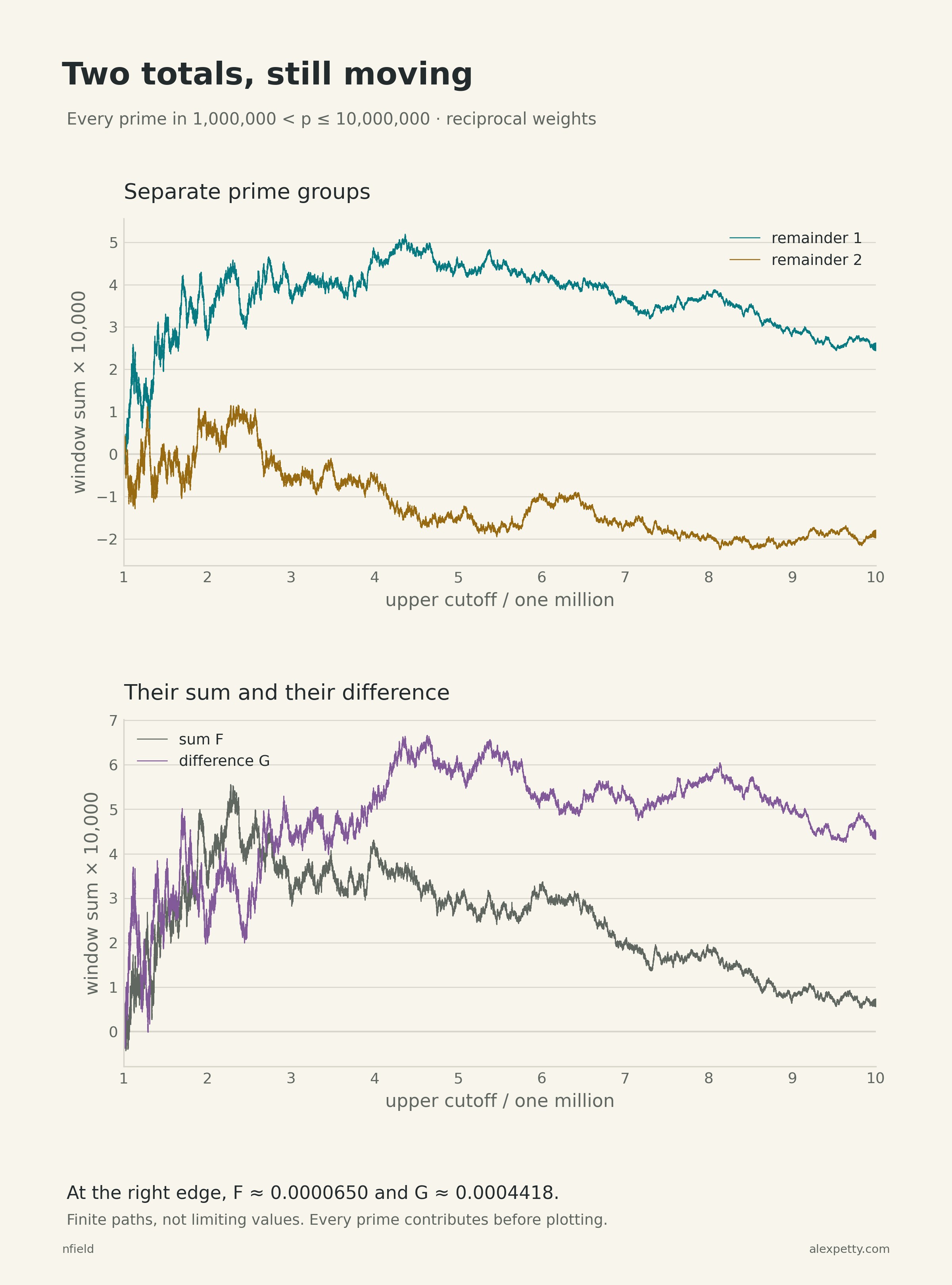
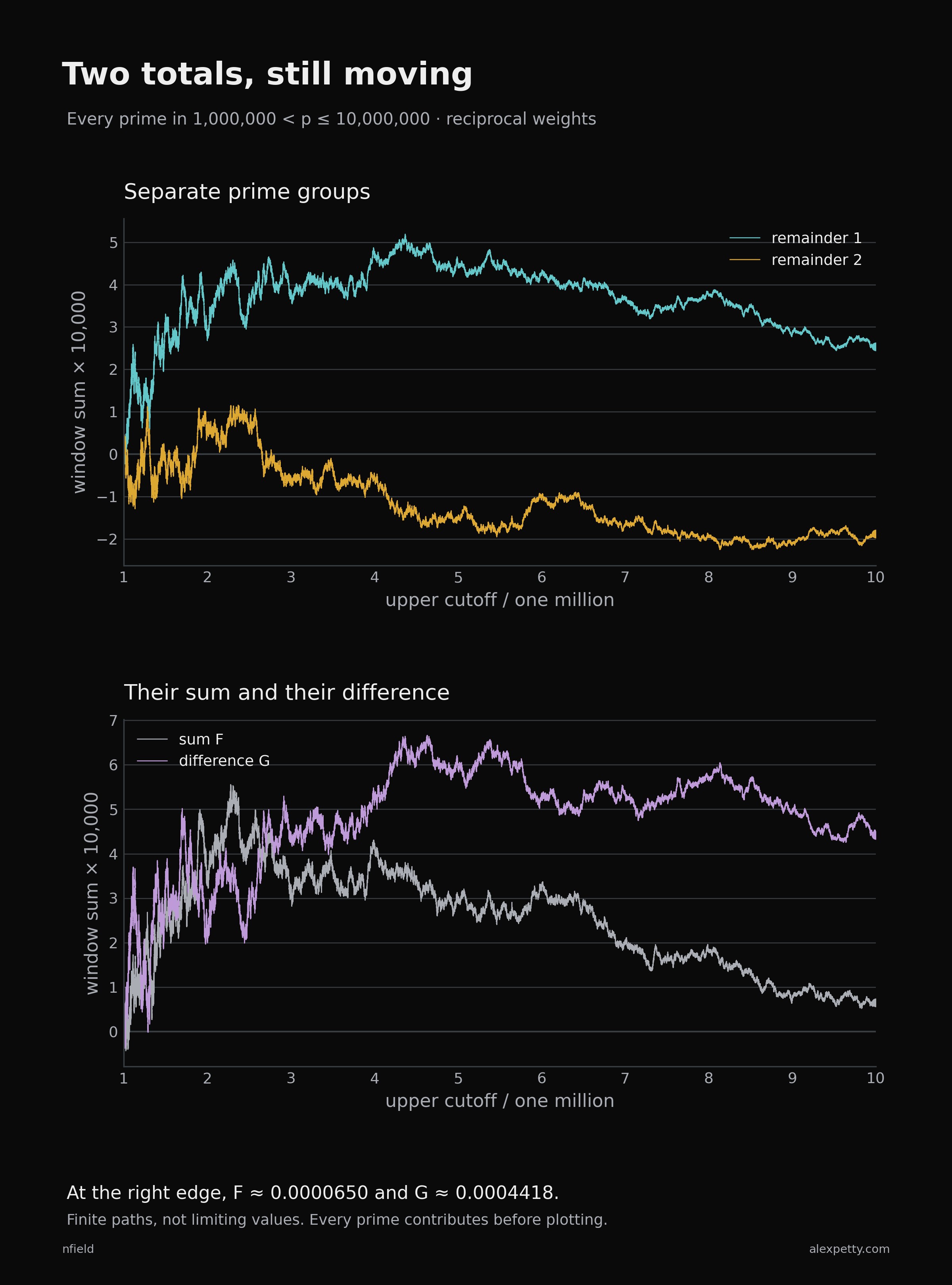
Two sums that grow without bound in opposite directions can add up to one that converges, and the total alone gives no sign of it. The collision sum could be hiding exactly that. The Centered Collision Sum proved that its total over the primes settles when each weight is divided by . Then The Collision Transform and the Critical Strip split one window of primes by their remainder on division by three. Between a million and ten million, the primes leaving remainder one push the total up by about , and the primes leaving two pull it down by about . The signs stay opposed at every exponent tested. If each group carried a drift of its own, growing like with opposite signs, the settled total would be two runaway sums cancelling by accident.
The neutrality theorem rules that out. Each group is neutral on its own, in every base and at every lag, and each converges separately at . The opposed signs belong to a single twist, the character modulo three, running through both. The argument rests on a distinction that is easy to miss, between the remainder a prime’s ending leaves and the remainder the prime itself leaves.
Same ending, different remainder
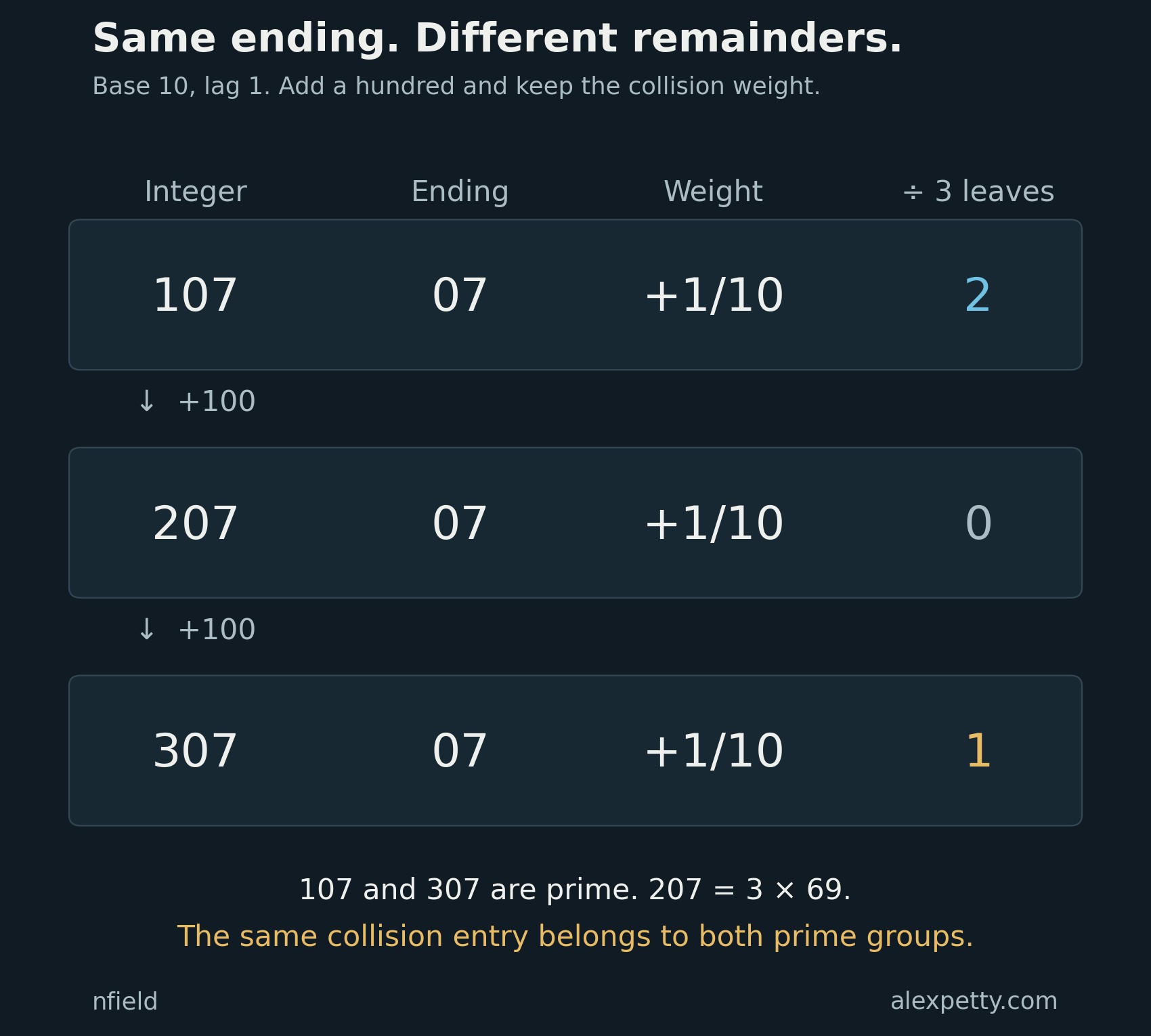
Take and . Both are prime, both end in , and the collision table gives them the same weight. At there are ten fractions with a doubled beginning against a bin size of ten. At there are thirty against thirty, so the table entry at is zero either way. Centering subtracts the average of the ten entries ending in , which is , and leaves
Division by three separates them.
The hundreds place is responsible. Write , with holding the last two digits. A hundred leaves one on division by three, so
and the quotient still has a say. Holding the ending at and adding a hundred at a time runs through all three remainders.
| Integer | Centered weight | Remainder on division by 3 |
|---|---|---|
| 107 | 2 | |
| 207 | 0 | |
| 307 | 1 |
The middle number is , composite, and the table weighs it all the same. Primality plays no part in this little cycle.
Forty strands through three hundred
Work in blocks of . Each allowed ending shows up three times, as , and , and those three leave three different remainders on division by three. One is divisible by three, one leaves one and one leaves two, and all three carry the same weight .
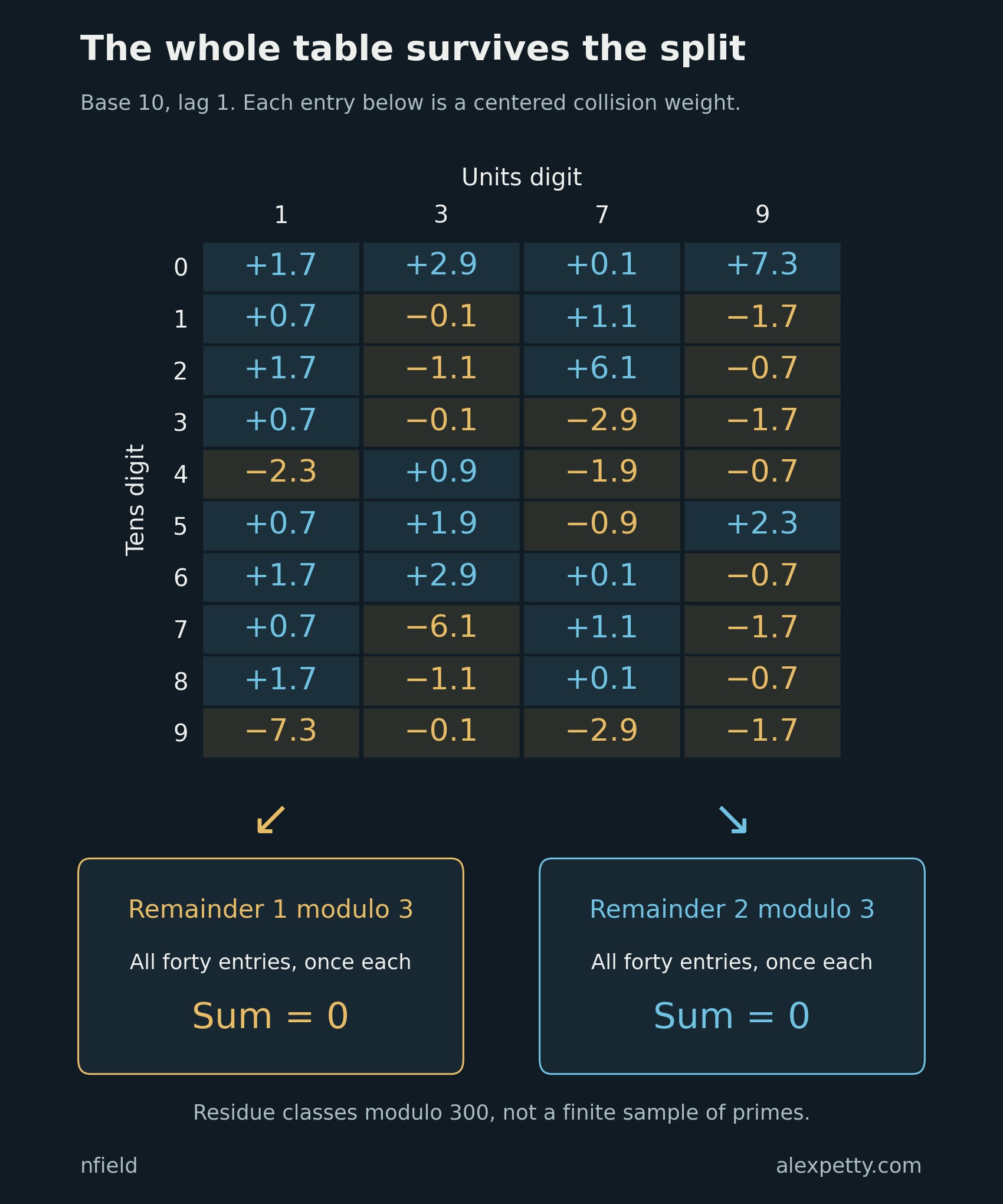
Do that for all forty endings and select the classes leaving one. Every ending is there, exactly once. Select the classes leaving two and every ending is there again. The forty centered weights add to zero, so each group sums to zero by itself. That is independent neutrality.
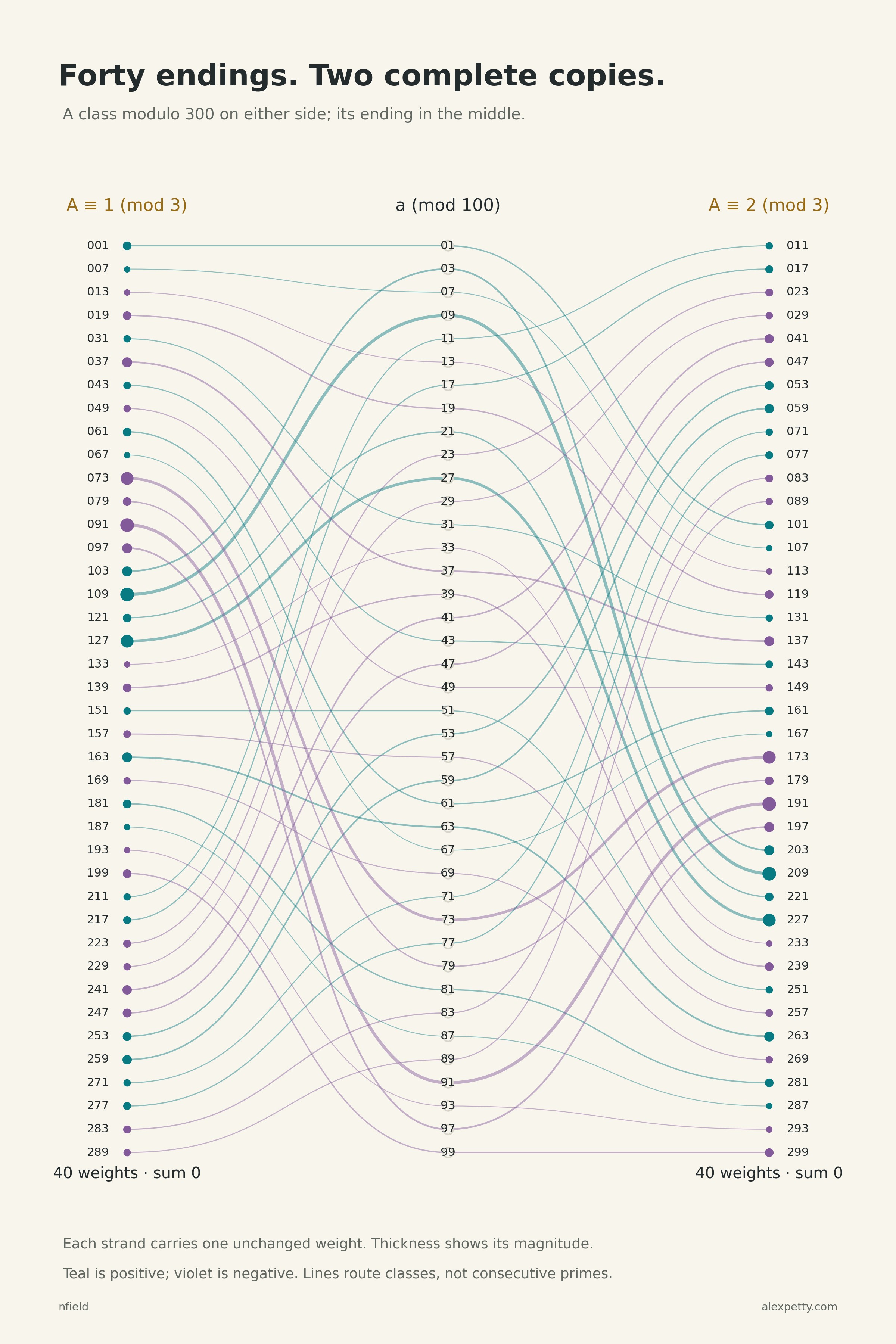
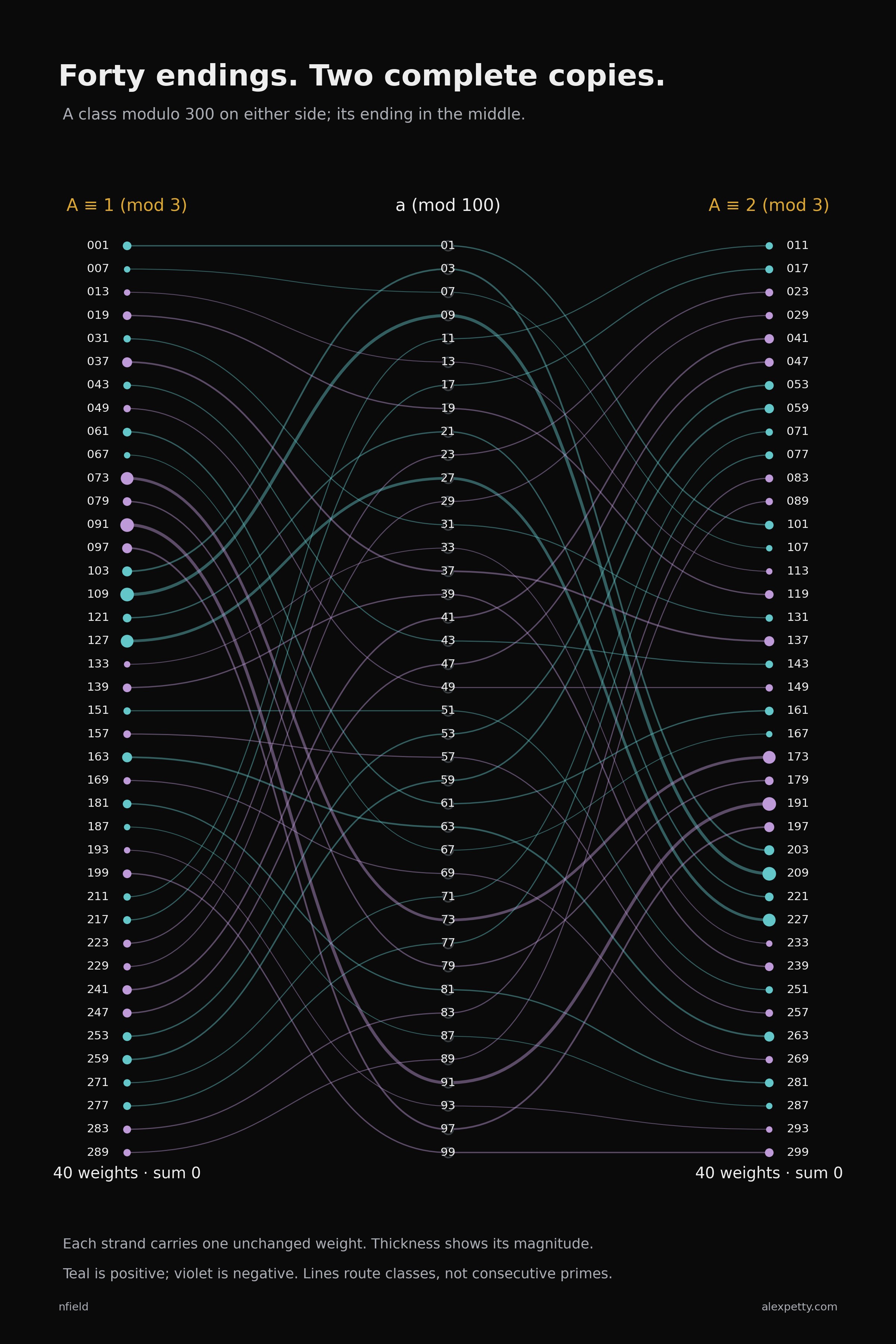
Each label stands for a whole class of numbers. The label on the left stands for , , and so on, some prime and some not, and every prime past falls into one of these eighty classes. The Chinese remainder theorem makes the count exact. Because and share no factor, an ending modulo and a remainder modulo pick out exactly one class modulo , with nothing missing and nothing doubled.
The same three-copy construction works at any lag and in every base that three doesn’t divide, where the table lives modulo . Each of the two prime groups receives the whole centered table. Three isn’t special here either. Any auxiliary modulus sharing no factor with does the same job, since fixing a remainder coprime to leaves one complete copy of the table modulo . A modulus that shares a factor with the base needs another argument, and three in base three is the first such case.
The mirror inside the table
Back in the original forty cells there is a second cancellation, and it is easy to mistake for the one just proved. Reflection pairs with . Their raw entries add to , as The Collision Periodic Table showed, and their centered weights are exact opposites,
The endings and both leave two on division by three, and so do and , and and . Reflection keeps that group together because
which sends two to two and swaps zero with one.
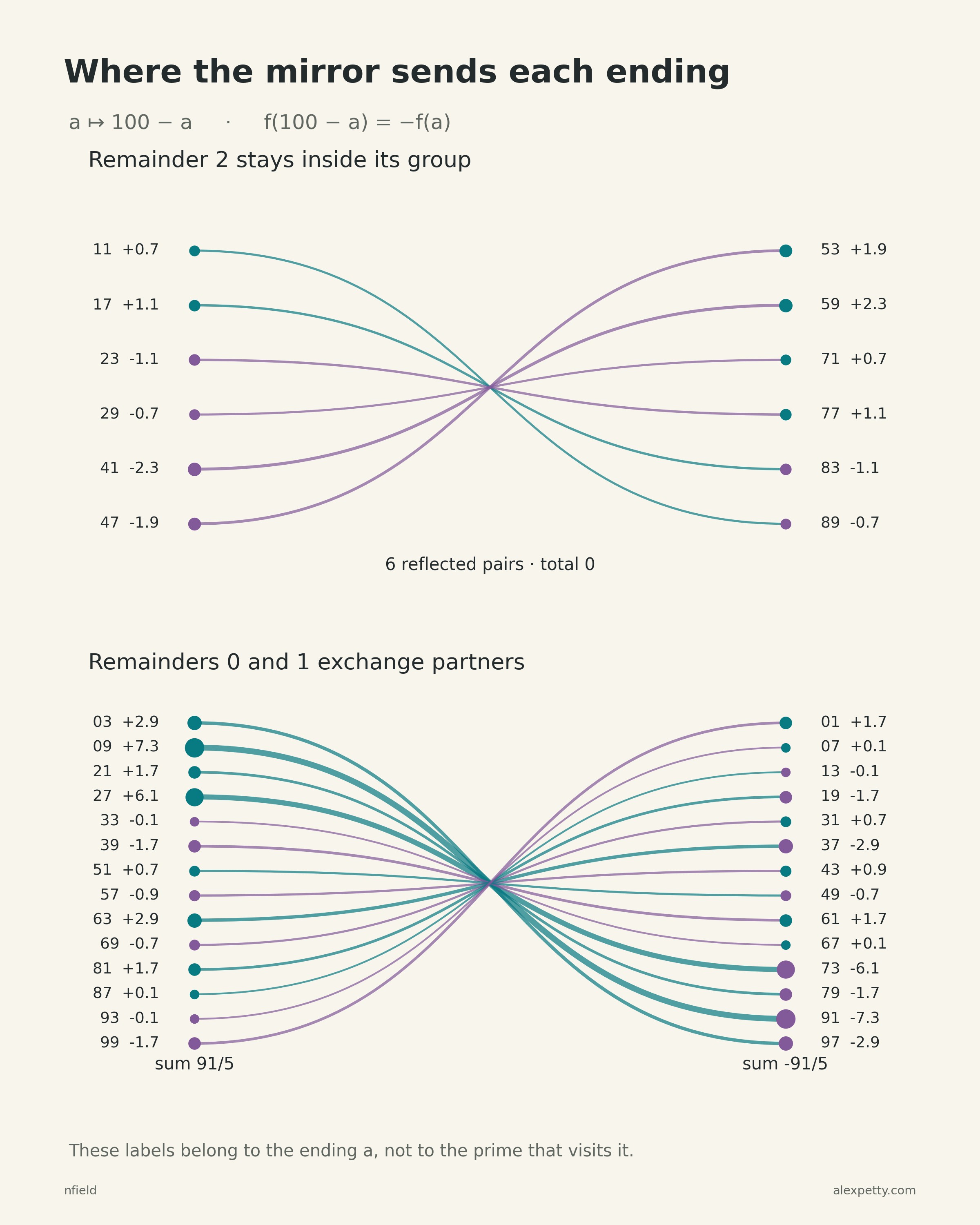
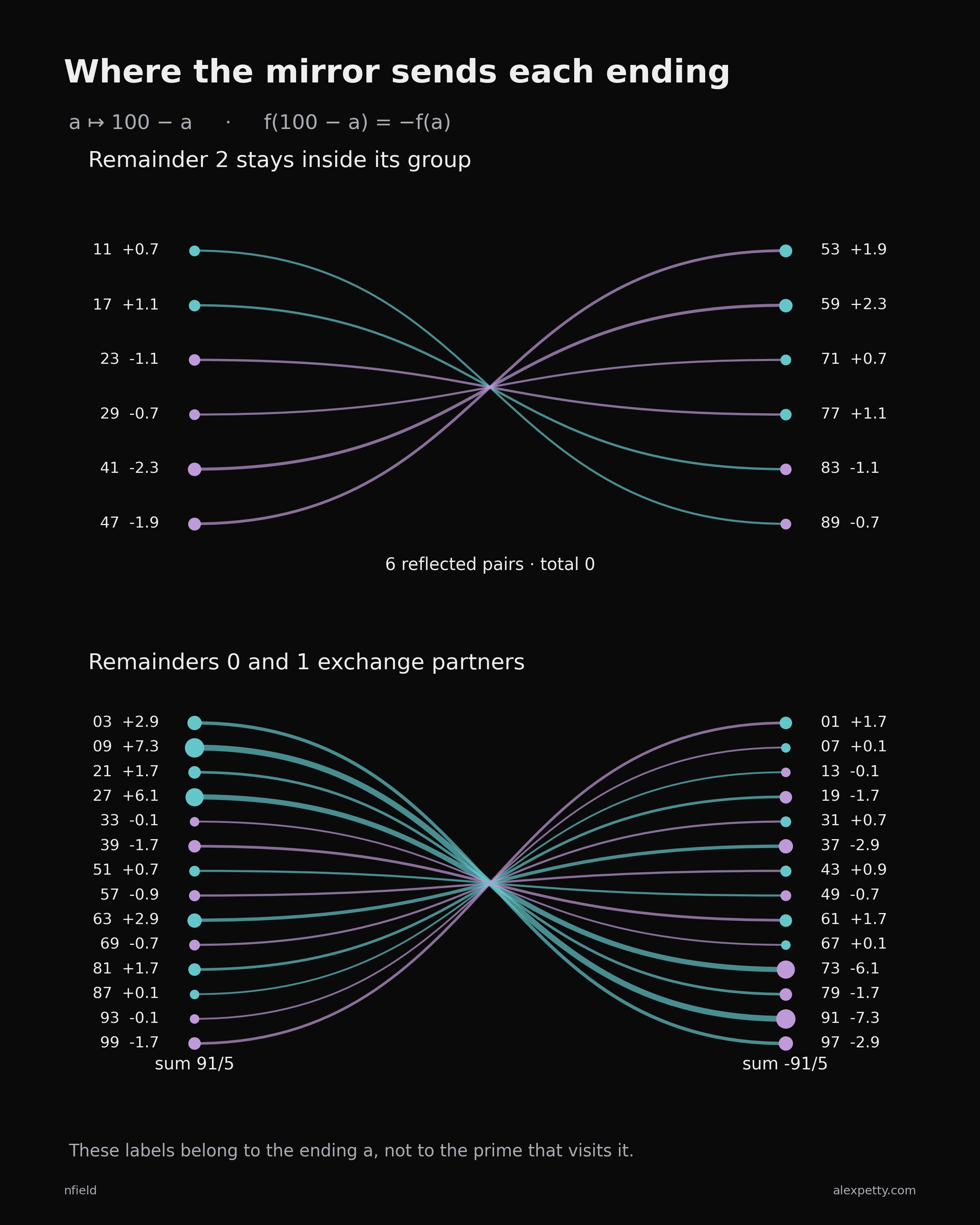
The twelve endings leaving two cancel in six pairs. The other two groups trade partners instead, and their sums are and , nowhere near zero on their own.
Those groups sort the endings, though, and a prime can land in a different group from its ending. The ending sits in the group leaving one, while the prime leaves two. Working modulo keeps track of the prime’s own remainder rather than its ending’s.
Bases divisible by three
In base three, adding a power of the base never changes a remainder modulo three, so there are no three copies to sort. The centering has to do the work itself. At lag one the table lives modulo nine and fits in six rows.
| Ending | Raw value | Family mean | Centered weight |
|---|---|---|---|
| 1 | 0 | ||
| 4 | 0 | ||
| 7 | |||
| 2 | 1 | ||
| 5 | |||
| 8 |
The first three entries leave one on division by three and the last three leave two. A prime’s remainder modulo three is simply its last base-three digit here. Each family was centered separately, so each group already sums to zero.
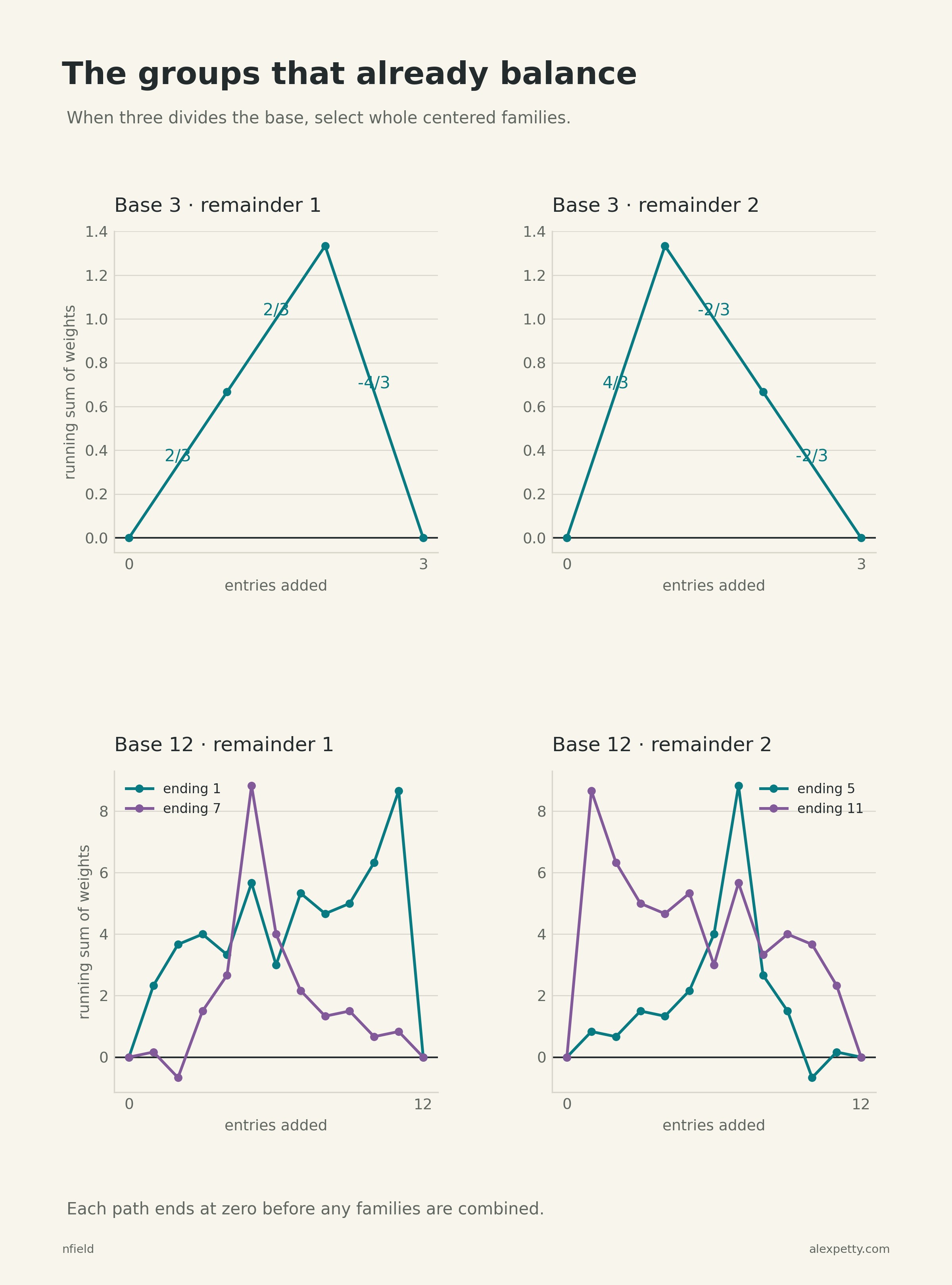
Larger bases divisible by three work the same way. In base twelve the allowed last digits are , , and . Primes leaving one end in or , primes leaving two end in or , and all four of those families were balanced before the split.
That covers every base and every positive lag. When three doesn’t divide the base, each prime group holds a whole copy of the table. When it does, each group holds whole families that were centered one at a time. Neither cut passes through the cancellation it needs.
Inspect the quotient layers at lags one, two and three
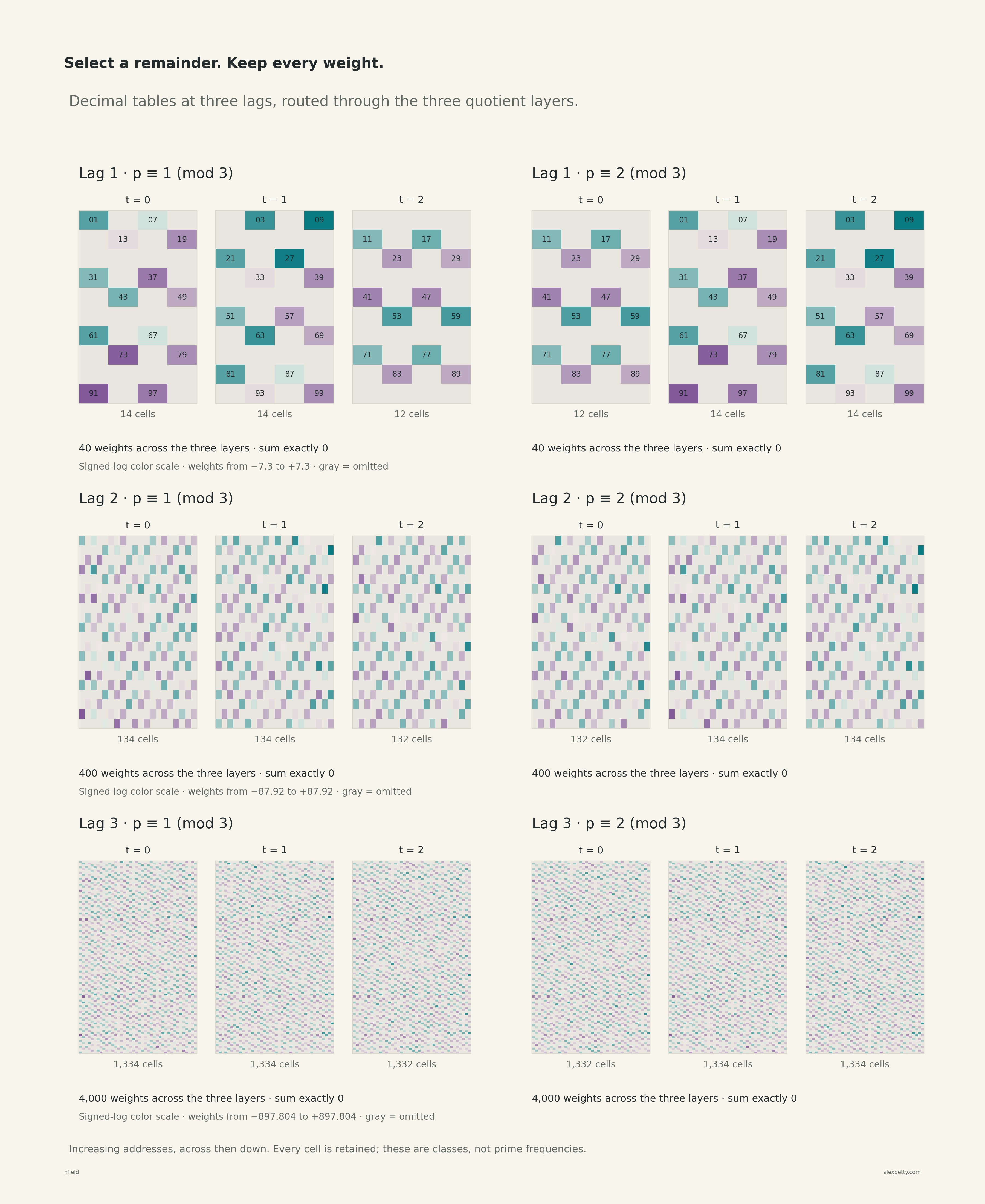
At lags one, two and three the decimal tables have forty, four hundred and four thousand entries, and each comes in three quotient layers. Choosing a remainder modulo three keeps exactly one occurrence of every weight.
The primes in the window
A complete table balances, but a stretch of primes needn’t. The primes reach the entries at different times, and dividing by gives each visit a different size. The window keeps the two groups apart.
| Remainder modulo 3 | Primes in the window | Sum of |
|---|---|---|
| 1 | 292,963 | |
| 2 | 293,118 | |
| Both | 586,081 |
These are finite contributions, not values of infinite sums, and the opposite signs don’t contradict neutrality. Neutrality decides which growing term has to vanish. It leaves the sign of the finite contributions open.
The passage to the infinite sums uses Mertens’ theorem for arithmetic progressions. Each allowed class modulo has
The constant depends on the class, and the growing term doesn’t. Multiply each class’s sum by that class’s weight and add over one remainder group only. The coefficient of is
which leaves forty weighted constants and an error that goes to zero. The other group goes the same way, so both reciprocal-prime sums converge separately. Their limits needn’t match, and neither has to be zero.
The finite table supplies the zero coefficient and Mertens supplies the limit. Nowhere does the argument assume that a finite run of primes spreads itself evenly among the classes. The Neutrality Theorem gives the proof in every base and at every lag.
The three small examples, drawn
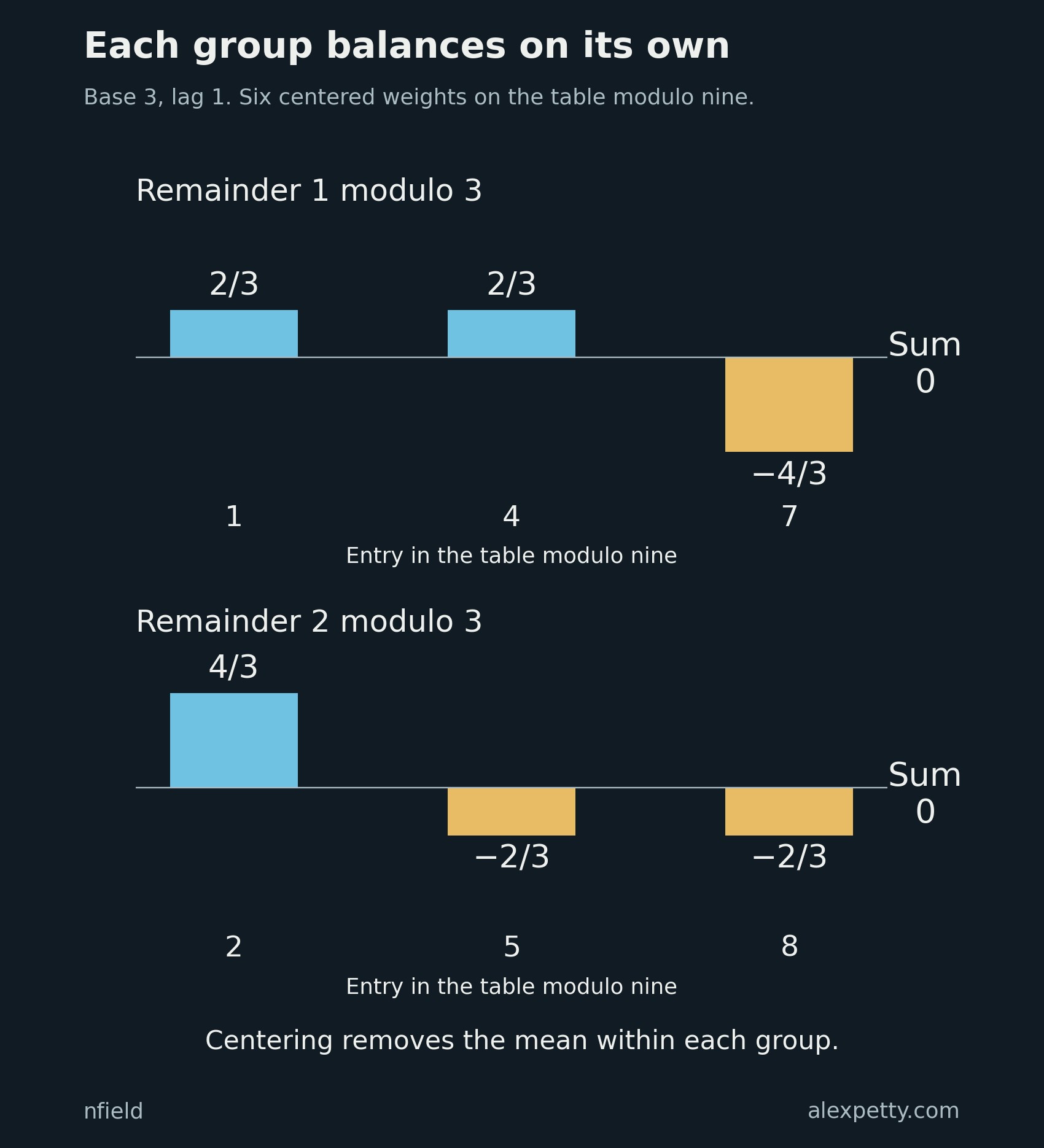
Half the sum, half the difference
Call the two running totals and , and keep their sum and their difference,
Either group comes back as or . To compute directly, keep the sign of every term from a prime leaving one and reverse it for a prime leaving two. That is multiplication by the nontrivial Dirichlet character modulo three, so is the collision sum twisted by that character.
In the window, is about and about , nearly seven times as large. The groups differ by far more than they add up to, even though neither one needs the other to cancel its drift. At weight both settle, since each is a combination of two convergent sums.
The primes and show the twist at work on a single pair. Each takes from the table. In , leaves two and contributes , while leaves one and contributes , so equal table weights turn into unequal terms of opposite sign. At those terms grow to about and , and neutrality gives no control over them. The principal term is gone from both groups. What remains of is a combination of nonprincipal characters modulo , and their prime sums below depend on where the zeros of their -functions lie.
Discussion
Sign in to join the discussion.