The Radiant Energy Receiver System of Nikola Tesla
Among the many ideas Nikola Tesla explored during his career, one of the most intriguing was the possibility of extracting useful electrical energy directly from the surrounding environment.
Tesla often referred to this concept as drawing energy from the “ambient medium.”
Unlike conventional power generation, which relies on consuming fuel or capturing intermittent sources such as wind or sunlight, Tesla imagined systems capable of operating continuously by tapping the natural electrical potential differences that exist throughout the Earth–atmosphere system.
This idea appears repeatedly in Tesla’s writings.
In a statement delivered on January 12, 1897 during the opening ceremony of the Niagara Falls hydroelectric station, Tesla hinted that humanity would eventually develop methods of obtaining energy without consuming material resources:
“We have to evolve means for obtaining energy from stores which are forever inexhaustible… the possibilities of the development I refer to, namely, that of the operation of engines on any point of the earth by the energy of the medium.”
Tesla returned to the subject in greater detail in his famous 1900 article “The Problem of Increasing Human Energy.”
In that article he proposed that the Earth and its surrounding atmosphere behave electrically like a gigantic capacitor:
“…the earth, with its adjacent insulating and outer conducting envelope, constitutes a highly charged electrical condenser containing, in all probability, a great amount of electrical energy which might be turned to the uses of man.”
The essential idea is simple.
If the Earth and atmosphere form a natural electrical capacitor, then energy is constantly flowing between the planet’s surface and the surrounding charged layers of the atmosphere. If this energy could be captured efficiently, it might provide a continuous source of electrical power.
Tesla proposed a remarkably simple device for exploring this possibility: a radiant energy receiver consisting of
- an elevated conductive plate
- a storage capacitor
- a connection to ground
The concept was formalized in Tesla’s patents:
- US Patent 685957 – Apparatus for the Utilization of Radiant Energy
- US Patent 685958 – Method of Utilizing Radiant Energy
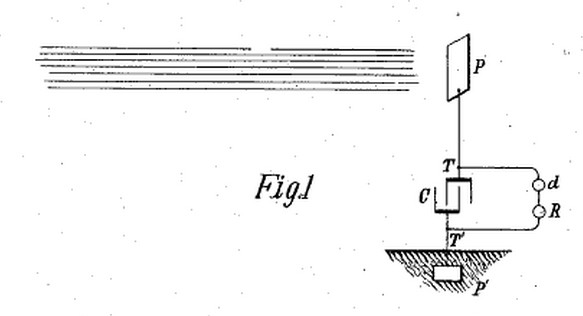
These patents describe a system in which incoming charged particles from the Sun and other cosmic sources accumulate on a conductive plate, charging a capacitor relative to the Earth.
The basic configuration is illustrated below.

Tesla explained the mechanism as follows:
“The sun, as well as other sources of radiant energy throw off minute particles of matter positively electrified… The opposite terminal of the condenser being connected to ground… a feeble current flows continuously into the condenser.”
Encouraged by Tesla’s description, I decided to investigate whether some aspect of this phenomenon could be reproduced experimentally on the bench.
What follows is not a claim of any extraordinary effect. Rather, it is a simple attempt to explore Tesla’s idea using straightforward electrical measurements.
A Working Model of Tesla’s Concept
Tesla frequently described the Earth and Sun as forming an enormous electrical system.
The Sun, in Tesla’s view, behaves like a gigantic positive electrical source, while the Earth acts as a vast reservoir of negative charge. Between them lies the dielectric of space and the insulating layers of the atmosphere.
If this picture is correct, the Earth–atmosphere system behaves electrically like a spherical capacitor.
In this model:
- the Sun acts as a distant energy source
- the ionosphere becomes a charged conducting layer
- the Earth’s surface forms the opposite plate of a planetary-scale capacitor
The simplified conceptual model looks like this:
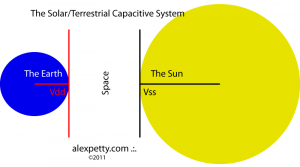
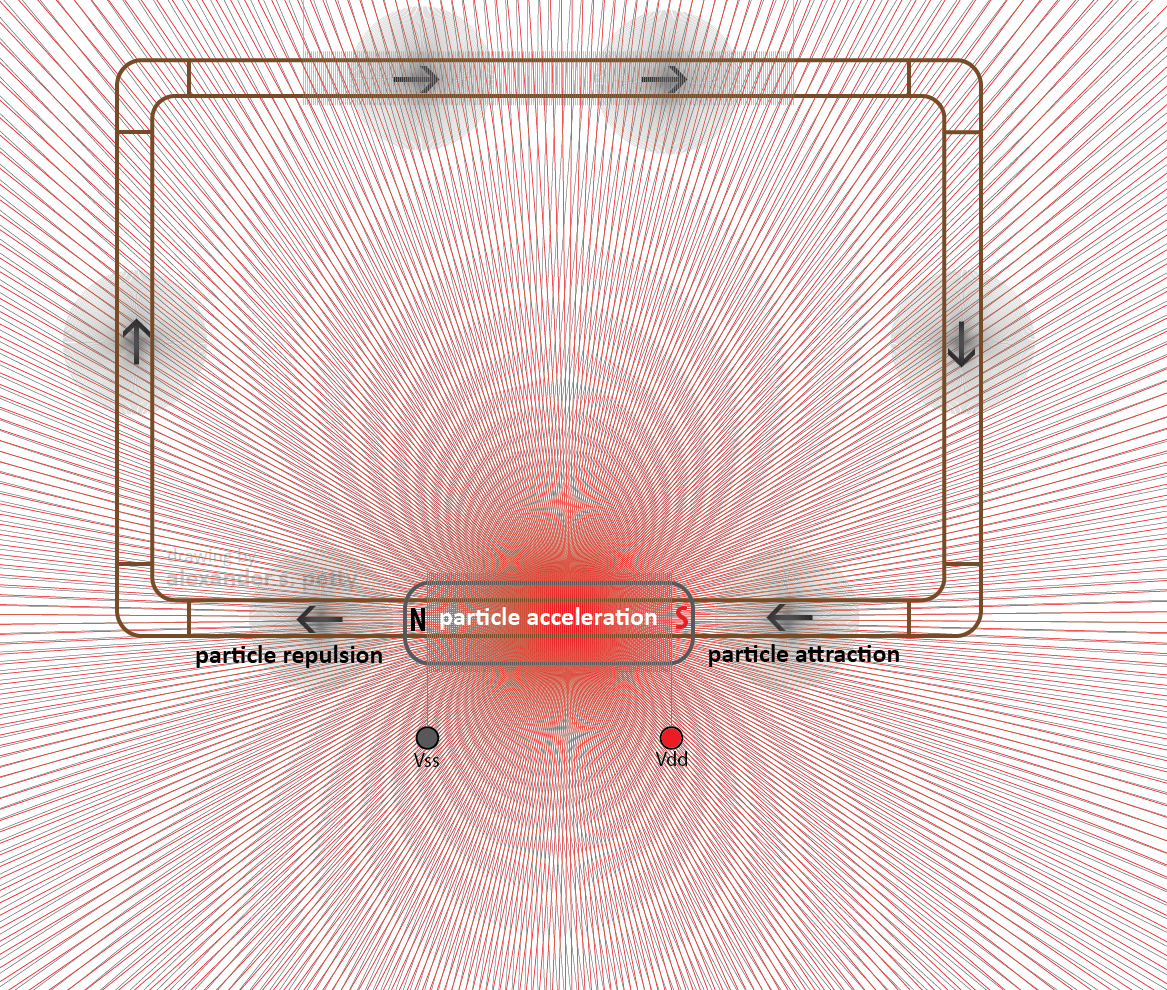
In this picture the Sun and Earth participate in a cascading sequence of charge paths. One segment’s drain becomes the next segment’s source.
Tesla often described electrical systems in this layered way: energy moves through a sequence of potential differences, each one feeding the next.
With that idea in mind, the solar–terrestrial system can be understood as a series of charge path segments.
Step 1 — Radiant energy arriving from the Sun
In addition to the visible light we receive from the Sun, Tesla suggested that other highly energetic radiations are constantly streaming toward the Earth. He referred to these as radiant energy.
These radiations deposit charge into the upper atmospheric layers of the Earth’s electrical environment.
In circuit language we can imagine this region as the source plate (Vss) of a very large capacitor.
Step 2 — The solar–terrestrial capacitor
Between the Sun and the Earth lies the dielectric of space. The vacuum of space behaves electrically as an insulating medium separating two charged bodies.
Under this interpretation the Sun and Earth form a very large capacitive system.
Energy flows across this dielectric in the same way charge moves through a capacitor.
Step 3 — Charging of the ionosphere
When radiant energy reaches the Earth’s outer atmosphere it charges the ionosphere.
In this conceptual model the ionosphere becomes the drain plate (Vdd) of the solar–terrestrial capacitor.
Step 4 — The Earth as a spherical capacitor
The ionosphere does not exist in isolation. Beneath it lies the surface of the Earth separated by roughly sixty miles of atmospheric gases.
Those gases act as an insulating dielectric.
This creates another capacitive structure — one that Tesla frequently referenced.
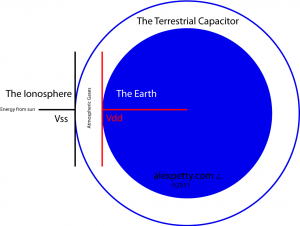
In this configuration:
- the ionosphere acts as the upper charged plate
- the Earth’s surface acts as the lower plate
- the atmosphere forms the dielectric between them
Measurements show that the electrical gradient between the ionosphere and the Earth’s surface is on the order of 360,000 volts.
Tesla therefore viewed the Earth itself as a massive spherical capacitor storing an enormous amount of electrical energy.
Step 5 — Cascading charge paths
Once again we can think of this in terms of charge path segments.
The ionosphere, which was the drain (Vdd) of the solar–terrestrial capacitor, now becomes the source (Vss) of the terrestrial capacitor.
Energy continues cascading downward through the system.
Eventually it reaches the Earth’s surface, which becomes the next available point where this electrical potential might be tapped.
This observation suggests a practical question:
If the Earth is continually being charged by this system, can some portion of that charge be detected or captured locally?
That question motivated the simple experiment described below.
A Simple Experimental Arrangement
Tesla’s patent suggests capturing charge from the environment using a conductive plate connected to a storage capacitor whose other terminal is grounded.
In Tesla’s design the plate is typically elevated and exposed to the sky so that charged particles and radiations can accumulate on it.
In my own tests I chose a slightly different approach. Rather than attempting to collect charge from above using an aerial antenna, I experimented with capacitive coupling to the Earth itself, which Tesla described as a “vast reservoir of negative electricity.”
My goal was simply to determine whether measurable charge accumulation could be observed under these conditions.
The arrangement I used is shown conceptually below.
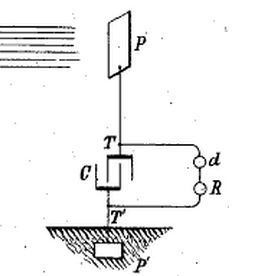
The configuration is similar to Tesla’s receiver circuit, except that instead of using an antenna plate exposed to the atmosphere, the receiving plate is positioned just above the Earth’s surface and capacitively coupled to it through a dielectric layer.
The steps I used were as follows.
Step 1 — Create a ground-coupled receiving plate
First I created a simple capacitive pickup from the Earth.
- Place a sheet of glass (or another material with a reasonably high dielectric constant) directly on the ground.
- Place a sheet of polished aluminum on top of the dielectric.
The dielectric prevents direct electrical contact while still allowing capacitive coupling between the plate and the Earth.
In this configuration the Earth acts as the source plate, while the aluminum sheet becomes the receiver plate.
Step 2 — Connect a storage capacitor
Next, one terminal of a capacitor is connected to the receiver plate.
Tesla emphasized that this capacitor should have:
- high electrostatic capacity
- extremely low leakage
- excellent insulation
The reason is that the charging current is extremely small and occurs over long time scales.
Step 3 — Establish a ground reference
The other terminal of the capacitor is connected to a solid earth ground, typically through a ground rod driven into the soil.
This completes the circuit path between the Earth and the receiver plate through the storage capacitor.
Step 4 — Measure the resulting voltage
Finally the voltage across the storage capacitor is measured.
In my experiments I observed that the capacitor slowly accumulated charge, reaching approximately 1.25 volts DC over a period of a few minutes.
The exact value varied depending on the capacitor used. Some lower quality capacitors exhibited higher leakage and stabilized at closer to 0.5 volts.
Tesla himself warned about this issue, noting that the storage capacitor must be extremely well insulated if the charge accumulation is to continue indefinitely.
He wrote:
“I use by preference the best quality of mica as dielectric, taking every possible precaution in insulating the armatures, so that the instrument may withstand great electrical pressures without leaking.”
Tesla claimed that with sufficiently well constructed capacitors he observed the charge continue to accumulate until the dielectric eventually ruptured.
While my own experiments have not approached anything like those voltage levels, the slow accumulation of charge does appear to confirm that some small electrostatic potential exists between the Earth and the receiver plate.
Encouraged by this observation, the next question naturally arises:
Can this small effect be amplified?
Electrostatic Charge of the Earth
Before asking how the effect might be amplified, it is helpful to consider the electrical properties of the Earth itself.
Measurements of the global atmospheric electric circuit show that the Earth carries a net negative charge of roughly 96,500 coulombs.
At the same time the ionosphere — a conductive layer in the upper atmosphere — remains positively charged relative to the Earth’s surface.
The potential difference between the Earth and the ionosphere is typically around 300,000 to 400,000 volts, with an average value near 360,000 volts.
Taken together, these two charged layers form a planetary-scale capacitor.
Using the familiar relationship for capacitance:
$C = \frac{Q}{V}$
where
- (Q) is the stored charge
- (V) is the potential difference
we obtain an approximate capacitance for the Earth–ionosphere system of about
$C \approx 0.25 \text{ farads}$
This is an astonishingly large capacitor by ordinary engineering standards.
If we estimate the energy stored in this system using
$E = \frac{1}{2} C V^2$
we obtain a value on the order of
$E \approx 1.6 \times 10^{11} \text{ joules}$
This corresponds to roughly 4–5 megawatt-hours of stored electrical energy.
Of course, this energy is distributed across the entire planet and exists as part of a constantly circulating atmospheric electrical system.
Nevertheless, the calculation illustrates the scale of the phenomenon that Tesla had in mind when he described the Earth as a vast electrical reservoir.
The practical question then becomes:
How can a small local system interact with this enormous electrical environment?
Tesla believed that two conditions were necessary.
- A region of lower energy must be created — what he called an energy sink or “cold hole.”
- That sink must be made to oscillate, allowing energy from the surrounding medium to continually flow into it.
Understanding what Tesla meant by an energy sink is the key to understanding the rest of his radiant energy concepts.
Tesla’s radiant energy receiver is built around a very simple electrical idea.
The environment itself is electrically active.
The sun emits charged particles and radiation. These particles strike the upper atmosphere of the Earth and produce electrical separation between the ionosphere and the planet’s surface. Tesla interpreted this condition as a gigantic natural capacitor. :contentReference[oaicite:0]{index=0}
In Tesla’s model the ionosphere becomes the upper plate of this capacitor while the Earth’s surface becomes the lower plate.
Between these two plates lies the insulating atmosphere.
The potential difference between them can reach hundreds of thousands of volts. :contentReference[oaicite:1]{index=1}
In this view the Earth is not merely a body sitting in space.
It is part of a vast electrical system continuously interacting with solar radiation.
Tesla’s receiver attempts to tap into this system.
The basic apparatus described in Tesla’s patent is straightforward.
A conductive plate is exposed to incoming radiation.
The plate is connected to a capacitor.
The opposite side of the capacitor is connected to ground.
As radiant particles strike the plate they deliver charge to it. The capacitor slowly accumulates this charge. Tesla noted that this process can continue for long periods because the incoming particles are charged to very high potentials. :contentReference[oaicite:2]{index=2}
To explore this idea I constructed a simplified experimental arrangement.
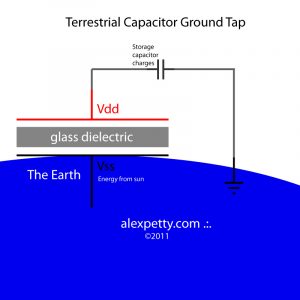
Instead of using an elevated antenna I experimented with a capacitive plate resting on the surface of the Earth.
The idea is simple.
- Place a sheet of glass or other dielectric on the ground.
- Place a metal plate on top of the dielectric.
- Connect this plate to a storage capacitor.
- Connect the other side of the capacitor to a ground rod driven into the Earth.
The plate and the Earth now form a small capacitor that is embedded inside the much larger solar–terrestrial electrical system.
In testing I observed that the storage capacitor slowly charges.
Within a few minutes the capacitor typically reaches about 1.25 volts DC. The exact value depends heavily on the leakage characteristics of the capacitor used.
While this voltage is small, it demonstrates that electrical charge can indeed accumulate from the surrounding environment.
Tesla reported that with extremely well insulated capacitors the voltage could continue to rise indefinitely. In some cases he claimed the dielectric would rupture due to the accumulated charge.
Electrostatic Charge of the Earth
The Earth itself carries an enormous static charge.
Estimates place the total charge at roughly 96,500 coulombs. When combined with the approximate 360,000 volt potential difference between the ionosphere and the ground, the Earth behaves like a spherical capacitor with a capacitance of about 0.25 farads.
Using the energy equation for a capacitor
E = ½ C V²
this system contains on the order of 1.6 × 10¹¹ joules of stored electrical energy.
Tesla believed that tapping this reservoir required two things.
- Creating an energy sink.
- Making that sink oscillate.
The oscillation allows energy from the surrounding electrical environment to flow continuously into the system.
In practical terms this means constructing resonant electrical circuits capable of interacting with the natural electrical field surrounding the Earth.
Tesla spent much of his later career exploring these ideas through high frequency resonant transformers and oscillatory circuits.
My own experiments so far have only scratched the surface of this concept. The passive charging effect is easy to observe, but producing useful power from it requires much stronger oscillations and much more careful circuit design.
Still, the basic observation remains striking.
The Earth is immersed in a vast electrical environment.
Energy is constantly flowing through it.
The question Tesla posed more than a century ago still remains.
Can we learn how to interact with that flow?
There is also some modern experimental work that appears to touch on ideas similar to what Tesla described.
One example often discussed is the device demonstrated by Tariel Kapanadze. In several demonstrations a generator is shown powering electrical loads while only a small starting input is provided. The device appears to use coils, transformers, grounding connections, and high frequency excitation similar to techniques Tesla explored in his own work.
In these demonstrations the system is briefly started with a battery or external supply and then appears to continue operating on its own. Kapanadze has claimed outputs in the kilowatt range from relatively small devices, although the exact internal construction has never been publicly disclosed.
At present there is no widely accepted scientific explanation for these demonstrations, and many researchers remain skeptical. Still, the experiments are intriguing because they appear to follow the same general line of thought that Tesla described more than a century ago.
If Tesla was correct that the Earth and atmosphere form a vast electrical system, then devices designed to interact with that system through resonance and charge accumulation might exhibit effects that are not yet fully understood.
Whether such devices ultimately prove practical or not, they point toward a direction of research that Tesla believed would one day become important.
Throughout space there is energy.
The real question is whether we can learn how to interact with it.
.:.