Spectra
The Spectral Structure of Fractional Fields

The fractions of 127, written in binary, make a table of 126 rows with no two alike. Yet every agreement between those rows fits into eight independent directions. The other 118 rows add nothing new, since each is a weighted combination of eight others. When a table that large carries that little independent content, there is usually a constraint hiding in it, the way a household budget always adds up to the paycheck, so that once you know every category but one, the last is already decided.
The Cross-Alignment Matrix kept every comparison between the fractions of a denominator and followed them into eigenvalues. Here I want to know why so many of those eigenvalues must be zero, and the answer is the plainest fact in long division. Every position holds exactly one digit, so the digit counts at a position always add up to the whole, like the budget. That one fact caps how many independent directions any prime’s table can have. The same view also explains something that looked like a rule at thirteen and isn’t. Two multiplication cycles gave two eigenvalue levels there, but two cycles don’t guarantee two levels, and the deciding question is where the matches between the cycles fall.
Seven in binary is small enough to see all of it. Its repeating blocks contain only zeros and ones.
| Fraction | Repeating block |
|---|---|
| 001 | |
| 010 | |
| 011 | |
| 100 | |
| 101 | |
| 110 |
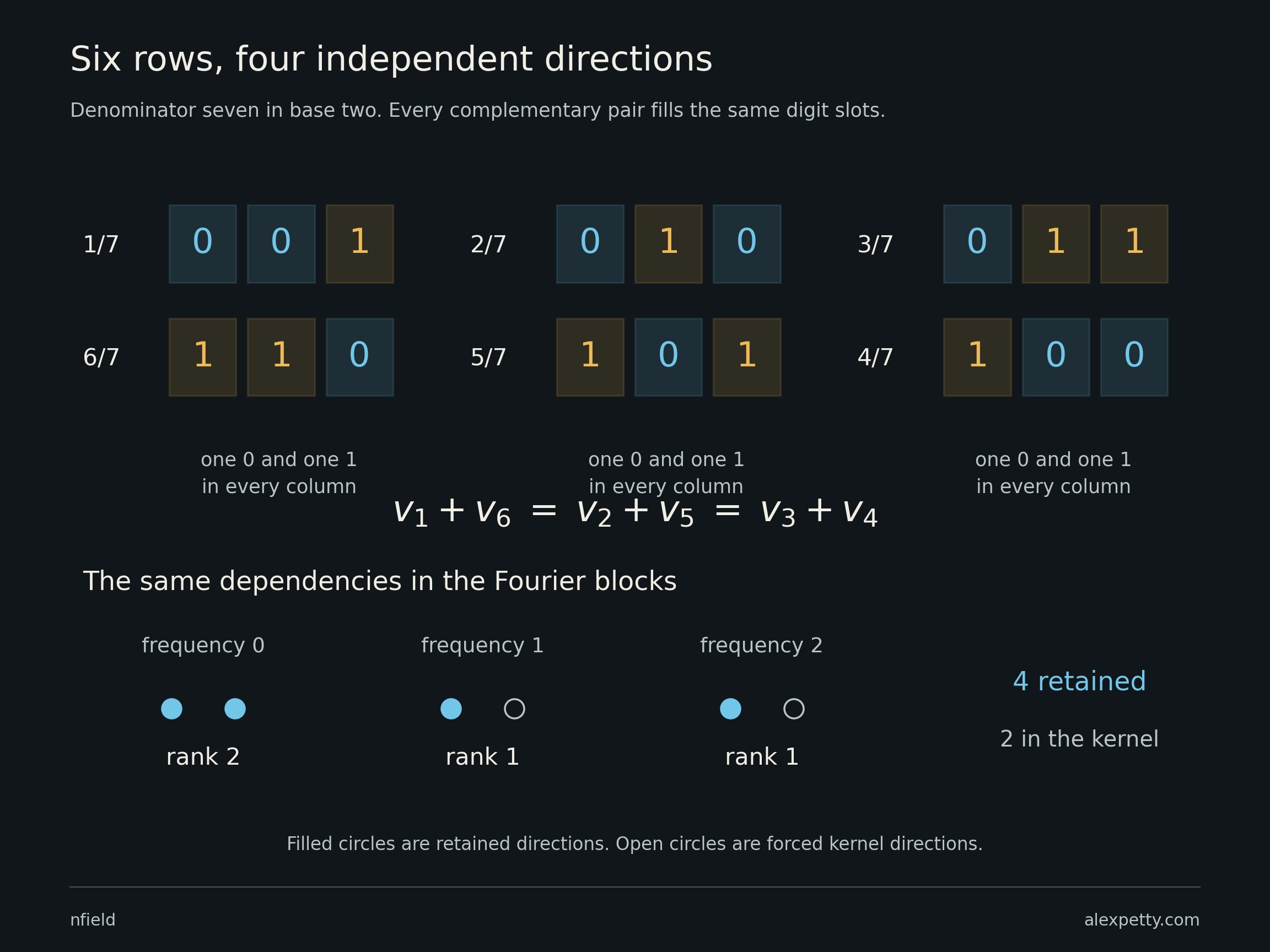
Pair the first row with the last, the second with the fifth, and the third with the fourth. In every pair, every position contains one zero and one one, so three different pairs give the same combined coverage of the digits. The matrix entry for two fractions is the proportion of positions where they agree, and this little table already contains two cancellations, which we can find before calculating a single eigenvalue.
Three pairs with the same total
Give each position two slots, one for zero and one for one. Each row occupies the slot its digit uses. As in the matrix construction, give each occupied slot weight , making the row vector a unit vector. Call the vector for by the name .
The pair 001 and 110 fills all six slots. So does 010 with 101. So does 011 with 100.
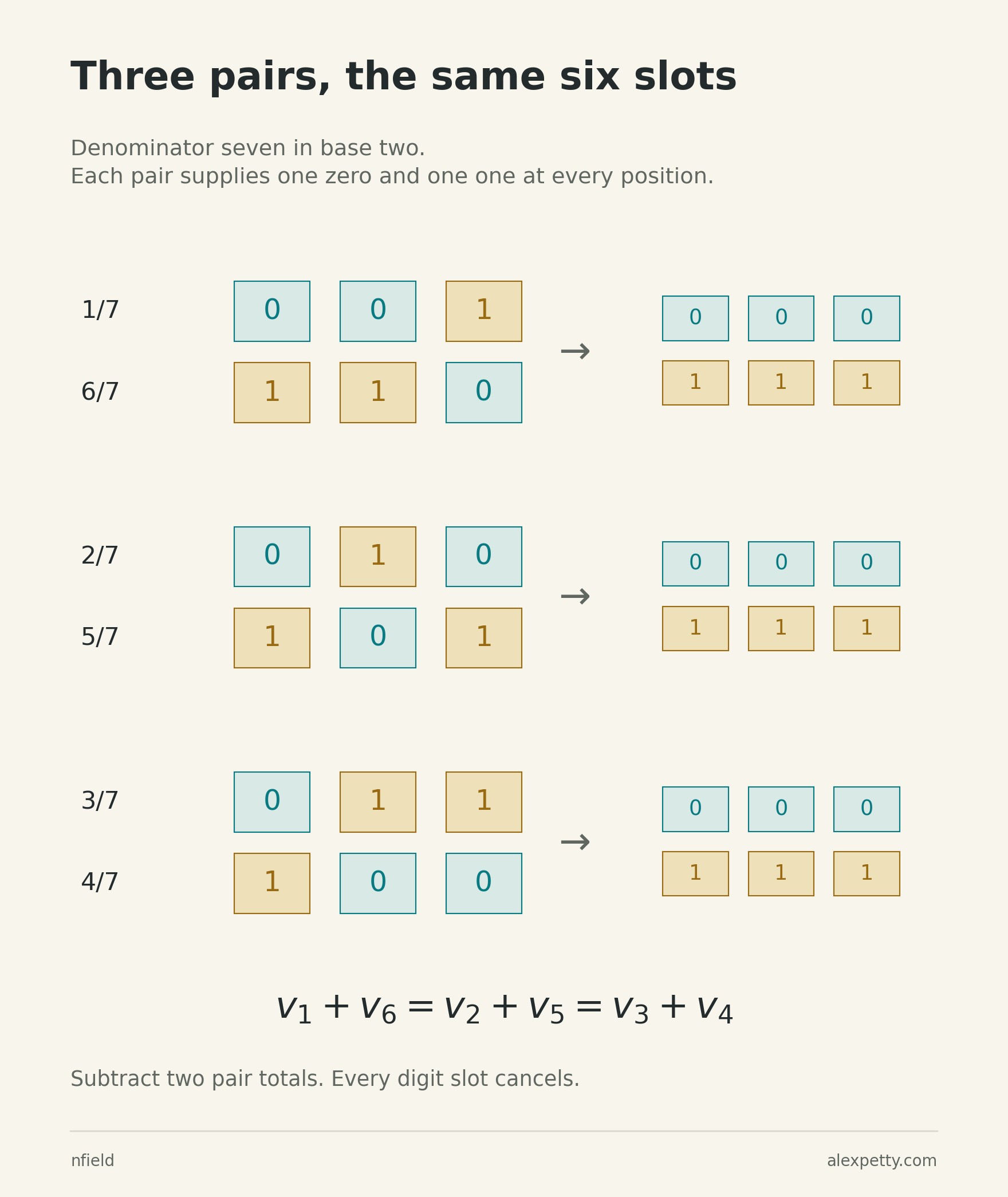
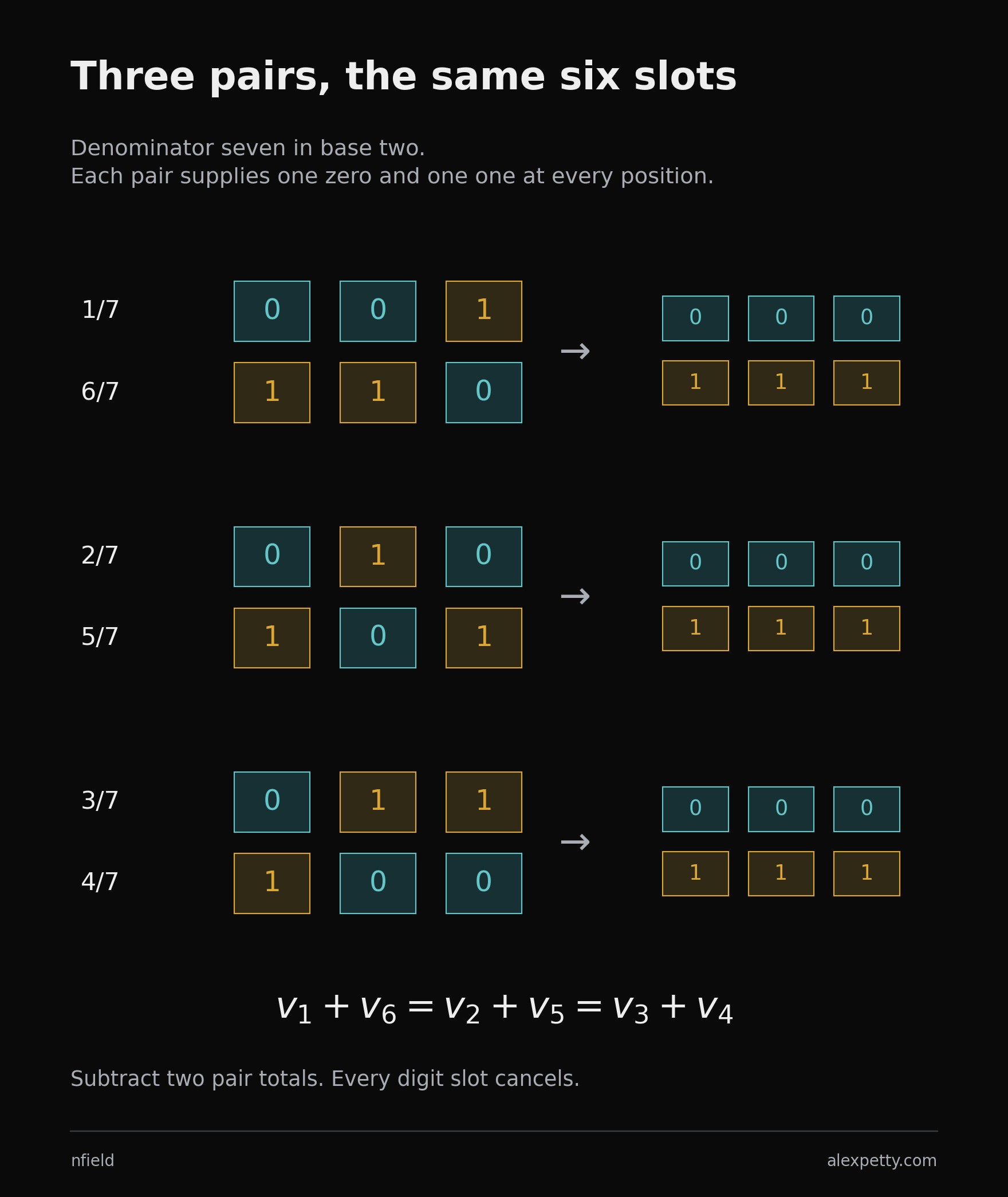
Subtract the second pair total from the first and every slot cancels. Subtract the third from the first and every slot cancels again. These are two independent relations among six distinct rows.
The matrix is a Gram matrix, a table of inner products of the row vectors, so it has exactly the same relations. The row weights that produce cancellation form its kernel, and its rank counts the independent directions that remain. With two independent cancellations in hand, the rank can be no larger than four, and we still have to show there are no others.
Zero and one cannot vary independently
Follow the word 001. Its zero-indicator is and its one-indicator is . At every position exactly one indicator is on, so their sum is the constant sequence one.
Subtract each indicator’s average and the two remaining variations are exact opposites. Where the zero-indicator rises above its average, the one-indicator falls by the same amount.
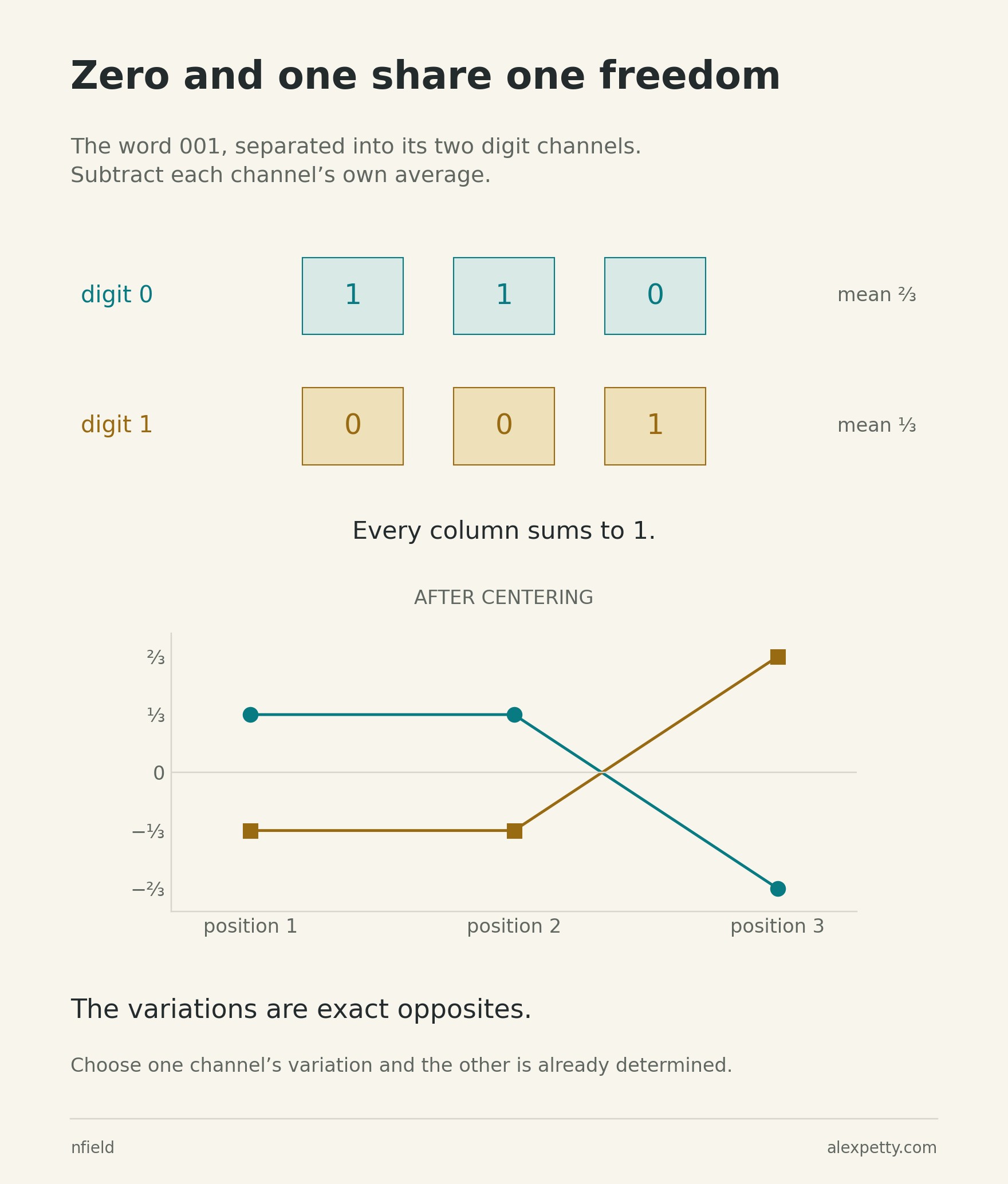
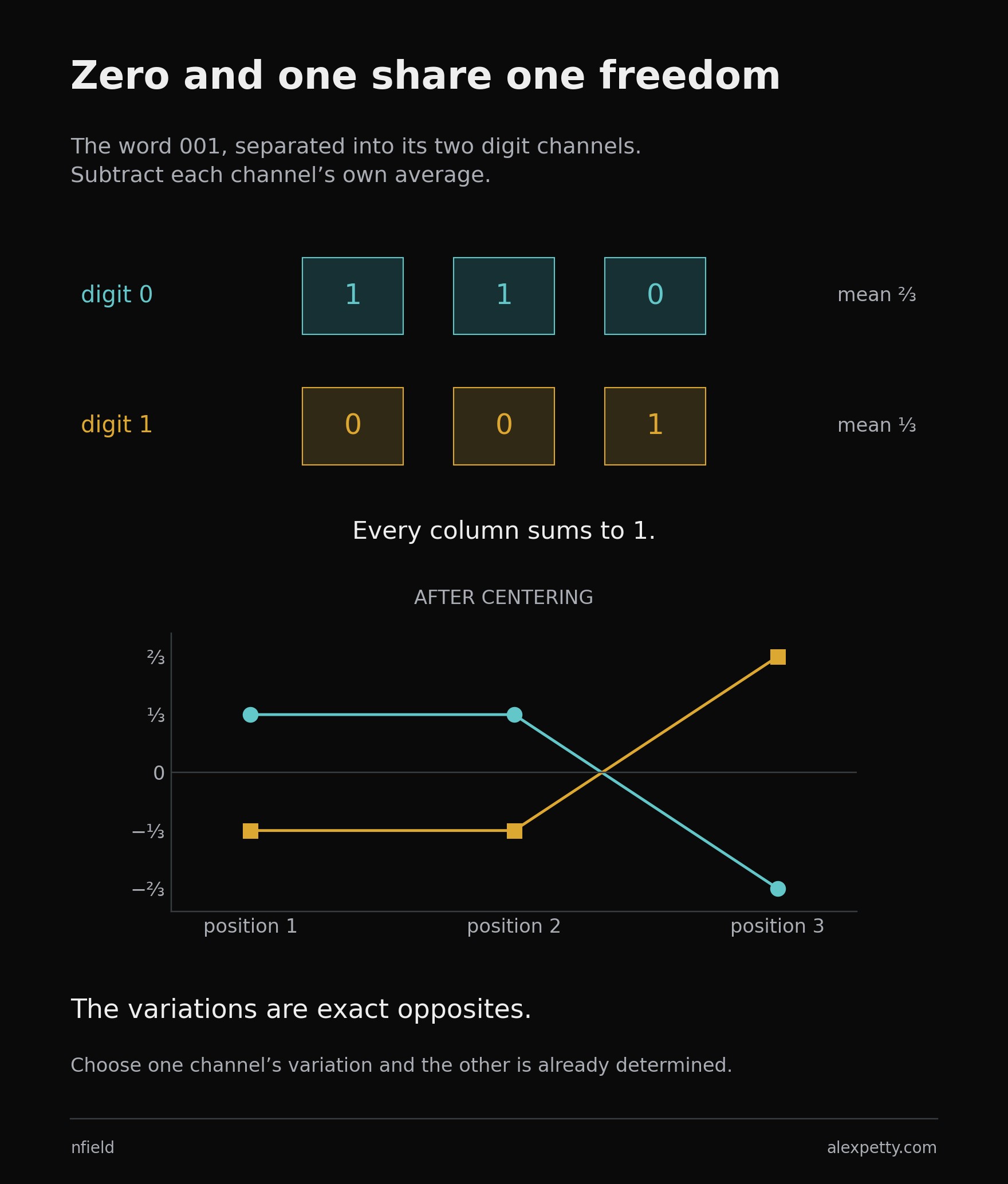
A Fourier transform expresses the variations as frequencies around the repeating cycle. Frequency zero records the digit totals and the other frequencies record variation. Opposite variations have opposite Fourier coefficients, so those two digit channels supply only one independent direction at any nonzero frequency.
With more digits the same restriction holds. If digits occur across the fractional field, their indicators sum to one in each row, and once centered they sum to zero, so knowing of the variations determines the last. It is the budget again, with the digits as the categories.
Mathematicians call this a partition of unity, which is a long name for the fact that every position contains exactly one digit.
Counting the directions that fit
Take a prime not dividing the base . Let be the repeating period and the number of multiplication cycles. The number of occupied digit bins is .
The Fourier reduction in The Cross-Alignment Matrix gives a problem at each of the frequencies. To construct it, record one digit-coefficient vector for each cycle. Each vector has coordinates, one for each occupied digit.
At frequency zero, at most of these vectors can be independent. At every other frequency their coordinates sum to zero, so they lie in a space of dimension with room for at most independent vectors.
Add the available dimensions across the frequencies.
Seven in binary has two cycles of length three, represented by 001 and 011. At zero frequency their digit-count vectors are and , and since neither is a multiple of the other, both directions survive.
At either nonzero frequency the digit coefficients sum to zero, which leaves at most one direction. Each word has a digit occurring exactly once, whose Fourier coefficient cannot vanish, so there is exactly one.
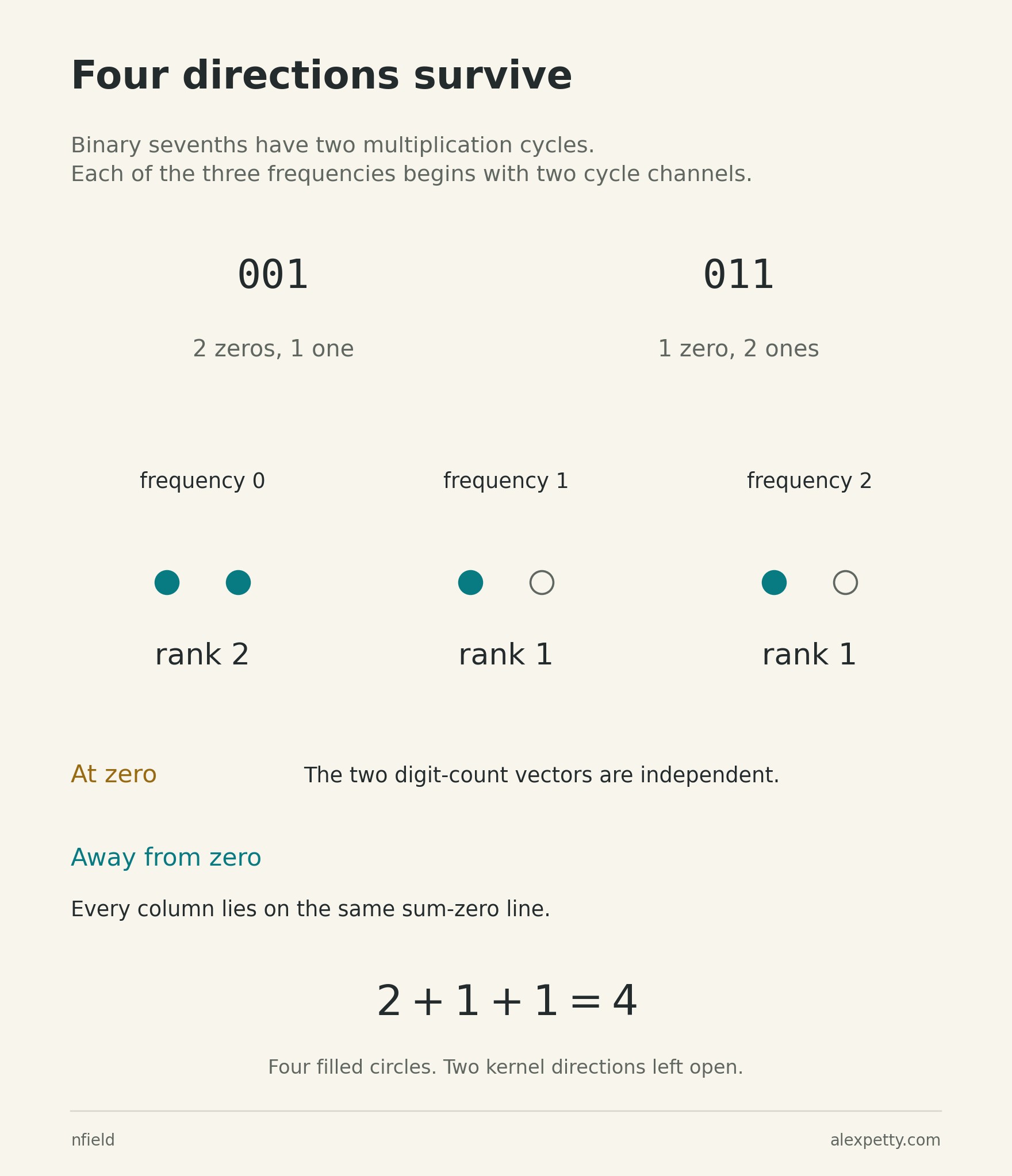
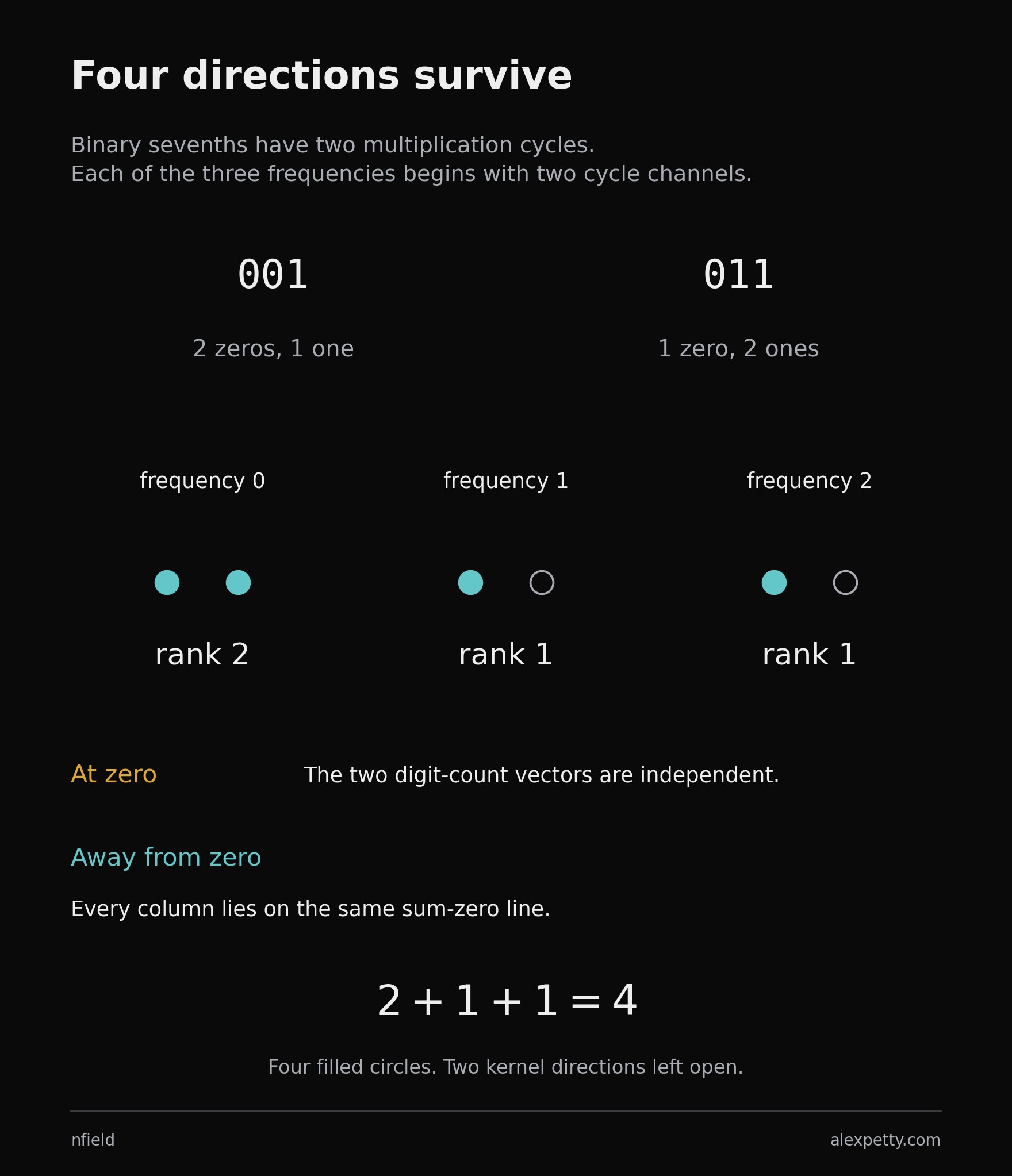
The rank is therefore . Six rows retain four independent directions, and the kernel has dimension two. The pair cancellations found at the start account for the entire kernel.
The exact rank and kernel identities
Let have one column for each multiplication cycle and one row for each occupied digit. Its entries are the unnormalized Fourier coefficients of the digit indicators. The comparison matrix at frequency is
A vector belongs to the kernel of exactly when it belongs to the kernel of . This follows from
The full Fourier decomposition therefore gives exact identities.
Only the dimension count that follows is an upper bound. These Fourier ranks are over the complex numbers, but the original real matrix has the same rank over either field, and conjugate frequencies combine to describe its real directions.
The frequency here follows the positions around a multiplication cycle. It is not the additive Fourier coordinate of the consecutive remainders.
A ceiling, not an exact count
The bound is attained at binary seven, but it need not be attained at another prime. Fifths give a smaller table where it is not.
1/5 = 0.|0011| in base twoAll four rows belong to one cycle of length four, with two occupied digits. The bound allows independent directions, which would be full rank.
But the alternating frequency gives successive positions the weights . In 0011 the zero-indicator occupies the first two positions, so its weighted sum is , and the one-indicator occupies the last two and cancels the same way. Both digit channels vanish at that frequency.
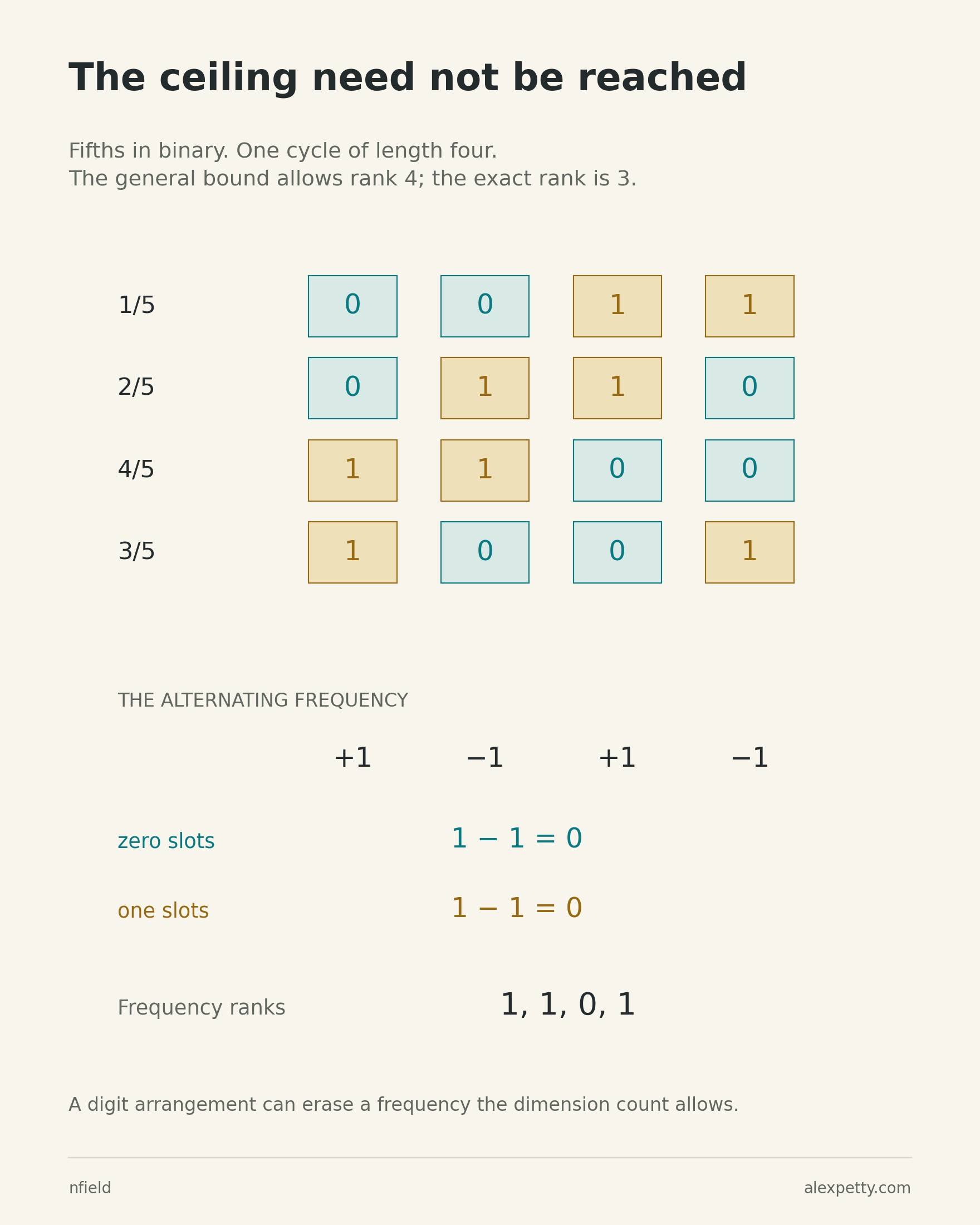
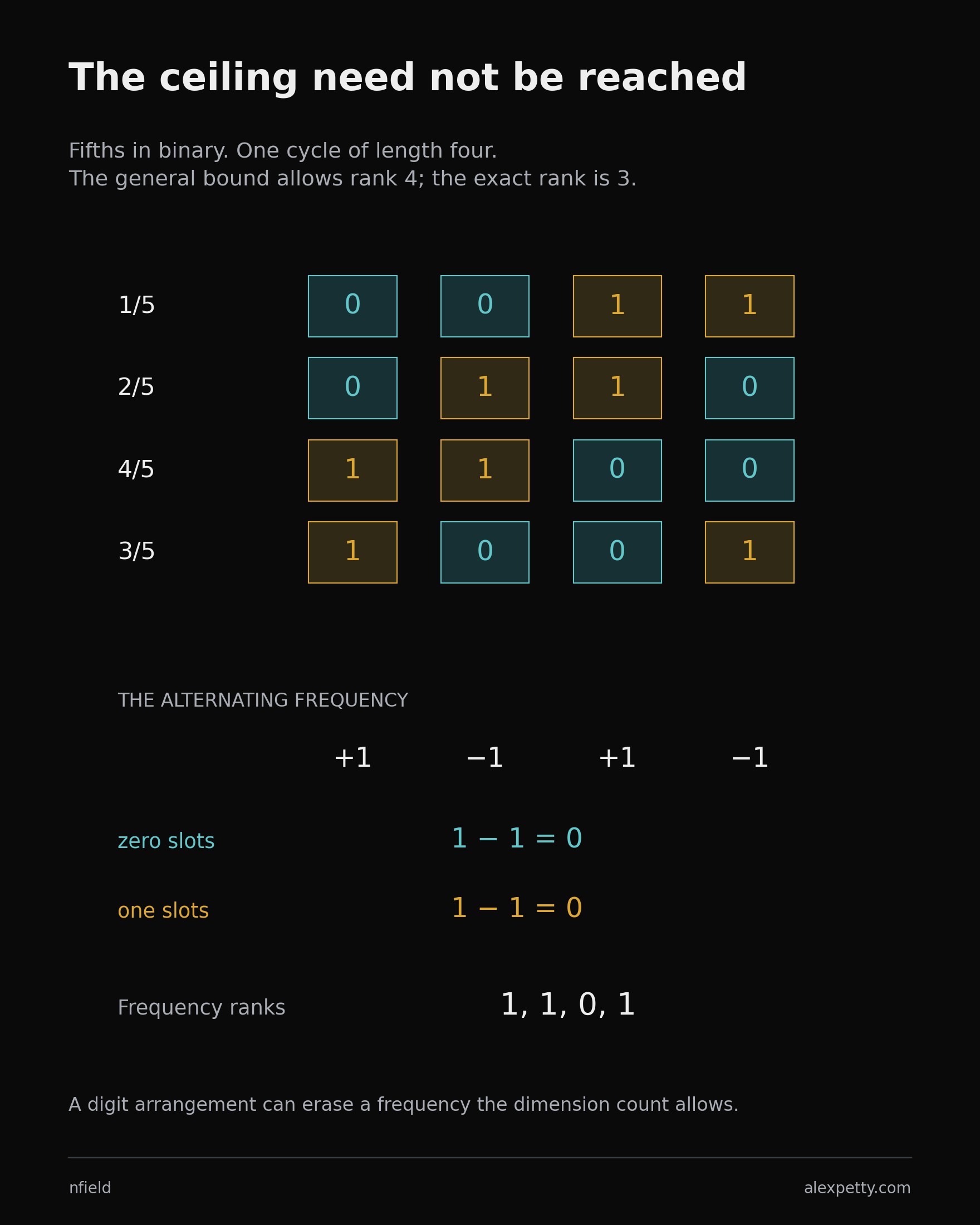
The four frequency ranks are , so the matrix has rank three. Its eigenvalues are . In the original rows, the missing direction is the relation
The general count allowed four directions and the placement of the digits supplied only three. At seven the partition constraint accounts for all the rank loss, while at five an extra cancellation comes from the word itself.
Six binary tables, from four rows to 126
These matrices use the same pair-score scale and ordinary numerator order. Their ranks come from exact rational elimination, not from rounding small numerical eigenvalues to zero, and the labels compare each actual rank with its partition-of-unity ceiling.
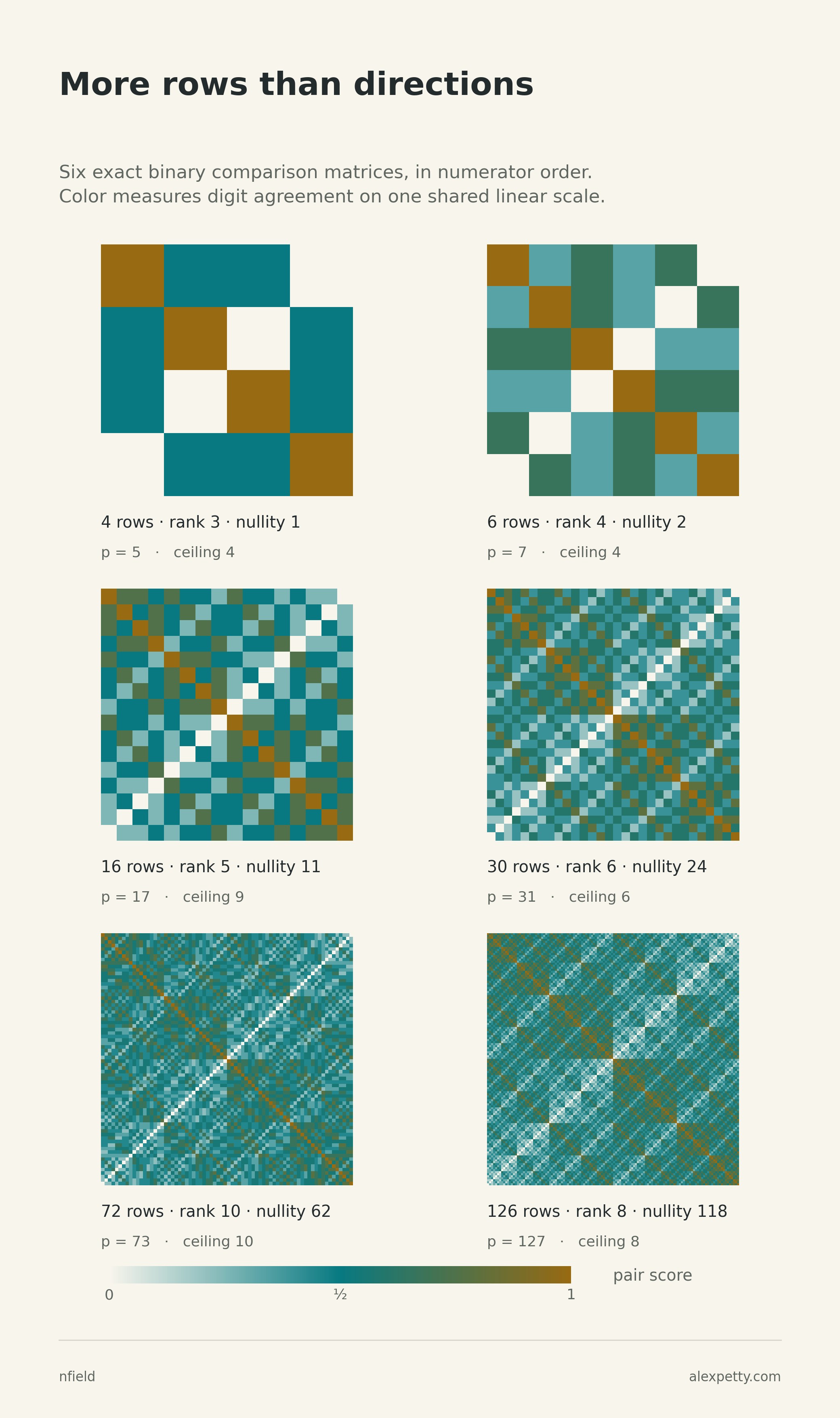
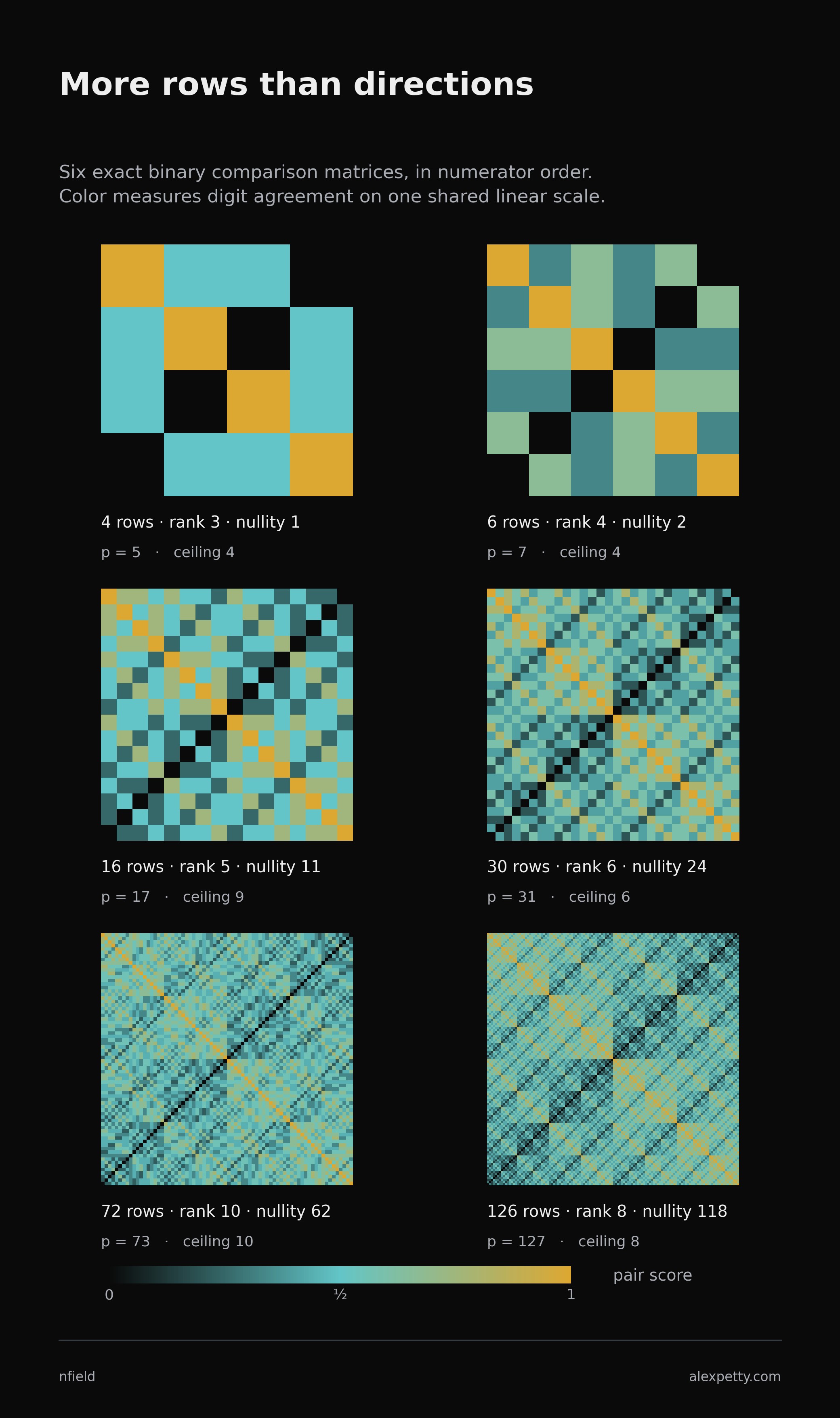
At seventeen the ceiling is nine while the exact rank is five. At 127 the ceiling is attained, and the 126 rows keep eight independent directions, leaving 118 dimensions in the kernel.
Two cycles do not guarantee two levels
Counting the surviving directions is one question, and their eigenvalue levels are another.
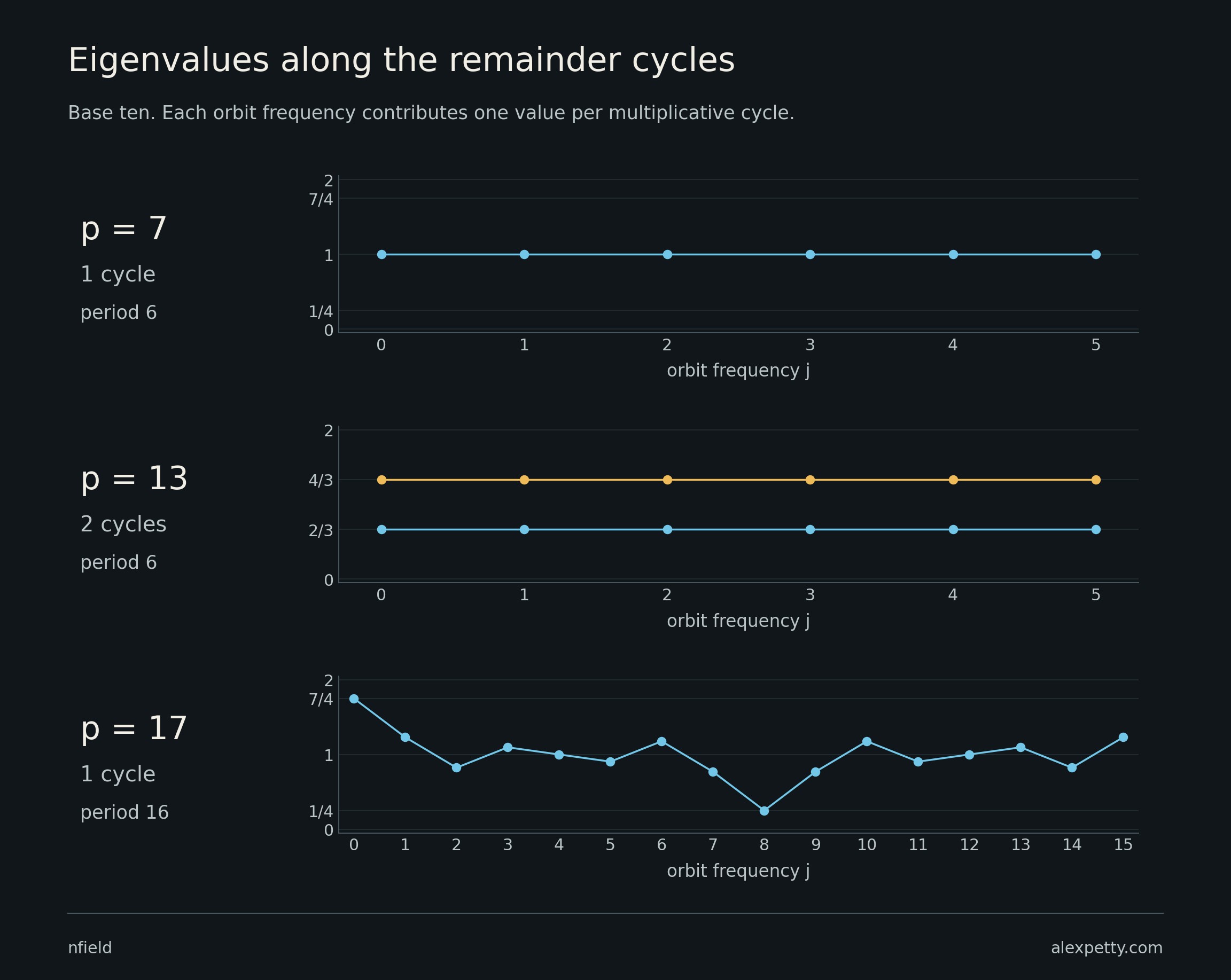
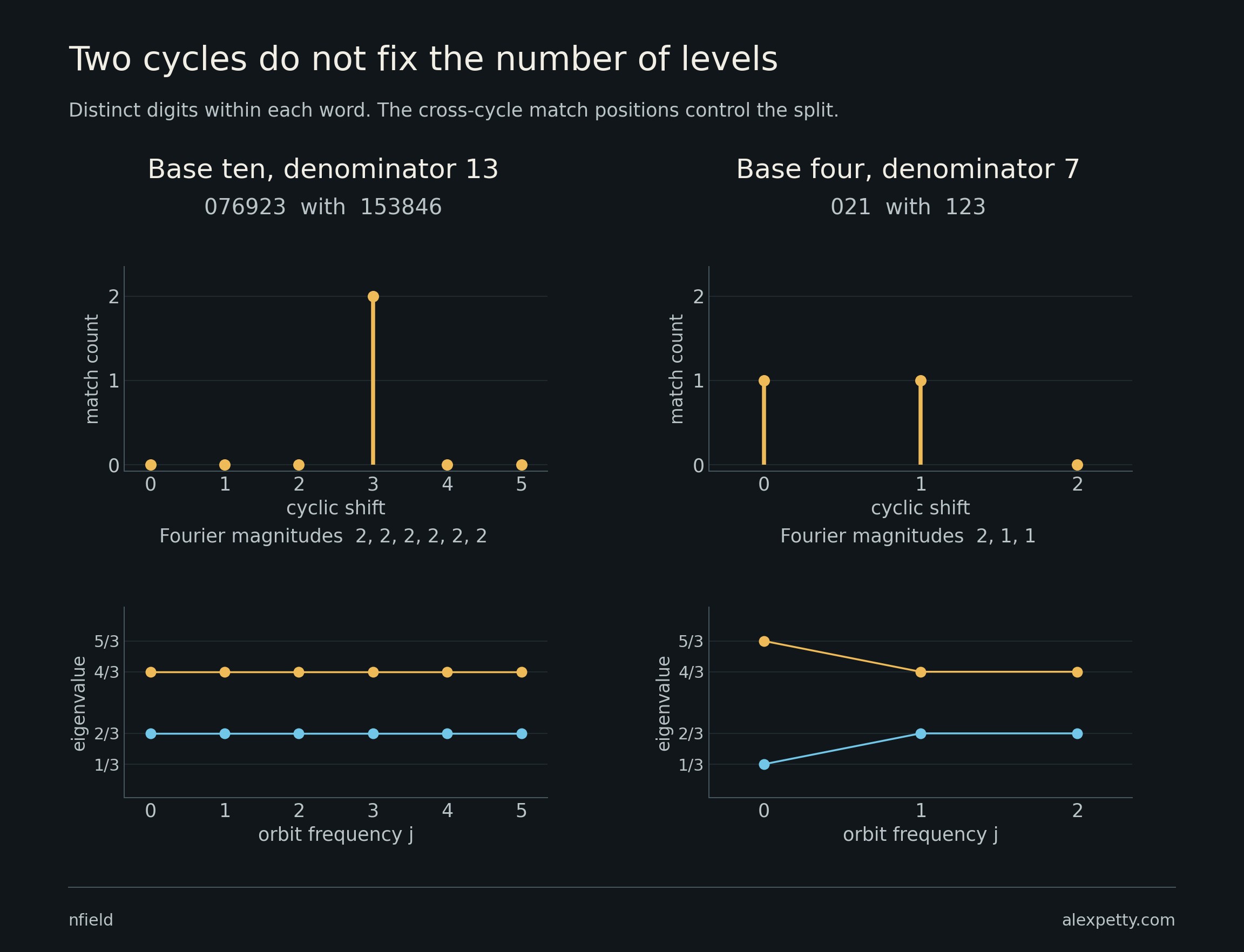
Recall thirteen in decimal from The Cross-Alignment Matrix. Its two cycle words have no repeated digit within either word, and all their cross-cycle matches occur at one shift. This gives two flat levels, and .
Now divide by seven in base four. There are again two cycles, represented by
1/7 = 0.|021|   in base four
3/7 = 0.|123|   in base four
Compare 021 with 123 and the middle digits agree. Shift the second word to 231 and the last digits agree, and shift once more to 312 and none do. The cross-cycle counts are .
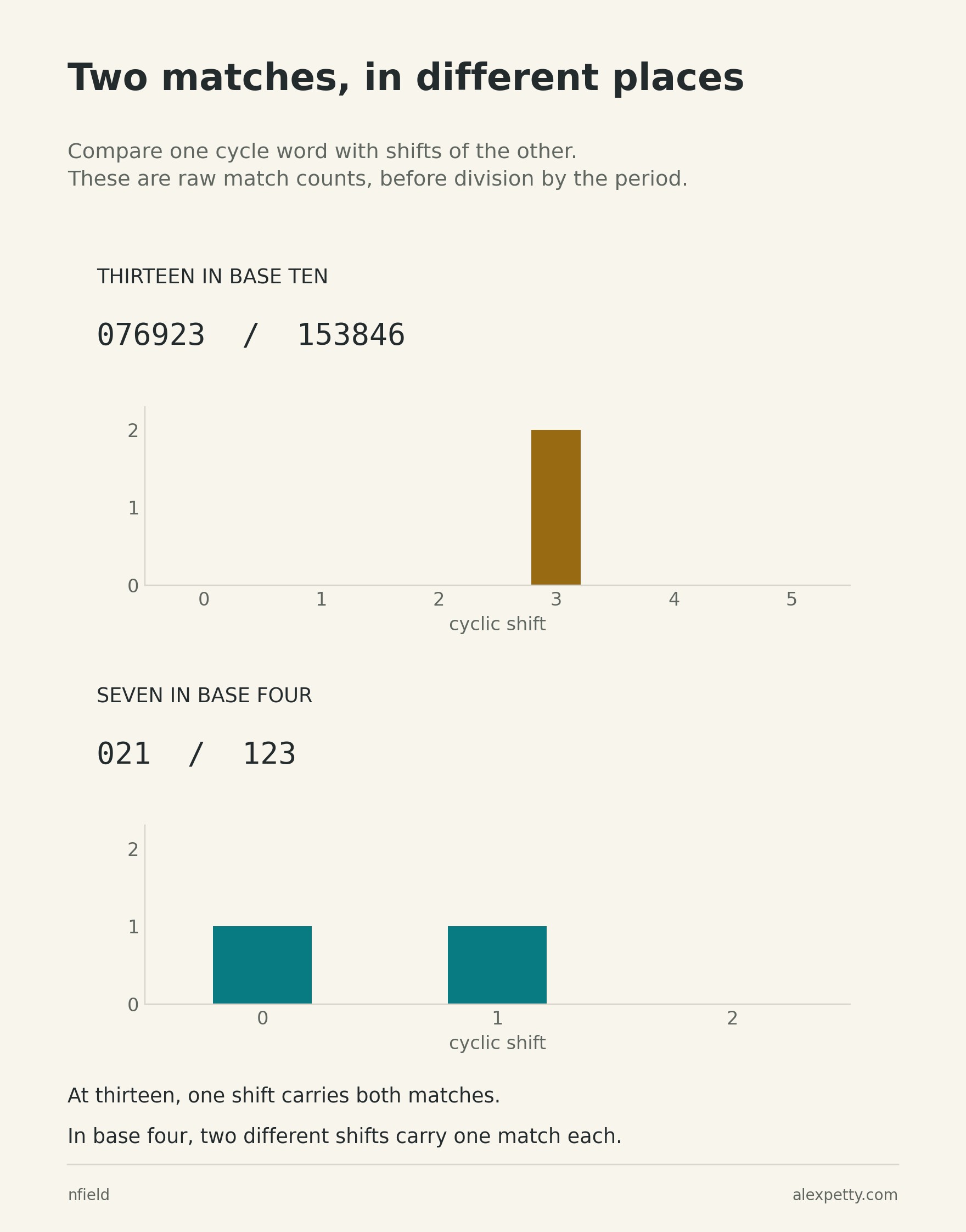
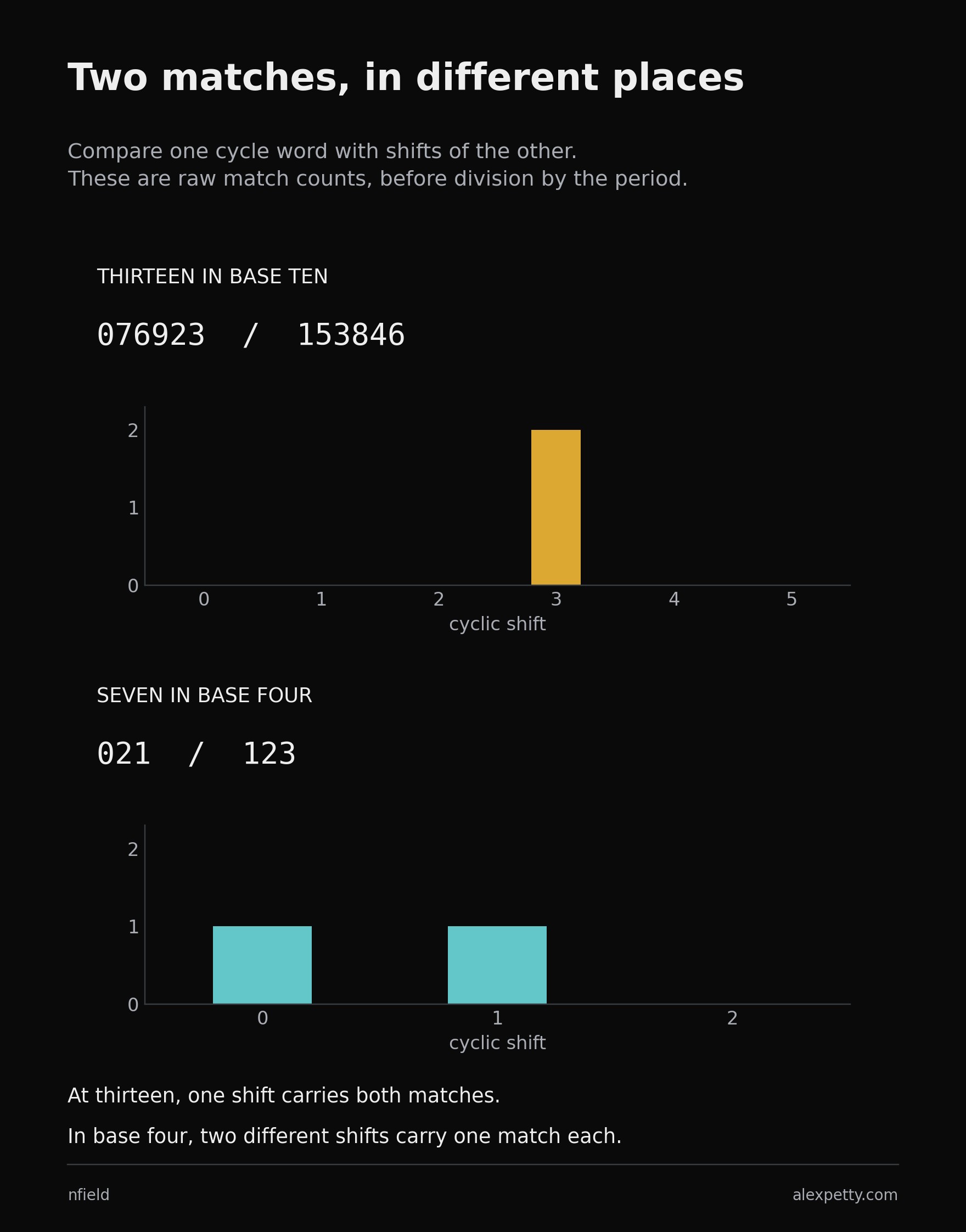
Both examples have two matches in their cross-cycle count, though their periods differ. At thirteen both matches occupy one shift, and in base four they occupy two. That placement determines whether the Fourier magnitude can stay constant.
One arrow, or two
In a Fourier sum, each occupied shift contributes an arrow whose length is the match count there and whose angle depends on the shift and the frequency.
At thirteen there is one arrow of length two. Changing frequency turns it without changing its length, and dividing by the period six gives the constant split .
In the base-four example, there are two unit arrows. At frequency zero they point the same way, giving a resultant of length two. At each of the other frequencies they make an angle of 120 degrees, giving a resultant of length one.
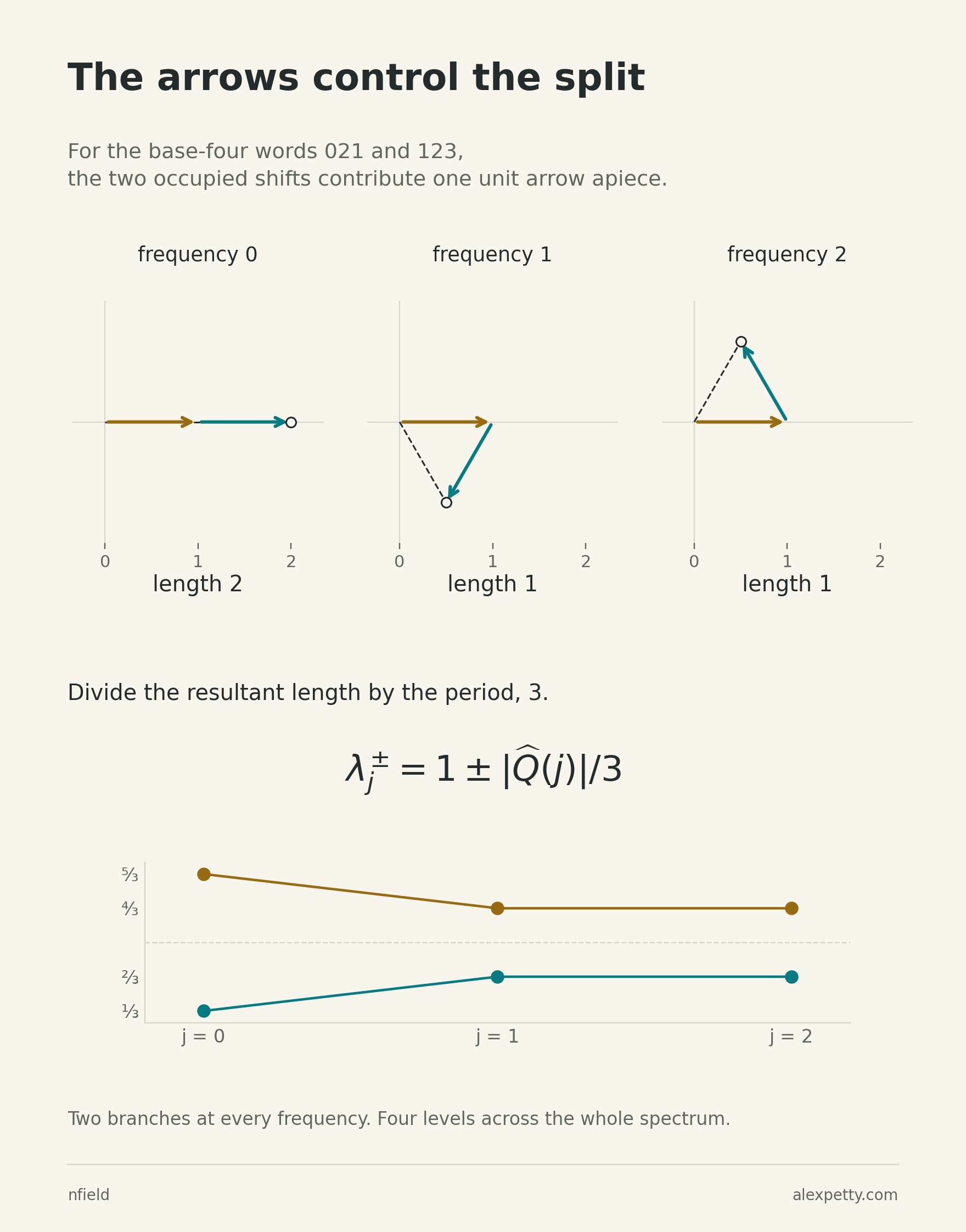
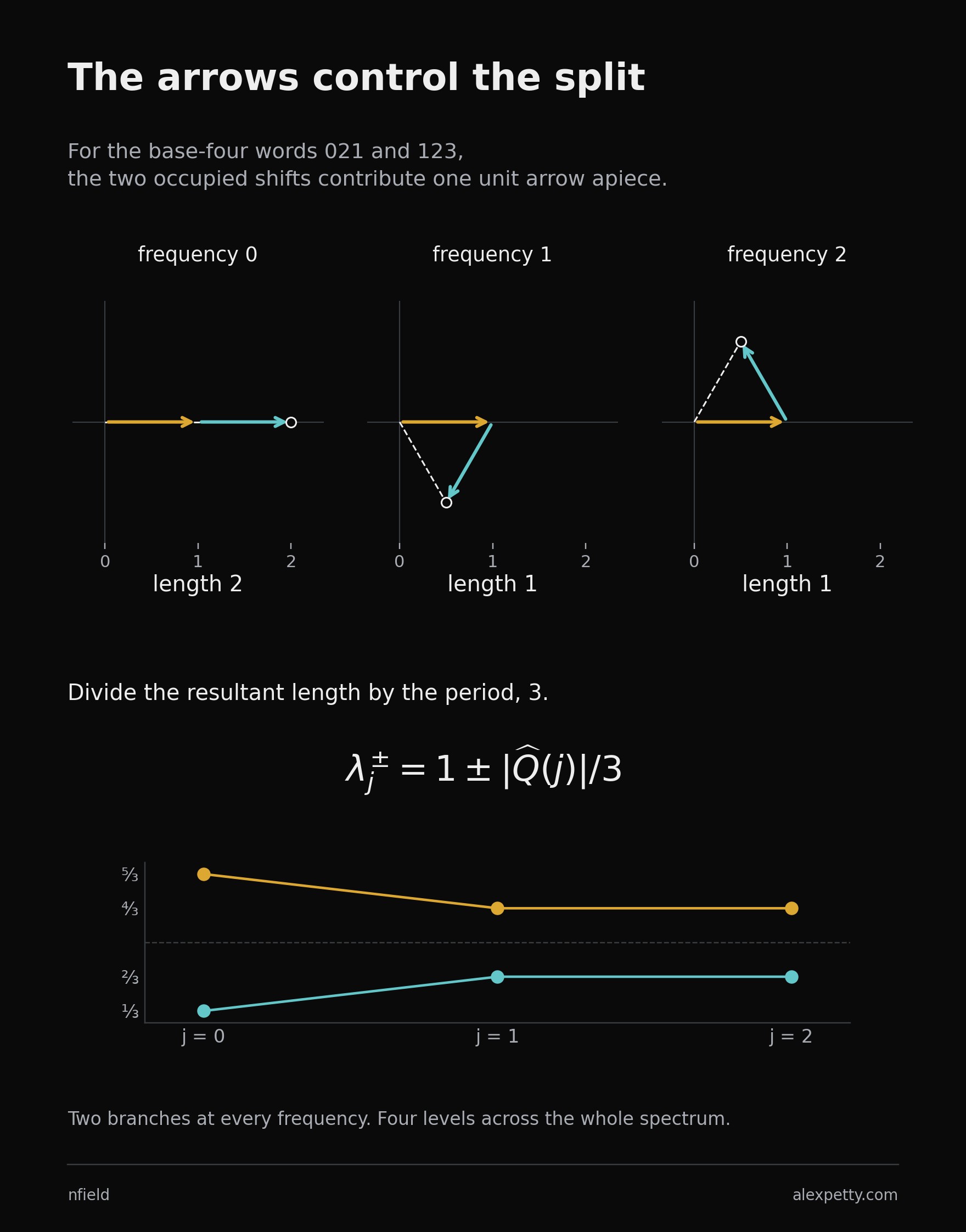
Divide those lengths by the period three. The eigenvalues are at frequency zero and at the other two frequencies. Across the whole spectrum, there are four levels,
There is an exact criterion here. With two cycles, and no repeated digit within either cycle word, there are exactly two global eigenvalue levels if and only if the cross-cycle count is nonzero and concentrated at a single shift.
One occupied shift gives one arrow of fixed length. For the converse, look at frequency zero, where all arrows point together and the resultant is as long as it can be. At the next frequency, distinct shifts give distinct angles. Two occupied shifts would make that resultant shorter. Constant length at every frequency therefore requires a single occupied shift.
Two cycles give two eigenvalues at each frequency, but nothing requires those eigenvalues to stay put as the frequency changes.
The two-level formula and its assumptions
Let count matches between the first word and the second word shifted by positions. Define
When both words have distinct digits, the two eigenvalues at frequency are
Exactly two global levels require the same nonzero magnitude at every frequency. A count of at a single shift gives levels and , each repeated times. If the words share no digits at any shift, the matrix is the identity and there is only one level. If either word repeats a digit, its own autocorrelation also enters the calculation and this simplified criterion no longer applies.
The Spectral Structure of Fractional Fields gives the general two-cycle formula, the exact kernel decomposition, and the rank bound. The classical correlation and Fourier sources are collected there and in The Cross-Alignment Matrix. The restrictions derived here come from applying that machinery to the digit partition across the complete table of fractions.
Pair cancellations and orbit-frequency profiles
The pair diagram and two-cycle comparison can also be inspected in these wider plates. The decimal profile plate keeps the eigenvalues from The Cross-Alignment Matrix at hand for comparison.
Swap the pair 001 and 110 for the pair 010 and 101 and every digit slot is still filled exactly once, so the rows change and the pair total doesn’t. At 127 the same bookkeeping runs across 126 binary rows with a period of seven. Choose eight independent row vectors and every one of the other 118 is a weighted sum of those eight, because at each of the seven positions the zero slot and the one slot always add up to the same total.
Discussion
Sign in to join the discussion.