Essay
The Structure That Survives
I chose the name collision invariant with its meaning in physics in mind.
In an elastic collision, two particles meet and leave with different velocities. The individual motions change, but the pair’s total momentum and kinetic energy survive the encounter. A collision invariant keeps track of that unchanged total. It lets a calculation follow something definite through a great deal of motion.
Long division gives me a small place to ask a similar question. Remainders move, digits change, and agreements appear and disappear. The whole process is available for inspection. I can write out every fraction, color the digits, and try another denominator.
Take the fractions with denominator 109. There are 108 of them between zero and one. Eighteen begin with two equal decimal digits. At denominator 1009 there are 1,008 fractions, and 108 begin with equal digits.
The second count is much larger, as it should be. There are nine hundred more fractions to work with. Take one tenth of the number of fractions, rounded down, as the baseline. That gives ten at 109 and one hundred at 1009. Subtract those baselines and both leave eight.
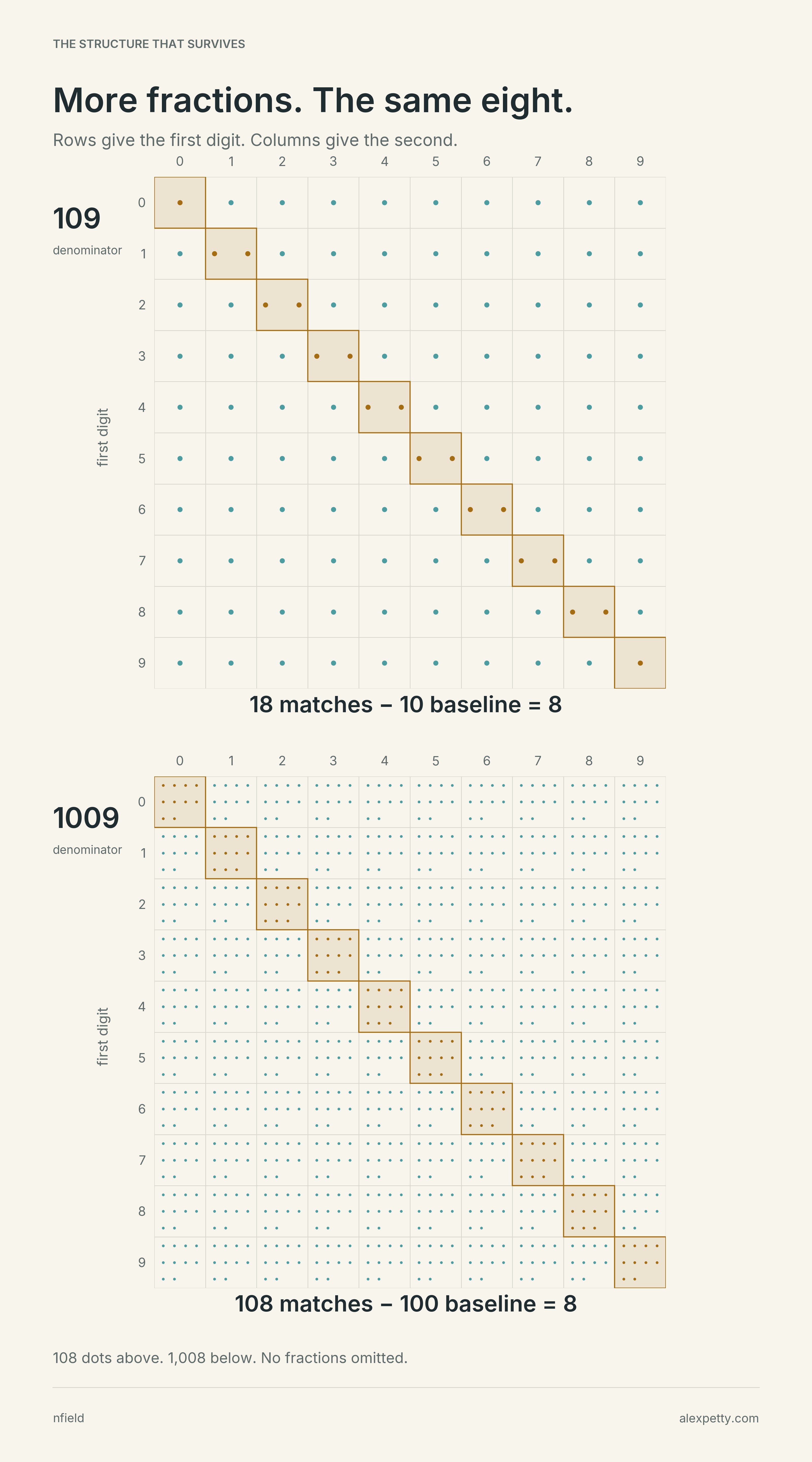
Eight is not a coincidence between two convenient examples. Every denominator ending in 09 leaves eight. Primality is unnecessary here. The Collision Periodic Table assigns the answer from the last two digits before we have counted a single match in the larger fraction field.
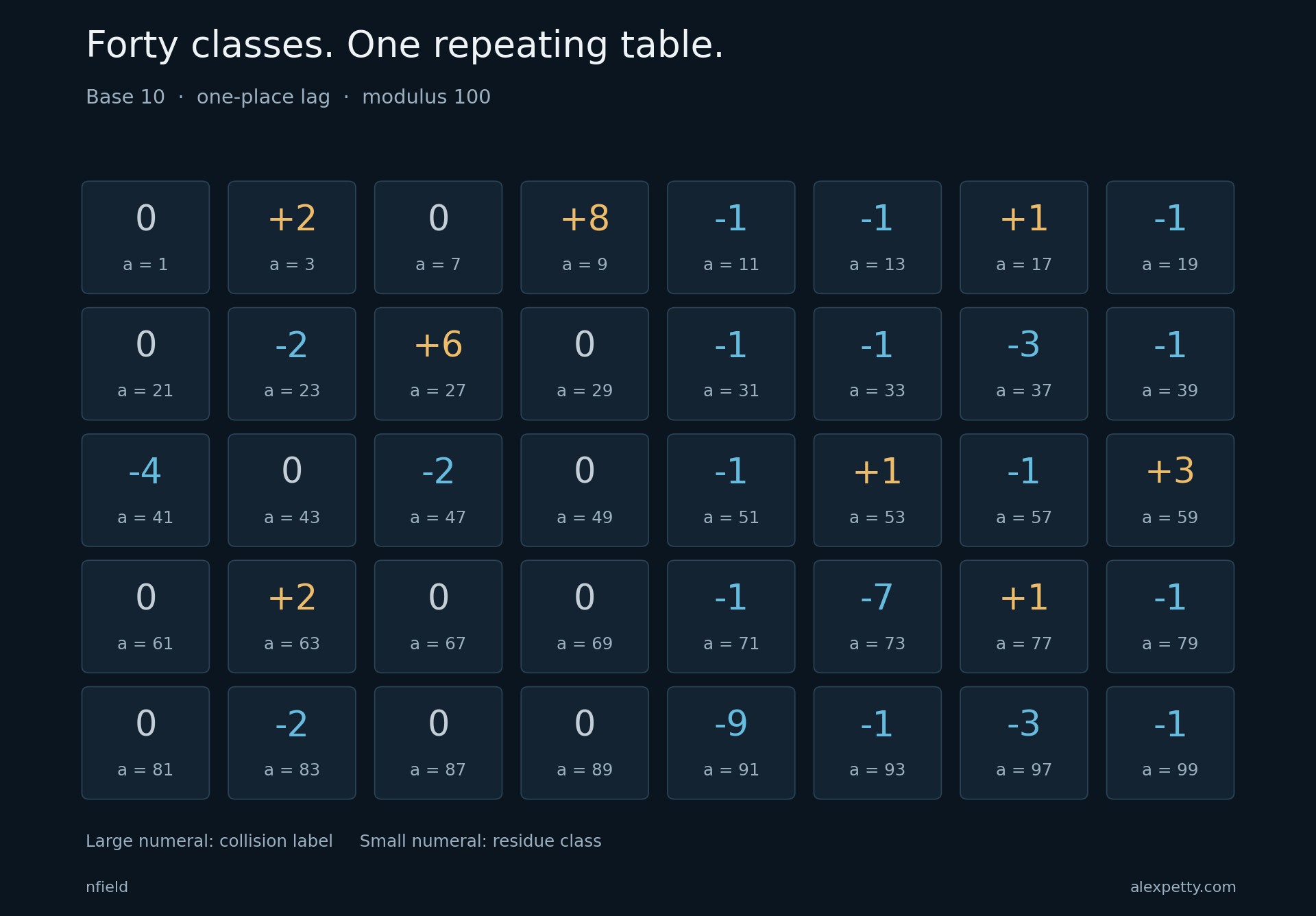
There are forty possible endings coprime to ten, but only twelve different labels among them. A prime can be as large as it likes. In this calculation, it still receives one of those twelve labels. The primes two and five receive zero, which is already on the list.
This is the change of view that keeps drawing me back. The fraction fields grow, and their detail can become difficult to take in. Yet one particular count, with its baseline removed, fits on a small page. I want to know what that page preserves, and what I have lost by reducing the field to it.
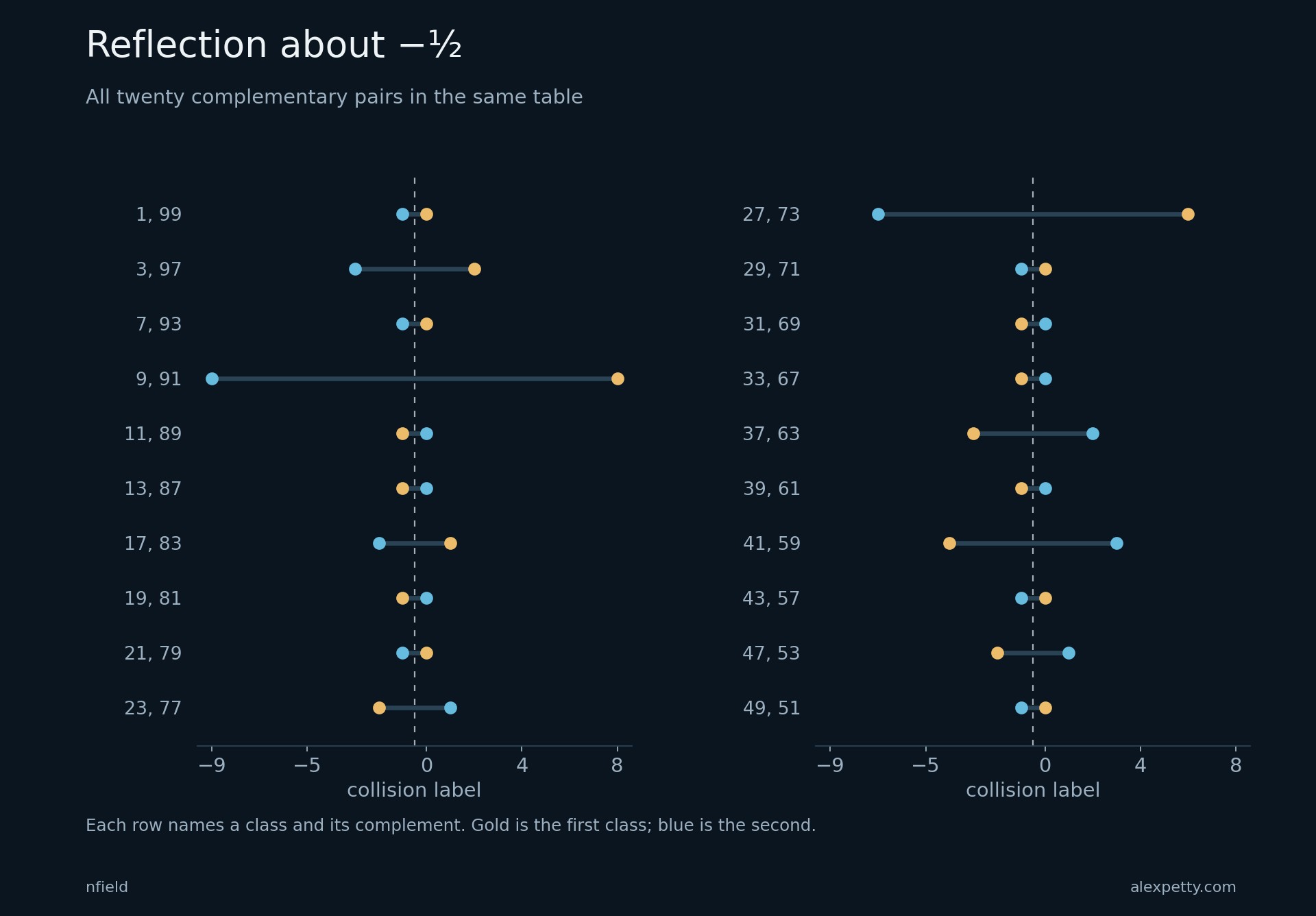
The mirror gives one answer. An ending and its complement to one hundred always carry labels adding to minus one. The label at 09 is eight; the label at 91 is minus nine. At 27 and 73 the pair is six and minus seven, a different excursion around the same midpoint.
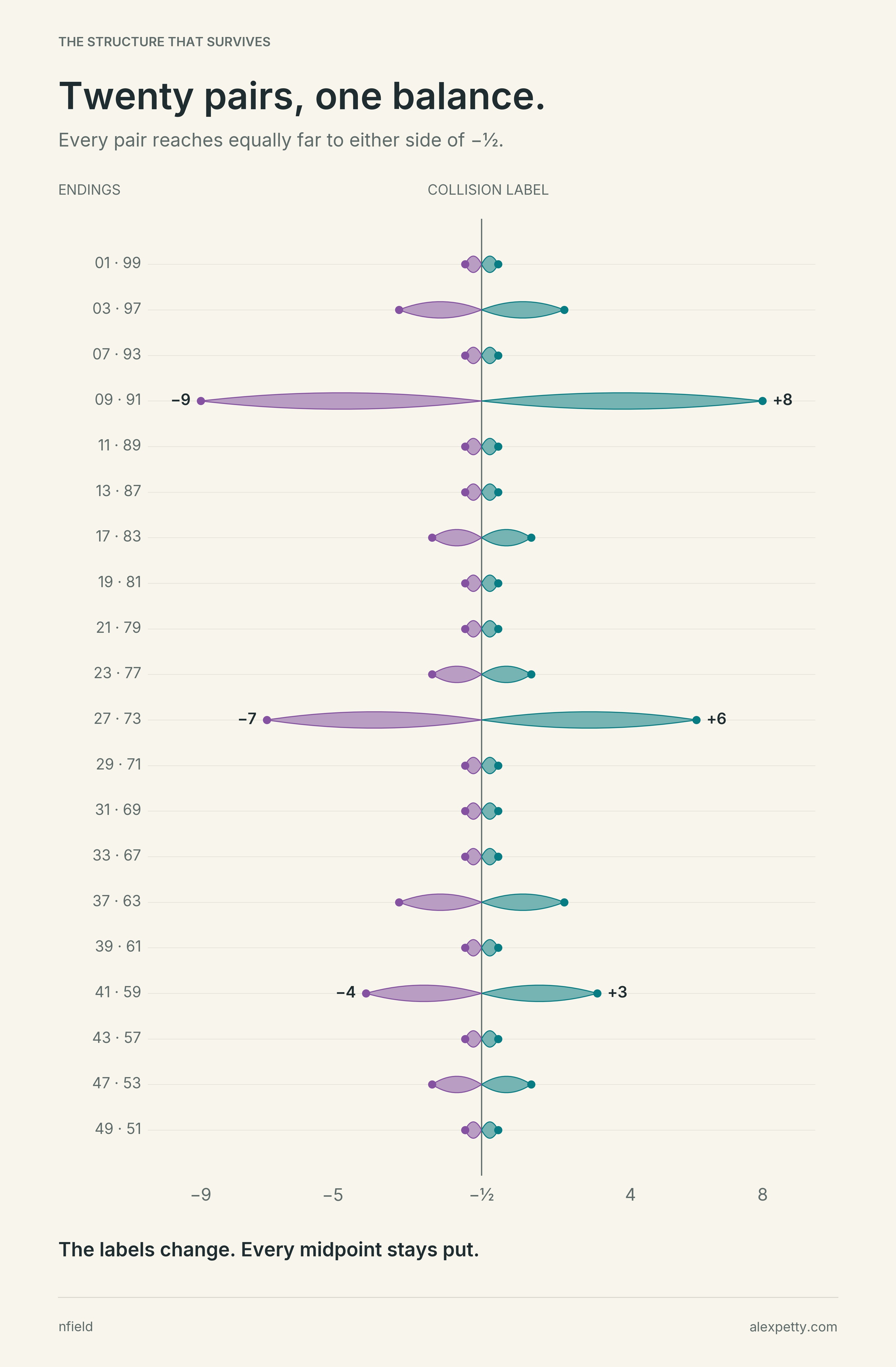
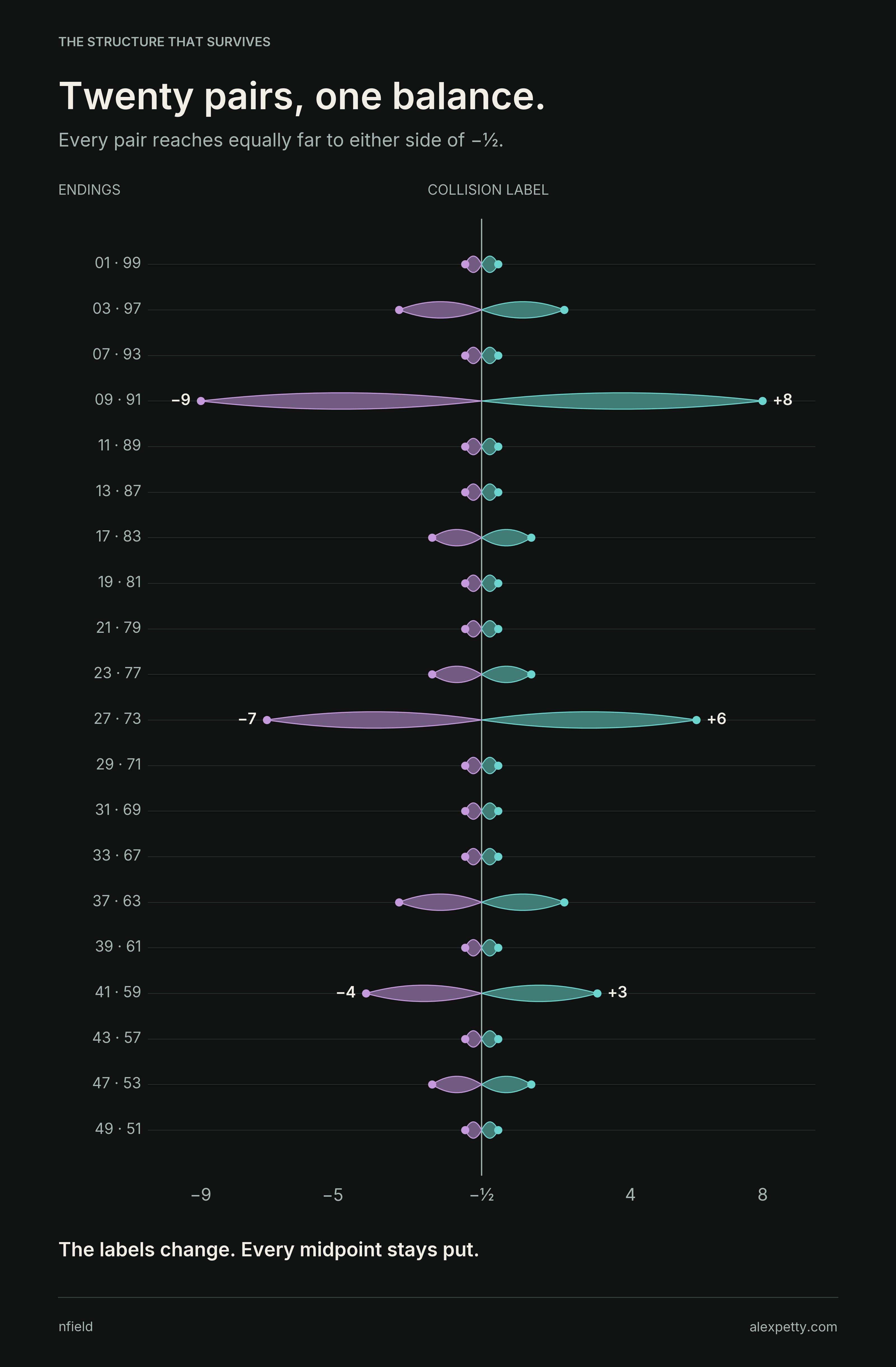
Set zero at that midpoint, minus one half, and every reflected pair becomes exactly opposite. There is no averaging over a long run of primes to make the balance emerge. It is present in each pair.
That is a relation I can keep while changing the numbers. It is also where the physics analogy has to earn its limits. These are agreements between digits, not encounters between particles. The arithmetic has its own identity and its own proof. The name carries a question from one setting to another, not a conservation law.
Repetition gives another way to see what remains.
Write the first three hundred primes along two sides of a square. At every crossing, compare their collision labels. Give equal labels gold and let larger differences fade. In prime order, the square looks woven. Move the primes with equal labels together, keeping the same order on both sides, and blocks appear.
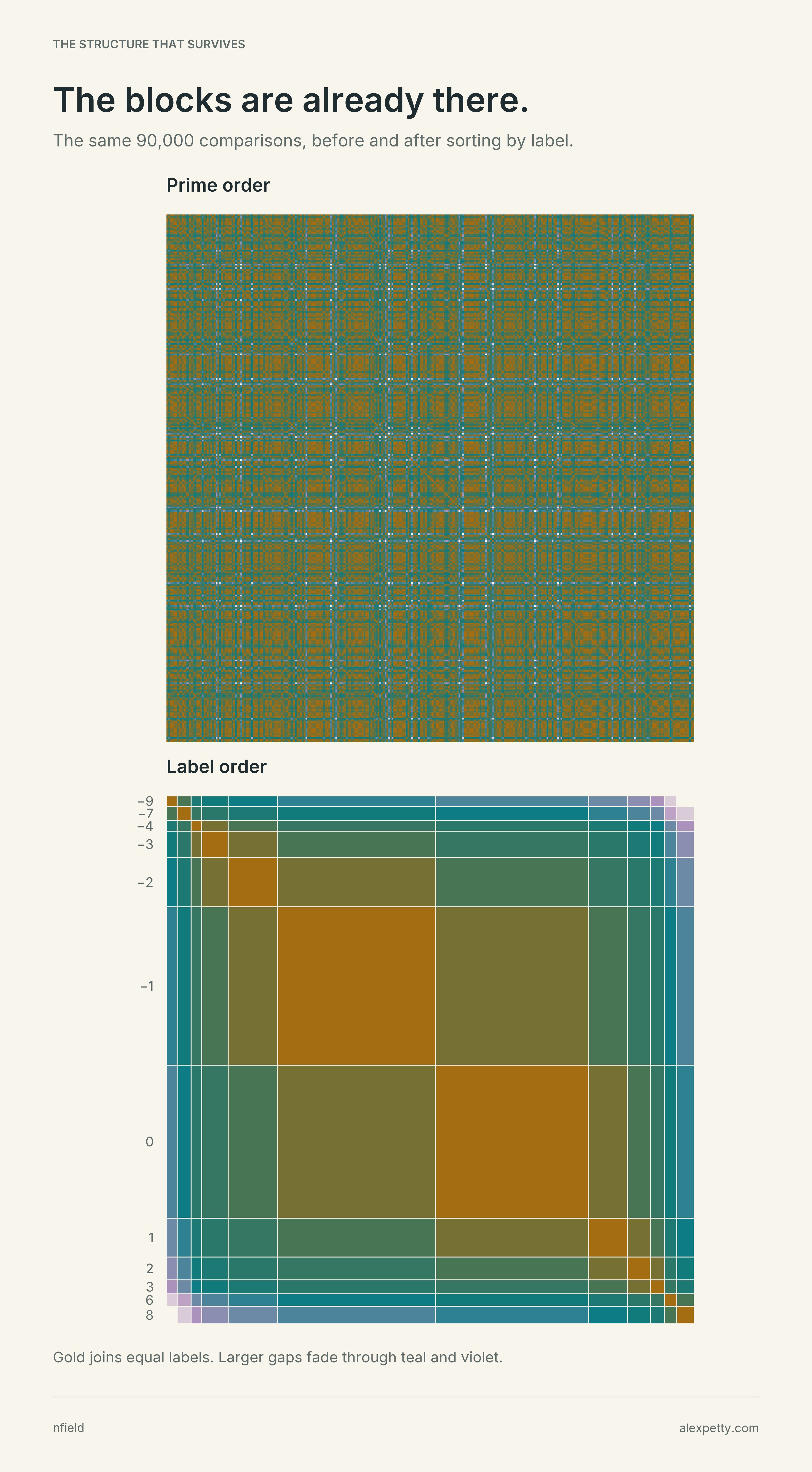
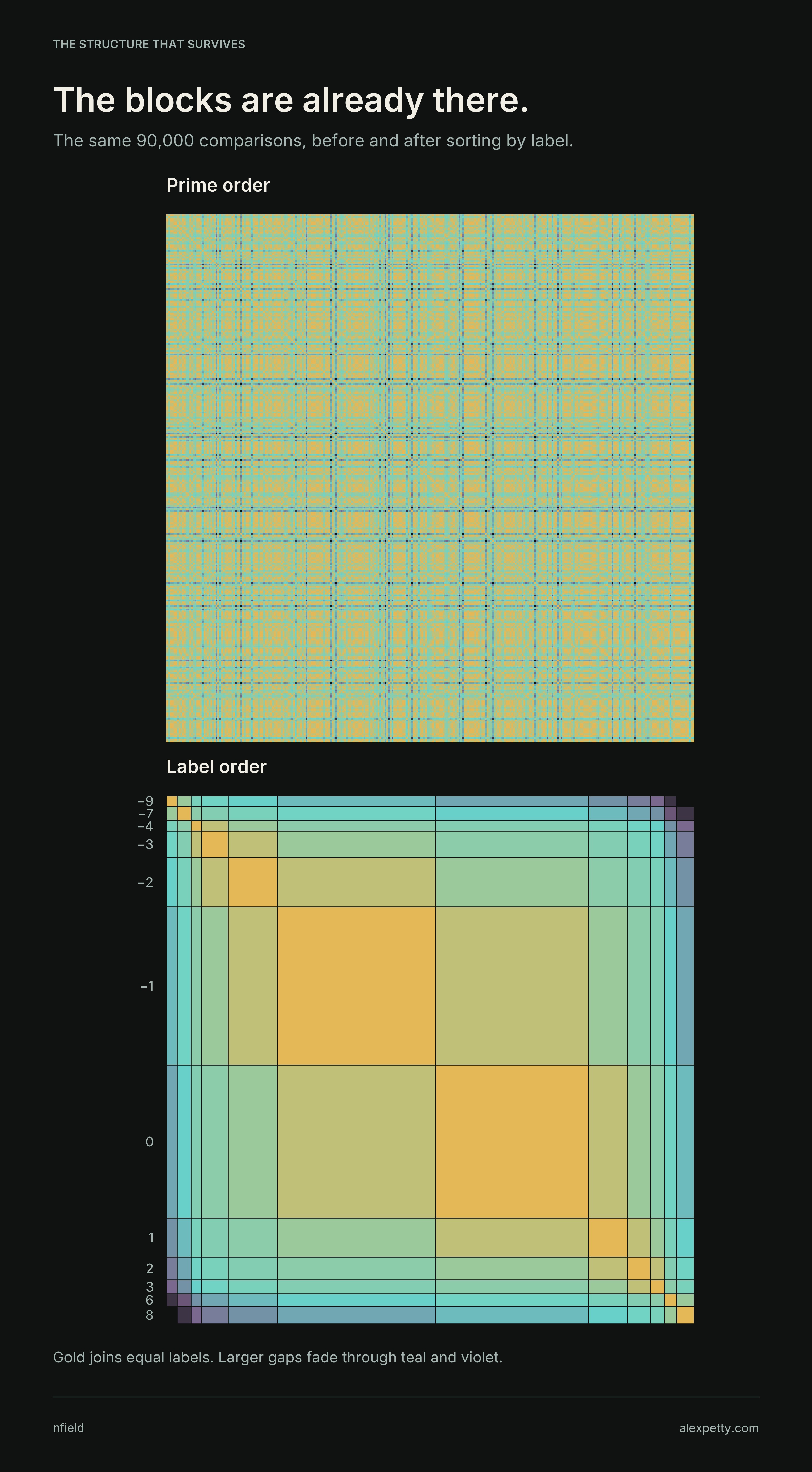
Nothing has been smoothed away. These are the same ninety thousand comparisons. The second drawing simply puts identical rows beside one another.
That repetition permits an exact reduction. For the comparison rule developed in The Structure That Survives, the spectral calculation for three hundred primes reduces to a twelve-by-twelve matrix and a repeated part whose behavior is already known. The population of each label still counts. Change those populations and the twelve remaining spectral values can move, though their number stays fixed.
So there is room for both persistence and variation in the same picture. The finite table does not explain away the primes. It tells us which distinctions this particular construction can make between them.
The exact labels and the matrix behind the drawing
For base ten and a one-place lag, count all fractions with whose first two digits agree. The label is
For every coprime to ten, including small and composite denominators, . Read the tens digit down the table and the units digit across it.
| Tens digit | Final 1 | Final 3 | Final 7 | Final 9 |
|---|---|---|---|---|
| 0 | 0 | 2 | 0 | 8 |
| 1 | -1 | -1 | 1 | -1 |
| 2 | 0 | -2 | 6 | 0 |
| 3 | -1 | -1 | -3 | -1 |
| 4 | -4 | 0 | -2 | 0 |
| 5 | -1 | 1 | -1 | 3 |
| 6 | 0 | 2 | 0 | 0 |
| 7 | -1 | -7 | 1 | -1 |
| 8 | 0 | -2 | 0 | 0 |
| 9 | -9 | -1 | -3 | -1 |
Reflection gives . Thus satisfies . This reflection centers the whole table at minus one half. It is distinct from the per-family centering used in The Collision Transform.
The drawings color the distance between labels. The paper turns that distance into an affinity. For labels and a fixed scale , it sets
Let be the diagonal matrix of row sums. Normalize the affinity and form the squared normalized Laplacian,
Primes with equal labels have identical rows in . A vector that sums to zero within each label group is therefore sent to zero by , and left unchanged by . If distinct labels occur among primes, these within-group differences account for exactly independent directions.
The other directions are constant within each group. In an orthonormal basis for those directions, the normalized affinity becomes the by quotient
where is a label, its population, and
The paper proves that has distinct eigenvalues in , one of them equal to one. Consequently has distinct eigenvalues below one and exactly copies of one. At the first three hundred decimal primes, and . This holds for the specified kernel and normalization.
At fixed base and lag , the table modulus is . The label set is finite before the prime list grows. Dirichlet’s theorem guarantees that every allowed residue class contains primes, so every table label eventually occurs. Twelve is the decimal one-place count, and other bases and lags have their own.
The finite calculations here independently check 8,839 direct collision counts, all nine displayed label systems, and the 300-prime quotient. Numerical matrix checks use and agree within . They illustrate the theorem proved in the paper.
Nine complete fields, in prime order and label order
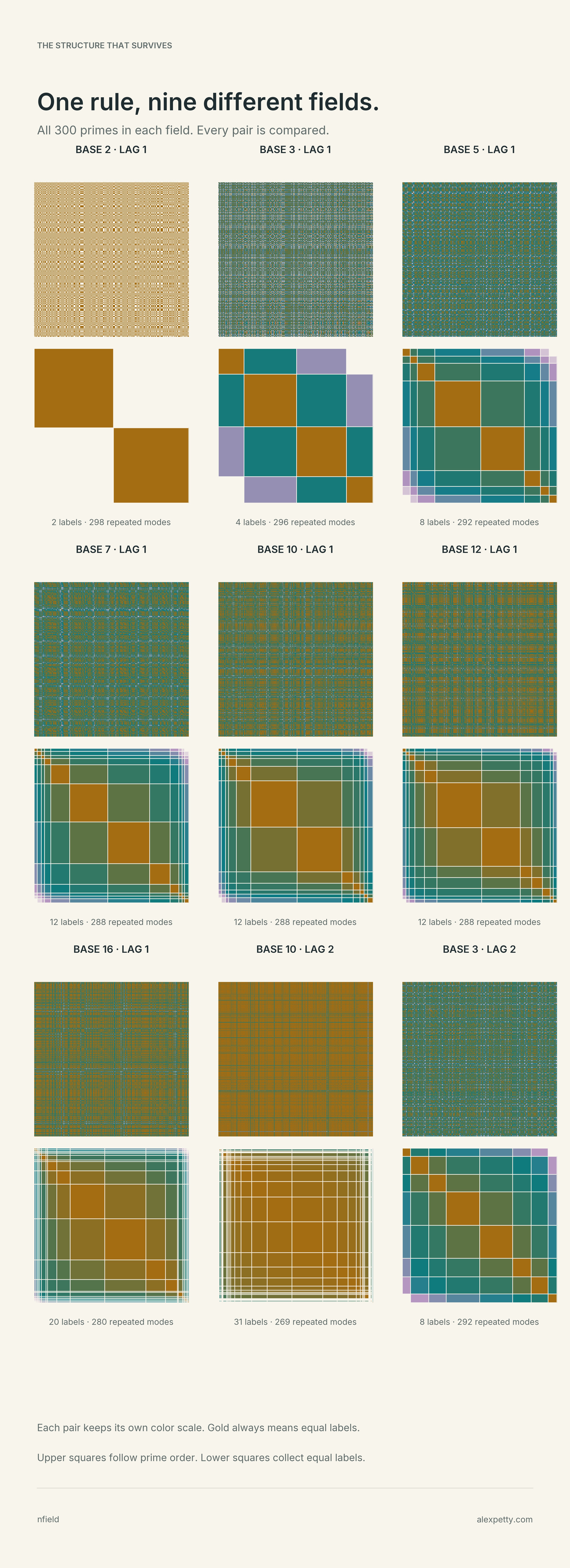
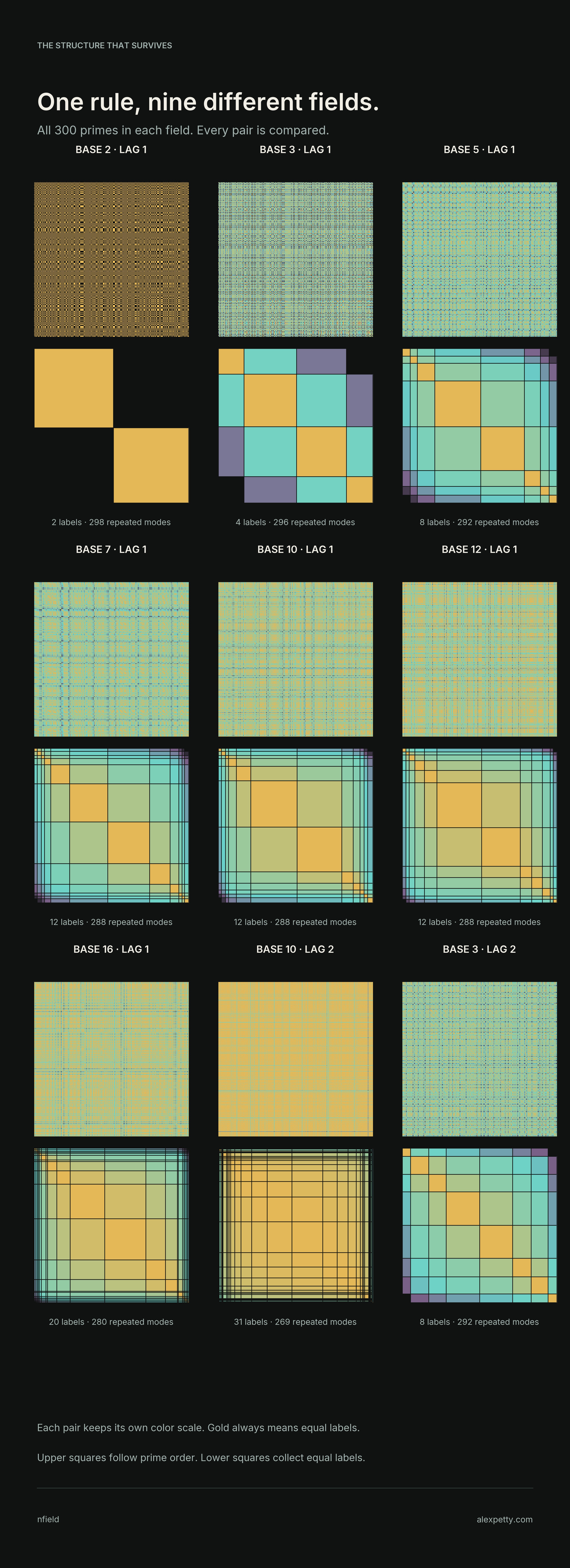
Each small square contains all ninety thousand comparisons. Changing the base or the lag changes the finite label set. Sorting exposes the repeated rows in every case.
The forty entries, their mirrors, and their prime populations
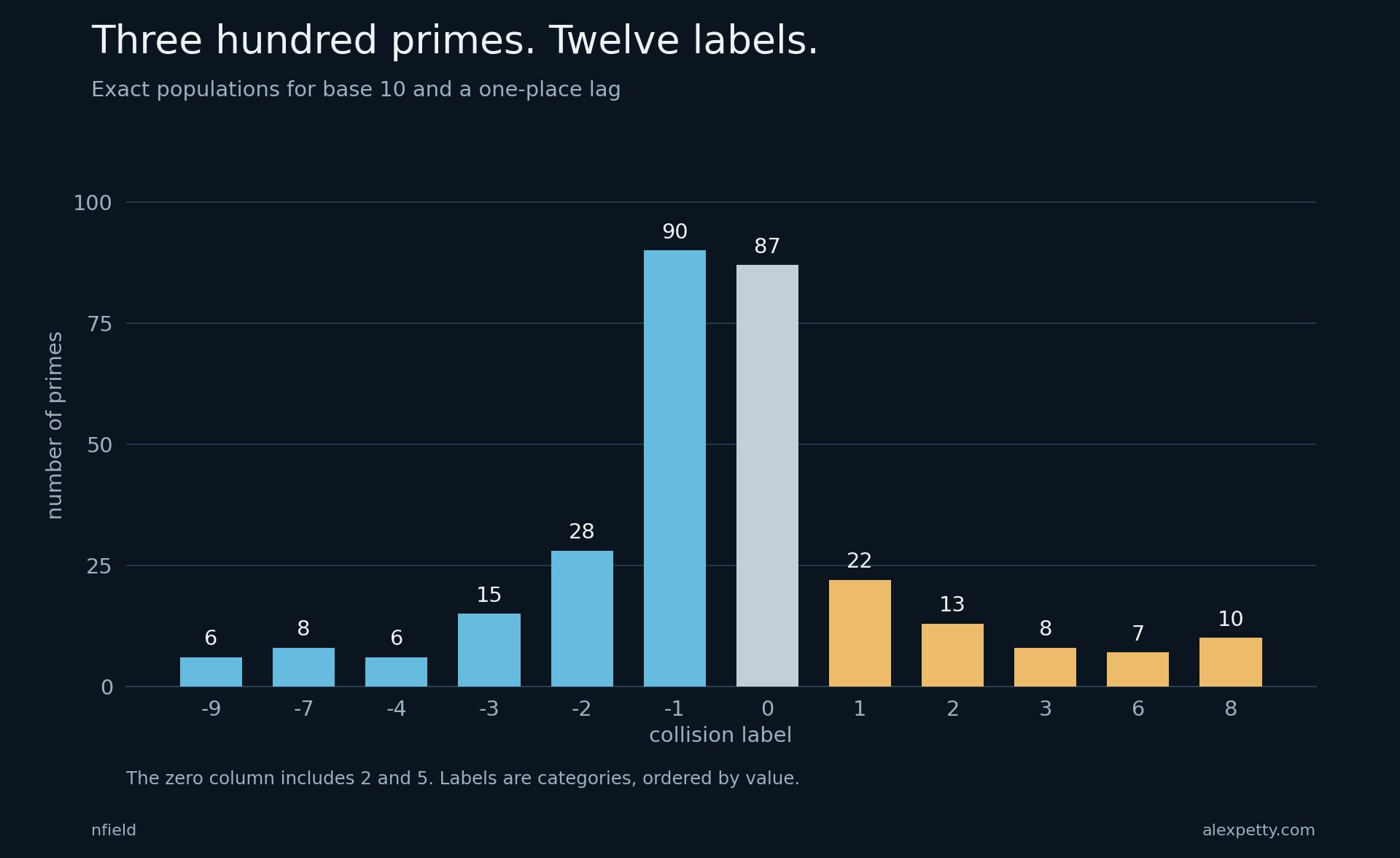
What holds my attention is how early some of the structure is settled. In the decimal calculation above, the forty-third prime supplies the last new label. That prime is 191. All the primes still to come have to work with those twelve.
Discussion
Sign in to join the discussion.