Alignment
Three and the Golden Ratio

The golden ratio gets credited for the Parthenon, the Great Pyramid, the Mona Lisa and the proportions of the human body. When George Markowsky went through the famous claims in 1992, most of them didn’t hold up once someone measured carefully. So when the golden ratio turned up in a table of fractions I was working on, my first reaction was suspicion.
This paper is the result of checking. The golden ratio really is there, at a particular crossing, and the prime three really is the only odd prime whose tables can reach it. The check also turns up a weak spot. Plenty of other numbers would pick out three just as well, and the golden ratio only earns its place through one extra condition that I add myself. Written out, that condition becomes a cubic, and the cubic factors at three with the golden ratio inside it.
Twelve on one page
Twelve is an accommodating denominator. It gives us quarters, thirds, sixths and a few decimals that take longer to settle into a pattern. Put all eleven proper fractions over twelve on one page, and the variety resolves into three kinds of behavior.
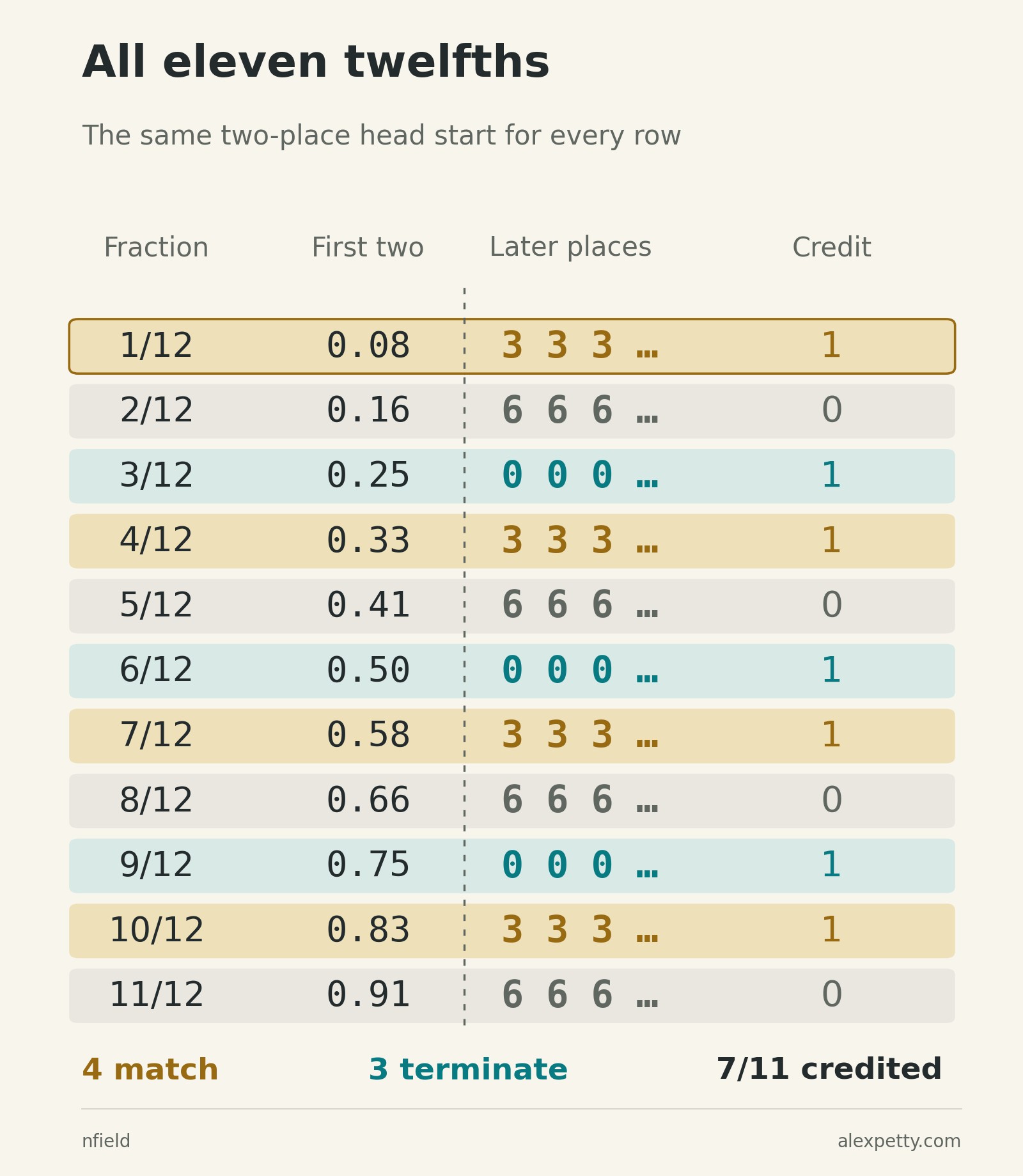
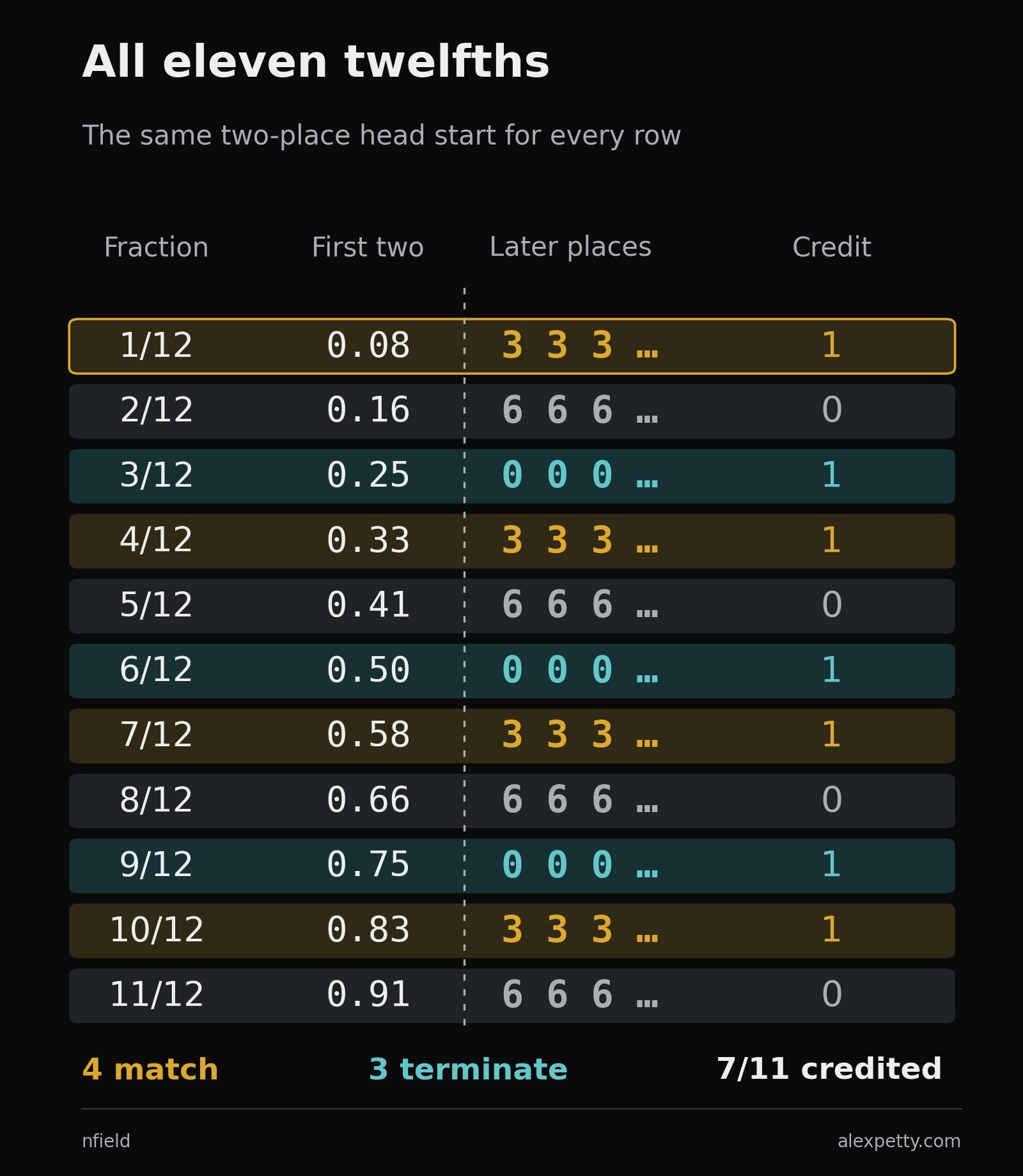
Every row gets the same two-place head start. Beyond that line, four rows repeat 3, four repeat 6, and three have finished. Their remaining digits are zeros. The first row, , supplies the reference. Its 3s continue down the gold rows.
This is the kind of view I want from long division. A fraction has its own sequence of digits, but the complete table lets me compare those sequences. At twelve, the repeating rows divide evenly between two complementary digits. Three and six add to nine at every place.
To turn the picture into a number, we need to say exactly what receives credit.
Seven out of eleven
The alignment score in this work counts a row if its repeating tail matches the reference. It also gives a terminating row full credit. That second rule is part of the definition. The zeros in a terminated row do not literally match the reference’s 3s.
At twelve, the accounting is small enough to keep on the page.
| Rows | Behavior after two places | Credit |
|---|---|---|
| 1, 4, 7, 10 | Repeat 3, matching the reference | 4 |
| 3, 6, 9 | Terminate, then stay at zero | 3 |
| 2, 5, 8, 11 | Repeat the complementary 6 | 0 |
The score is therefore , about . Counting only literal matches would give . Restricting the comparison to the eight repeating rows would give , exactly one half. Those are answers to different questions. I will use the first convention throughout.
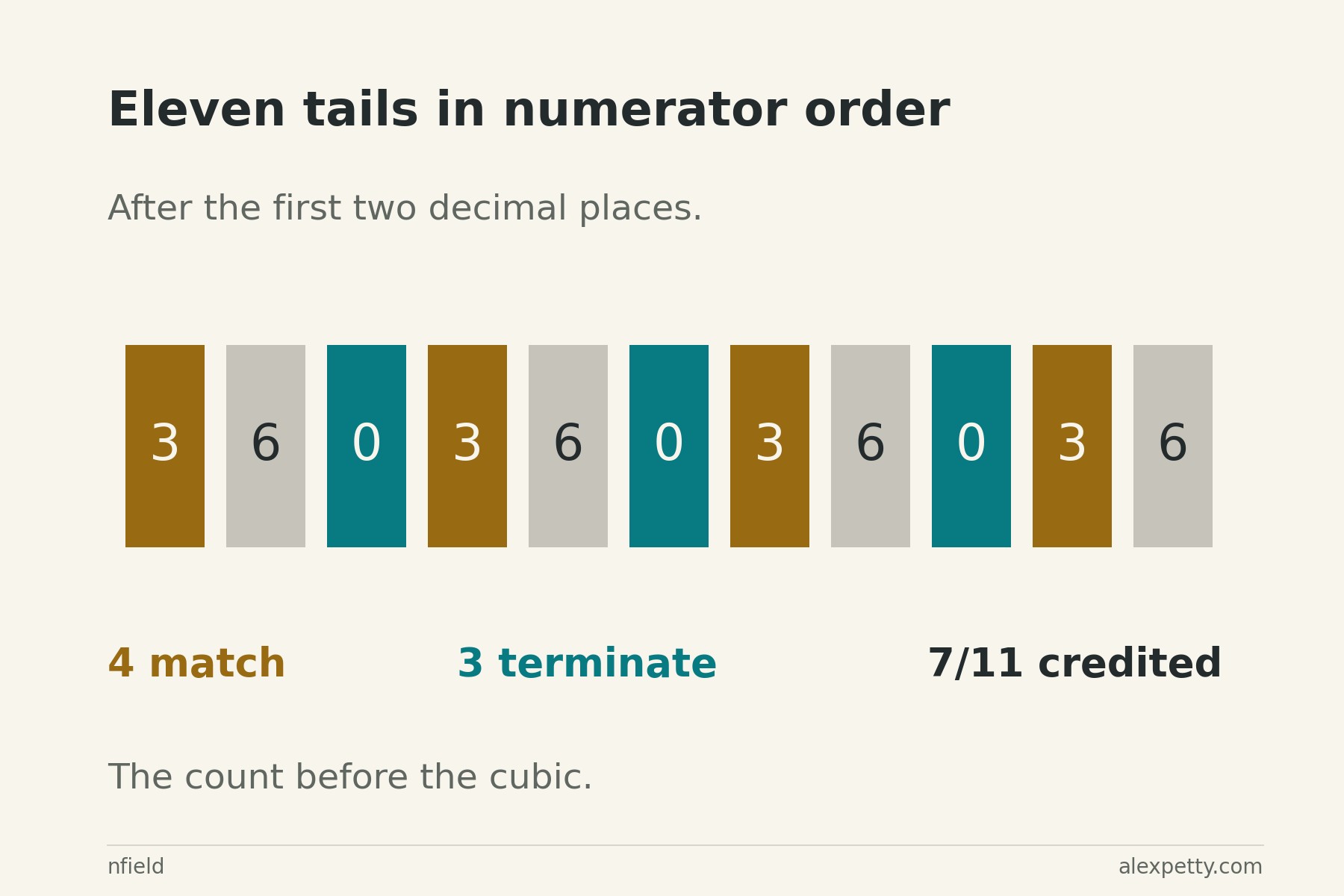
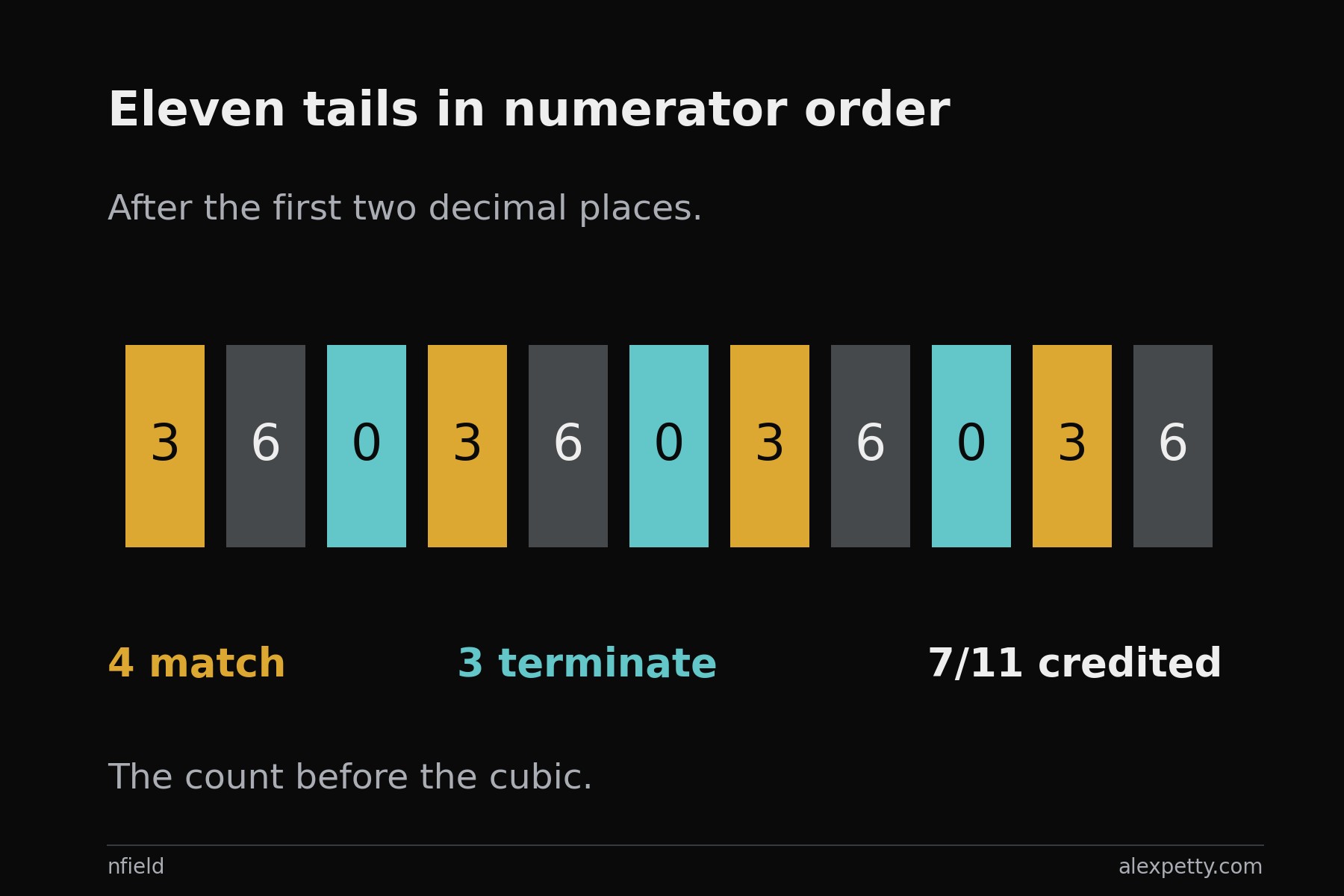
There is a useful discipline in this little example. Before admiring a ratio, count the rows that produced it.
The repeating-block notation
In the sheets for Geometries
Hidden in the Number System I wrote the tail of one twelfth as
|333|. I repeat whole copies of the shortest pattern until
their digit sum is divisible by one less than the base. In decimal that
divisor is nine. Three copies of 3 give nine, and three copies of 6 give
eighteen. Thus |333| and |666| both close
under that rule, although their shortest repeating patterns are single
digits.
For one seventh, the block |142857| already has digit
sum twenty-seven. Its six rotations supply the tails of all six proper
sevenths. The twelfths have a different organization, with terminating
rows and two constant tails. The digit grid above shows three later
positions so the comparison can be made at a glance.
The count behind two thirds
Twelve belongs to a family of decimal denominators , where is made entirely from powers of 2 and 5. Advancing far enough in decimal clears those factors. Use the same depth for every row, and the remaining behavior depends on the numerator’s remainder on division by three.
Among the proper fractions, there are terminating rows. There are rows in the same remainder class as the reference numerator 1, and in the other nonzero class. These two repeating groups carry the reference digit and its nines complement. At twelve, those are the gold and gray rows in the grid.
Credit the terminating and matching groups, and the formula follows directly.
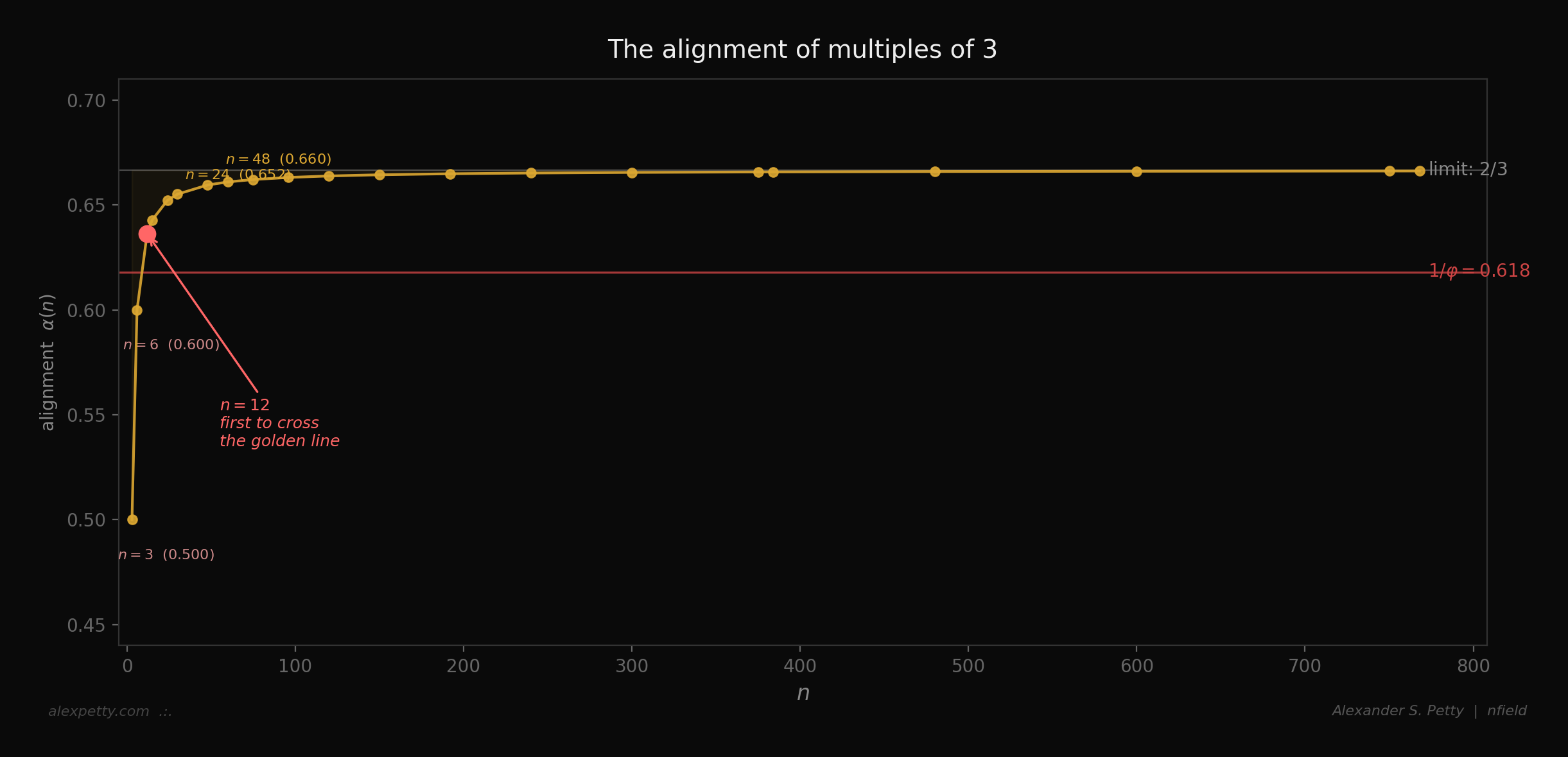
Two of the three groups receive credit. As the table grows, the missing zero-numerator row becomes a smaller part of the count, and the score rises toward two thirds. It stays strictly below that limit.
The condition on matters, because it lets us clear the finite prefix in decimal. Nine, for example, is a multiple of three, but its multiplier falls outside this family.
A golden threshold
Now put a horizontal line across the curve at the reciprocal of the golden ratio.
Solving for the point where the score reaches that line gives , approximately . This is an equality on the real curve obtained by extending the formula. An actual table still needs an admissible integer multiplier.
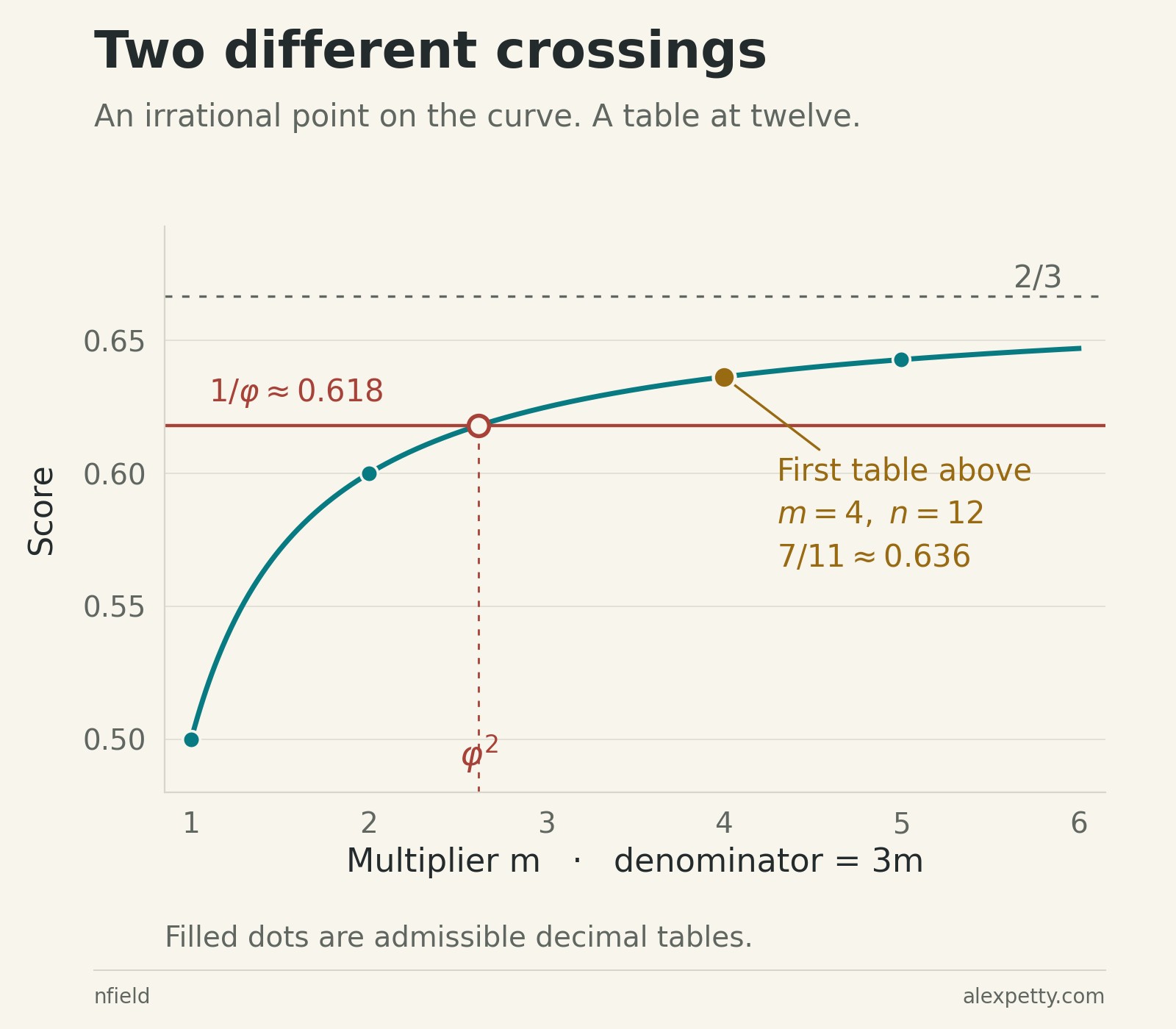
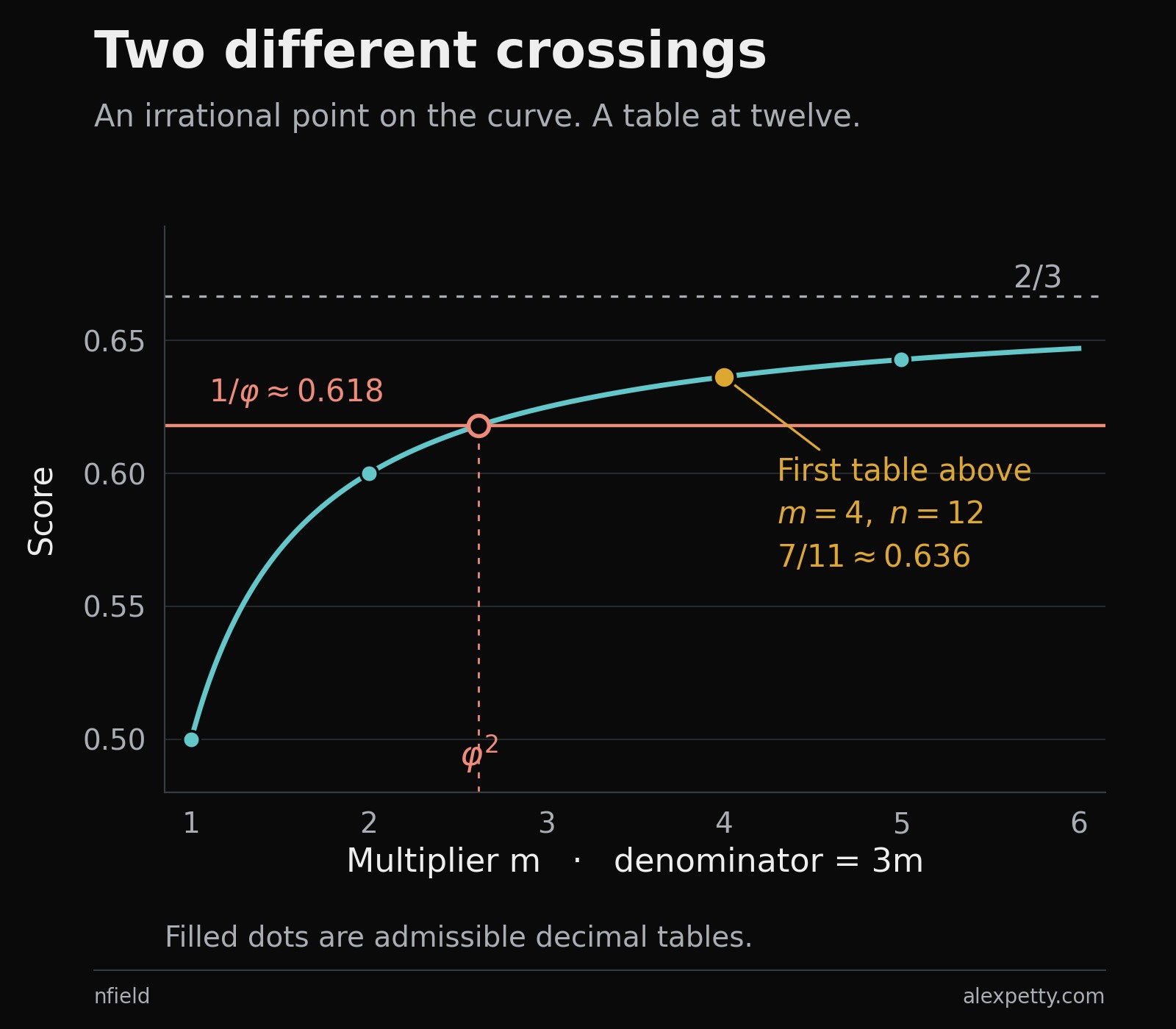
The allowable multipliers begin 1, 2, 4, 5. Three is absent because it cannot be built from 2s and 5s. Four gives the first table above the line, with denominator twelve and score .
So there are two things to keep distinct in the drawing. The hollow point marks the exact golden crossing at an irrational scale. The gold dot marks an actual fraction table whose rational score has passed it. No table has acquired an irrational number of matching rows.
The relation between the two golden quantities is more suggestive. The threshold is and its crossing scale is . One is the reciprocal square of the other. We will return to that relation after checking how much of the selection is already explained by the count.
Three among the odd primes
Replacing three with another prime requires some care with the base. For this construction, choose a base that leaves remainder one on division by , and let divide a power of . These conditions give constant repeating tails and the same form of counting argument.
Three works in decimal. Five works in base six and seven in base eight. We are comparing such admissible families. The formula does not describe every prime in decimal.
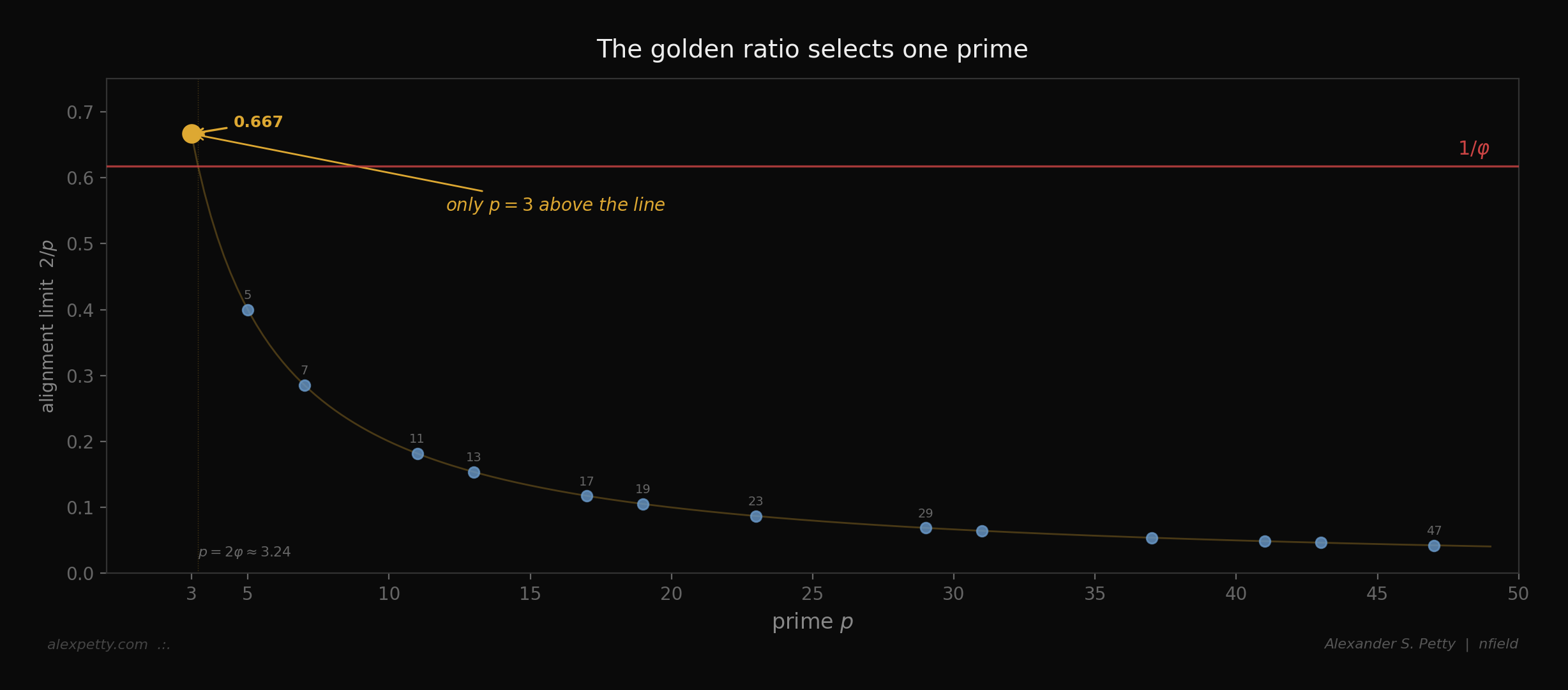
For an odd prime, the score approaches its limit from below. To reach the golden threshold, that limit must be greater than . Three has room to cross. Five and every larger prime run out of room first.
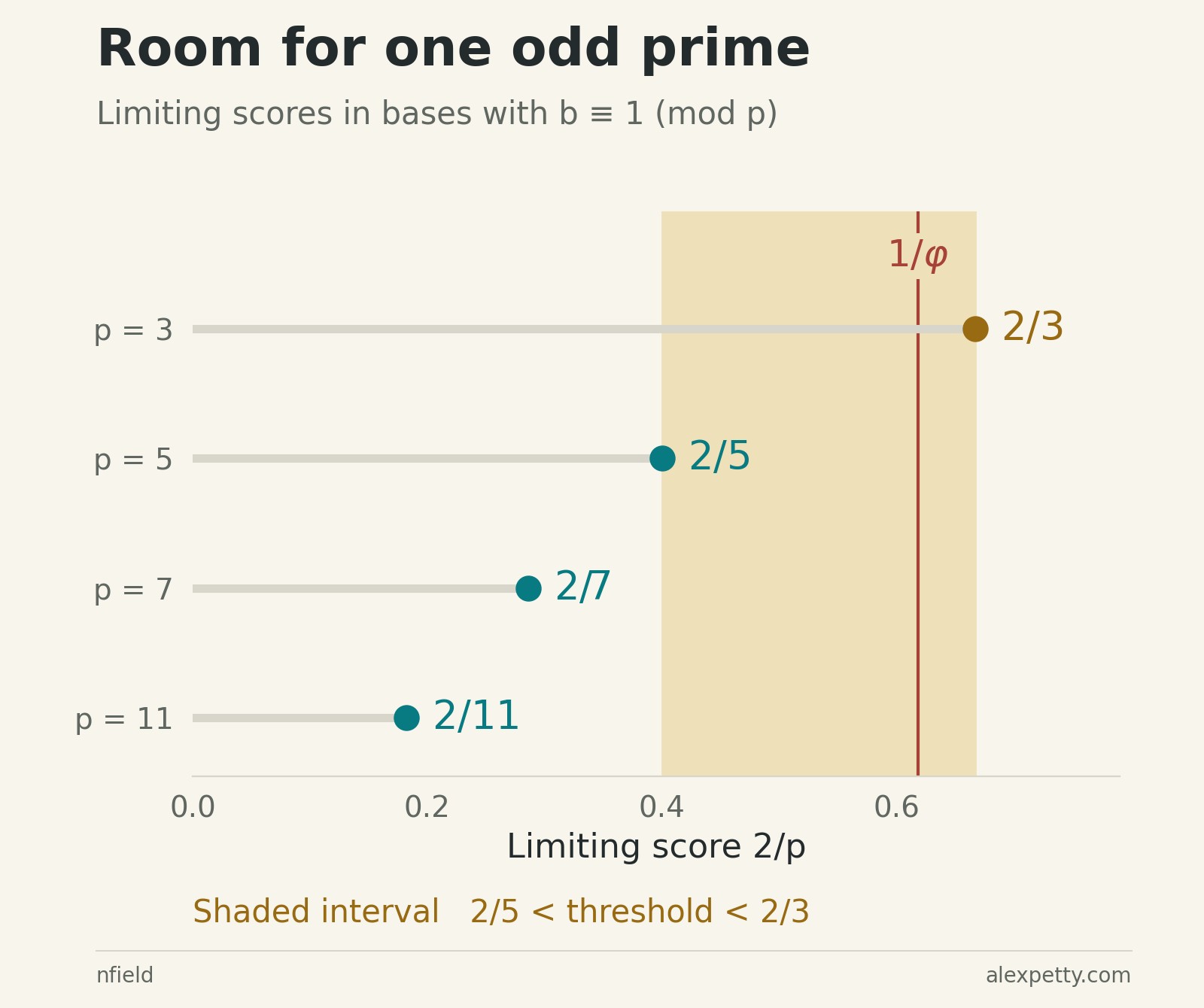
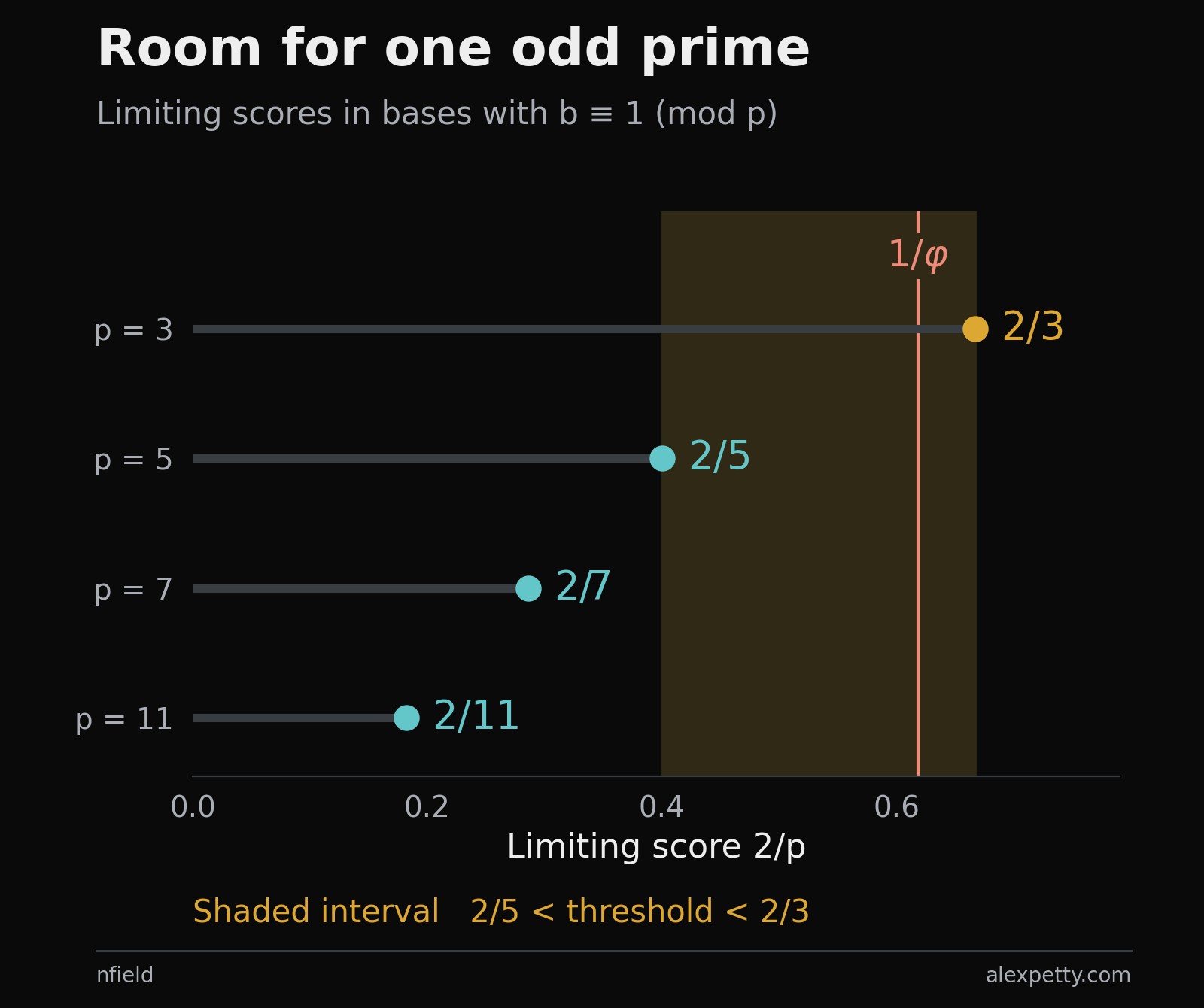
The arithmetic is . Only one odd prime fits. Two is a separate case, with score 1 throughout its admissible families.
But the shaded interval also shows how much freedom we have. Every threshold strictly between two fifths and two thirds separates the same odd primes. Choosing would do it. The golden ratio needs a more specific reason to stand out.
The reciprocal-square condition
Return to the relation between the golden threshold and its crossing scale. Write for a threshold between zero and one. Ask for the scale where the score reaches to equal .
This is an additional condition I choose to study. The digit count supplies the curve, and nothing in it requires this relation. Once the condition is stated, however, we can solve it across the entire prime family.
Substitute into the score. The resulting equation is
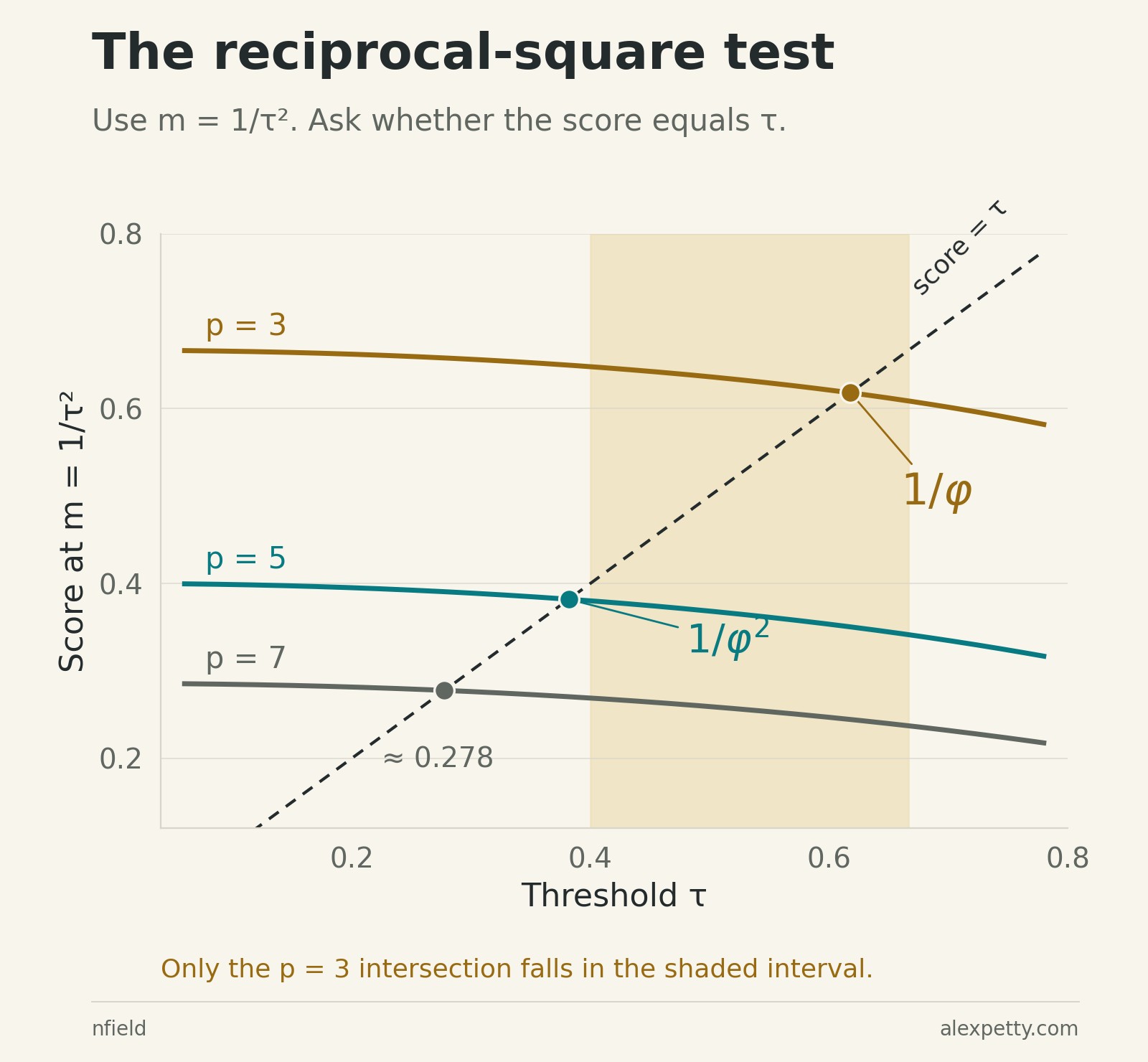
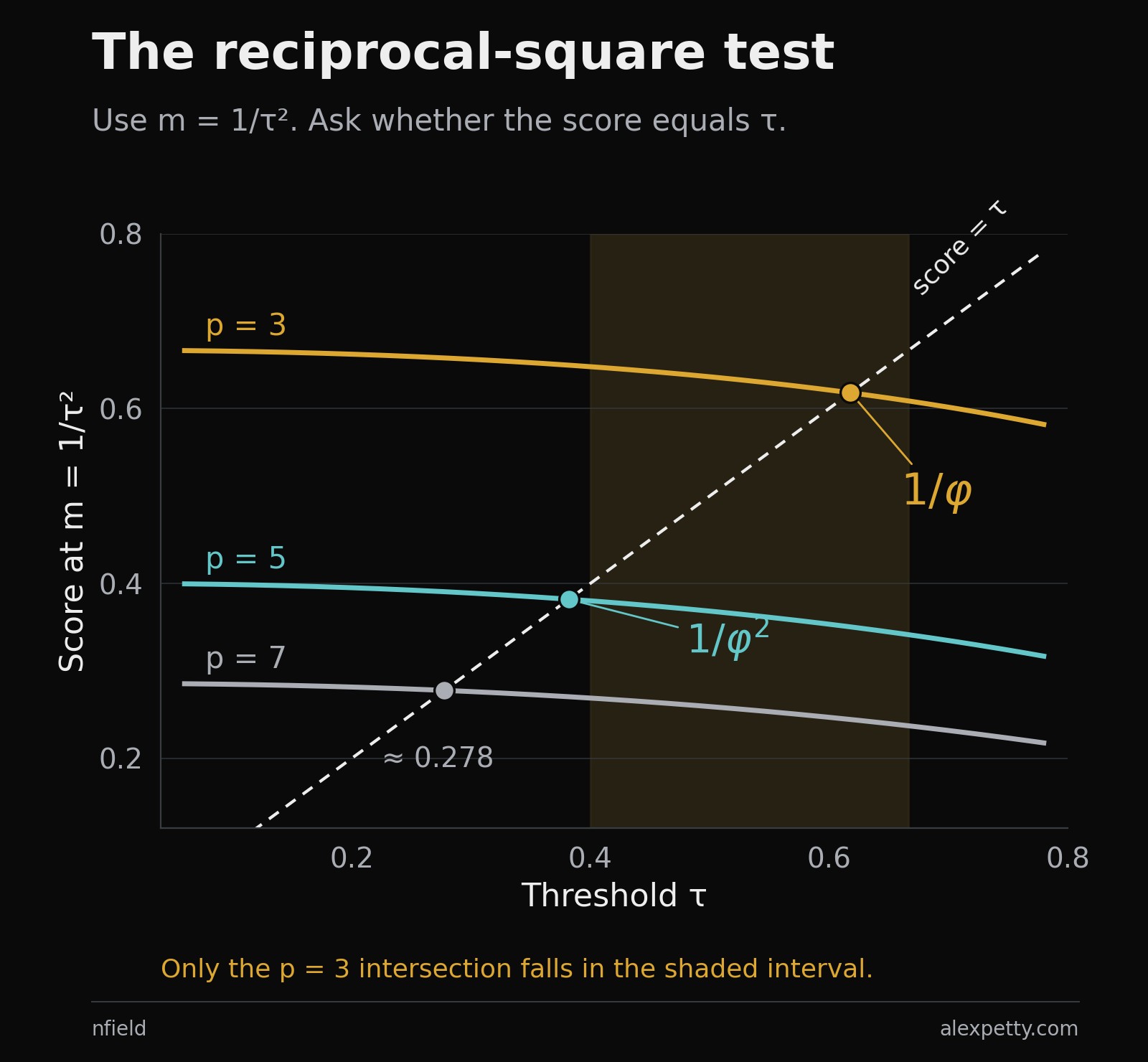
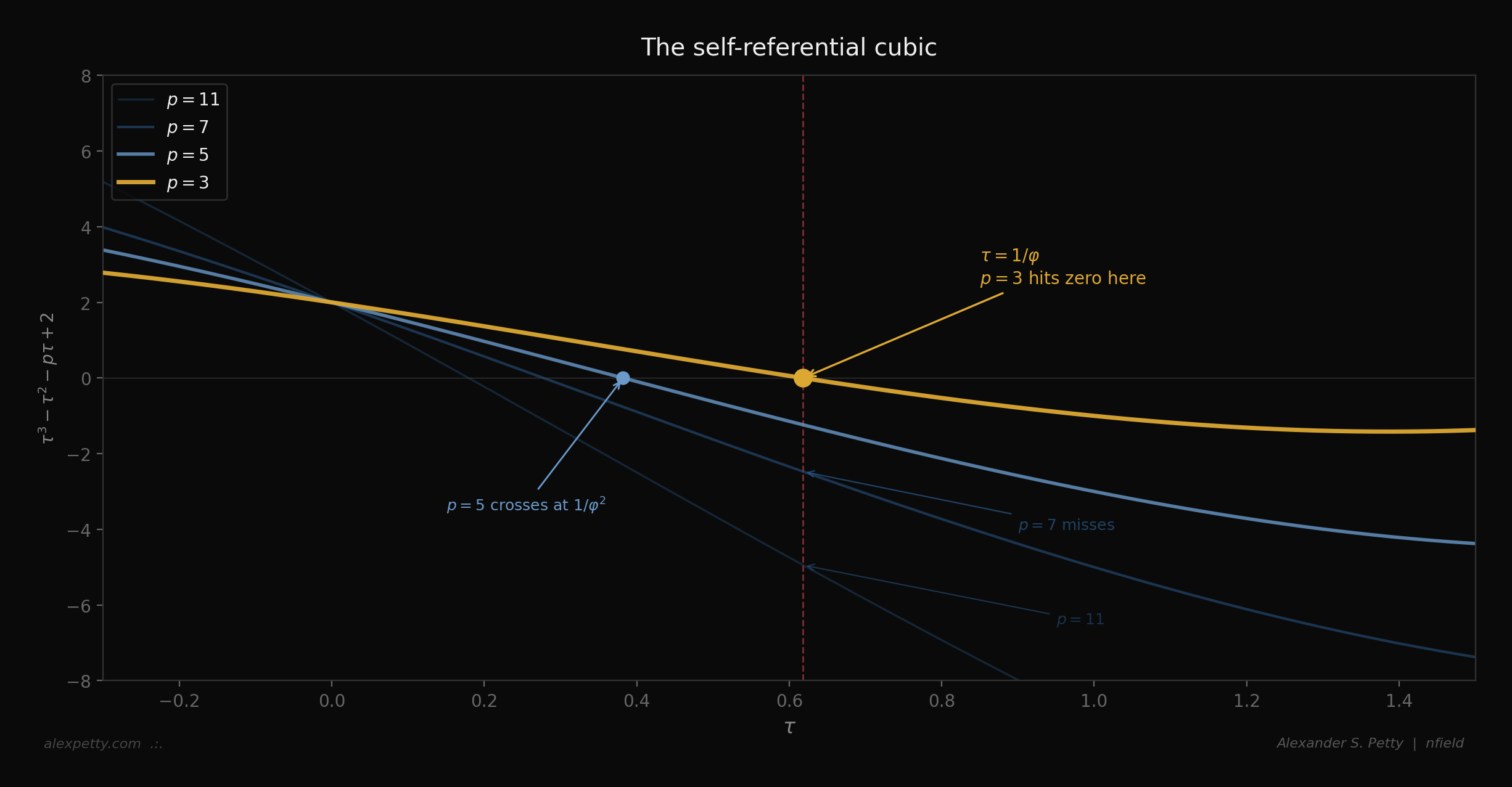
The next drawing makes the test visible. Each colored curve gives the score at that prescribed scale. The diagonal gives the threshold itself. An intersection is a place where they agree.
Multiplying out turns the intersection problem into a cubic.
For every prime , there is exactly one root between zero and one. At three the cubic factors, and the golden relation appears explicitly.
The root in our interval is . Five also factors, giving . That second golden value lies below the separating interval. From seven onward, the threshold roots are cubic irrationals. None belongs to a quadratic field, including the field built from rational numbers and .
The factorization in a few lines
A monic cubic with integer coefficients can factor over the rationals only if it has a rational root. Here the possible roots are .
| Candidate | Value of the cubic | Prime giving zero |
|---|---|---|
| None | ||
The factorizations at three and five are
Both quadratic factors have discriminant five. Their roots in are and . At two the factorization is , with no root strictly between zero and one. For primes at least seven, the cubic is irreducible over the rationals.
Uniqueness of the root is equally short. For , the cubic is positive at zero, negative at one and strictly decreasing between them. Its root also lies below . Consequently the roots for primes at least five all fall below the separating interval.
The ingredients are classical. Repeating expansions, complementary digit sums, rational-root tests and golden-ratio identities have long histories. Why the Golden Ratio Selects the Prime Three gives the proofs and references. Its particular result belongs to this alignment score and the added reciprocal-square condition.
Three in the remainder
The cleanest expression of the selection comes from polynomial division. Divide the prime-indexed cubic by the golden quadratic . The quotient is . The remainder is
At the positive golden threshold, this vanishes exactly when . The same three that sorted the twelfths into their rows is the only prime that leaves nothing over.
Three wider views
The same calculations over a wider range, with the scores out to 800, the limits through 47 and the cubics past the unit interval. Open any image at full resolution.
Discussion
Sign in to join the discussion.