Origins
Arithmetic Foundations
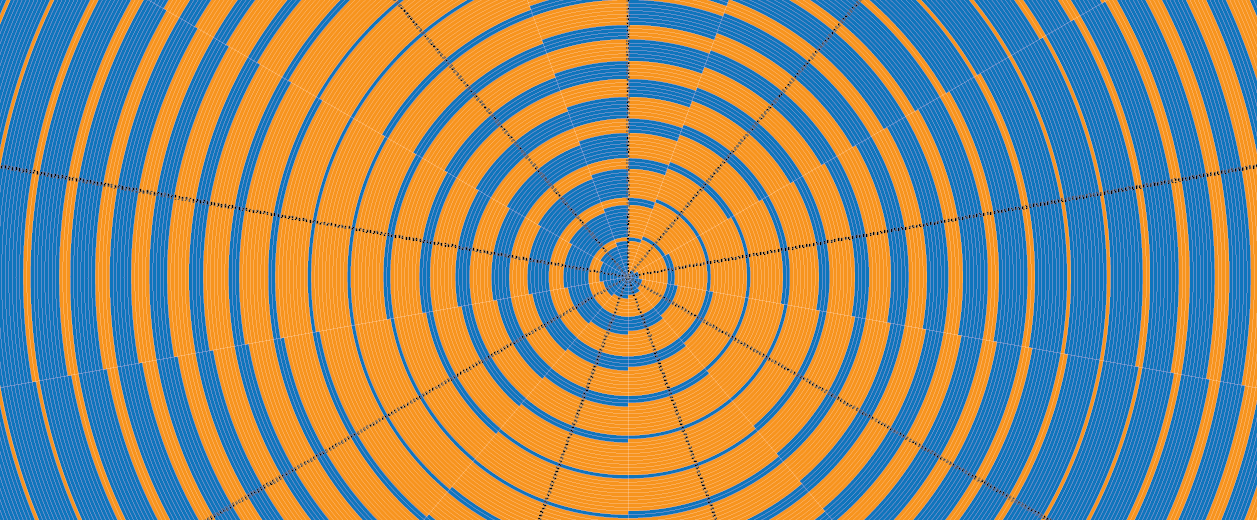
Counting by nines is special in base ten, because nine is one less than the base. Each step of nine adds ten and takes away one. The tens digit goes up, the units digit goes down, and the digit sum usually does not move at all. Write every number from 1 to 2016 on a wheel of nine spokes, so that each spoke counts by nines, and color each number by the sum of its digits. The wheel fills with interlocking blue and orange spirals, as though someone had woven it.
Nobody wove it. The digit sum moves only when a step of nine carries twice, or not at all, and then it jumps by nine and the color flips. The pattern of those flips comes from resets, the carries that reach the hundreds place. Every time the hundreds digit ticks over, the digits below it start again with one less to spend, so the run of one color loses an entry and the run of the other gains one. The offsets between neighboring spokes then twist those runs into spirals.
Follow the spoke at the top and the resets become a palindrome. Its runs of color, counted in order, read the same backward, although the numbers along the spoke only ever grow.
Add nine to 91 and you get 100. The two numbers have the same remainder when divided by nine, but their decimal digit sums differ. The digits of 91 add to ten. The digits of 100 add to one.
These drawings keep both facts in view. The long table records the arithmetic entry by entry. The circle puts the sequences beside one another, where their alignments and offsets become easier to see. Moving between the two became one of the most useful habits I took from this early work.
I was still learning number theory. Making a picture gave me something definite to investigate, and keeping the table underneath it gave me a way to check. Some of my favorite questions began with that simple exchange.
In the circular view, follow a spoke outward, then trace a band across the neighboring spokes. The first path reveals a sequence of returns. The second reveals the shifts between them.
Two coordinates
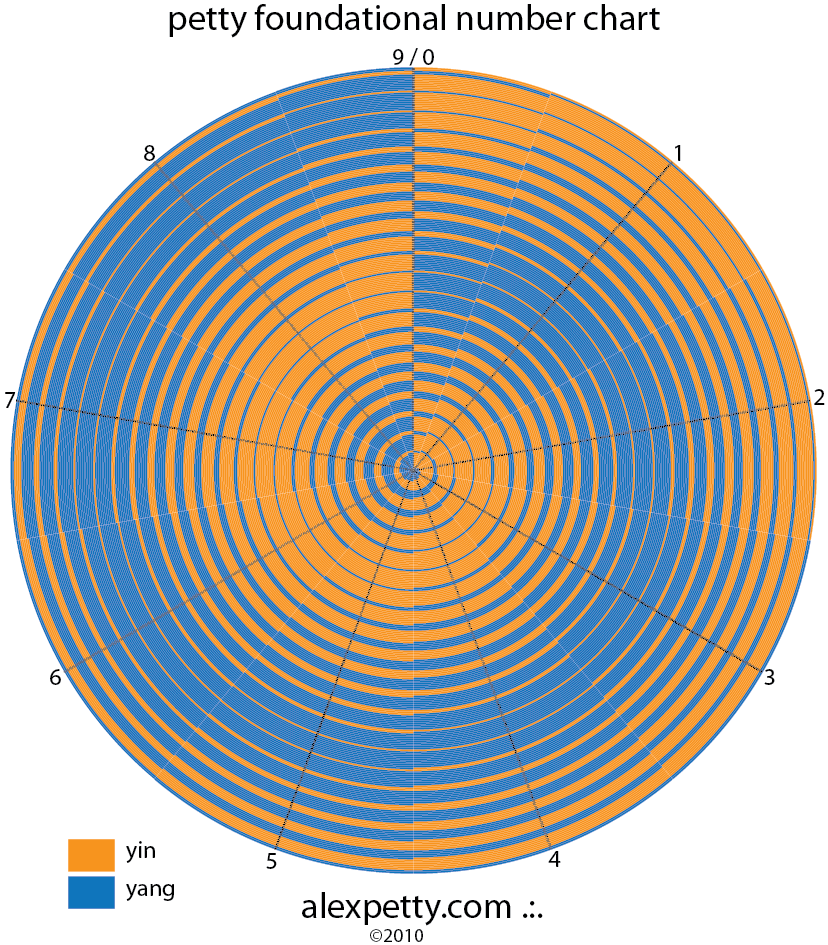
The drawing arranges the integers from 1 through 2016 on nine spokes. Each number goes on the spoke given by its remainder after division by nine. One, ten, nineteen, and twenty-eight share a spoke. Nine, eighteen, and twenty-seven share the zero/nine spoke. Each step outward adds nine.
The second coordinate comes from adding the decimal digits. Keep that sum before reducing it any further.
For 19, the sum is 10. For 28, it is also 10. For 100, it is 1. All three belong to the same spoke. The digit sum distinguishes numbers whose remainder gives them the same address.
In the full table at the end of this essay, the columns record the original number, its digits written as an addition, their sum under B10, and the remainder under M9. The colors come from the digit sum. Blue covers 0 through 8, gold covers 9 through 17, blue returns for 18 through 26, and gold again for 27 through 35. The circular drawing uses orange for the gold regions.
The change from 91 to 100 now has a visible consequence. The spoke stays fixed, while the color changes from gold to blue. A decimal carry moves the number into a different band. Repeating the same addition builds a much richer picture than the fixed remainder alone would suggest.
A palindrome along the radial
Begin with the zero/nine column. Leave the initial zero aside and start at nine.
The ten entries from 9 through 90 all have digit sum 9, forming a gold run. The next entry, 99, has digit sum 18. It makes a blue run of one.
After that come nine gold entries, from 108 through 180, followed by two blue entries, 189 and 198. Then eight gold entries and three blue ones. One run shortens as the other lengthens.
| Gold run | Number of entries | Following blue run | Number of entries |
|---|---|---|---|
| 9 to 90 | 10 | 99 | 1 |
| 108 to 180 | 9 | 189 to 198 | 2 |
| 207 to 270 | 8 | 279 to 297 | 3 |
| 306 to 360 | 7 | 369 to 396 | 4 |
| 405 to 450 | 6 | 459 to 495 | 5 |
Continue through 990 and sort the runs by the hundreds digit.
hundreds digit   0   1   2   3   4   5   6   7   8   9
gold run        10   9   8   7   6   5   4   3   2   1
blue run         1   2   3   4   5   6   7   8   9  10
Read the runs in order, gold then blue, column by column. Ten, one, nine, two, and so on out to one, ten. Read that list backward and it stays the same. Every column adds to eleven, and the gold row is the blue row reversed. The integers keep increasing while the run lengths reverse their sequence.
This is the radial palindrome in a form we can count. Across the whole stretch there are 55 gold entries and 55 blue entries. Gold runs shorten from ten entries to one as blue runs lengthen from one to ten. Reversing the window also exchanges the colors.
This particular palindrome runs from 9 through 990. The full table continues through larger carries, letting us inspect how the pattern changes beyond those endpoints.
Mirrored endings
The one-spoke in the five hundreds gives another way to see a return. Begin with its first six entries.
505, 514, 523, 532, 541, 550.
Keep the leading five fixed and watch the endings.
05, 14, 23 | 32, 41, 50.
The last three reverse the digits of the first three, in the opposite order. Every entry has digit sum 10. Adding nine advances the tens digit while reducing the units digit. The entries walk through the little mirror one step at a time.
The next five entries are 559, 568, 577, 586, 595. Their endings are 59, 68, 77, 86, 95, with 77 at the middle. Their digit sum is 19, so they occupy the next color band.
There are now two related patterns to follow. The endings reverse inside a run, while the runs themselves change length. Reducing everything to the spoke number would erase both. Keeping the intermediate arithmetic makes them visible.
The turn between radials
Lay the columns around the circle. The color changes occur at different distances from the center because neighboring spokes are at different stages of their runs. Trace a boundary across the spokes and those offsets give it a twist.
The interlaced spirals bring the two directions together. Along a radial, we can follow the run-length palindrome. Across radials, we see the displacement between those patterns. I later used torsion for the coupling between the two directions.
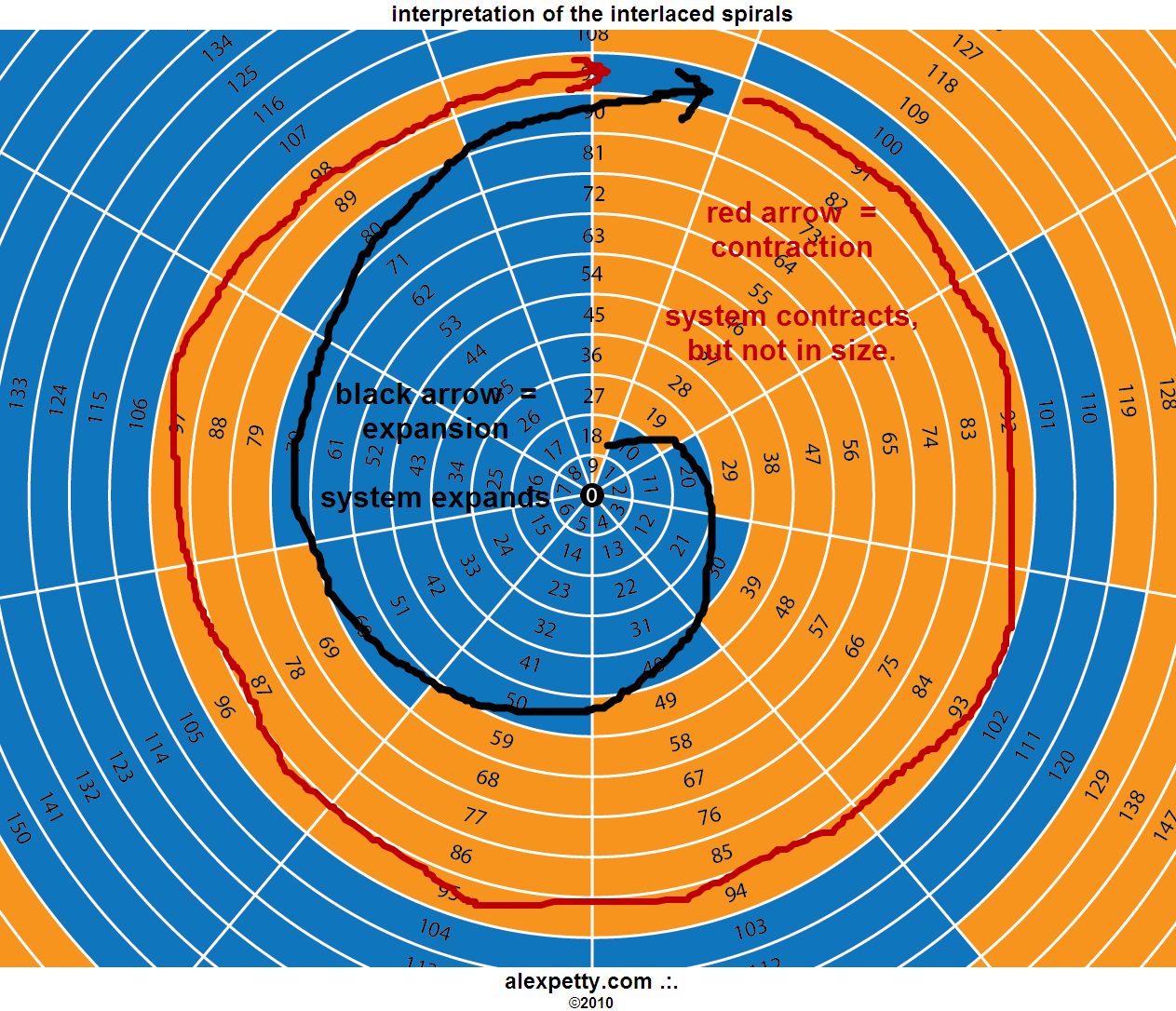
I could follow a shape into the table, locate the entries that made it, and return to the circle with a more precise question. That was a large part of learning to work with these images. The drawing suggested a relationship. The arithmetic gave me somewhere to put my finger.
Closer views
The original magnifications make that journey in small steps. At a distance, the broad bands stand out. Closer to the center, the numbers become legible and we can check the entries on either side of a boundary.
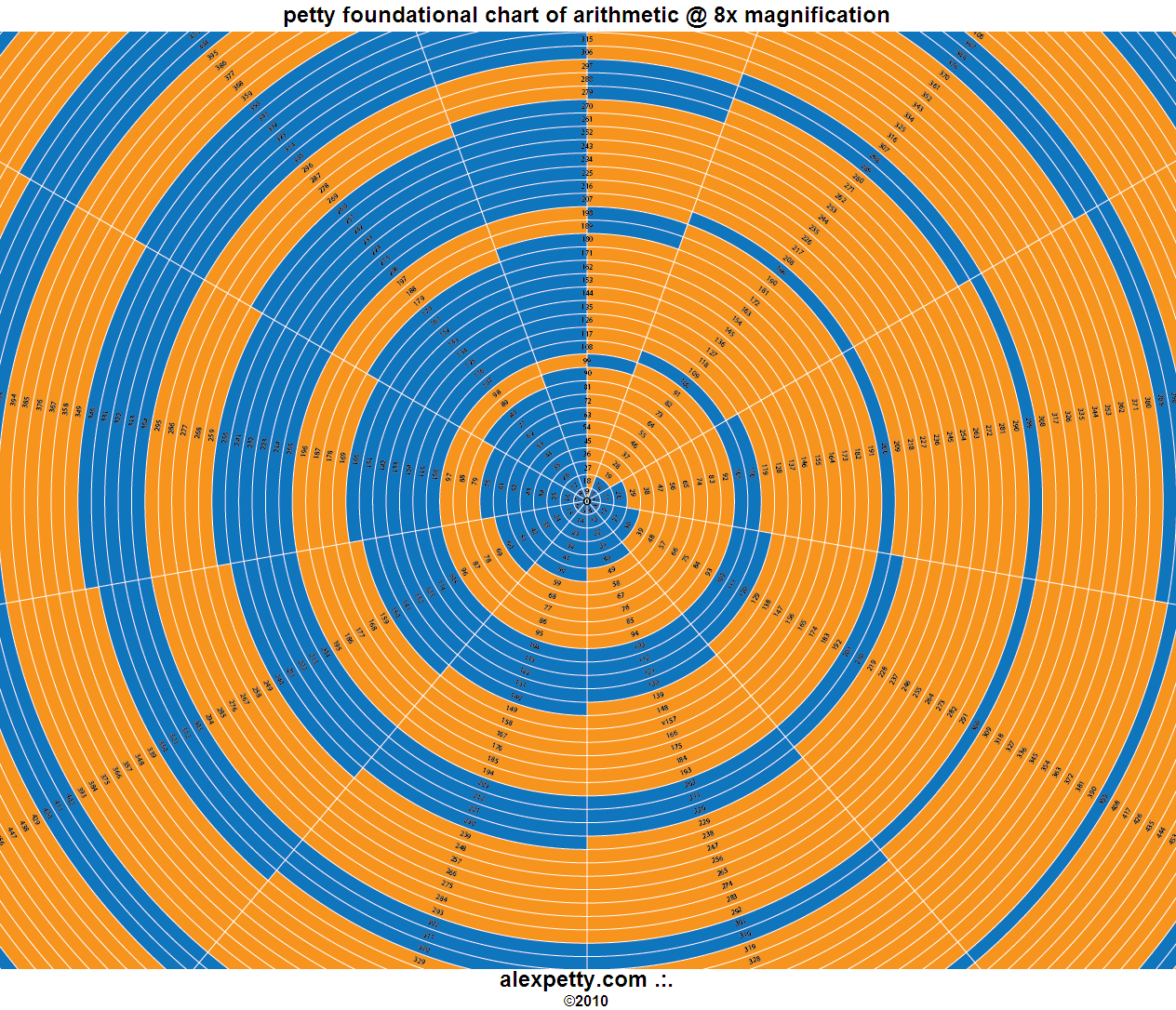
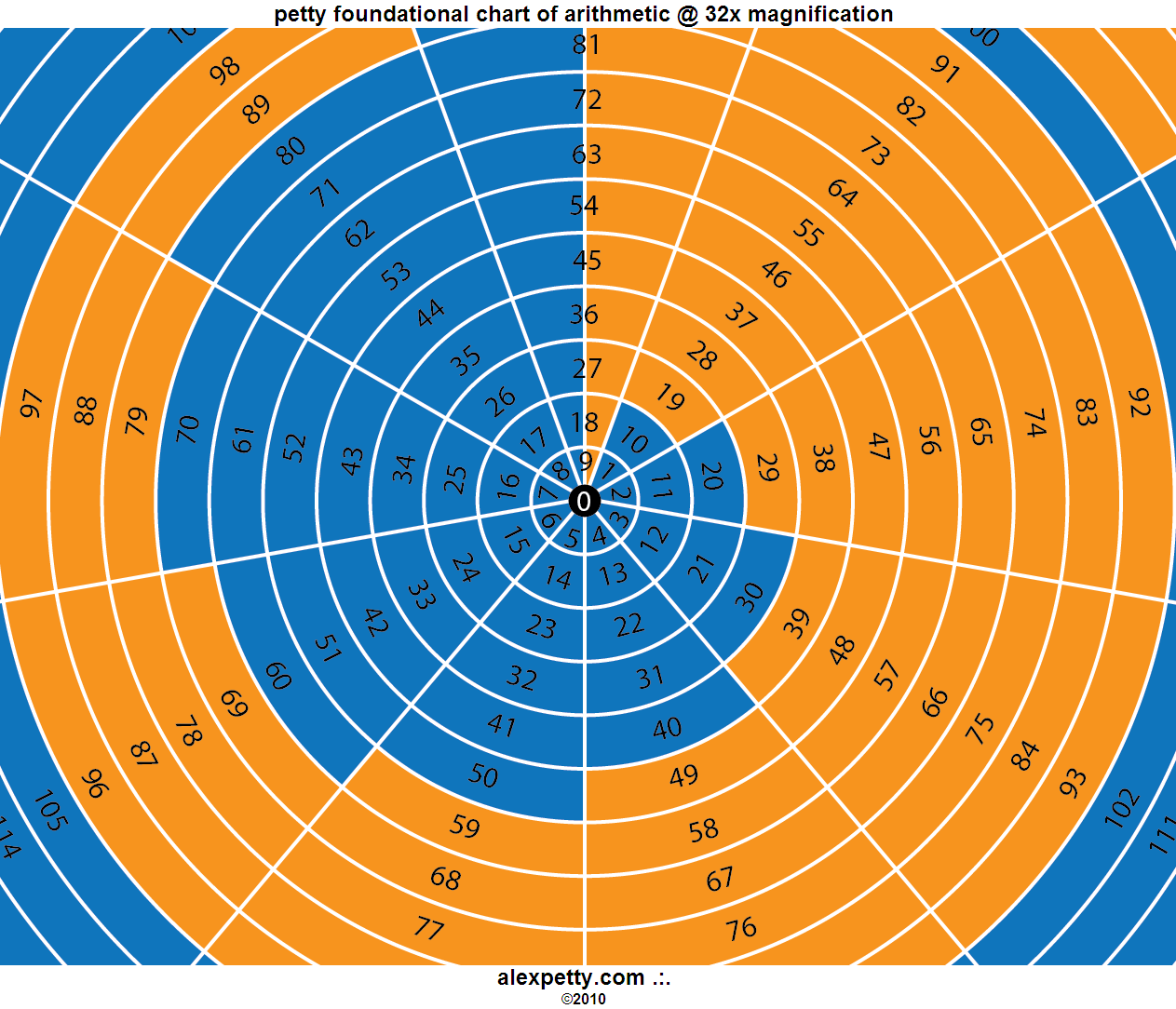
See the original 2×, 4×, 6×, and 16× magnifications
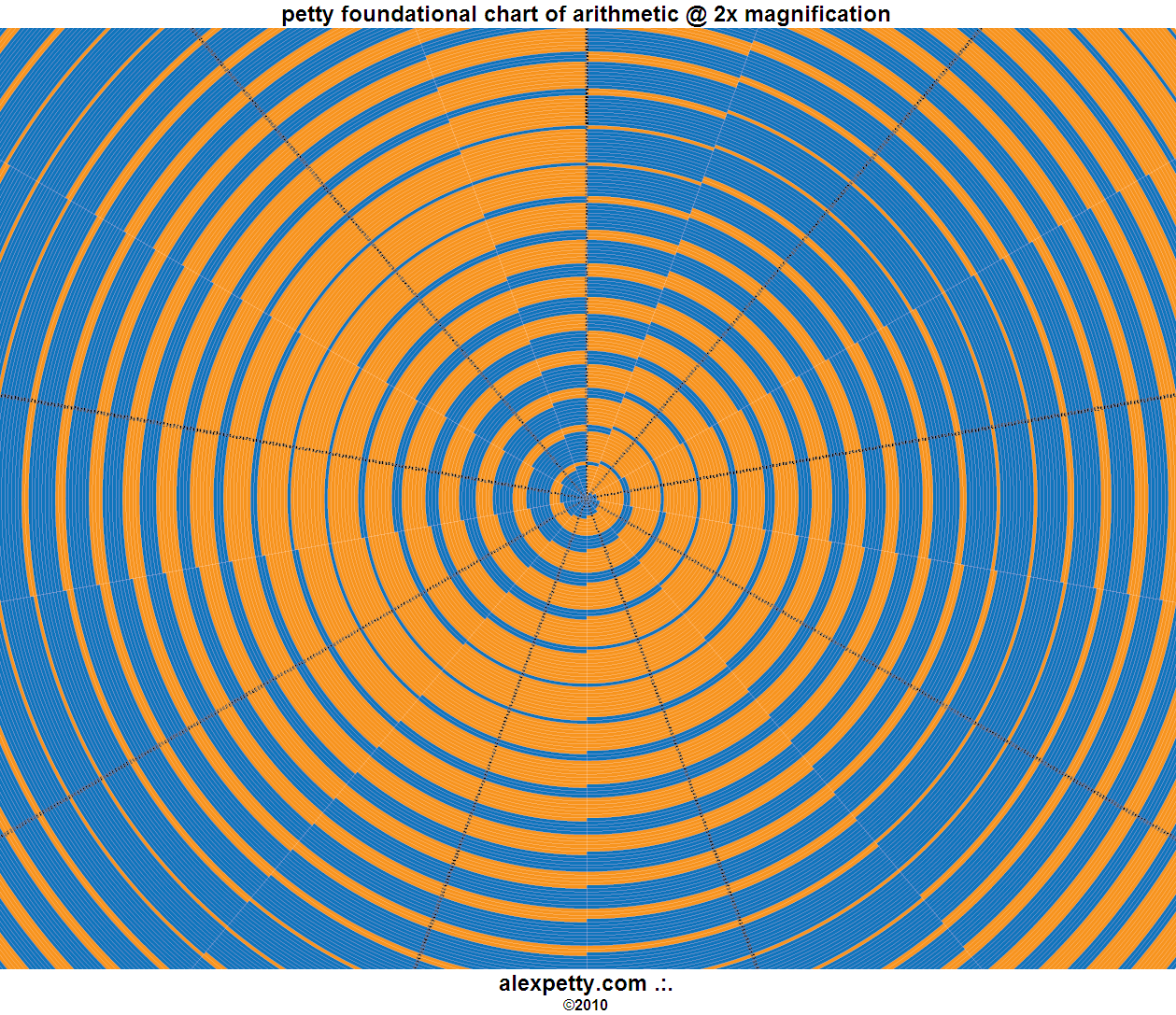
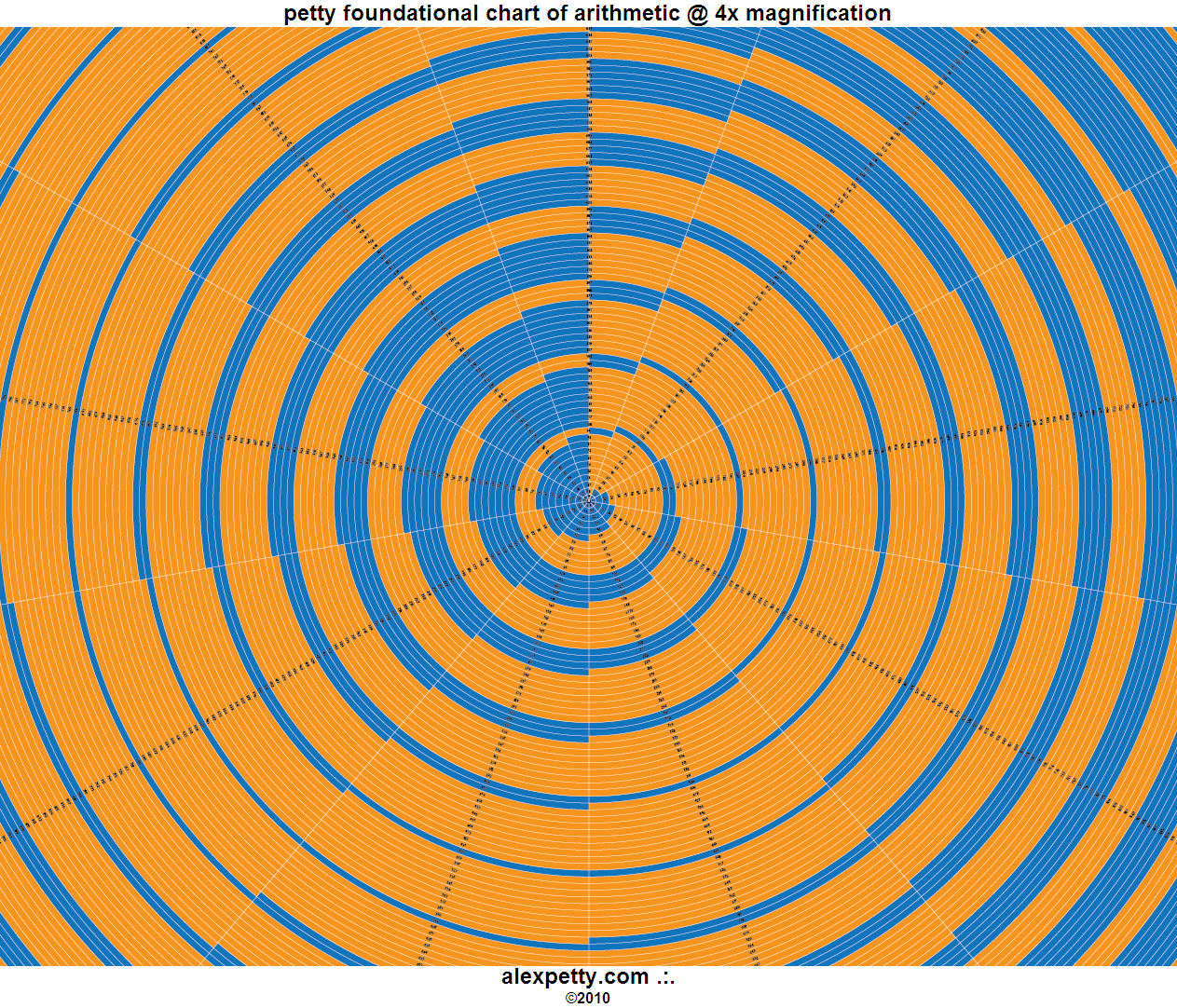
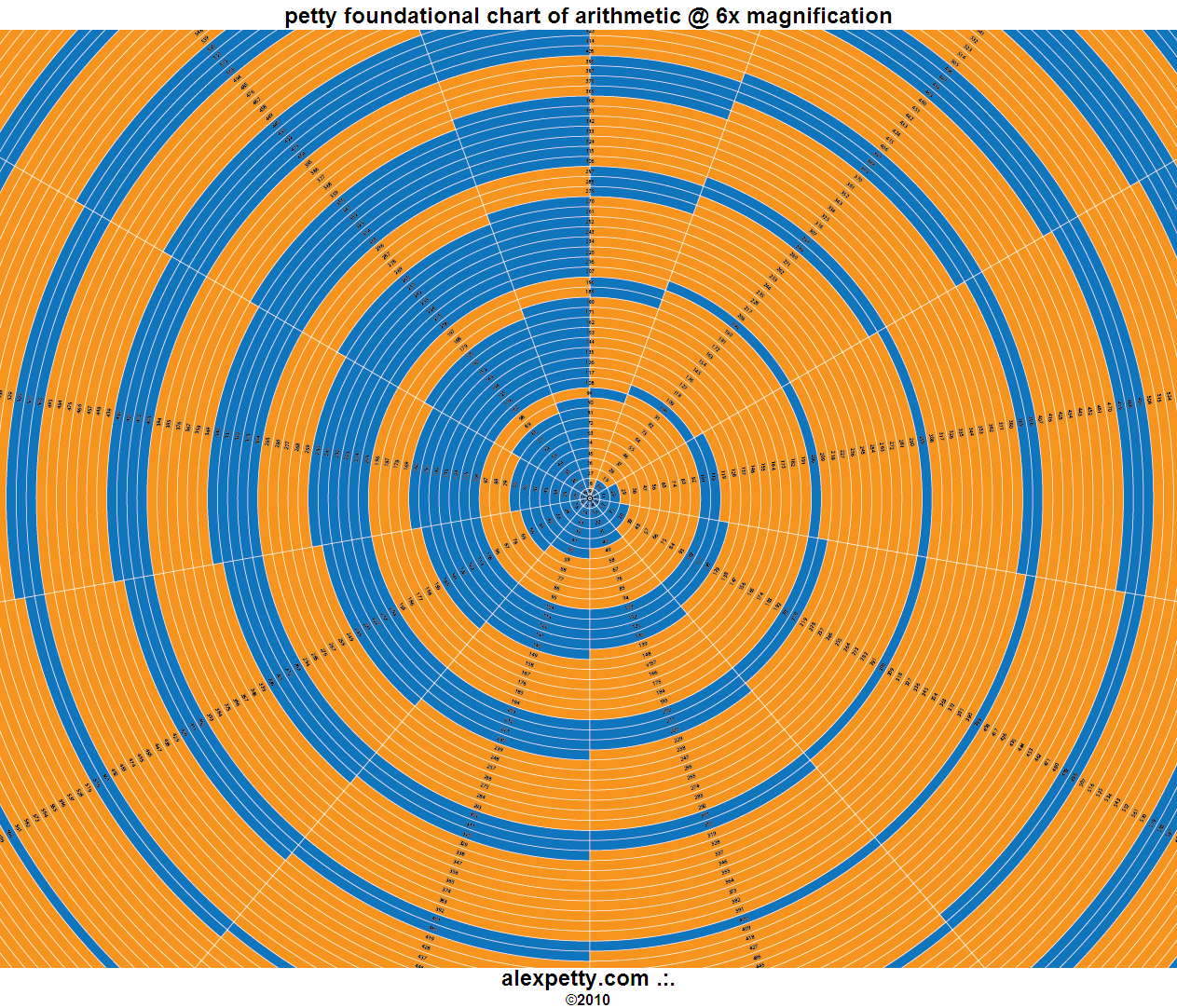
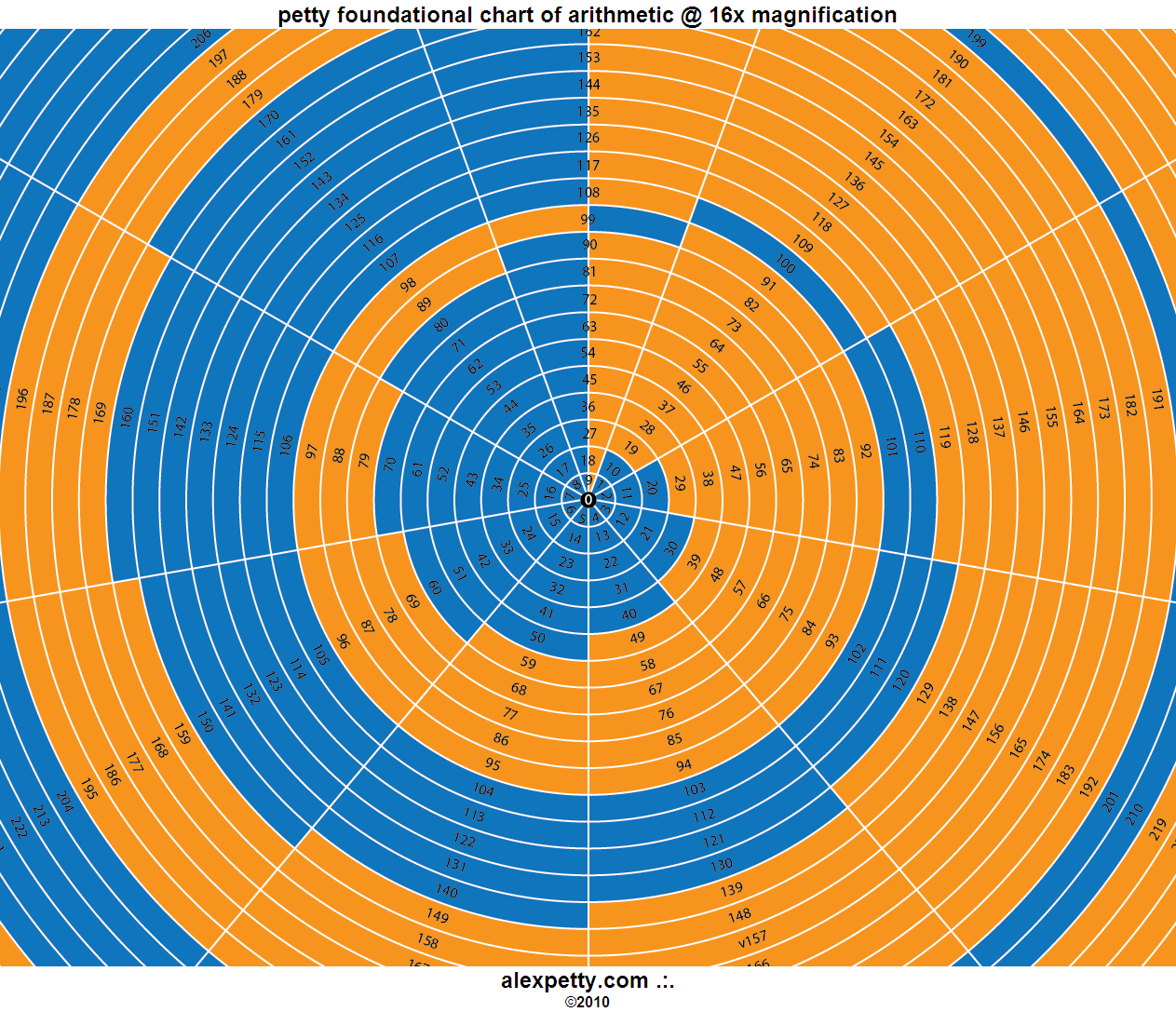
All six enlargements show the same construction. The sequence keeps the larger arrangement in view as the individual entries become readable.
Multiplication paths and primes
The multiplication drawings in Foundational Tables of Multiplication fit the same nine positions. Their six-position doubling path and the triangle through three, six, and nine can be laid directly over the arithmetic chart.
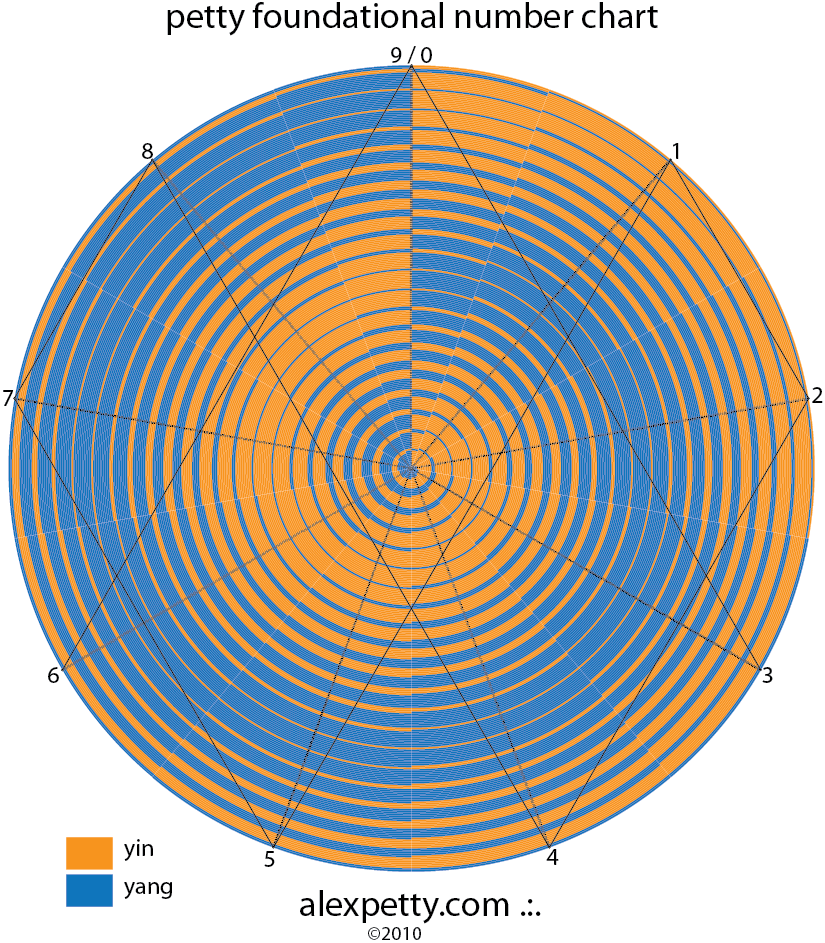
I also put the primes back into the picture, as I had in The Circle of Nine. This time they sat against the full pattern of digit sums and carries.
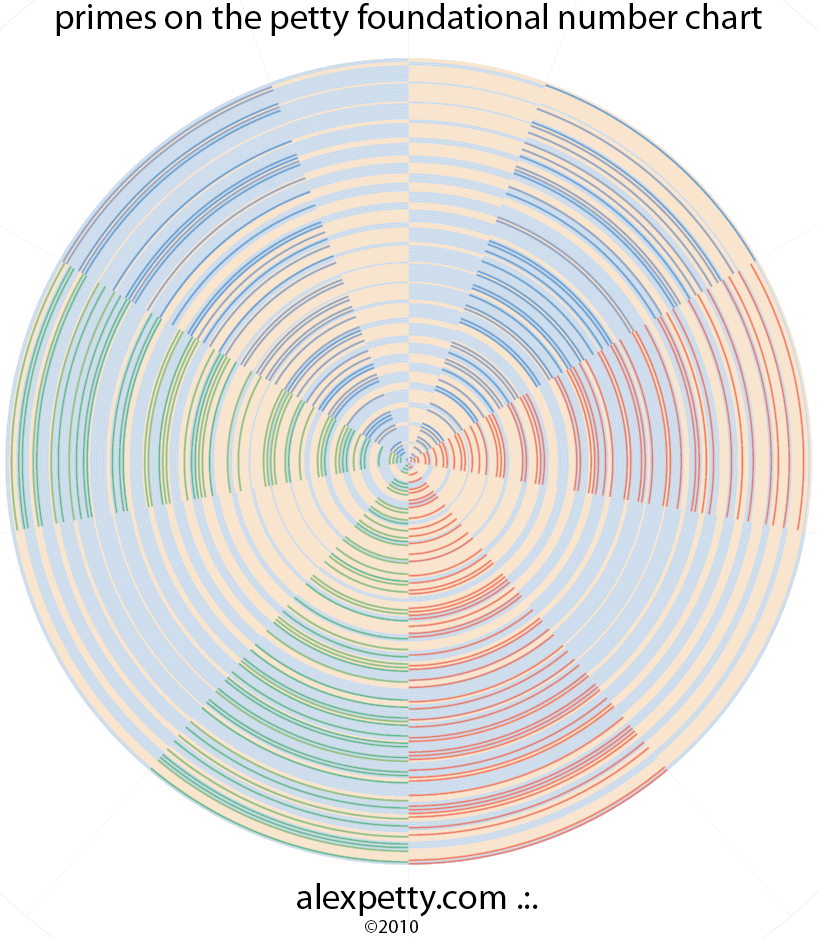
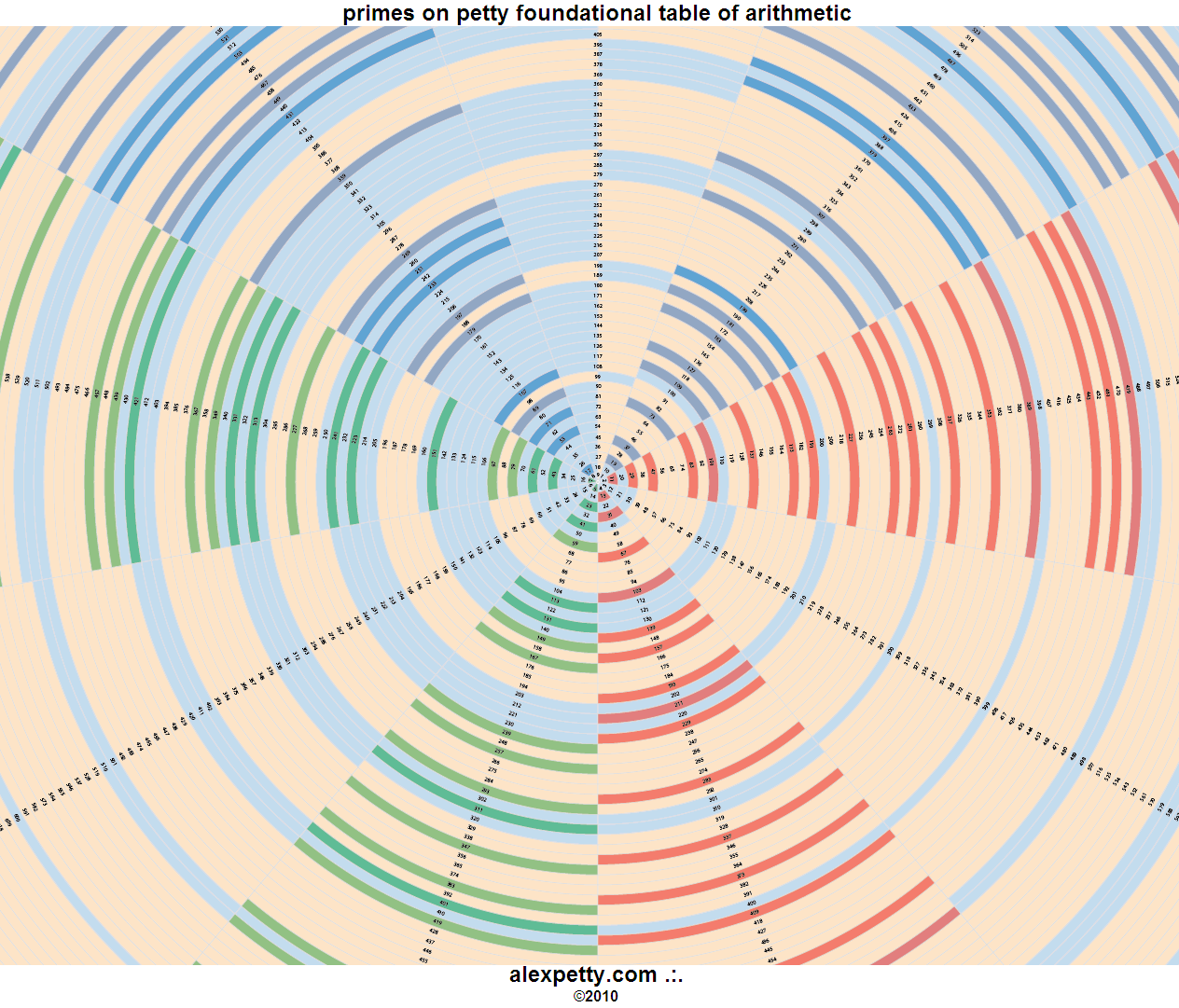
I wanted to examine the primes in relation to the bands and their joins. Keeping the composite numbers visible gave me the surrounding arithmetic as a reference. I could choose a stretch of the picture, inspect its entries, and compare it with another stretch. The overlay gave that investigation a place to begin.
Balance and energy
These pictures helped me distinguish radial palindromic energy from torsional energy. The table made the return along a radial countable. The circle showed the relative shifts between radials. Keeping both in view became essential to my thinking about balance.
A balance can conceal activity. A step of plus one followed by a step of minus one has no net change. Square the two steps and their contributions add to two. The two totals answer different questions about the same pair of steps. These drawings made me attentive to that distinction long before I could formulate it cleanly.
The same line of thought kept bringing me back to two thirds and one third, and eventually to The Cubic Law for Digit-Collision Energy. There, as the prime base grows, the equal collision ratios carry one third of the leading cubic mass and the unequal coprime ratios carry the other two thirds. Those thirds measure energy, while the 55 and 55 above count entries in one stretch of an old drawing. The pictures gave me the question that carries across, how much activity survives a cancellation.
Keeping the arithmetic underneath a picture has a practical advantage. I can follow a column, find the carry that changes its color, then return to the circle and see how the local change fits into the larger pattern. Years later, I can still pick a column and begin again.
The full table
The full-resolution table below is meant to be read. Open it, use the zoom controls, and move across or down the image. Start with the MOD9 Web Radial 0/9 panel at the left. Find the gold run from 9 to 90, the single blue 99, and the nine gold entries that follow. Then compare the neighboring one-spoke.
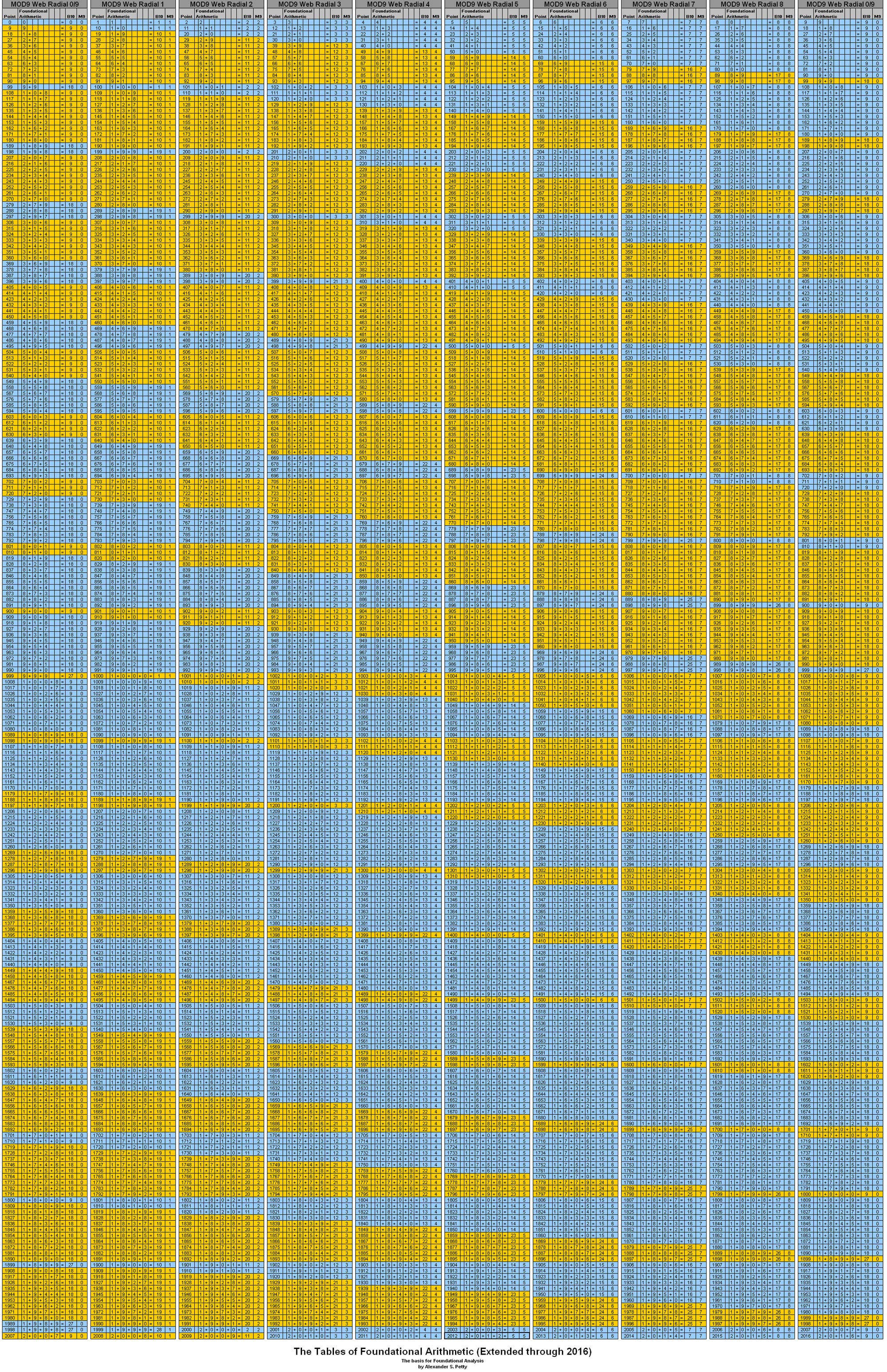
First written in January 2010, and rewritten in September 2026 around the original drawings.
Discussion
Sign in to join the discussion.