Alignment
Repetend Rigidity at the Golden Scale

Three and the Golden Ratio found the golden ratio at a crossing in a table of fractions, and it left a weakness in plain view. The crossing depended on choices. Every fraction had a one-digit repeating tail, the terminating rows got full credit, and the modulus was three. Change any of those and the golden ratio might simply disappear.
So this paper loosens everything at once. Tails can repeat with any period. The modulus can be any whole number, prime or not. Terminating rows can get any rational share of credit, from none to full. Then it asks again where the curve can meet the reciprocal golden ratio at a golden-power scale.
The answer is narrow. The golden equality survives in exactly two cases, and in both the repeating tail has period one. Loosening the assumption, instead of dissolving the one-digit tail, ends up forcing it. Every longer period is blocked by a small fact about long division, easy to prove and easy to miss. There is a band of cycle lengths that no remainder can ever have, and the first cycle the golden algebra asks for, a three-step return modulo five, falls inside it.
A route that never appears
In base three, one fifth repeats every four digits.
1/5 = 0.012101210121… (base 3)Base three uses only the digits 0, 1 and 2. The long division works
as usual, with three in place of ten. Multiply the remainder by three,
divide by five, and write down the quotient digit. Starting from
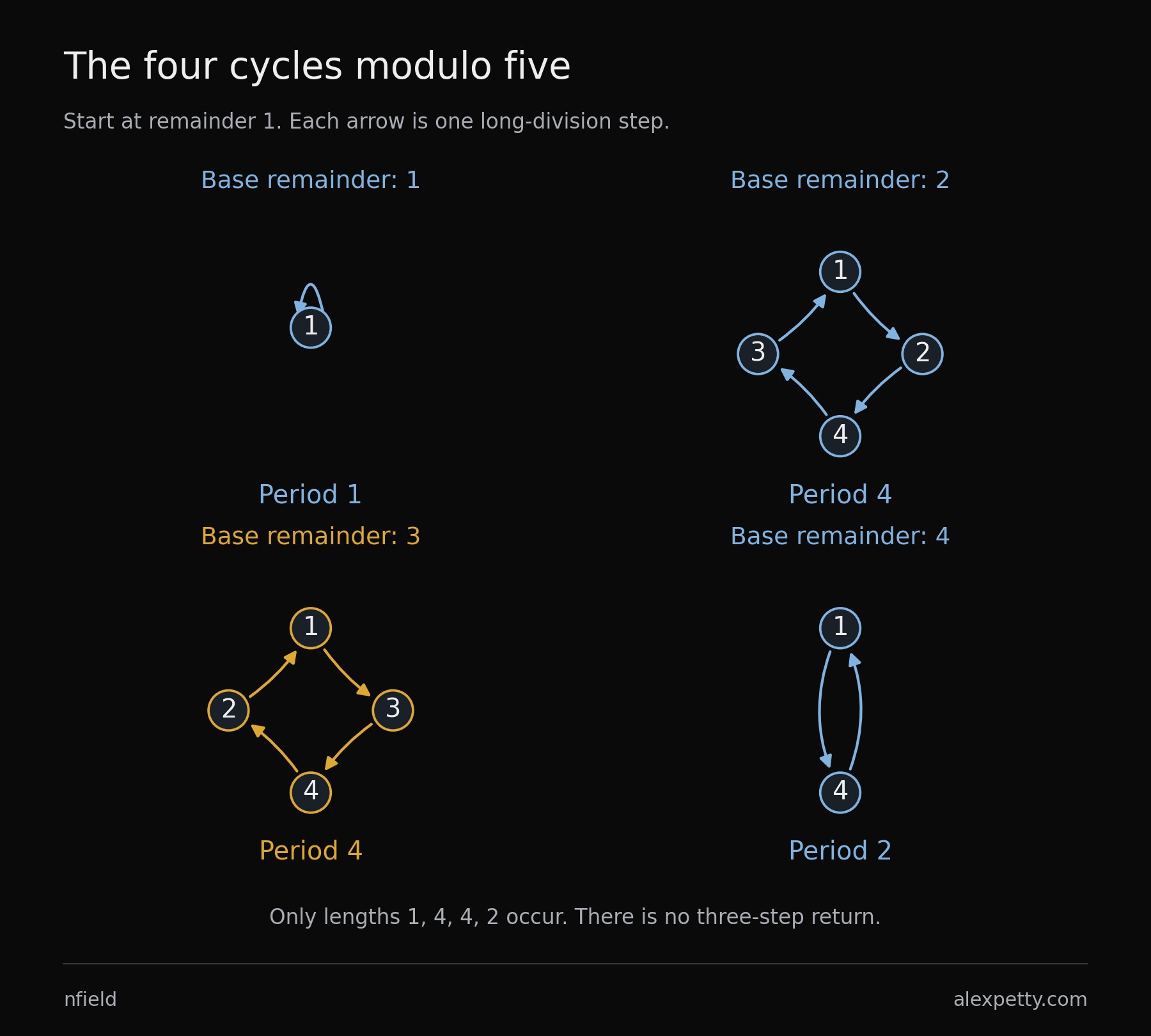
remainder 1, the successive remainders are 3, 4, 2 and 1. We have
returned to the beginning, so the block 0121 repeats.
Changing the base changes the route through those remainders. It can shorten the period to one digit or two, or leave it at four. It never gives three.
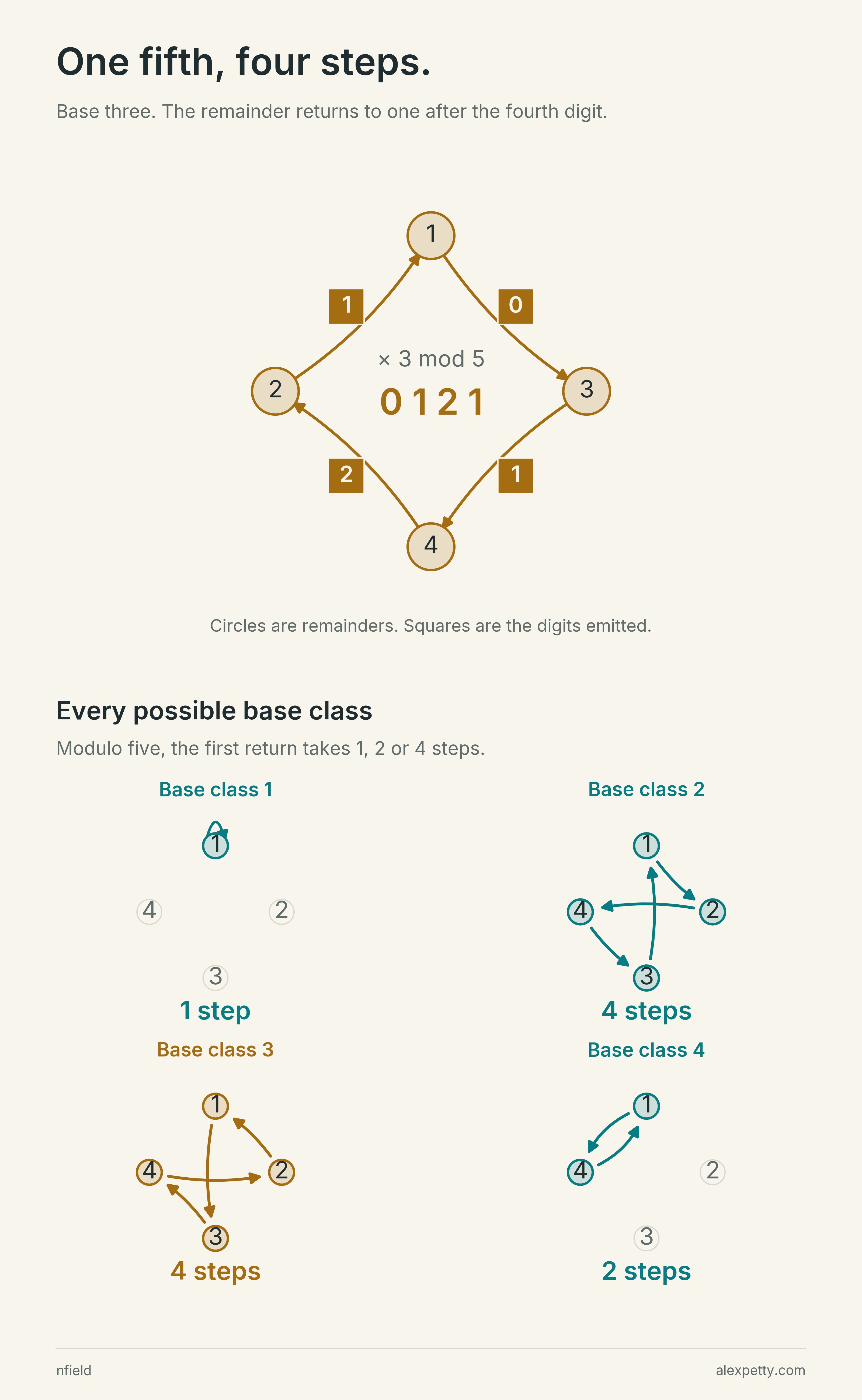
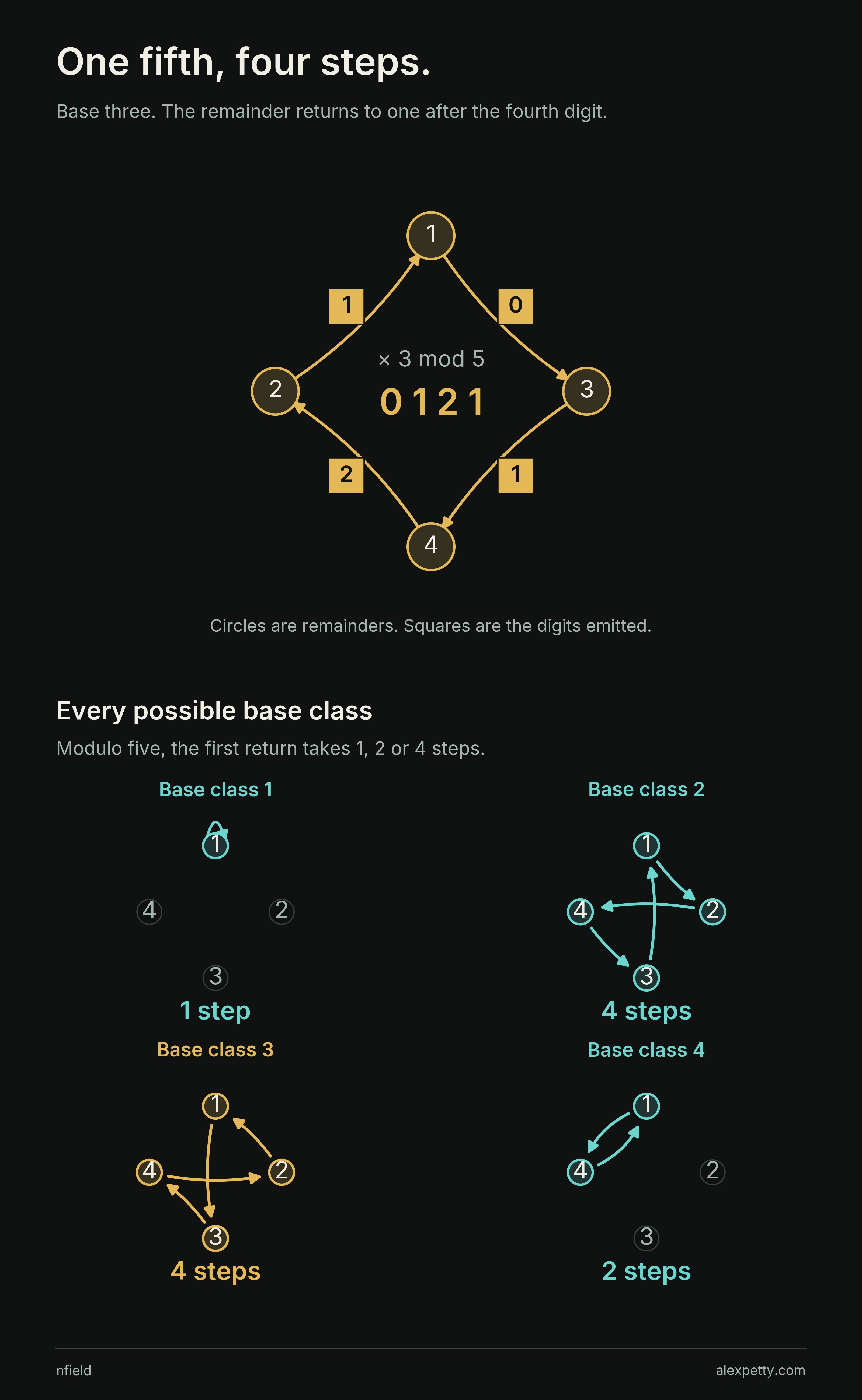
These four routes cover every base that is not a multiple of five. Bases with the same remainder modulo five follow the same route, and bases divisible by five make the fraction terminate.
The golden-ratio calculation that led me here asks for a three-step cycle modulo five. That period satisfies the algebraic equation. To realize it in long division, we would need another route through a table that is already complete.
Follow the four steps of the division
All the numbers in this table are written in decimal. The quotient column supplies the base-three digits.
| Remainder | Divide after multiplying by 3 | Digit | Next |
|---|---|---|---|
| 1 | 3 = 0 × 5 + 3 | 0 | 3 |
| 3 | 9 = 1 × 5 + 4 | 1 | 4 |
| 4 | 12 = 2 × 5 + 2 | 2 | 2 |
| 2 | 6 = 1 × 5 + 1 | 1 | 1 |
Back to twelve
The example in Three and the Golden Ratio was one twelfth in ordinary decimal.
1/12 = 0.08|333|After 08, a single 3 repeats forever. The three copies
inside the bars come from the display convention I use for these mixed
cycles. Repeat whole copies of the shortest block until their digit sum
is divisible by one less than the base. In decimal, , so the first such group is
333. I call this cumulative closure. The primitive
period is one digit, and its closure takes three. The nonrepeating
prefix stays outside the sum.
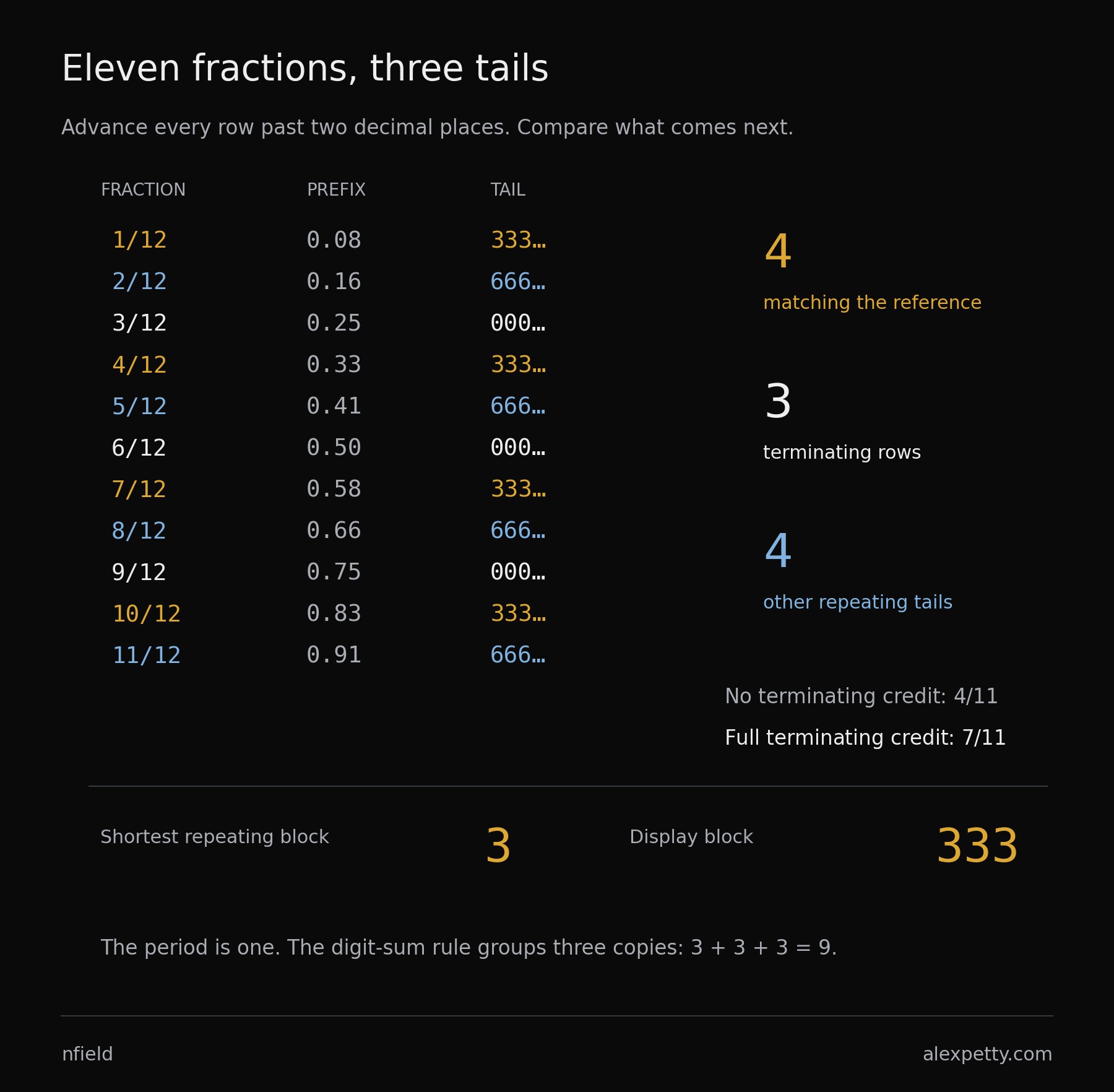
Write out all eleven proper twelfths and move past two decimal places in every row. Four tails repeat 3, four repeat 6, and three continue with zeros. Four therefore match the reference tail. Under the alignment convention, the three terminating rows receive full credit too, giving .
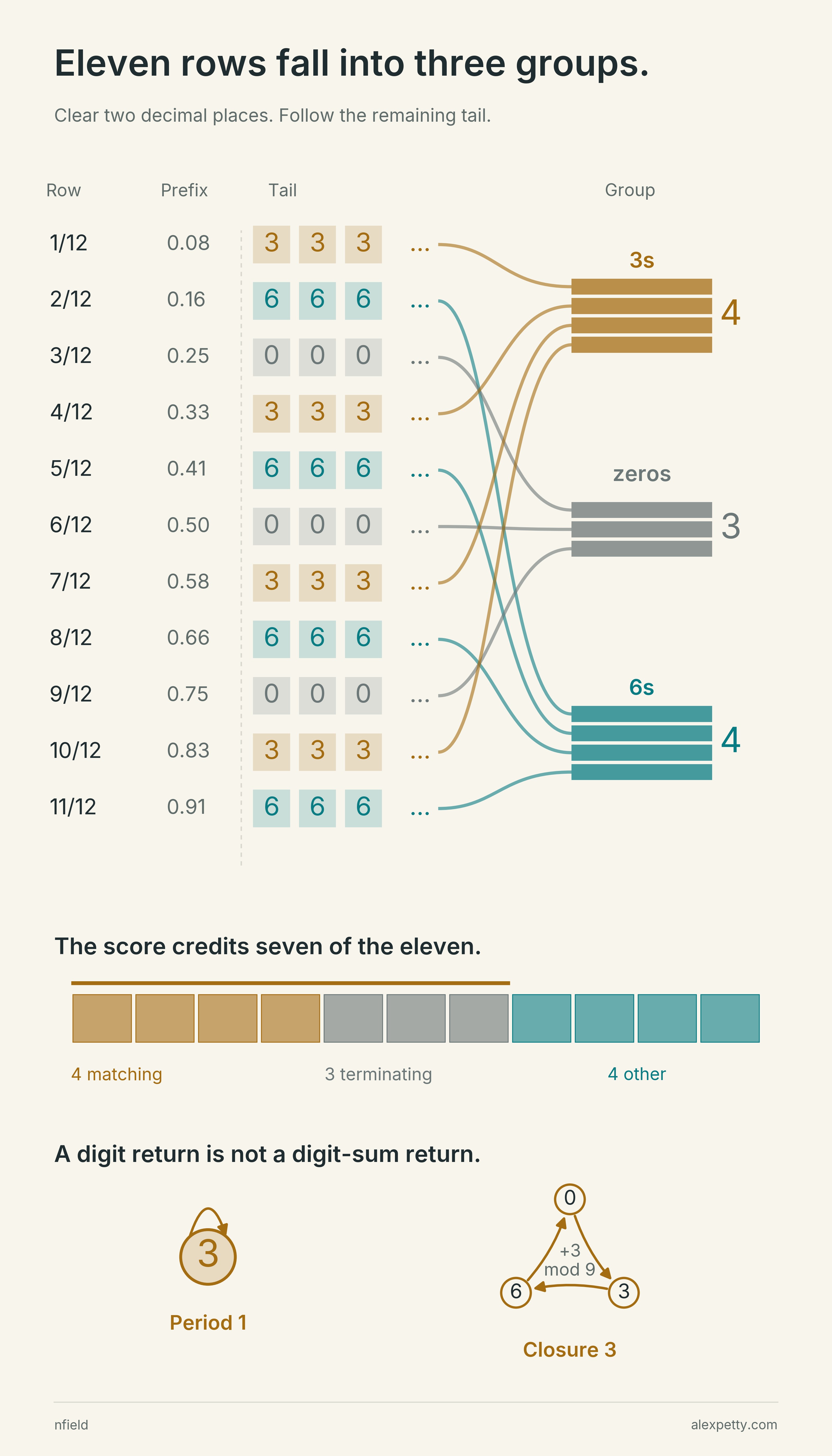
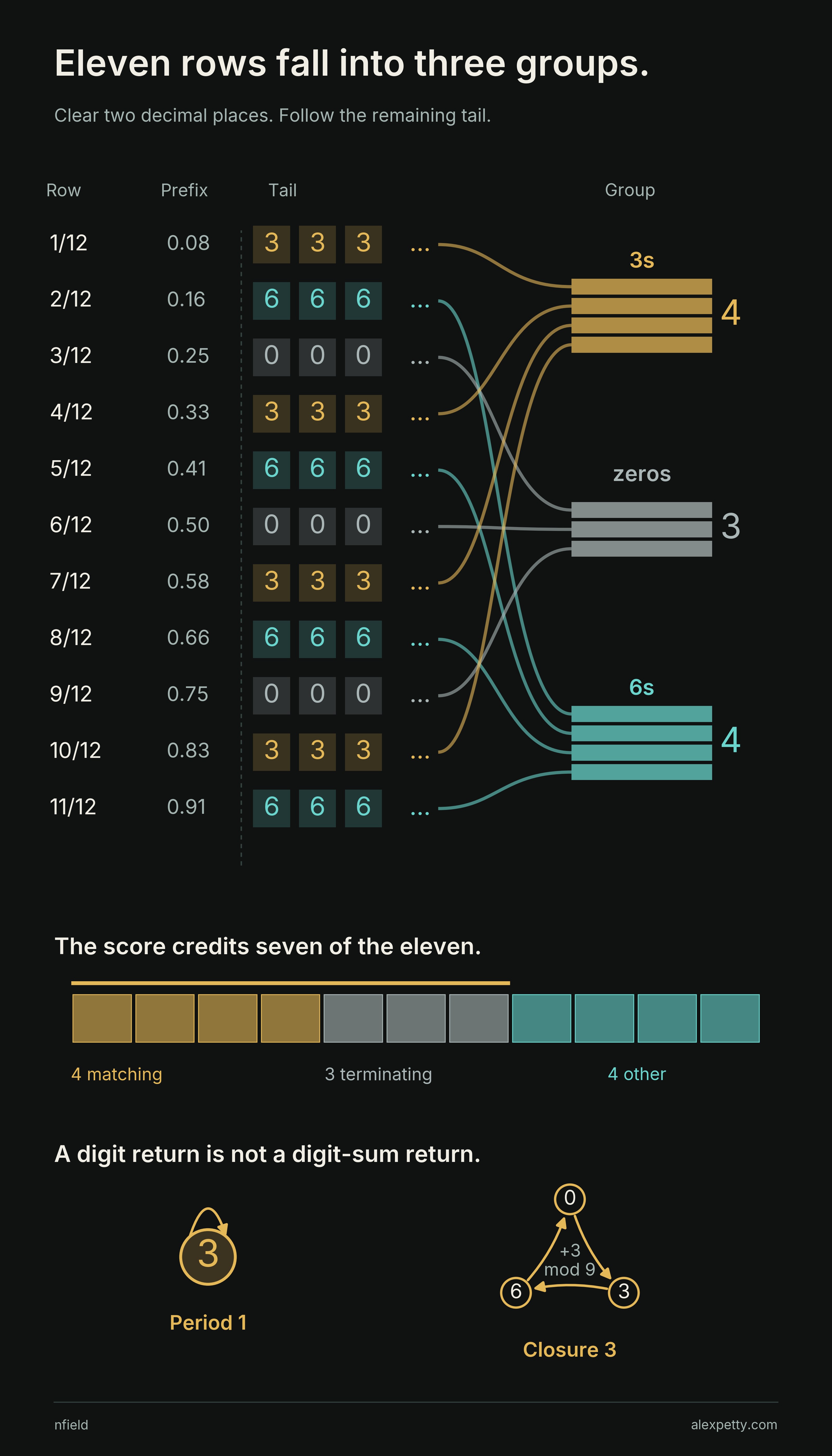
The zero tails do not literally match a repeating 3. Crediting termination is a choice in the score, and I will vary that choice shortly.
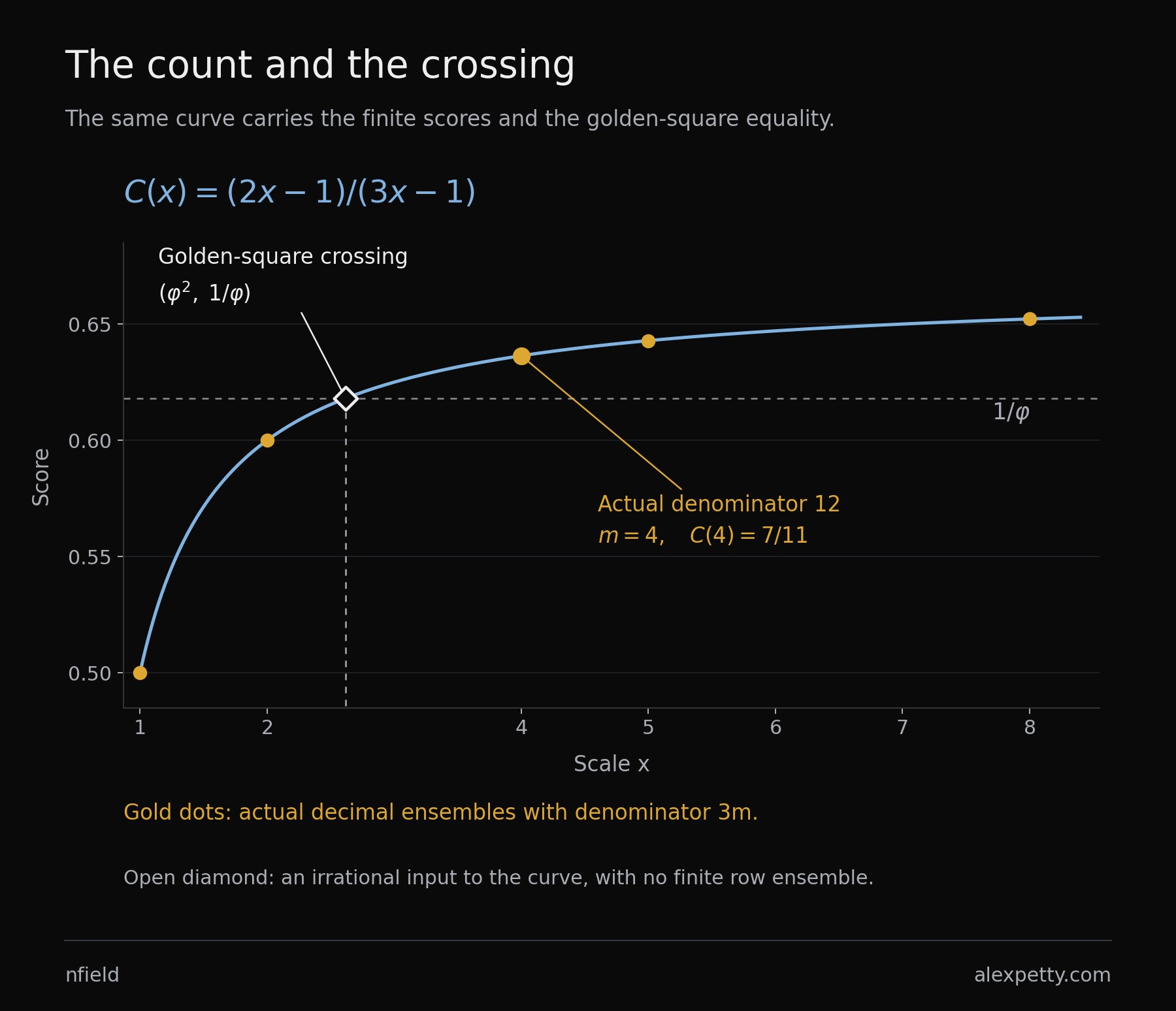
Replace twelve by , where uses only factors of two and five, and the same partition gives matching rows and terminating rows. Their scores lie on the curve
Twelve corresponds to , giving . The curve can also be evaluated between the allowed integer inputs. At the square of the golden ratio, , it takes the reciprocal value.
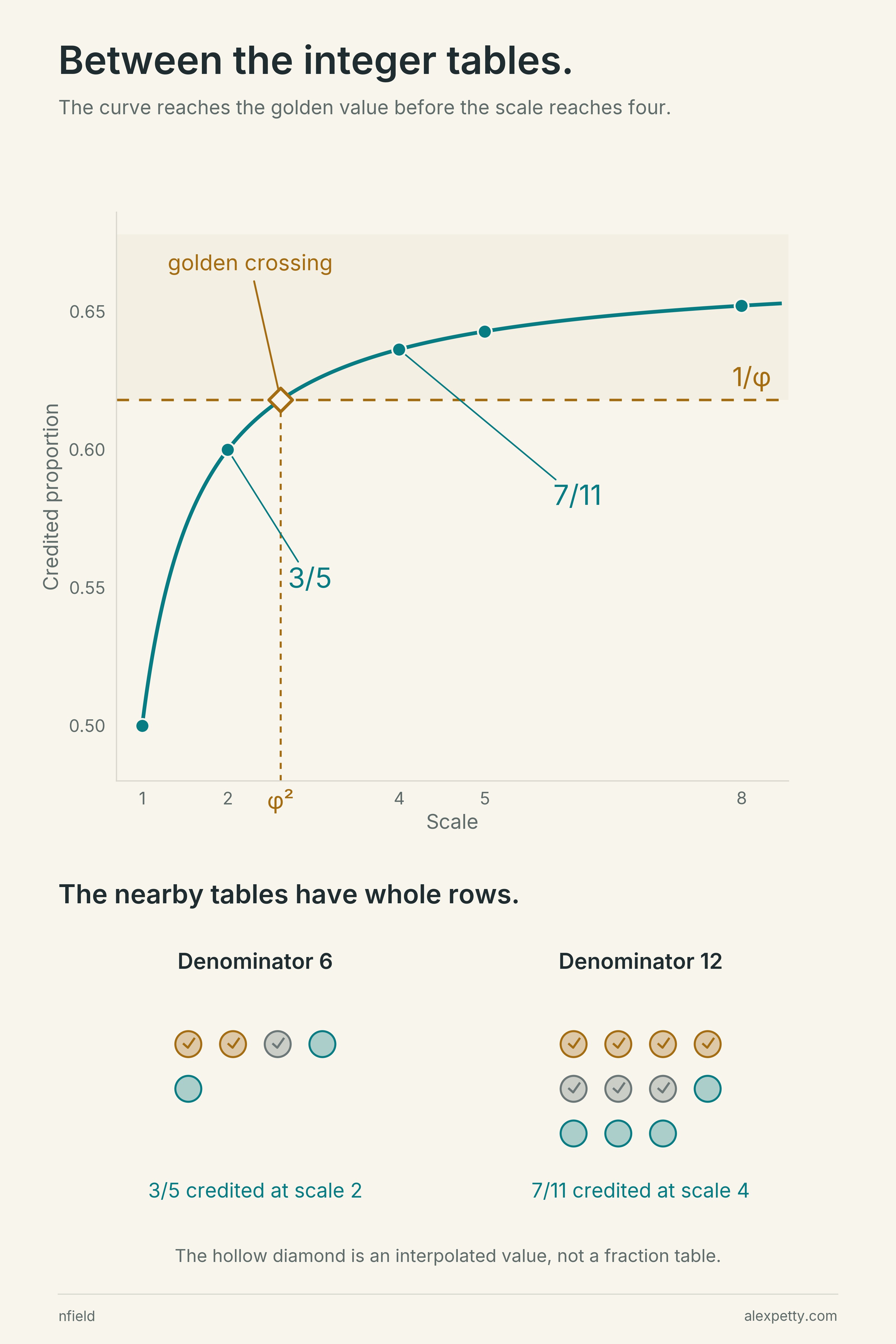
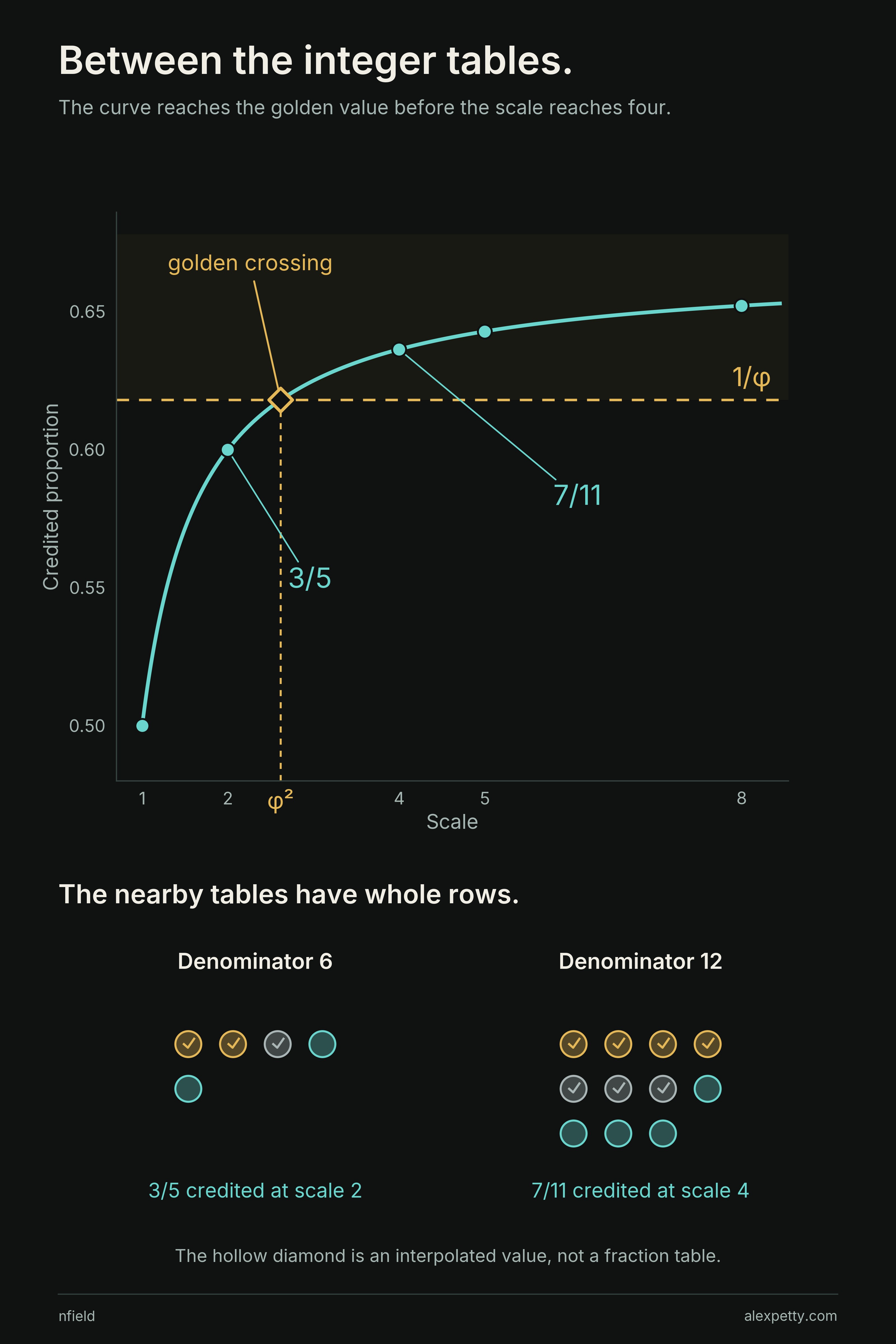
The filled dots represent actual fraction tables, while the open diamond marks an irrational input to the curve. There is no table with an irrational number of rows, and the eleven twelfths still have score .
The intervening years took the investigation into the structure of whole fraction tables. Digit-Partitioning Primes and the Alignment Formula distinguished the digits we see from the remainder states that produce them. The Alignment Limit for All Primes showed that the cycle followed by a reference fraction can affect even its limiting score. The Cross-Alignment Matrix organized the comparisons by cycles and their relative shifts, leading into the spectral work.
Those distinctions give a more precise way to return to twelve. The repeating digit, the cycle carrying it and the rule used to award credit are separate ingredients. We can vary them and ask which choices the golden equality will tolerate. Counting rotations together will let the actual cycle length enter the score, where it can be tested against the arithmetic of the remainders.
To test whether a longer cycle can give the same reciprocal value, I keep as the target and try the scales . The denominator and the credit for termination can vary. Choosing those scales sets the question, and nothing in the fraction count requires them.
The same cycle, started elsewhere
For a longer tail, we first need to decide what counts as agreement. Compare two sevenths in decimal.
1/7 = 0.142857142857…
2/7 = 0.285714285714…
Start the first block at its 2 and it becomes the second. Their digits disagree at corresponding positions, but both rows travel around the same six-digit cycle. Here I accept all rotations of the reference tail. This is a whole-cycle count, distinct from the synchronized digit matching in Three and the Golden Ratio.
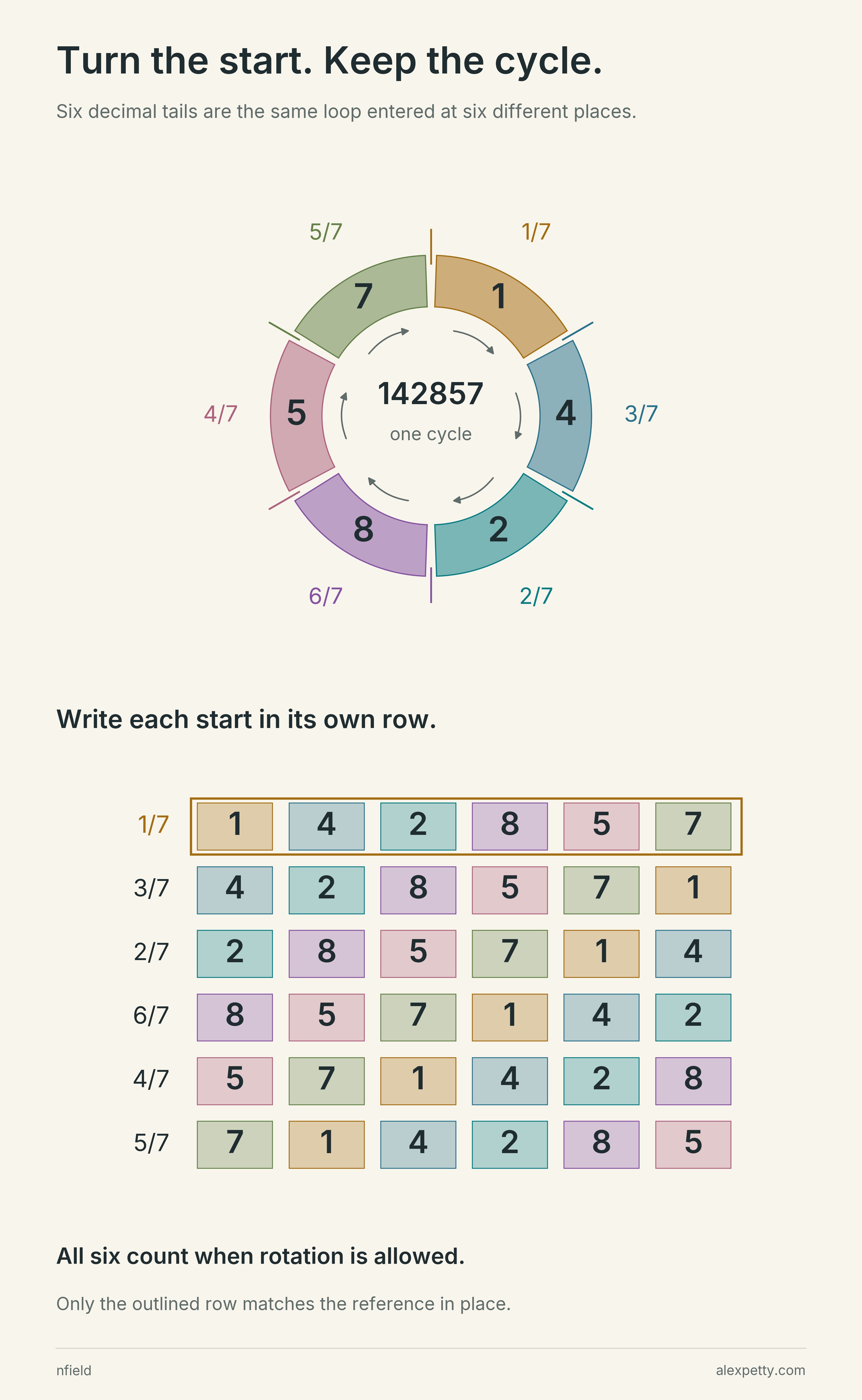
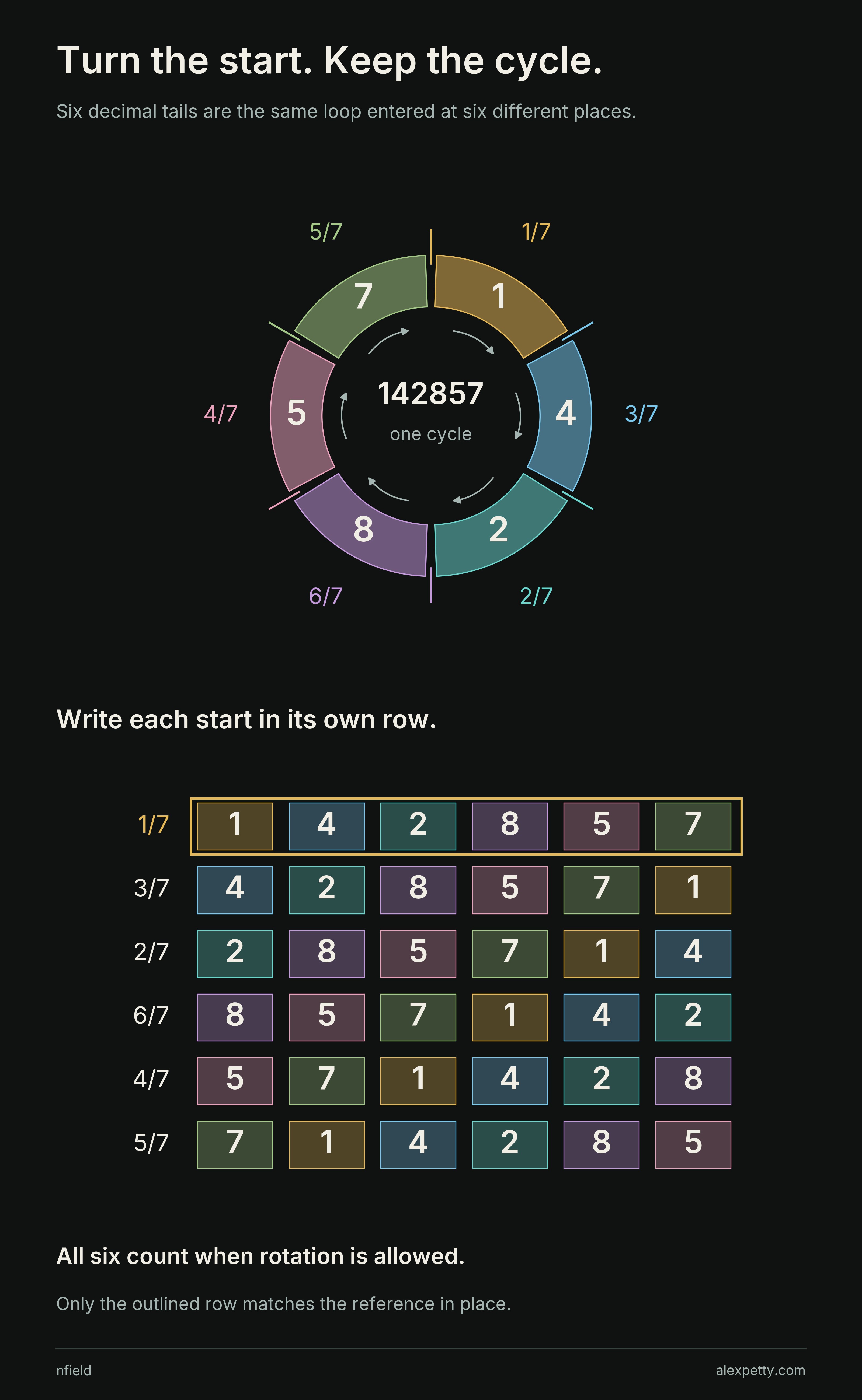
A period of length has distinct starting points. To count the rows that reach them, write the denominator as . The factor divides some power of the base and disappears from the denominator of the tail after enough division steps. The remaining factor is coprime to the base. At decimal twelve, these two factors are and .
Each accepted numerator class modulo occurs times among the rows. The rotations therefore account for rows, while the zero class gives terminating rows. If a terminating row receives credit , the score is
Zero credit ignores termination and full credit includes it. A rational credit also has an ordinary counting interpretation. For half credit, make two copies of every row. Mark one copy of each terminating row and both copies of every accepted rotating row. The proportion marked is exactly the score with .
Extend this formula to a curve by replacing with a real variable . We are asking when
where is a positive integer and is rational, between zero and one. There is no prime restriction on . But must be the length of the actual remainder cycle produced by the base. It cannot be chosen independently to make the equation work.
The missing three
The identity reduces every higher power to a whole number plus a whole-number multiple of . The coefficients follow the Fibonacci sequence.
This is classical arithmetic, described in Beard’s 1966 note. It gives us a way to separate the score equation into two rational conditions. With rational credit, a nonzero rational multiple of cannot cancel a rational number, so both coefficients must vanish separately.
The odd powers fail that test. At the fourth power, the two conditions are
Set the credit to zero and we get the candidate from the opening, , . As an algebraic choice of two integers it works, but none of the four routes modulo five can supply its period. We can change the base as often as we like without finding a fifth possibility.
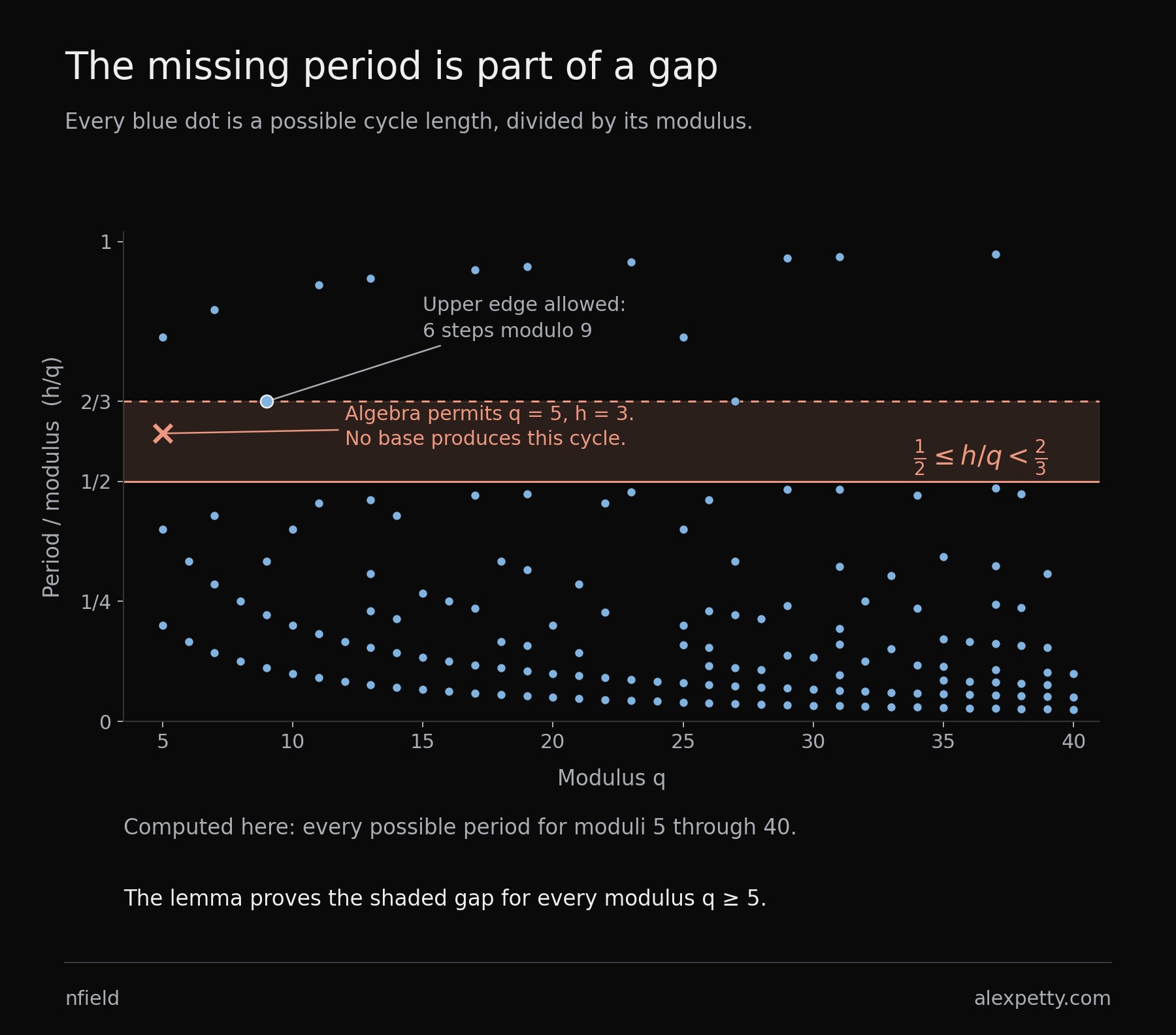
The later even powers encounter the same kind of obstruction. Their Fibonacci coefficients require and force the requested period into the interval
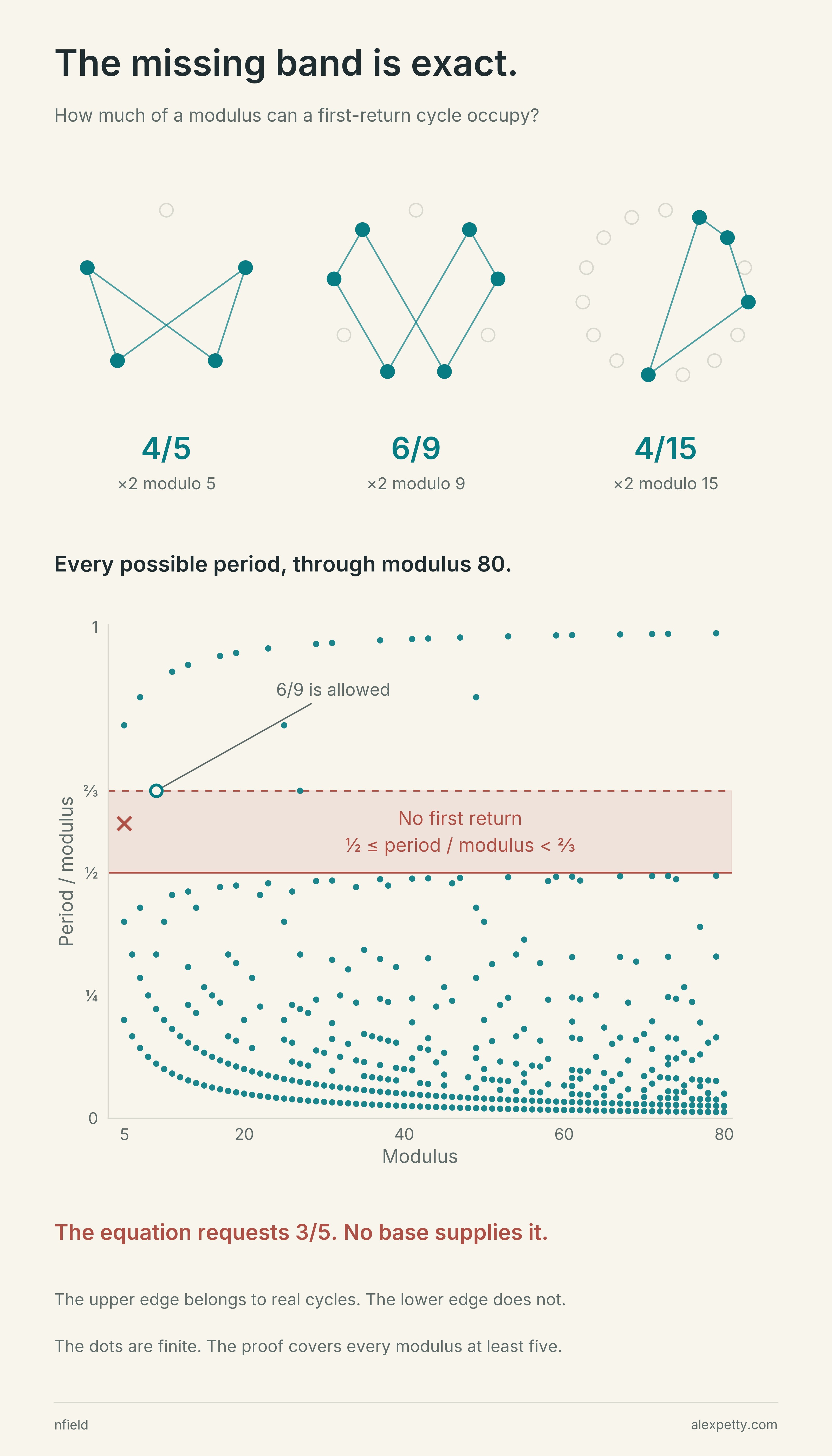
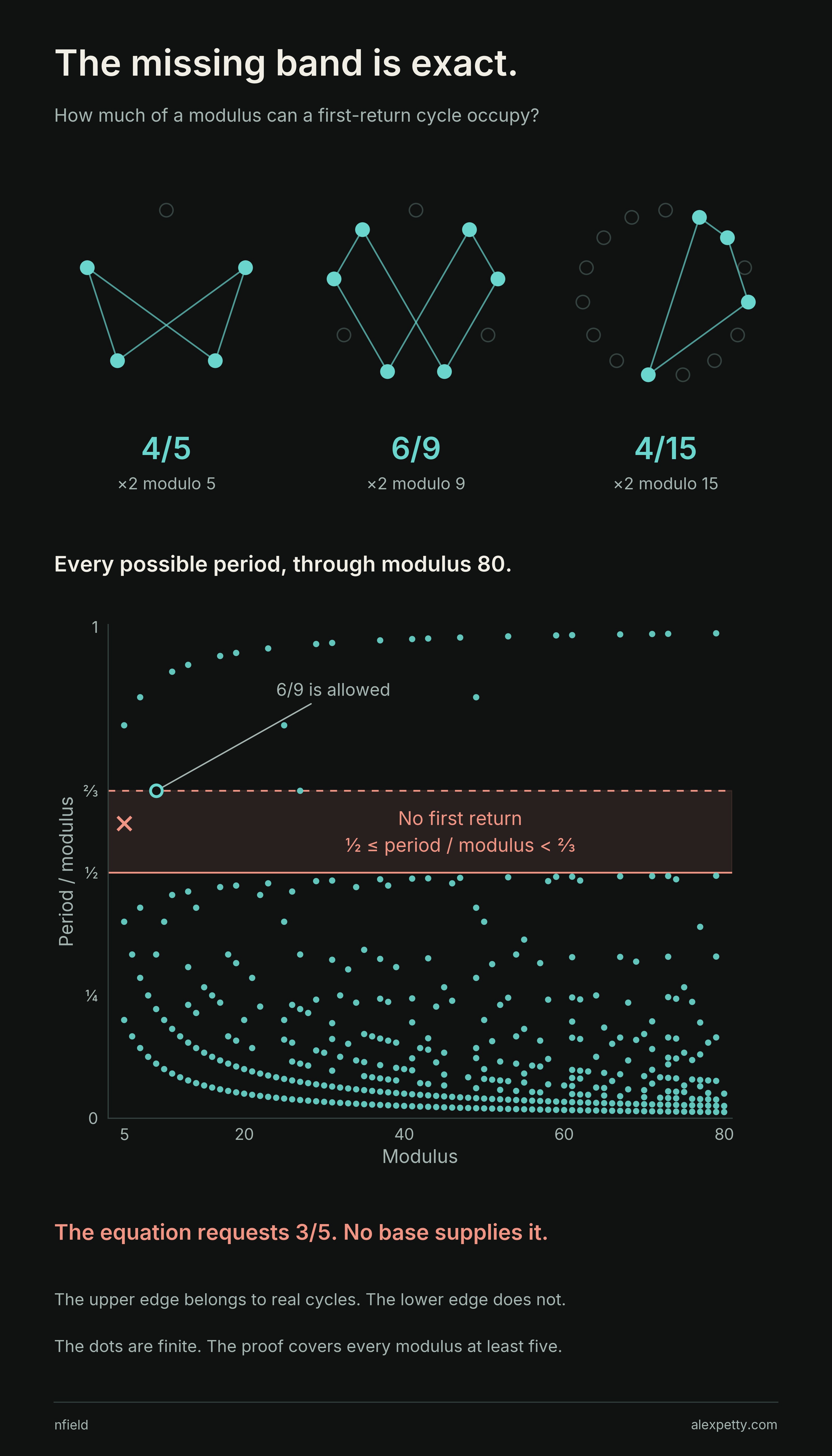
The empty band in this finite plot persists for every modulus . To see why, count the invertible residues modulo , those sharing no factor with it. A cycle starting at 1 has length dividing that count. Since there are fewer than such residues, a cycle of length at least would have to visit all of them. There is no room for a second multiple of its length.
For , a full cycle of this kind is possible only when is an odd prime power or twice an odd prime power. In the first case, at least two thirds of the residues are invertible. In the second, fewer than half are. The required interval falls between them.
That rules out every later even power, including the fourth. The upper edge must remain open. A six-step cycle modulo nine really exists, with , and the golden-power equations always ask for a ratio strictly below it.
The Fibonacci conditions at every even power
Let , , and . For even , the two rational conditions are
At , these give and . The Fibonacci recurrence gives the same bounds for every later even power. Thus lies in the forbidden interval whenever is even. Repetend Rigidity at the Golden Scale supplies the complete argument, including the exclusion of odd powers and an elementary proof of the order gap.
Two cases at the square
At the square, the equations reduce to
The integer lies between two and three, leaving just the endpoints. With , terminating rows get no credit and the base must be odd. With , they get full credit and the base must leave remainder 1 on division by three, as bases 4, 7 and 10 do. Both have a one-digit repeating tail.
No intermediate rational credit supplies another case. If irrational credit is allowed, further golden powers become possible even with one-digit tails. The rational restriction belongs to the result, along with the chosen target and scales.
Decimal twelve belongs to the second endpoint. Its repeating 3 closes
after three copies, giving 0.08|333|. At the other
endpoint, two copies of the repeating digit close the sum. The closure
lengths are two and three, while the primitive period remains one in
both.
I began with a single repeating digit and allowed every longer period to take its place. The rational golden-scale condition still forces period one. To get beyond it, the algebra asks long division for cycles it cannot supply, beginning with a three-step return modulo five. Four routes are enough to see that first refusal.
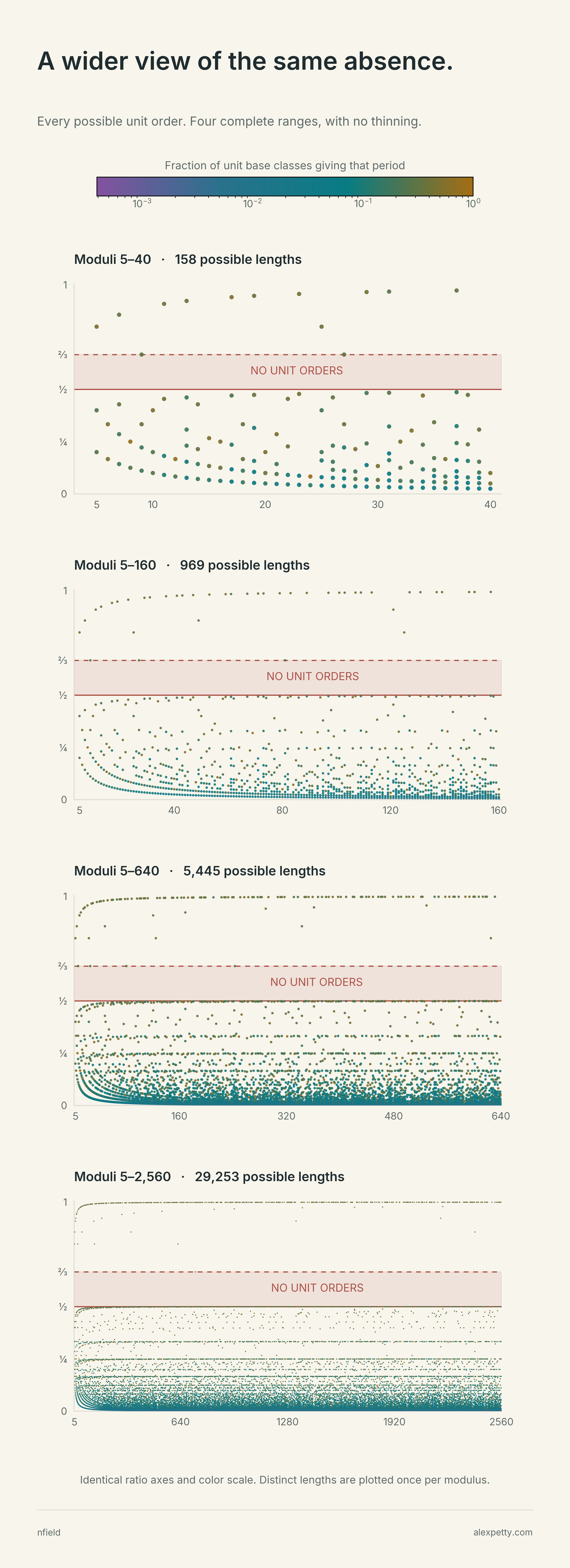
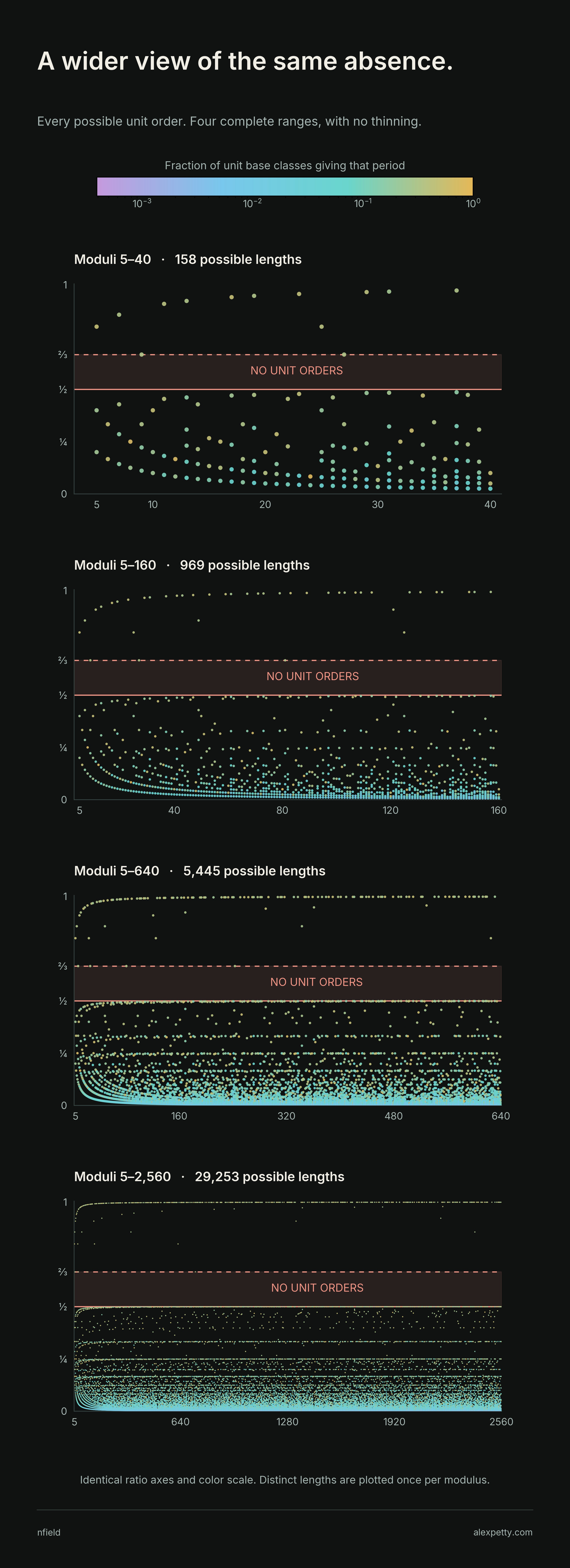
The order gap, from forty to twenty-five hundred sixty
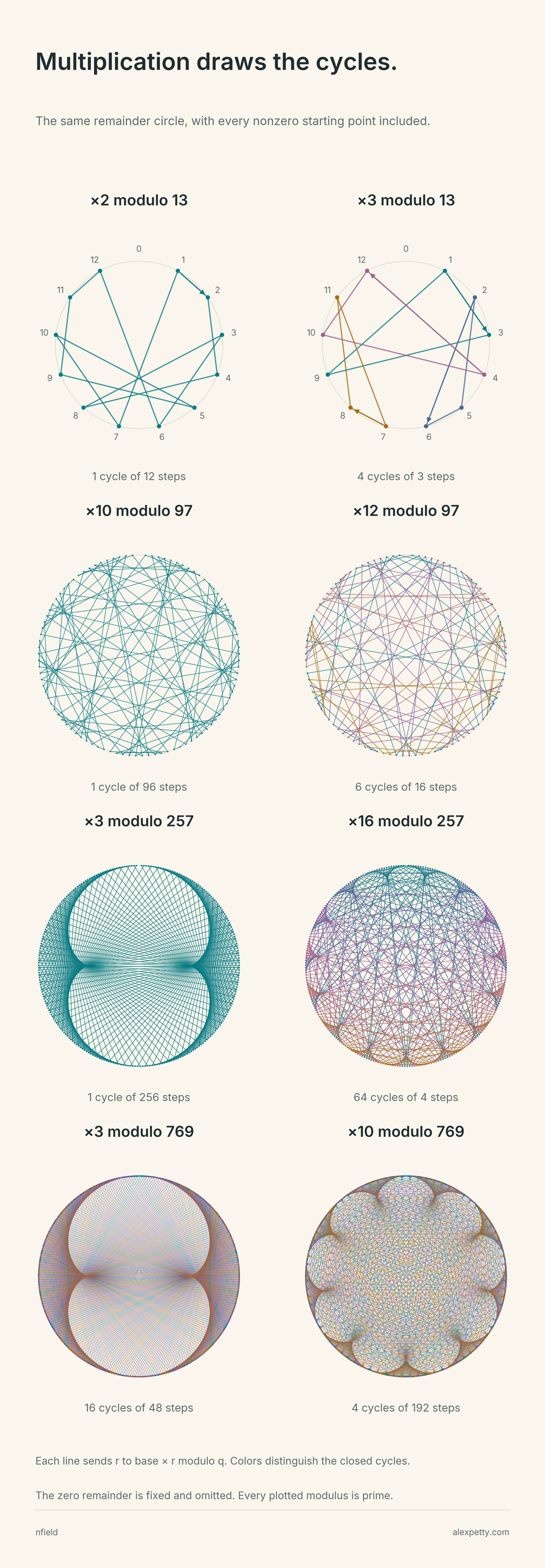
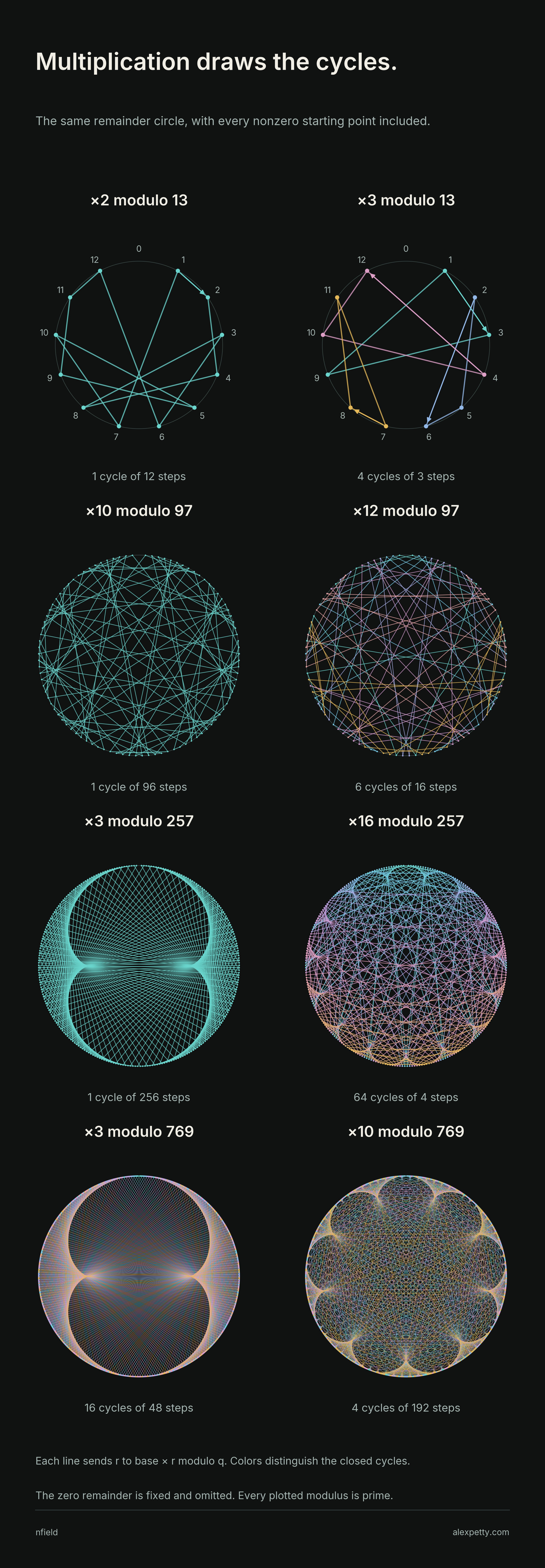
Eight complete multiplication diagrams
Remainder loops and the order gap
The four routes modulo five are drawn here as closed loops. Compare their lengths, then follow the table of twelfths through the golden crossing and the gap in possible periods.
Discussion
Sign in to join the discussion.